Twenty years ago today I wrote the first post in this space.

Apparently the effort it took to do this was so Herculean that I didn’t get around to writing another post until two months later, a post wherein I linked to a description of how I maintained the “constantly updated collection of news and links” that we now call a blog, but didn’t yet really, at least in any popular sense.

I was 33 years old when I started writing here. I’d been with Catherine for 8 years, but Oliver was still seven months from conception, sixteen months from being born.

When the blog turned ten, in 2009, I marked the occasion with a statistical breakdown: 996,016 words written, in 5,388 posts.

Now, 20 years in, it’s 2,670,757 words in 8,970 posts

But a statistical breakdown doesn’t really say much about the last 20 years; so here’s a single post from each of those years as a kind of proxy:

That collection is more akin to a series of flashes of landscapes from a moving train than a comprehensive review. But if you want to get a hint of a taste of my last two decades, it’s a good place to start.

By lucky happenstance, this anniversary comes on the day that we’ve rendezvoused with Luisa and Olle here in Halifax. They have been such dear friends over such a large swath of these 20 years. Catherine and Oliver and Olle and Luisa and I went out for an excellent Japanese meal tonight and we continued the conversations we started many years ago. And started new ones. Kind of like this blog. It was an excellent way to mark the date.

🗓️
Weblogs  •  History

We are in Halifax for 48 hours to retrieve Olle and Luisa, who arrive by air late late tonight via Copenhagen, Reykjavík and Toronto. We arrived today so as to get our bearings.

We had supper at Tako Loko, a new Mexican restaurant on Isleville that makes tacos as they are intended: small corn tortillas filled with simple ingredients. We’ll be back.

After supper we went around the corner to Humani-T for tea and dessert, and I captured Catherine and Oliver just before they were about to eat cake:

Catherine and Oliver in Halifax

With the tourist high season ramping up, the nights of $69 rooms at the Westin are no longer, so we are staying in the Westwood Residence at Mount Saint Vincent University. I booked here because it was cheap–$114 a night for a 4-bedroom apartment with kitchen, living room, and two baths–but was pleasantly surprised to find it’s in a quiet, wooded location, high above Bedford Basin, but is just 10 minutes from downtown Halifax. It also sports a pond:

Mount Saint Vincent Westwood Residence

We’ll rendezvous with Luisa and Olle tomorrow morning, have 24 hours of fun & frolic in the big city, and then high tail it back to Charlottetown for Pen Night on Saturday.

🗓️

My seminal memory of high school history class is a black and white film that we were shown about the war of 1812. It was a low budget educational film, and because of its low budget there were several scenes where it was obvious that the characters were walking around and around and around the same tree. I guess they could afford only one. We were not impressed. But we did learn something about Laura Secord.

Oliver is taking MUS801A - Styles of Popular Music this semester, a course that offers a decidedly different lens on history: he reports that this week the focus is on the 1970s, and today’s subjects included Joni Mitchell, the Eagles and Frank Zappa.

While the 1980s were certainly a more educationally enlightened decade than, say, the 1950s, the idea that Frank Zappa would ever be a subject of study in high school history would have been so outside the realm of possibility so as to never have even been considered.

We’re traveling to Halifax tomorrow and so Oliver is missing two days of school. As a result, he’s going to miss the history of punk.

🗓️

Anne Boyer has a piece in the April 8, 2019 issue of The New Yorker, What Cancer Takes Away, where she writes, in part:

Being sick makes excessive space for thinking, and excessive thinking makes room for thoughts of death. But I was always starving for experience, not its cessation, and, if the experience of thought was the only experience my body could give me beyond the one of pain, then opening myself to wild, deathly thinking had to be allowed. I warned my friends in a set of e-mailed instructions: Don’t try to make me stop thinking about death.

In the you-or-someone-in-your-family-has-cancer world there’s a social prohibition about talking about death. As though talking about death will kill you. Or as though admitting the possibility of death is somehow bursting a bubble of hope, letting the team down; “don’t talk that way.”

It took me a while to be able to say “when Catherine dies” out loud. But as soon as I did, the monsters receded just a bit, as I’d taken away some of the power they have from being unspeakable.

🗓️
Death  •  The New Yorker  •  Anne Boyer

I’ve had Montreal, by Port Cities (recorded | live | remix) on rotation for weeks now.

It is a lovely song, with strong lyrics. But, more than that, I think it’s a sort of universal song, inasmuch as the possibility of meeting someone at a house party in Montreal is within the atlas of possibilities for many Canadians: it just seems like the kind of thing we might all have in our past.

I recall hearing a story, perhaps apocryphal, about the late Marc Gallant: he was living in an apartment in Montreal, and about to be evicted. So he invited everyone he knew to a house party and asked everyone to take something from the apartment home with them, to prevent the apartment’s contents from being seized by the landlord.

Just over a decade ago we saw Bruce Guthro in concert at Harmony House in Hunter River; Bruce brought his then-17-year-old son Dylan up on stage with him during that concert, and it was obvious that he’d inherited the family musicality. Ten years on he’s one of the trio that is Port Cities.

🗓️
Montreal  •  Port Cities  •  Marc Gallant  •  Dylan Guthro  •  Bruce Guthro

VBike, in Vermont, is a non-profit cycling advocacy group:

VBike is a unique advocacy group dedicated to bringing super bike mobility to Vermont. We’re talking a bike revolution. Electric-assist cargobikes for families & households, e-bikes and e-trikes for seniors & commuters – it’s a game changer! Now we can get over the hills, ride our kids, smile, and not be confined to the automobile.

In my experience it’s really hard to get information about anything other than “regular” bicycles here on PEI; while bike shops occasionally get in tricycles or three-wheel recumbent bicycles, they tend to be presented as a rare, unusual and expensive.

It seems clear that the future is going to demand that we use bicycles more, and for that to be accessible to all of us we’re going to have to tackle a broader range of active transportation options.

🗓️
🗓️
Coffee  •  Receiver Coffee  •  Sunshine  •  Photos

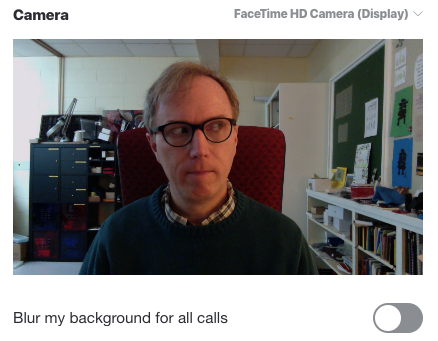
I was setting up audio and video in Skype this morning in preparation for a call with my friends Elmine and Ton and noticed a setting, Blur my background for all calls, that I hadn’t seen before.

Here’s what I looked like with the setting toggled off:

Skype with camera blur off

And here’s the blur turned on:

Skype with camera blur on

The background was noticeable enough for Ton to remark on it; I like it because it reduces the visual clutter of my office while not completely eliminating the background (presumably a “remove the background” setting would be a possibility using similar algorithms).

When Ton toggled the setting on it was less satisfying: there was a bookshelf in the close background that Skype couldn’t quite distinguish from Ton’s head, leaving him with a bookish halo effect.

I’ve largely abandoned Skype, as my weekly conference call with the home office has replaced it with Zoom. One of the reasons we made the switch is that Skype updates were forever interrupting our calls, but with no obvious improvement in functionality stemming from the update; indeed this “blur” function is the first new feature I can recall in Skype in a long, long time. Not enough to win me back, but still interesting nonetheless.

Zoom is not without its own real time video processing: it offers a Touch up my appearance setting that appears to work like a kind of digital putty knife:

Here’s Zoom with the setting turned off:

Zoom with Touch up my appearance turned off

Zoom with Touch up my appearance turned on

While Skype’s background-blurring feature seems innocuous and helpful, Zoom’s touch-up feature seems creepy and dishonest. And so I leave it off.

🗓️
Skype  •  Zoom  •  Video

The seminal learning I took away from grade 2 concerned simple machines: Ms. Abrams, our teacher, did an excellent job at schooling us in the ways of the pulley, the lever, the inclined plane and the rest. There must have been something about the elegance of getting something for nothing that appealed to me, as the lessons stuck with me.

I thought of simple machines when I read Accessibility guidelines as heuristics, or the need for a ramp and emergency pants by Anne Gibson, wherein she makes a solid case for the utility of everyone installing an inclined plane at their house:

A few years ago, we replaced the back deck in our backyard. Instead of stairs leading to a damaged brick patio, I requested an ADA-compliant ramp that runs alongside the house, terminating just at the garage door.

The contractor was puzzled. “Why an ADA-compliant ramp?”

The obvious reason is because if I ever land myself in a wheelchair, or my husband does, it’d be nice if we can still get in the house.

The less obvious reason is because I am too lazy to go do the research myself on what a safe, usable, effective ramp consists of. How long should it be? What’s its maximum slope and rise? What’s the minimum width? The Americans with Disabilities Act research have already done all of that work so that neither I nor my contractor have to. We just need to comply with it.

The reason I gave the contractor was, “We collect pinball machines. If it’s safe for transporting a fragile yet heavy human being, it’s probably also safe for transporting pinball machines.”

Another word for accessible design is good design, and Gibson’s post is a helpful reminder of that.

Inclined planes entered my field of view again this morning when YouTube offered up a video of the Elbląg Canal in Poland (can the YouTube algorithm be so good that it realized I was in a simple machines-receptive state of mind?). The canal incorporates canal inclined planes to overcome a water level difference of 100 m between Lake Drużno and lake Jeziorak:

The inclines all consist of two parallel rail tracks with a gauge of 3.27 m. Boats are carried on carriages which run on these rails. The inclines rise from the lower level of the canal to a summit and then down a second shorter incline to the upper canal level. The first part of the main incline and the short upper incline were both built at a gradient of 1:24. A carriage is lowered down the incline to counterbalance an upward moving carriage. Once the downward moving carriage has reached the summit and started down the main incline its weight helps pull up the upward moving carriage. This allowed the slope of the incline for this section to be built at a higher gradient of 1:12.

Here’s a photo of one of the inclined planes in the canal:

Elbląg Canal inclined plane, from https://en.wikipedia.org/wiki/Elbl%C4%85g_Canal#/media/File:Oberl%C3%A4ndischer_Kanal2.jpg

Here in Canada there is one canal inclined plane, the Big Chute Marine Railway, part of the Trent-Severn waterway in Ontario. Its reason for being is at least partially biological rather than elevational, as part of a plan to keep sea lamprey out of Lake Couchiching and Lake Simcoe:

Research was done to find a way to prevent the migration of the sea lamprey into Lake Couchiching and Lake Simcoe, while still effectively increasing the flow of traffic. A biologist sat at the bottom of the railway for days, checking the bottom of boats that locked through, and finally saw a lamprey attached to the bottom of a boat. The lamprey fell off after less than 6 meters, so the railway was determined to be effective at preventing the sea lamprey’s migration. In 1976, it was finally decided that a new, enlarged railway would be built.

As it happens, I was resident at Camp Kitchikewana, just 20 km to the west, that same summer of 1976, but knew nothing of the burgeoning simple machine megaproject next door.

The Trent-Severn canal system runs from Lake Ontario to Lake Huron and is an impressive an engineering achievement. It’s also been something of a spine for significant portions of my life: beyond my childhood proximity to Big Chute, I later worked at a summer camp at Lakefield College School (on the system), lived in residence at Trent University with a view of the system from my window, spent time at a cottage owned by a friend of my mother’s from college on Stoney Lake, dated a woman whose family had a cottage at Rama (on the system north of Lake Simcoe), and, over the years, I’ve known people from Trenton, Campbellford, and Rice Lake.

Oddly, save for taking my young summer camp charges out in kayaks in the Otonabee River, and a bit of sailing in Stoney Lake, I’ve never actually been out on the canal. I’ll have to do that someday.

🗓️

I’ve been a Jane Siberry fan for as long as it’s been possible to be so, and it’s not an exaggeration to say that no musician has been more influential in my life over the course of the last 35 years.

And yet, after seeing her play live at Ontario Place, and then again at Victoria Hall in Cobourg, both in the late 1980s, I hadn’t had a chance to see her perform for the last three decades.

But last night she played Harmony House in Hunter River and I had a seat in the front row.

It was a unique evening.

I’d imagined myself to be the only Jane Siberry fan on Prince Edward Island: from the size and ferocity of the audience, this is clearly not the case. To my surprise, there were many who I’d consider part of my not-too-distant-extended-community in the house last night, people I’d never considered I might have this in common with. It was a good reminder that commonality is often hidden behind closed doors.

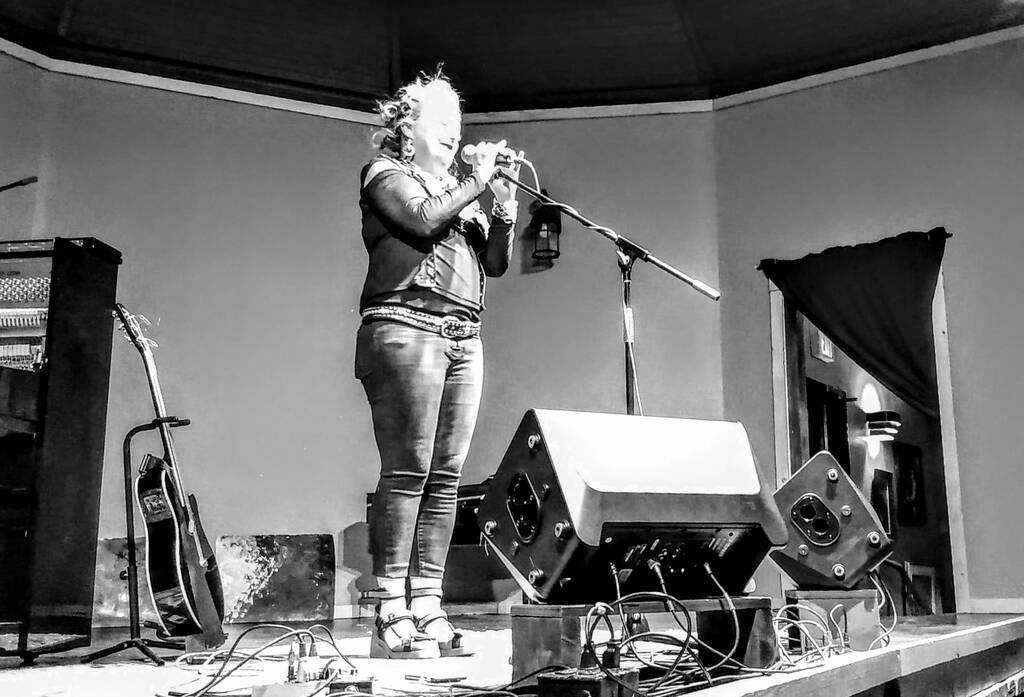
Black and white photo of Jane Siberry at Harmony House, May 22, 2019

And it was a weird concert: a kind of aural patchwork quilt of sounds and stories that appeared, initially, to be too random and too slapdash but that, over the course of the evening, shimmered into something larger. It was really quite delightful to witness and be a part of.

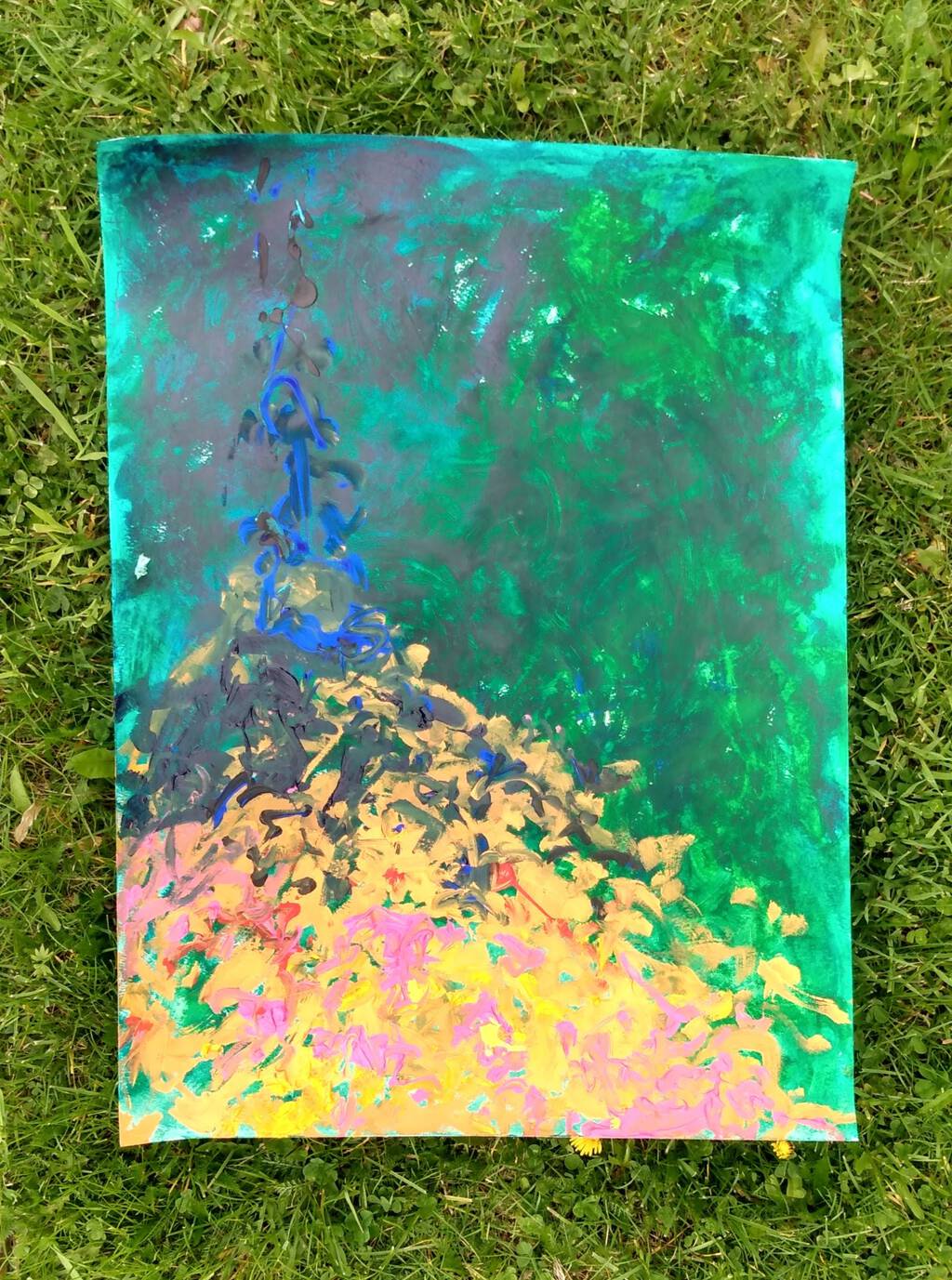
At the end of the evening Jane offered up three of her paintings for sale–”I can’t take these on the plane with me”–and the one you see between her guitar and her feet, right in my eyeline, was the one that caught my eye (when it’s not rendered in black and white it’s all manner of orange, green, red and blue). So I waited until the crowds had cleared, offered her all the money in my wallet, and we had a deal.

Painting by Jane Siberry

A good night.

🗓️

About This Blog

Photo of Peter RukavinaI am . I am a writer, letterpress printer, and a curious person.

To learn more about me, read my /now, look at my bio, listen to audio I’ve posted, read presentations and speeches I’ve written, see things I’ve favourited elsewhere, or get in touch (peter@rukavina.net is the quickest way).

I have been writing here since May 1999: you can explore the 25+ years of blog posts in the archive.

You can subscribe to an RSS feed of posts, an RSS feed of comments, an RSS feed of favourites elsewhere, or a podcast RSS feed that just contains audio posts. You can also receive a daily digests of posts by email. I also publish an OPML blogroll.

Instagram • YouTube • Vimeo • ORCID • OpenStreetMap • Internet Archive • PEI.art • Drupal • Github.