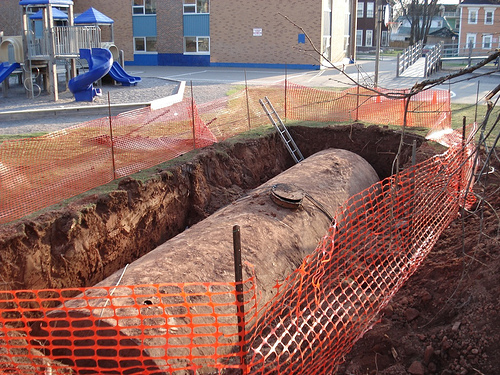
Correspondent G., who is now a mobile journalist with his digital camera strapped to his belt, sent in this photo of an oil tank unearthed on the grounds of Prince Street School:

Prince Street School Oil Tank

G. reports that the tank was discovered when kids on the playground noticed oil oozing out of the ground; he says it was obviously left over from the old Prince Street Elementary School that was torn down in the early 1960s.

🗓️

Kudos to those in the design department at the new Brit’s Fish & Chips in downtown Charlottetown for their new sign, which is a triumph of simplicity:

Fish & Chips
🗓️

The latest from the product development lab here at ruk.ca is a line of ruk t-shirts for kids. Twenty-one colours. Printed on demand. Visit the store now and outfit your tiny relations.

the many colours of ruk
🗓️
Clothing  •  Design  •  Weblogs

I’ve come to realize that it’s impossible to simultaneously plan to travel and decide whether to travel.

The two involve incompatible thought processes.

This is because if you’re on the fence rather than fully committed every stage of travel-planning will involve some fulcrum against which you can make your decision to travel more difficult.

“Oh, if I do that then I’ll be carrying around that pair of bagpipes around London at six o’clock in the morning. I can’t go!”

“There aren’t any rooms at that great hotel with the yellow curtains. I can’t go!”

Travel is hard, and full of stress bogeymen. Unless you’re past the point of no return, those bogeyman can trump almost any logic.

A tremendous aid to easing this burden is to purchase non-refundable air tickets as the first step in any travel-planning exercise. There is nothing to focus the mind and make one fully commit to a project like having a pile of money on the line that will be rendered useless without the accoutrements to go with it (place to stay, something to do, etc.). And the will to go in the first place.

🗓️
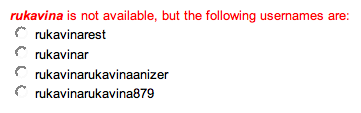
Screen shot from Gmail new user registration screen showing weird variations of rukavina user name
🗓️
Gmail  •  Internet  •  Technology

I’ve been doing some twiddling this week for some possible travel in Europe for reboot. Part of my twiddle involves a stop in Berlin, both because I’ve never been there, and also to let me see my friend as Plazes face-to-face.

To help assuage my carbon guilt, I’m looking at taking the train for all of the intra-Europe travel rather than following my usual habit of flying cheap on easyjet and the like.

Here’s the economics of the difference:

Train Plane
Travel Time 7.5 hours 1 hour
Journey Time 8 hours 5 hours
Cost $170 $40
Tonnes Carbon 0.018 0.05

For “Journey Time” I added in the time it would take to get to the airport from downtown, the need to arrive at the airport in advance, and the time to get downtown from the airport. Cost is converted to Canadian dollars, and reflects the cheapest fare I could find (it’s easier to find airfares than it is railfares, so there might be less expensive ways to take the train).

🗓️
Berlin  •  Copenhagen  •  Denmark  •  Germany  •  Travel

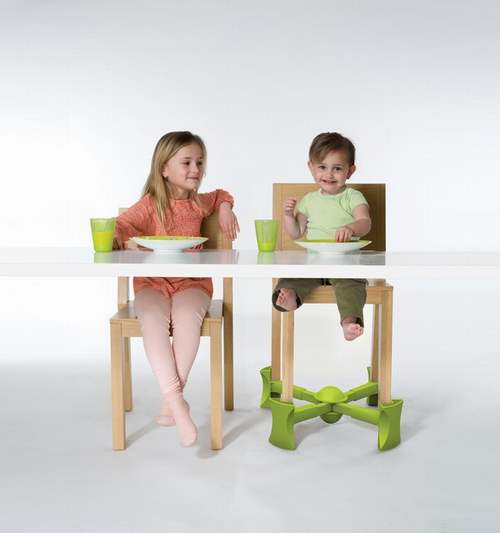
Kaboost is a “portable chair booster” that fits most 4-legged chairs and lets you use regular chairs for young children instead of booster seats:

Photo of Kaboost

Link from cribcandy.

🗓️
Children  •  Design

As I mentioned here, Rob and I once had a project, called “This Bag of Potatoes Has a Website,” that would have seen farmers in the Kinkora area provide a code of every bag of potatoes leaving their warehouse and bound for consumers. Customers could enter the code into a web application and find the “provenance” of the potatoes — why grew them, what fertilizers they used (and when), how many miles they’d traveled to market and so on.

The Kinkora project never happened, but now Dole is doing much the same thing for bananas. Soon, I think, consumers are going to demand this sort of information in the same way we now expect nutritional labeling on packaged food.

🗓️
Design  •  Food  •  Health  •  Technology

Although we’ve been busy moving around piles of data and piles of paper for a while, today marks our first burst serious provincial general election activity.

The big data management challenge at the front end of the electoral process is that data gathered door to door by 291 teams of “confirmation officers” during the first week of the election period has to be used to update the Registry of Electors that’s used to generate the Preliminary List of Electors later this week.

What this means in practice is that information about almost 100,000 electors has to be confirmed, added or deleted in the space of 48 hours. This is all made possible by data entry team of about 100 who start work on Tuesday night once the confirmation period is over.

The data gets entered into a web-based application that we first created for the 2003 election and that’s evolved in the interim as it’s been used for municipal elections and provincial by-elections.

Today is “data entry training day.” Starting at 11:30 a.m. we’ll run through four 30 minute training sessions with different groups of the data entry team, reviewing the basics and covering any changes since the last big “data entry event.” The sessions are held in the same windowless basement audio-visual theatre that’s otherwise used for press conferences and the like; it’s a place with little air and no light, and so keeping sharp — especially after three sessions — is always a challenge. When we did this back in 2003 I recall looking up from my notes after the third session and completely forgetting how far along I was, and convinced I was repeating myself (turns out that I wasn’t).

Tomorrow night the Big Fun begins: the 291 binders of confirmation forms will all get delivered to our “data entry HQ,” and then they’ll be distributed out to the data entry team and inputting will continue well into the night. We’ll repeat on Wednesday night, and the Preliminary List of Electors will get generated Thursday morning.

I covered some of the technical details of the data entry application in my talk in 2003 at Zap Your PRAM if you want to know more about the particulars.

🗓️

As proof that I can waste time measuring (and then blogging about) pretty well anything, I present the following video of the new traffic lights at the corner of Prince and Grafton Streets. My reasons are just, however: I wanted to get a good idea of just how much time I have to get across the street.

From the beginning of the cycle (which starts 19 seconds in):

  • 00:00 - vehicle and pedestrian lights turn green
  • 00:06 - flashing pedestrian “red hand” begins
  • 00:26 - vehicle lights turn yellow, pedestrian solid red
  • 00:30 - vehicle lights turn red
🗓️

About This Blog

Photo of Peter RukavinaI am . I am a writer, letterpress printer, and a curious person.

To learn more about me, read my /now, look at my bio, listen to audio I’ve posted, read presentations and speeches I’ve written, see things I’ve favourited elsewhere, or get in touch (peter@rukavina.net is the quickest way).

I have been writing here since May 1999: you can explore the 25+ years of blog posts in the archive.

You can subscribe to an RSS feed of posts, an RSS feed of comments, an RSS feed of favourites elsewhere, or a podcast RSS feed that just contains audio posts. You can also receive a daily digests of posts by email. I also publish an OPML blogroll.

InstagramYouTubeVimeoORCIDOpenStreetMapInternet ArchivePEI.artDrupalGithub.