Here’s a story about Don Sutherland.

Three years ago I hacked together a little project to create an RSS feed of applications under the Lands Protection Act. The Act is administered by the Island Regulatory and Appeals Commission and my hack scraped data from their website and reformatted in a form that made it easy to get automatically alerted to new applications.

As with many such projects of mine, there was a more than a small dose of “hey, you guys should be doing this kind of thing” moral suasion attached to this, an approach that usually fails abjectly to achieve its desired result.

Except that the person administering the IRAC website was Don Sutherland, and when I sent him a “hey, you guys should be doing this kind of thing” email his response was, two months later, to make the RSS feeds available directly from the source.

Now this may not seem particularly remarkable, but it was. Being a public servant is hard, and one of the things that makes it hard is the complicated dance required to serve the public, the public good, and ones political masters, each with their often competing impulses. A side effect of this complicated dance is that it’s rare the public servant who will accept feedback from outside institutional walls (especially cocky “moral suasion”-type feedback), see merit in it, and act.

This project was but one example of many over the last decade where Don manifested this openness. We were colleagues, of a sort, when I was working with Government on its own website, and we cooperated on projects several times under that umbrella. And, once I left that project, from time to time I would send him obscure questions about things like gas pricing data and he always responded with uncommon attention and detail.

Don Sutherland died tragically over the weekend, and in addition to the tremendous loss for his family and friends, we the people are worse off for his death, for we’ve lost one of those rare public servants who was able to dance that complicated dance expertly, and truly serve the public. He will be missed.

🗓️

On Thursday morning a tweet came my way from Kerry Campbell, Island Morning morning staffer and sometimes-host, throwing down the geek gauntlet:

Peter, we need you to create a website that allows us to track the location of lobster vendors in real-time. I know you can do it.

Rather than mystically incanting such a site into existence, instead thought it better to show Kerry how to create such a tool himself: a Google Maps-based custom map that can be updated by anyone, making it a sort of “wikilobsteria” — a collaboratively edited map that can be co-created by Kerry and his listeners and, presumably, by lobster fishers themselves.

What you’ll need to do this…

  • A computer with an Internet connection (preferably a fast one) and a web browser.
  • Basic familiarity with Google Maps: how to move and zoom the map to different locations.
  • Knowledge of how to “cut and paste” text on your computer.
  • A collaborative spirit.

You can click on any of the screen shots below to see a more readable full-sized version.

1. Get a Google Account

You may already have a Google Account, but it’s easy to get one if you don’t: just go to https://www.google.com/accounts/NewAccount and fill out the form you find there, taking note of the account name and password you create for yourself.

2. Go to Google Maps and Sign In

Go to Google Maps (http://maps.google.com/) and sign in (click on the “Sign In” link in the top-right corner) if you’re not already signed in to your Google Account. Then click on the My Maps link:
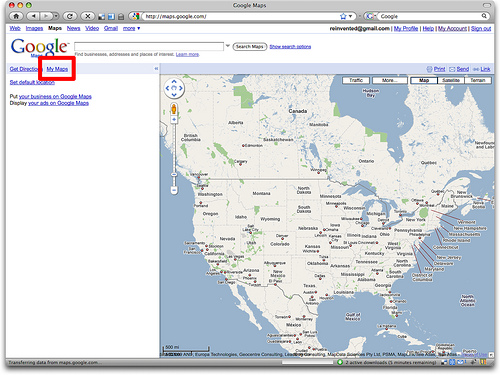
Sign in to Google and Click My Maps

If you’ve created Google Maps before (like I have in this example), you’ll see a list of the maps you created earlier; if you haven’t, this area will be empty.

3. Create a New Map

Click on the Create new map link to create a brand new map:
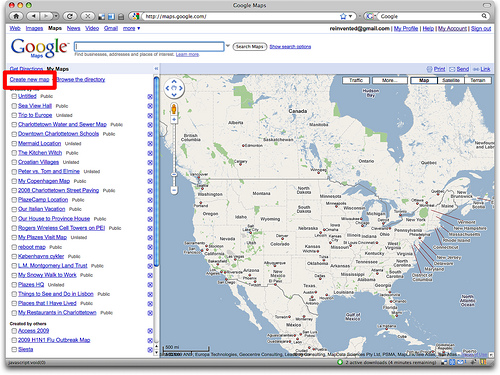
Create a New Map

4. Enter a Title and Description

Enter a title and description for your new map. Remember that this is the text that people looking for your map will be searching, so be as descriptive as possible. Make sure you mark your map Public - Shared with everyone so that anyone will be able to see it:
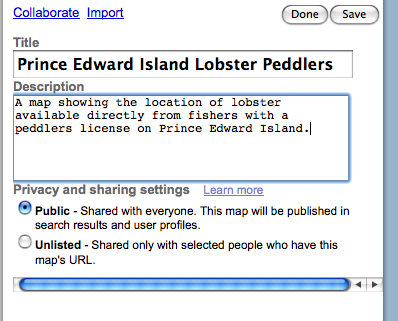
Description and Title for Map

5. Start Adding Markers

Zoom and pan your map window (just like you would with a regular everyday Google Map) to the area where you’re going to start adding markers — i.e. locations where lobster peddlers are located. When you’re in the right area, click on the “marker” icon in the top-left corner of the map (it’s a blue teardrop shape) and then drag your mouse to move the marker to the location you want to mark.
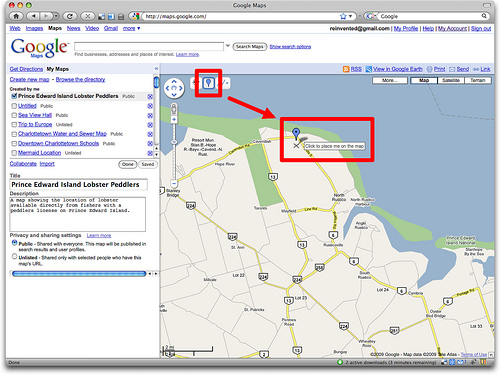
Adding a Marker

Click the mouse to drop the marker in place and you’ll be prompted to add a title and description for the marker; again, be as descriptive as possible:
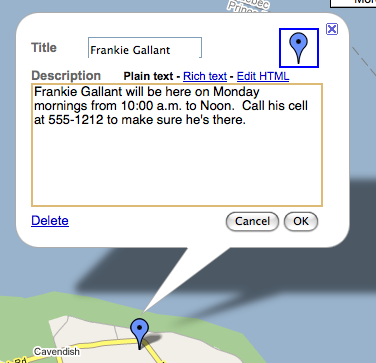
Details of Map Marker

Click OK to save your new marker, or Delete if you’ve made a mistake and want to start again. Simply repeat the process for each location on the map you want to mark.

6. Turn on Collaboration

Because you want anyone to be able to edit the map, you need to turn on “collaboration” for the map. Click on the Collaborate link just above the map description and check the Allow anyone to edit this map box and click OK:
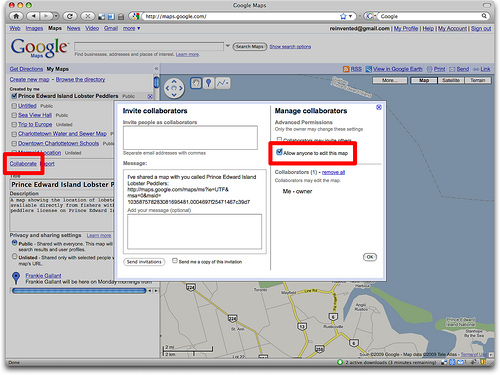
Turn Collaboration On

7. Save and Get a Link

Once you’re done adding markers to your map and are ready to save it and unleash the world on it, click the Save button and then the Done button, and then the Link link in the top-right corner of the map. Next, copy-and-paste the web address from the “Paste link in email or IM” box into an email message, instant message or word processor (you’re going to need this link in the next step):
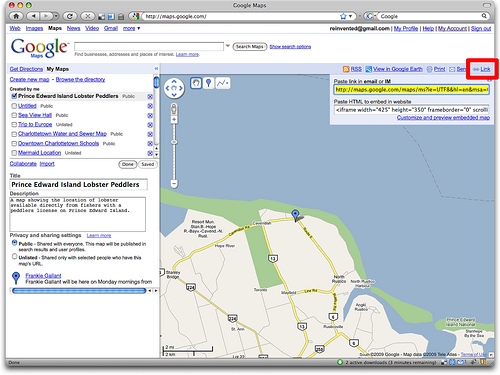
Link

8. Create a Tiny URL

Because you’re likely going to want to share this address — perhaps say it over the radio — you need a shorter way of expressing it. Go to http://tinyurl.com and paste the link you copied from the map into the “Enter a long URL to make tiny” box, and type an easy-to-say word into the “Custom Alias” box — something like peilobster, for example:
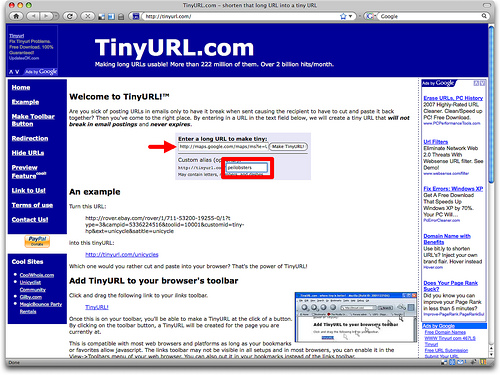
Creating a TinyURL for the Map

Click the Make TinyURL! button and you’ll have a brand new link — like http://tinyurl.com/peilobster in our example — that will lead to your map. People following the link will see something like this:
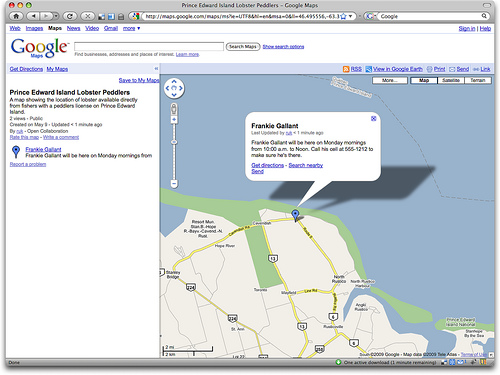
The Map

9. How Others Edit

Anyone else who has signed in with their Google Account will, in addition, see an Edit button on your map:
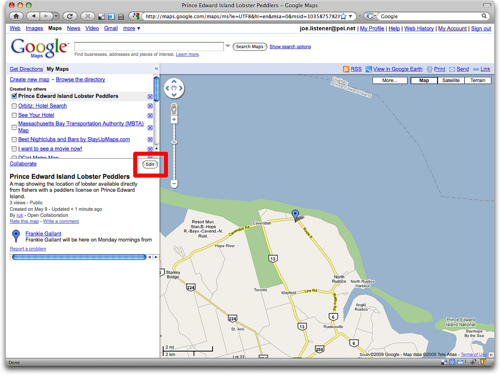
How to Edit the Map

And anyone clicking on that Edit button will be able to add new markers, delete or edit existing markers, add comments to the map, and/or update its title or description.

10. How to Tell Others How to Edit

Here’s a suggested script for telling others how to collaborate on the map:

To see our map, just go to tiny u r l dot com slash p e i lobster. If you want to help make the map, click “Sign in” in the top-right corner, sign in to Google (or create a new Google Account). Once you’re signed in and back at the map, click the “Save to My Maps” link under the map and then Edit to add or update locations.

That’s it. And of course you can do this for any sort of map. I suppose you could even have an Island Morning “help us make the lobster map” contest if you wanted.

🗓️
CBC  •  Charlottetown  •  GIS  •  How To  •  Mapping  •  Radio

🗓️
Casa Mia  •  Video

Graffiti has been in the news here in Charlottetown this week. Inscription: marking our place on architecture, from on site, offers a different perspective on the issue. Sarah Zollinger writes, in part:

When we become lost in the cities we live in, we rediscover our place by responding to the stories that architects tell with our own marks — words and images that tell stories in the cities we inhabit. Writing one’s name on a building claims space and makes place: it makes that building surface ours. Design cannot be spontaneous, but graffiti needs to be. Architecture may be hard and solid and slow, but writers move quickly. Writing names and identities onto the city is how we engage the slowness of architecture and put ourselves into the stories of the places we live.

It’s a compelling point of view and one that suggests that, if graffiti is seen as a civic scourge, the solution might require a far broader reexamination of how the city is planned, designed and developed.

The response of the business community has been to launch a Taking Action Against Graffiti program, at the heart of which is:

By cleaning up graffiti, no matter how long it’s been there, we are showing that we are “taking back” that area.

Framing the issue as a battle between the business and graffitists, where each tries to “take the territory” of the other, is an approach doomed to fail: to understand graffiti you need to understand and respond to what gives rise to it. Zollinger says at the conclusion of her essay:

In this, buildings, the collection of stories told by architects, become the backdrop. The anonymous walls of anonymous buildings become canvases where the average person comes in contact with the city and meets the moment when our lives can inscribe the rigid world that we live in. This is where the people that walk the streets make architecture human: flexible, changeable and where we urban dwellers, who live our lives in the shadows of buildings, push back at an unyielding architecture.

Might it me that “unyielding architecture,” and “develop or die” impulse that gives rise to it, creates an environment where graffiti is an inevitable response? Perhaps rather than trying to stamp out graffiti it would be better to try to listen to it, to attempt to parse what it tells us about our community and how we construct it.

🗓️
Art  •  Charlottetown  •  Design  •  Politics

At power.silverorange.com you’ll find a live dashboard of the electricity usage here at 84 Fitzroy Street. Some of the kilowatts you see flying by there are powering the server that is delivering this post to you. Very cool.

🗓️
Naked Holman's
🗓️

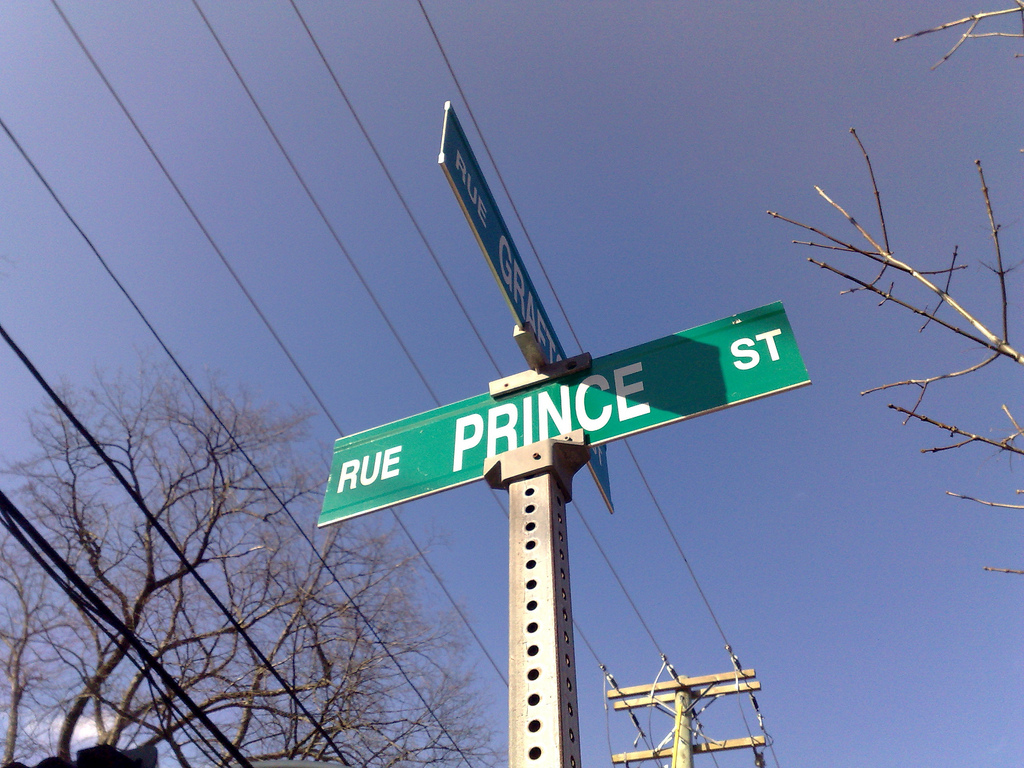
Last week this is what the sign on the corner near our house looked like:

Prince Street Sign (Old)

It followed accepted standards for colour, typography and layout, and, more importantly, it was clear, easily visible both close-up and far-away and served its way-finding role well.

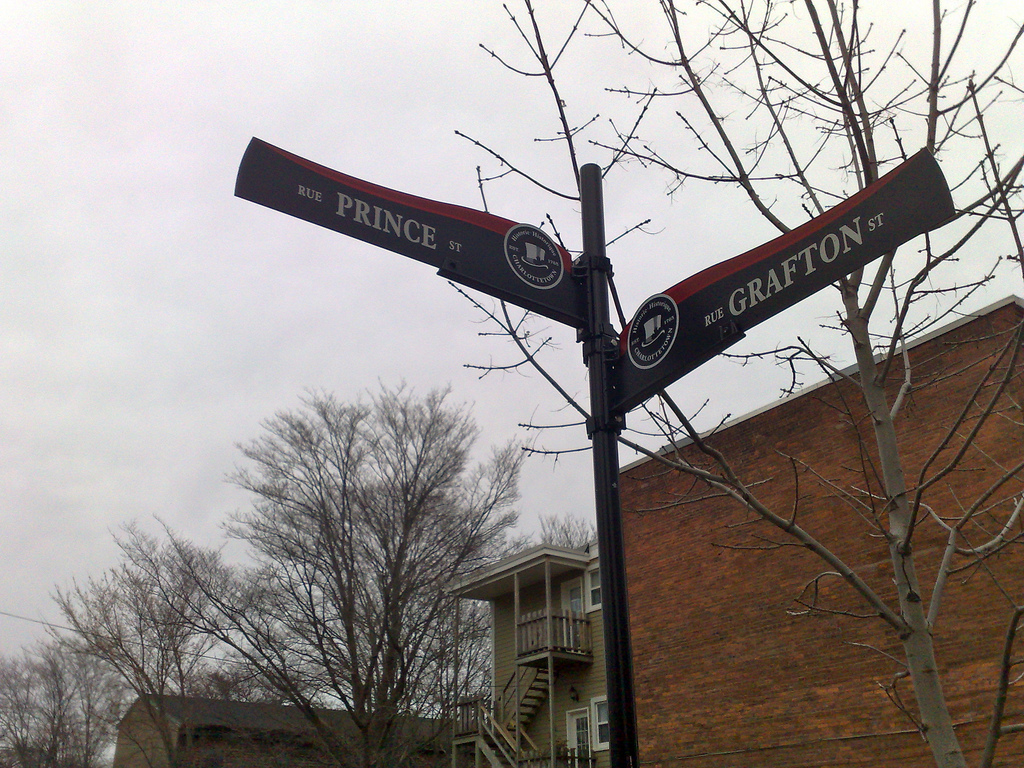
Here’s the sign that replaced it this week, part of an $22,000 effort to “brand the downtown as ‘Historic Charlottetown’ ”:

Prince Street Sign (New)

The new signs are non-standard, use considerably smaller type, colours that are much more difficult to read, and are a significant step backwards in terms of their purpose of clearly identifying city streets.

This is clearly a case where the “ye oldeification” tendencies of tourismocrats trumped principles of good design. What a shame.

🗓️
Charlottetown  •  Design  •  Signage

As I first noted in 2001 and as well-reviewed in the Spring 1986 issue of The Island, the original owners of our house at 100 Prince Street, the family of Henry Smith, set forth in the late fall of 1858 for New Zealand. By way of explaining what might draw Islanders into such a Herculean venture The Island suggests:

Reports on the favourable New Zealand climate could also have been an inducement to emigrate. The conditions and the terms of the Waste Lands Act as applying in the six provinces were set out by Charles Hursthouse in his book New Zealand, the ‘Britain of the South’, published in 1857. Its favourable reports on the colony’s potential and careful instructions for would-be emigrants were believed at the time to have influenced the architects of the Prince Edward expedition, especially Robert Haszard, who was its principal organizer.

Thanks to Google, it’s now possible to read New Zealand, or Zealandia, the Britain of the South in its entirety (there’s another edition as well, although it’s incomplete). It’s a truly amazing work — I wish there were contemporary versions available for all the countries of the world. Here’s what it suggests is one of the attractions for those who might immigrate:

Families emigrating to New Zealand in 1861 will find a population sufficiently large to have subdued the roughness of the wilderness to have established society and social institutions to have founded several thriving Settlements and to have raised annual exports to the value of nearly a million sterling But they will not find a population sufficiently large as in the United States and in the older emigration fields of Canada and Australia to have taken the cream of the country by monopolizing town and village sites garden valleys water privileges and the crack agricultural estate creating lands.

All was not altruistic sweetness and light however:

The occurrence of the native disturbances described in the last chapter is much to be lamented. But we must remember that these affect only the north island and that in all human probability these ere long will effectually and for ever be put down. Indeed in a few months I trust we shall be able to liken these native disturbances to the thunder storm clearing the political atmosphere of the north and producing for the Auckland and New Plymouth emigrant of 1861 such welcome fruits as good land and plenty of it clear titles and good laws.

In other words, no so much unlike Canada.

Update: You can buy a re-print, New Zealand, Or, Zealandia, The Britain of the South, Volume I, from Amazon.com.

🗓️
Charlottetown  •  History  •  Travel

Issa, the artist formerly known as Jane Siberry, has a new album out called Dragon Dreams. And while you can buy a physical copy from CD Baby, you can’t buy a downloadable version as Issa’s Sheeba store is offline for the moment. Helpfully, however, is this notice there:

if you ordered Dragon Dreams mp3s here and haven’t downloaded yet, or would like to order any music here and know what you want, email me for link. you can pay later at EZpay when the store re-opens if you wish to.

She sent out the link to Dragon Dreams in her email newsletter and it is in my iTunes now. If you are a fan, I think you’ll like it. I’m particularly fond of the track When We Are Queen, with lyrics, in part:

It will be more about giving,
And less about getting,
And farmers, teachers and nurses
will be returned
to their honoured place in society
And all the widows will open
(for obvious reasons).
When we are Queen.

You have to imagine that wrapped up in bongos and harpsichord and children’s voices.

🗓️
Customer Service  •  Music  •  Jane Siberry

Pardon me, but I spend an inordinate amount of time thinking about things like this.

My Danish friend Luisa revealed to me that the letter otherwise know to me as “o-slash” — ø — is not, as far as Danes are concerned, a “letter ‘o’ with a slash through it” but rather a bona fide letter all its own. Or, as Wikipedia says:

Speakers of languages which use the letter ø hold that it is not a ligature or a diacritical variant of the letter o (That is, emically they perceive it as a different letter entirely).

Which leads me to the question of Upper Prince Street.

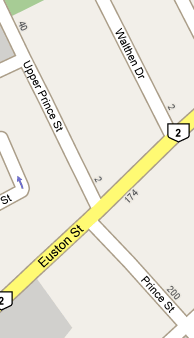
Upper Prince vs. Prince

Oliver’s school is called Prince Street School but its civic address is 66 Upper Prince Street (emphasis mine). That the school is not called Upper Prince Street School suggests that Upper Prince Street belongs to the “Prince Street family” — in other words, it is a “ligature or a diacritical variant” of Prince Street. And thus, because our house is at 100 Prince Street, we live on the same street as the school.

This runs contrary to my own view, based simply on my own biases, which is that Upper Prince Street is a different street entirely, an opinion supported by the fact that Upper Prince Street and vrai Prince Street each have their own set of street numbers (which is why we often get mail intended for the Scouts at 100 Upper Prince).

Please let me know your view on this.

🗓️

About This Blog

Photo of Peter RukavinaI am . I am a writer, letterpress printer, and a curious person.

To learn more about me, read my /now, look at my bio, listen to audio I’ve posted, read presentations and speeches I’ve written, see things I’ve favourited elsewhere, or get in touch (peter@rukavina.net is the quickest way).

I have been writing here since May 1999: you can explore the 25+ years of blog posts in the archive.

You can subscribe to an RSS feed of posts, an RSS feed of comments, an RSS feed of favourites elsewhere, or a podcast RSS feed that just contains audio posts. You can also receive a daily digests of posts by email. I also publish an OPML blogroll.

InstagramYouTubeVimeoORCIDOpenStreetMapInternet ArchivePEI.artDrupalGithub.