Here are some statistics that might interest you about how things have gone since I turned the comments back on here a week ago.

Over the last 7 days there have been 10 comments from real people commenting about real things – “ham” in the spam-fighting game.

During the same 7 days, Mollom, which I am using to filter spam, has stopped 1,421 spam comments.

Two or three pieces of spam are still getting through each day, which I must manually delete: these are usually of the “heap praise” variety of spam, things like “that’s a really great post that I found really great interesting,” with the author’s name linking, because I allowed a “home page” entry on the comment form, to sites selling jeans or sunglasses or domain names or whatever.

These two or three a day are annoying and dispiriting, but I’m a lot better off than I would be deleting 200 spam a day without filtering.

🗓️
Weblogs  •  Comments

The Australian film Tracks is playing at City Cinema until Sunday night. It’s an interesting film, especially if you are a fan of the “epic solo journeys by indefatigable Australians” genre as I am (see also Half-Safe: Across the Atlantic by Jeep).

Based on the true story of Robyn Davidson, who walked from Alice Springs to the Ocean in 1977, the film is beautifully shot, and an oddly compelling tale, given that the action consists mostly of a woman, a dog and four camels walking across desert landscapes.

There is, I warn you (spoiler alert) dog-related pathos that was especially shocking to me as I had Ethan at my feet throughout; fortunately his head was under the seat of the person in front of me, so he didn’t witness it.

🗓️

From the article Wrong Answer, published in The New Yorker edition dated July 21, 2014, concerning organized cheating, by teachers and administrators, on standardized tests in Atlanta schools:

John Ewing, who served as the executive director of the American Mathematical Society for fifteen years, told me that he is perplexed by educators’ ”infatuation with data,” their faith that it is more authoritative than using their own judgment. He explains the problem in terms of Campbell’s law, a principle that describes the risks of using a single indicator to measure complex social phenomena: the greater the value placed on a quantitative measure, like test scores, the more likely it is that the people using it and the process it measures will be corrupted. “The end goal of education isn’t to get students to answer the right number of questions,” he said. “The goal is to have curious and creative students who can function in life.” In a 2011 paper in Notices of the American Mathematical Society, he warned that policymakers were using mathematics “to intimidate—to preëmpt debate about the goals of education and measures of success.”

The article referenced is available online – Mathematical Intimidation: Driven by the Data – and is an interesting exploration of the concept of “value-added modeling” in educational testing.

So much of the educational agenda over the last school year was consumed with public discussion of the December 2013 release of PISA test results for the Islandaround the Home and School table as much as anywhere else – that it’s helpful to gain context about how testing is conducted, how the results are interpreted and reported, and whether or not they are of value for making practical decisions about educational policy.

🗓️
Education  •  Testing

For the last 90 days I’ve been running an app called Backtitude on my Android phone that sends my geolocation to a server where it gets stored away in a database.

Backtitude updates my location every 5 minutes, but only if it detects that I’ve moved more than 20 metres, so it’s recorded a total of 4,189 geolocations over 90 days rather than 25,000+ that it would have otherwise.

I built a little web app for myself to visualize my travels: there’s a dot on every location and lines connecting each successive one.

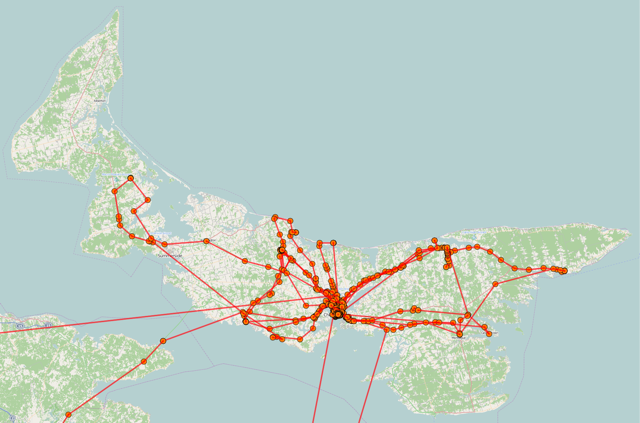
Here’s what my summer – May 21 to August 20 – has looked like so far:

Map of my summer so far, zoomed way out.

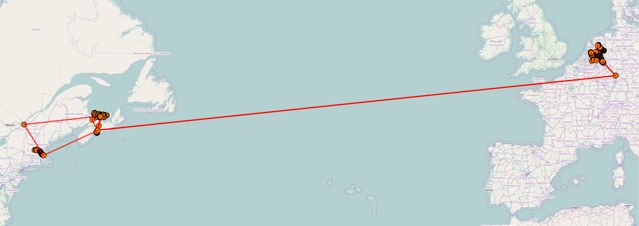
I took a trip to Europe in June and a trip to New England in July: that’s what the long connecting lines are.

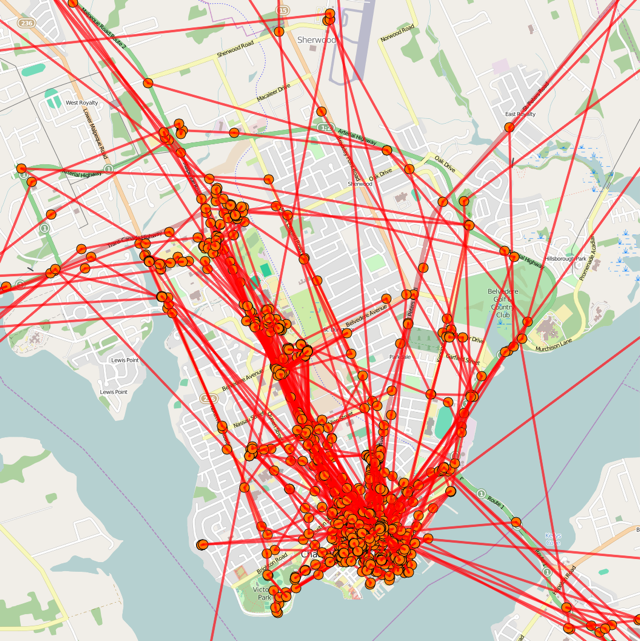
The map is more interesting when I zoom in; here’s my travel on the Island, for example: I’ve gone as far west as Ellerslie and and as far east as Cardigan.

Travel on  PEI this summer

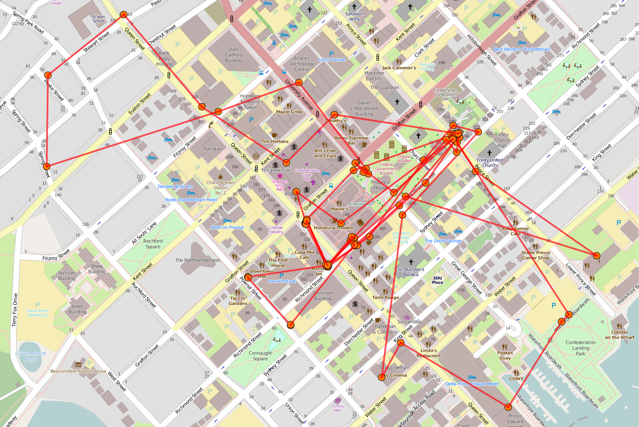
And here’s my summer in Charlottetown, where I spent the most time:

It all becomes more manageable if I decrease the date range that I visualize; here’s the last 24 hours in Charlottetown, for example. Outside of the Richmond Street corridor that connects my house to my office, everything else is dog-walking.

24 hours in Charlottetown

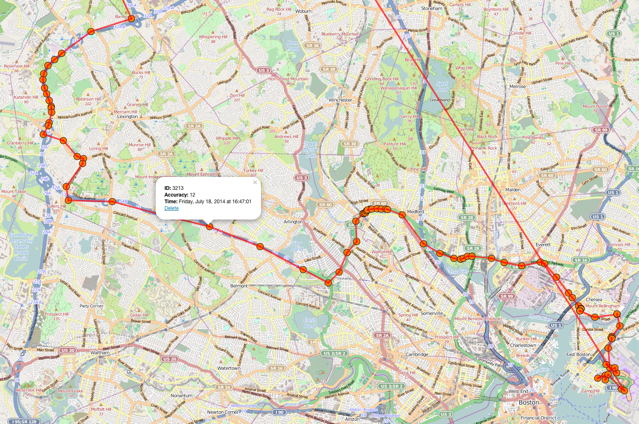
There’s utility both in looking at the overall terrain I’ve covered, but also in looking at specific trips: back in July I decided to follow Waze’s guidance for getting into Logan Airport in heavy traffic. As a result, I blindly drove hither and thither and had no memory of where I’d been. Except that I did:

Trip into Boston

So I know, as a result, that on July 18 at 4:47 p.m. I was on Rte. 57 between the 128 and Alewife.

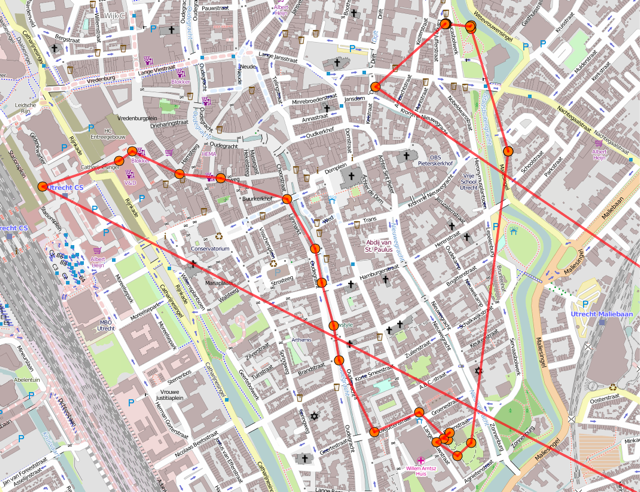
And here, earlier in July, is a day-trip into Utrecht in The Netherlands, arriving at the train station, walking through the centre to the Universiteitsmuseum, then a walk uptown for summer before returning to our campground:

Utrecht afternoon.

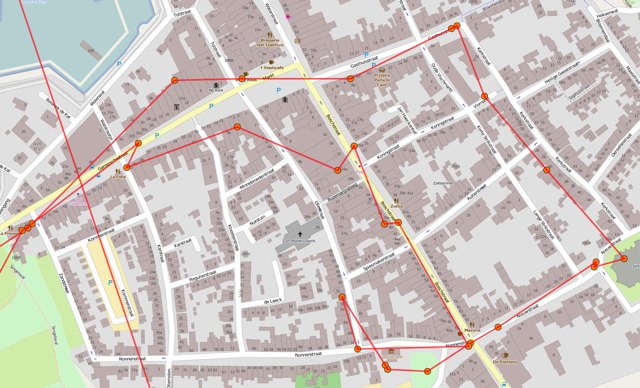
And here’s a walk around the centre of the town of Zaltbommel one afternoon on an open studio tour:

Zaltbommel studio tour

Looking back over the last 90 days my travels are fading from memory far enough that navigating back through my geolocation timeline has an effect similar to flipping through vacation photos. I’ll be interested to experience the same thing once I’ve been tracking my location for, say, a year or two.

If you’re interested in doing the same thing, here’s the server-side code that accepts geolocations from Backtitude.

🗓️
Geolocation  •  GPS  •  Android  •  Backtitude  •  Travel

One of the side-effects of suspending the cross-posting to Facebook that I announced yesterday was that you readers were again left without any way of leaving comments on posts here, something that, once I removed the ability to comment here directly several months ago, Facebook jumped in to fill a vacuum.

While I didn’t want to go back to old-school-spam-embattled commenting, I did want to reintroduce reader comments, and so I migrated the archive of 20,000+ comments stretching back more than 15 years into Disqus, something I dipped a toe in the water of in 2012

Like Facebook, Disqus too is “a commercial somewhere else,” but in this situation I think the utility afforded by Disqus makes this outsourcing worthwhile, at least as an experiment.

So comment-away, dear readers.

And, while you’re at it, revel in your newfound access to comments of yore: the Mac OS X Accounting Software for Canada? post, for example, has 175 of them, many containing really useful information.

Comments on the return of comments – and on the functionality offered by Disqus – are welcome.

Update later in the day: I knew that Disqus was too good to be true. I realized, almost as soon as I started to navigate the web, that the Disqus business model is based on its ability to litter cookies into users browsers tied to content, which is then sold to third parties as a vector for advertising. I noticed this because I was using this post on Transunion to test comments, and all of a sudden all the advertising I was seeing on the web was for Transunion. This kind of thing is precisely why I turned off Google Analytics, another vector for advertising data to leak out of the site, and so reintroducing this through the (otherwise quite handy and functional) Disqus seemed like a step backwards. So, new plan: I’m importing all of the old native-to-Drupal-stored-here-not-elsewhere comments – you’ll find them in place now, albeit rendered in a rather ugly fashion – and I’ll turn back on the ability to add new comments tomorrow. Sorry for the confusion. Lesson learned.

Update the next day: Comments have returned. Proceed as you were.

🗓️
Weblogging  •  Comments  •  Disqus

About a year ago I had someone coming to visit me from away and the only way I had of getting in touch with them was through Facebook.

Which meant that I was exposed to Facebook again for the first time in several years.

And so I decided to pay attention for a while: I was interested to see if, despite misgivings about its status as a sort Compuserve-like private Internet, there was value to be derived for the parts of my soul I was forced to give up.

I stuck with it for a year. I did, indeed, connect with some long-lost friends. And got some good letterpress advice from Sweden. I even set up an IFTTT recipe to automatically repost anything appearing on this blog as a new Facebook post, just to see what would happen, and when I shut off comments here Facebook became the de facto place for readers to leave comments. There certainly was some value to be had in the connections I made there, and in the continuous partial attention I was able to pay to a wide circle of family, friends and neighbours.

But, after a year, I’m bringing the experiment to a close. This will be my last post echoed to Facebook, and you shouldn’t expect to be able to reach me through Facebook’s communication tools any longer.

Which means that if you want to read what I write, you’ll need to come over to http://ruk.ca/ to do so, and if you want to reach me you’ll need to use one of the other myriad ways you’ll find laid out at http://ruk.ca/contact-peter-rukavina.

What’s ultimately responsible for disconnecting me from Facebook is simply being uncomfortable with contributing to the Facebook paradox: people join Facebook, and stay there, because everyone else, it seems, has a Facebook account. And so on. It’s where the baby pictures are. And the value proposition for many means that they’re willing to put up with the highly-targeted ads to see those baby pictures.

I’ve got nothing against the baby pictures, but I’ve decided that I can’t countenance continuing to engage with a system that is missing so many aspects of what makes free, open, non-Facebook Internet attractive.

And so, as much as I’m able, I’ll work on furthering that free, open, non-Facebook Internet, creating other less onerous homes for baby pictures.

It’s been an interesting year. I’ll see you all outside, I hope.

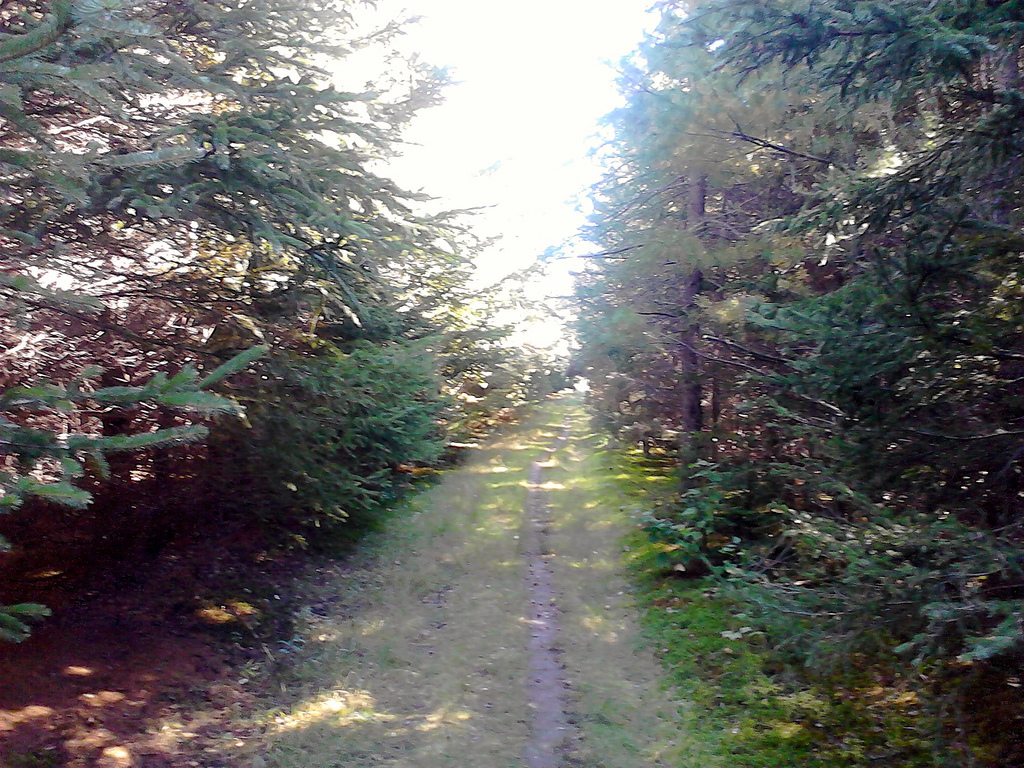
Winter River Trail Head

🗓️
Facebook  •  Weblogs

In an episode of corporate gymnastics that I don’t completely understand, CIBC sold part of its Aerogold Visa business to TD Canada Trust. I happened to be in the part of the business that was sold, and so in June of this year my CIBC Visa became a TD Visa (ironically I’d switched away from TD Visa several years ago to CIBC; they just keep pulling me back in again).

As part of the transition, I received a new Visa card number, and had to switch to using TD’s online systems. Because I’m a “pay my credit card balance every month, on time” kind of person, on the day I received my new TD Visa card, I immediately registered for a “TD EasyWeb” account for the card and turned on email statement notifications so I’d be sure not to miss my first statement.

And then life went on.

Until yesterday when I went to pay for something with my new TD Visa only to have it declined.

This morning I phoned TD to find out why and I was told that there was a “non-payment hold” put on my account because I hadn’t made a payment. I replied that I hadn’t received a statement yet, despite having set up email statement notification.

It was only at this point that I learned that, sometime after I set up a new EasyWeb account for the new credit card, TD, of its own volition, merged the new Visa card into my existing EasyWeb account, attached to a line of credit and a long-dormant chequing account. This old EasyWeb account didn’t have email notification turned on, which is why I never received a statement.

The agent claimed that the only way to make all of this right was to make a payment on the account, wait 3 to 5 business days for the payment to clear, then wait a further 2 business days for the hold to be removed.

In other words, I’d be without my business credit card for a week.

Despite my protests that this would be extremely inconvenient – not only would I not be able to purchase anything online for the business, but any automatic payments associated with the account would presumably be kicked back declined as well – I was told there was no way to override the system and that I was stuck.

I hung up.

I called back.

I explained the situation again, from the start, to a second agent.

The second agent told me he would immediately remove the hold, remove the $16 in interest that had accrued because of non-payment, and that I could start using the card again immediately.

So, TD, I’m not impressed.

And if you find yourself in the same situation you may want to both check to make sure you’re email statement notifications are turned on, and, if you find agent number one unhelpful, call back and speak to agent number two or three, who may have better answers.

🗓️

In honour of our friend Ron Boyles, who died earlier this week, here’s a television ad, produced by my longtime friend and former business partner David Moses, that ran on the CBC in the mid 1990s. It was an ad most remarkable for the fact that despite having seen in dozens of times, it was only years later that I realized it was an ad for Boyles Optical, Ron’s family business.

To this day I have no idea whatsoever how David managed to convince Ron that producing a minute-long noir drama set in abandoned buildings down by the docks was exactly what his optical business needed.  But he did. And it aired. And Ron had a story to tell for years after. It is, I think, the most interesting television commercial ever to air on the Island.

And that tells you a little something about Ron that might get lost in all the talk about his status as a gruff but legendary golfer. Which is not to say that Ron couldn’t be gruff or that he wasn’t legendary. But he was a complex man, not so easily summed up, and, despite being perhaps as far to the opposite end of almost any spectrum you can name from Ron, I always had a soft spot in my heart for him.

Thanks to Beryl and Jason at Moses Media for digging into the company video vault.

Ron’s funeral service will be held tomorrow, Friday, August 14, 2014, at 3:00 p.m. at Spring Park United Church in Charlottetown with visitation following until 6:00 p.m.

Our thoughts this week are with Carol and their children and grandchildren; Ron will be missed by many.

🗓️
CBC  •  Moses Media  •  Boyles Optical

I’ve been doing some work this week on “geopresence archiving,” culminating in the release of some code, called GeoArchive, that will slurp in Foursquare, Plazes, Twitter, Openpaths, Google and Flickr geopresence data and convert it into GeoJSON.

GeoJSON is a funny thing: you’d think that the last thing the world would need is yet another format for GIS data. But it turns out that is exactly what the world needed, for GeoJSON appears to have hit a sweet spot of portability, understandability and flexibility that is causing a whole new set of geographical tools to flower.

Using the aforementioned GeoArchive, I converted every single geopresence I’d logged in the last 10 years (starting in 2004 with Plazes and continuing until the present) and dropped the resulting GeoJSON files into a GitHub repository called geotraces (yes, that’s making public some detailed private information, but it’s information about the past, and I haven’t murdered anyone or had an affair, so I’m comfortable with that).

I then used the (excellent, free, open) GitSpatial tool to sync that repository so that I could use its spatial querying magic to extract interesting insights from it.

I eat lunch at Tai Chi Gardens, a small vegetarian restaurant around the corner from my office, several times a week.

But exactly how often do I go there?

I decided to use my newfound geo-superpowers to find out.

I used the (dreamy) BoundingBox tool to get the coordinates for a bounding box around the restaurant, building in a comfortable buffer to allow for the inexactness of GPS:
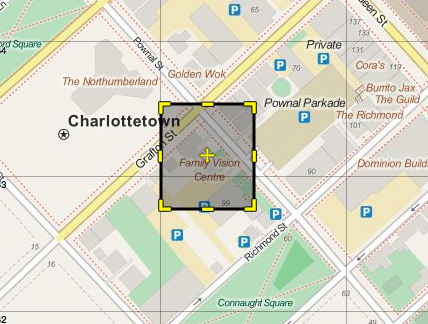
A bounding box around Tai Chi Gardens.

This gave me a bounding box (selecting the CSV format) of:

-63.1299796551,46.232755568,-63.1289904541,46.2335363014

To query my GeoJSON, I opted to start with my Google Latitude traces, which cover the longest recent period in the most detail (because, in part, they were collected passively; I didn’t need to “check in” to record my presence); the GitSpatial URL I ended up with was this one and visiting it gave me – handily and happily – some more GeoJSON, which I could feed to the (very helpful) GeoJSON.io, which allowed me to double-check that everything worked as I wanted (it did):
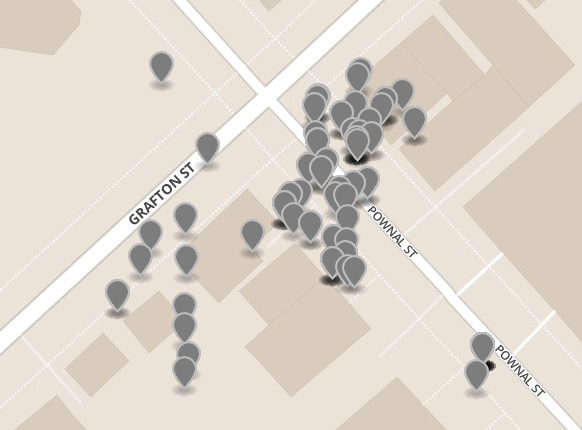
Tai Chi Gardens geopresences in geojson.io

With this GeoJSON in-hand, I then used some old-school UNIX command line magic to extract the number of unique dates in that file:

grep when taichigardens.geojson | cut -d" " -f10 | cut -d'"' -f2 | sort | uniq

That gave me a list of dates when I’d been inside that bounding box – and, likely, eating lunch at Tai Chi Gardens:

2010-01-16
2010-02-20
2010-05-29
2010-06-15
2010-06-19
2010-06-26
2010-06-28
2010-10-16
2010-11-17
2010-11-20
2011-03-31
2011-04-05
2011-04-11
2011-04-20
2011-06-11
2011-06-13
2011-09-06
2011-09-27
2011-11-14
2011-11-23
2011-11-30
2011-12-12
2012-05-14
2012-05-15
2012-05-16
2012-05-18
2012-06-05
2012-06-06
2012-07-30
2012-08-01
2012-08-03
2012-08-06
2012-08-08
2012-08-10
2012-09-10
2012-09-17
2012-09-21
2012-10-31
2012-11-05
2012-11-13
2012-11-22
2012-11-26

Piping that result through wc and I find out that over the period from January 16, 2010 to November 26, 2012 I visited Tai Chi Gardens 42 times:

grep when taichigardens.geojson | cut -d" " -f10 | cut -d'"' -f2 | sort | uniq | wc -l

This is just a toe dipped in the water of the experimenting I hope to do with my decades-long stretch of geopresence data. I welcome you to join me.

🗓️
Geolocation  •  GeoJSON  •  GeoArchive

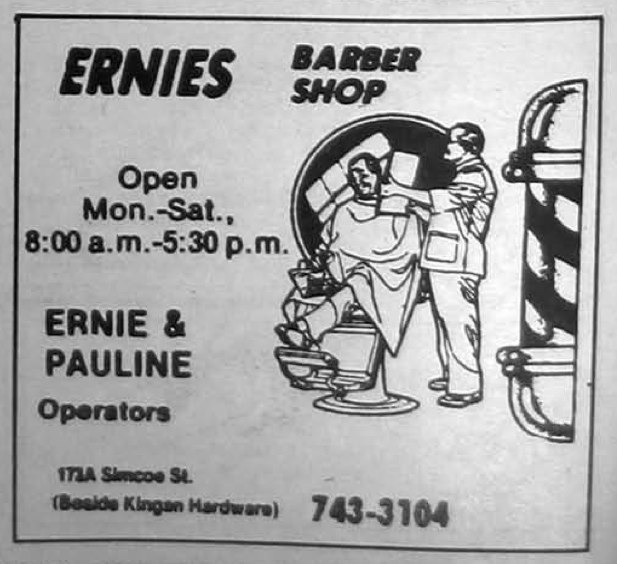
While I was trawling through the archives of Arthur from 1985 this morning, I noticed that there was an ad in every issue for Ernie’s Barber Shop – “Ernie & Pauline, Operators” – on Simcoe Street:

And then, in the issue of November 11, 1985, a review of Ernie’s that I wrote – my first newspaper story (although it ran, oddly, without a byline), headline “Real haircut”:

For the past 15 years, I’d been making the monthly trek out to the old “Long Acres Barber Shop” near home; Kurt, Louis, Joe and Mike were always there, always friendly and had become like members of the family. Moving away meant saying good bye to all that; facing the world on my own: finding a NEW barber.

I roamed the streets of Peterborough … oh there were places to get your hair cut — “Rice’s House of Unisex Hair Design,” “Fernando’s Hairateria”, “The Hair Cutting Ranch” — but no real barbers. In desperation. I let my fingers do the walking and pulled out the yellow pages. There. between “Dynasty Hair Design” and “Esquire Hair Salon” was what I’d been looking for “Ernie’s Barber Shop”.

Quickly I found my way to 173-1/2 Simcoe Street. At first I thought that Ernie’d been bought out by some crazed lawn ornament salesperson. There were all sorts of things — I think they call them “curios” — in the front window. It turned out that Ernie IS the crazed lawn ornament salesperson: I guess you can’t make a living just cutting hair.

I opened the door, walked in, and immediately knew I was in my element. I was greeted by Pauline (Ernie’s protege) and escorted to a real barber chair. Pauline was extremely friendly and my fears disappeared within minutes. The conversation was pleasant, my fellow customers interesting (there’s one lady who comes in nearly every day and has been for the past couple of decades) and the hair cut superb (I was assured that if I wasn’t pleased I could come in anytime and they’d touch it up “on the house”).

That article in Arthur caught the eye of James Ramsay, also an Arthur writer and a Trent student a few years my senior. James also grew up in near Aldershot, and also got his hair cut at the Long Acres Barber Shop. We remain friends to this day.

I had my cut for years thereafter at Ernie’s, sometimes by Ernie, and sometimes by Pauline (although after a while Pauline left and Ernie was on his own). Eventually the original location closed and Ernie opened up in a more modern space around the corner, and I followed him there. Who knows how many times Ernie cut my hair.

Toward the end of my time in Peterborough I went into Ernie’s for what turned out to be my last haircut in the the city and my last hair cut from Ernie. As I was sitting there in the chair with Ernie at work I noticed a newspaper clipped taped to the corner of the mirror: it was my article from Arthur.

I thought about telling Ernie that I was the writer – and for all know he’d figured it out — but I decided to remain anonymous. My haircut done, I paid Ernie, left him a tip, and headed out, a satisfied customer.

I learned this afternoon that Ernie died, of lung cancer, a couple of years ago; here’s his obituary

KALWA, Ernst “Ernie” Erwin, born 26 October 1929 in Osterode, Germany, succumbed to lung cancer in Peterborough on 01 December 2012. Ernie immigrated to Canada in 1953, and came to Peterborough on the recommendation of a man he met on the ship. He found work as an orderly at St Joseph’s Hospital where he met Registered Nurse Muriel Doris Calberry of Hastings. They were married 26th October 1955. He began barbering in 1954, operating Ernie’s Barber Shop on Hunter Street, and later on Simcoe Street, until retiring “a legend in barbering” in September 2012. Ernie was an avid angler and horse-racing enthusiast. He is survived by his loving wife Doris, son Paul Elliott Allen Kalwa of Peterborough, son Ernest Larry Kalwa (Elysia DeLaurentis) of Elora, sister Elli and brother Walter, both of Germany. He is predeceased by his parents Johann and Augusta Kalwa (née Opalka), brothers Adolf and Paul, and sisters Ida and Hedwig, all of Germany.

It amazes me to learn that Ernie was still barbering until two years ago, 27 years after I first walked in his door.

Thank you, Ernie, for filling an important void in my life at an important time. And for getting me started in the writing game.

🗓️

About This Blog

Photo of Peter RukavinaI am . I am a writer, letterpress printer, and a curious person.

To learn more about me, read my /now, look at my bio, listen to audio I’ve posted, read presentations and speeches I’ve written, see things I’ve favourited elsewhere, or get in touch (peter@rukavina.net is the quickest way).

I have been writing here since May 1999: you can explore the 25+ years of blog posts in the archive.

You can subscribe to an RSS feed of posts, an RSS feed of comments, an RSS feed of favourites elsewhere, or a podcast RSS feed that just contains audio posts. You can also receive a daily digests of posts by email. I also publish an OPML blogroll.

InstagramYouTubeVimeoORCIDOpenStreetMapInternet ArchivePEI.artDrupalGithub.