I’ve been sitting on the Publications Committee of Island Studies Press for the last six months, and in that capacity I had occasion to read an early version of the manuscript for John Cousins’s book on the New London, Prince Edward Island. It’s a compelling read: not a community history, at least in the traditional sense, as the New London about which John writes isn’t the New London we know and love today, but rather an earlier incarnation of the village, with a grander vision:

New London was unique in the history of Island settlements. It was begun not as a community of scattered farms but as a compact industrial village stretched along “Leadenhall Street,” the road leading to the harbour mouth. The villagers for the most part were woodsmen, mill workers, and artisans: shoemakers, blacksmiths, coopers and woodworkers like the famous Benjamin Chappell. There was even a village doctor: Dr. Cullshaw. The plan of Robert Clark, the London Quaker who owned Lot 21, was to exploit the sea and the forest of his Island properties and export fish and lumber to the Caribbean. In return, products from the Caribbean – rum and sugar, for instance – would be carried back to the Island.

The book will be published later this year, but in the meantime you can hear a sneak peek from John himself on April 19, 2016 at the final of the Island Studies Lecture Series of the year. John’s lecture, New London: The Island’s Lost Dream, starts at 7:00 p.m. in the Faculty Lounge in Main Building.

If you have but a scintilla of interest in Island history you should attend: John is a wise, entertaining speaker and the tale he will weave is fascinating.

John Cousins

Screen capture from the video Telling Island Stories
Robertson Library, University of Prince Edward Island

🗓️

Here’s how wrong numbers go down on Prince Edward Island:

Caller: “Oh, shoot, I dialed the wrong number; sorry about that.”

Me: “No problem. Have a good day.”

Caller: “You too; take care.”

We are a gentle, polite lot.

🗓️

The front page of the April 12, 1915 edition of The Guardian contained, in addition to news of the war, a breakdown of Prince Edward Island’s provincial spending and revenue for the previous year:

Public Accounts of PEI, 1915

The same information is available for last year, 100 years later, on the Public Accounts website, which includes this summary:

Public Accounts of PEI, 2015

In 1915 the province took in $477,841 and spent $574,964.

In dollars adjusted for inflation, that’s revenue of $9,823,157 and spending of $11,819,751.

In 2015 the province took in $1,725,913,000 and spent $1,747,187,000.

That means 2015 revenue was, in adjusted dollars, 175 times greater than in 1915, and spending was 147 times greater.

In the 1911 census, the population of PEI was 93,728 and in the 2011 census is was 140,204, an increase of only 50%.

🗓️
Prince Edward Island  •  Budget  •  Money  •  History

In a way that would be anathema to more sedate dogs-off-the-furniture families, Ethan has the run of the couches and chairs in our house – how else could he cozy up to Oliver, after all. Sometimes he takes his dominion over the human world very liberally; witness the position I found him in this morning after breakfast:

Ethan at Rest

🗓️

Here’s a photo of delegates at our PEI Home and School Federation Annual Meeting yesterday engaged in what we called “Success Story Speed Dating.”

The idea was that rather than focusing on “I wish they would do X” discussion, we would instead focus on “we did Y and it really worked well discussion: sharing stories of successful initiatives of local home and school associations that could be cross-pollinated to others.

PANO_20160409_110327

We pre-selected 10 topics and our members picked 5 each, spending 10 minutes on each “round” until they stood up and moved on to the next one. The topics were:

  1. Increasing Transportation Safety
  2. Breakfast and Lunch Programs
  3. Influencing Education Policy
  4. Building Better Playgrounds
  5. Parent Leadership Grants
  6. Making our Schools Greener
  7. Fundraising
  8. Building Engagement in Home and School
  9. Engaging Volunteers
  10. Working with Our Principal

This was going to be something that either worked well or flopped colossally, and signs are that it was the former, which was great. We’re going to summarize up the success stories shared and distribute them back to our members to use in their plans for this spring and forward.

I sat in on the “Building Better Playgrounds” session and it was fantastic: lots of talk about using natural areas around the school, about adventure playgrounds, about risk vs. reward.

🗓️

One of the duties of the President of PEI Home and School Federation is penning a monthly columns for The Guardian newspaper; as I hand over the position to someone new this Saturday at the Federation’s Annual General Meeting, this week’s column was my last, and my editor at the paper crafted a lovely headline to go with it – “Be part of the superpower” – that neatly sums up why I’m so passionate about Home & School as a vehicle for change.

"Be part of the superpower" the The Guardian, April 7, 2016

The headline extends from this paragraph:

What is unique about this meeting is the breadth of the participation: a table at the meeting might include the Minister of Education, a local union president, a teacher, a principal, and several parents and guardians. The superpower that this affords Prince Edward Island is estimable: what might take years to develop consensus around in larger jurisdictions can happen in a morning here in Prince Edward Island. It’s a superpower that Home & School members are rightly proud of. Next month’s column will summarize the results of these discussions.

And I genuinely believe that.

Although I cede the presidency to someone new on Saturday, I’ll continue to be involved in home & school: Oliver, after all, has three more years of public education left, and I continue to sit on the Federation’s executive as Past-President for another two years. 

Twenty-year-old-Peter would never believe that fifty-year-old-Peter would feel so warmly about such activities, but I do.  Weird.

🗓️

I turn 50 today (see also turning 48, 47, 45, 43, 42, 41, 40, 39, 38, and 36; before age 36, apparently, I was young enough not to notice my age).

The day started with Oliver secretly passing a note to his vice-principal at school when I dropped him off asking her to make an announcement about my birthday, which she kindly did.

The day continued with PEI Home and School Federation-related duties at the PEI Science Fair, where I selected and then awarded special prizes. This was great fun, both because I got to have many interesting conversations with young scientists about their projects, and because, being special prizes, our awards fall outside of the normal structure of the fair, and thus, as long as they recognize projects that “focus on the total well-being of children, including health, safety and learning,” are completely left to the discretion of the judge. Such freedom! I’ll never be able to go back to regular prize judging, with its onerous rubrics and forms.

As is usually the case, I’m at my least pensive on my birthday, so I’ve no wise words for my future self. Actually, scratch that: future self, remember to look up from time to time, take stock of things, turn down a different path, try on a different hat, say hello to someone unexpected. Please report back.

50 Brick

Photo by Paul Kalupnieks, Creative Commons Attribution-ShareAlike 2.0 Generic license.

🗓️

Via Alphabettes, a link to Beyond TYPO, a whimsical new font that’s free to download:

The Beyond TYPO Font is a hybrid creature, mixing hand-made letters and amœba. A high saturation of OpenType makes the font come to life: auto-shuffling characters, fun alternates, crazy ligatures, and plenty of initial and final forms that grow one-celled creatures, trunks, legs, and miscellaneous biomorphic extensions at either end of your words and sentences.

Here’s an example:

Beyond Typo Example: Prince Edward Island

🗓️

Among the maps in the Island Imagined collection at the University of Prince Edward Island, my favourite are the Charlottetown Fire Insurance maps from the turn of the last century.

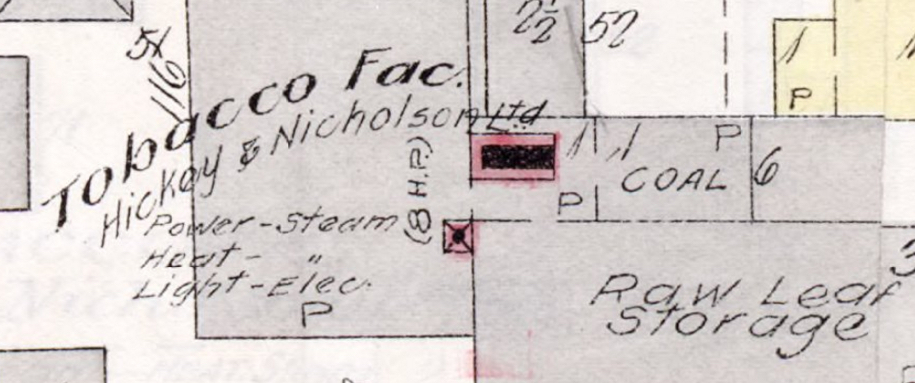
One of the great things about the digital versions of these maps is that it’s possible to experience them in great detail; here’s part of our block, for example, showing the Hickey & Nicholson tobacco factory:

Detail from Charlottetown Fire Insurance Map.

While the digital has its distinct advantages, sometimes having an analog map in your hand has its own particular benefits. And so on the weekend Oliver and I, with an hour to kill out by Staples, decided to make some printing Charlottetown Fire Insurance maps of our own.  Here’s how we did it.

You’ll need a USB flash drive to copy map images onto.

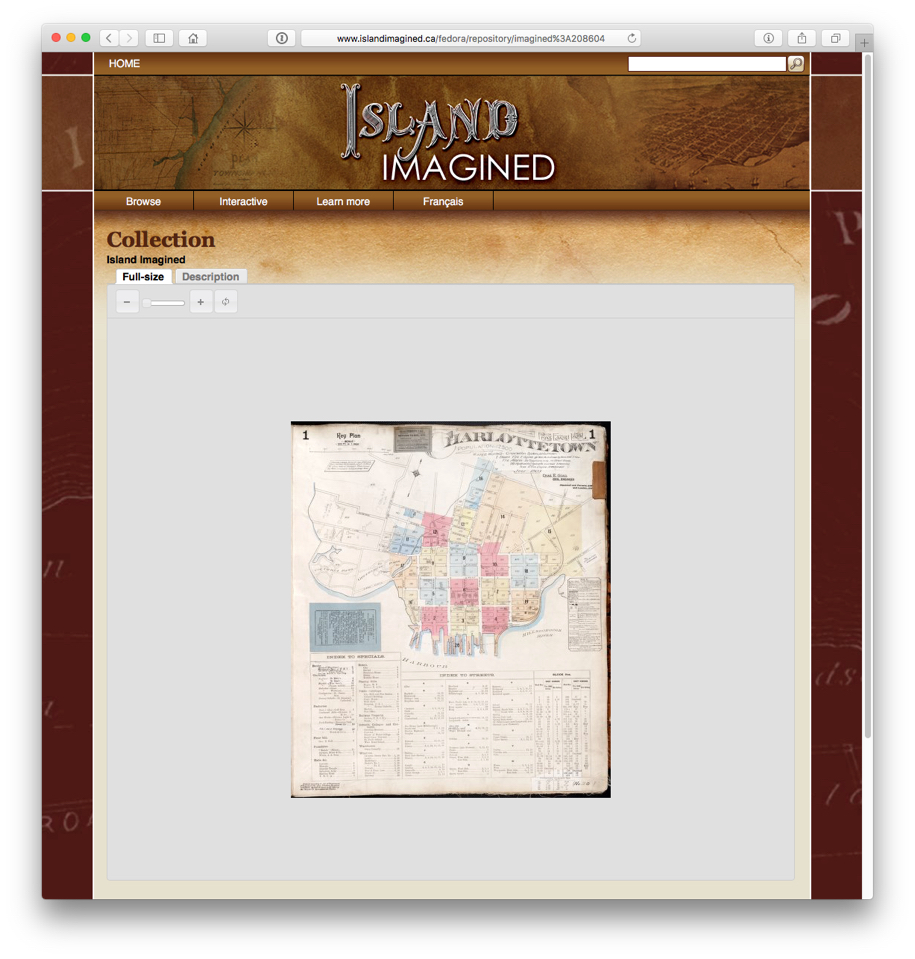
First, we commandeered one of the display computers at Staples. We selected a MacBook, but there are many computers on display, and any of them will do. We went to the IslandImagined.ca site, and located the map we wanted to print first, the index map:

Charlottetown Fire Insurance Index Map

There is, unfortunately, no mechanism in the IslandImagined.ca viewer to request a high resolution suitable-for-printing version of the map, but it’s possible to obtain one through a little bit of manipulation:

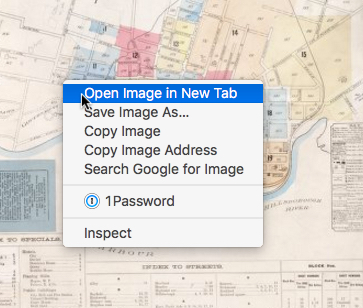
Don’t zoom in: work from the map as it loads initially. With your mouse pointer over the map image, right click and select “Open Image in New Tab”:


Open Image in New Tab

In the new tab that opens up you’ll see a URL in the address bar that looks like this:

http://137.149.200.109:8080/fedora/get/imagined:208604/
ilives:jp2Sdef/getRegion?
uid=
&level=3
&region=0,0,505,429

You need to edit that URL to produce a higher-resolution version of the entire map by:

  1. Change level=3 to level=10.
  2. Remove the &region=0,0,505,429 entirely.

The resulting URL is:

http://137.149.200.109:8080/fedora/get/imagined:208604/
ilives:jp2Sdef/getRegion?
uid=
&level=10

Load up this URL and you’ll receive a very high resolution image. Copy this to image onto the USB stick, eject it, and take it over to one of Staples colour photocopiers in the print centre (be sure to look at the copier labels: only a couple of them are colour).

Insert the USB stick in the standalone terminal that’s beside the copier and follow the instructions to print a file from a USB stick; select the file you just copied, and, for best results, print on 11x17 inch paper.

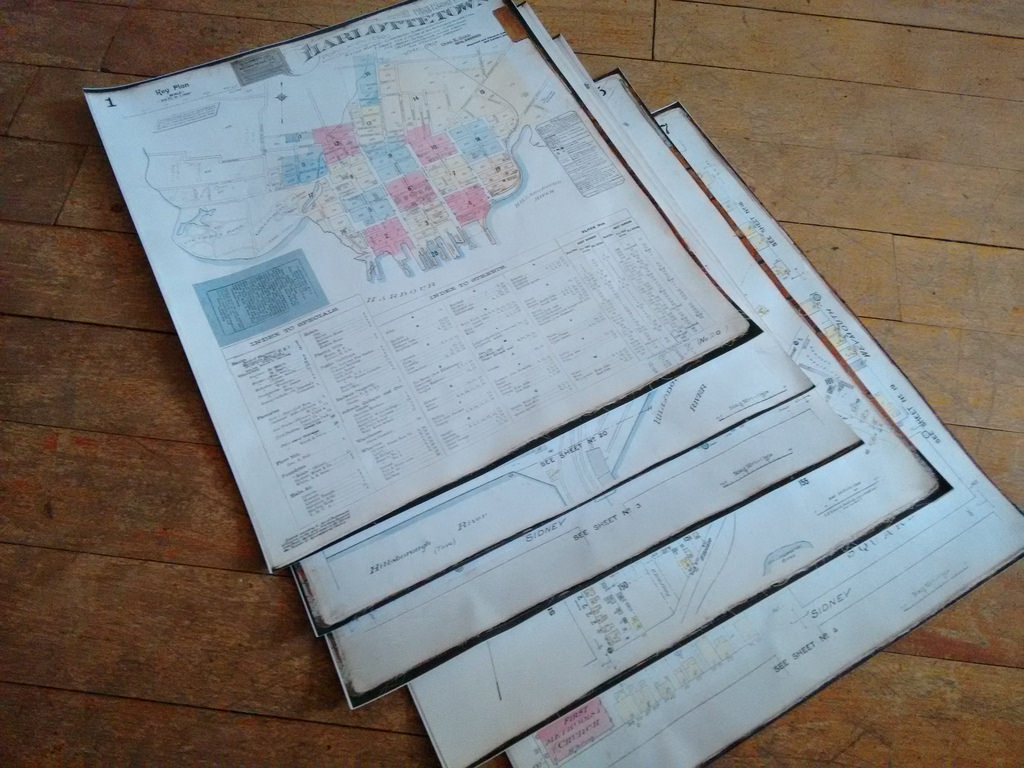
Charlottetown Fire Insurance Maps

Staples charges about $1.00 per copy, and the results are very impressive. We repeated the process 4 more times to get good coverage of our block and down to the Charlottetown waterfront.

You’re not limited to Charlottetown Fire Insurance maps, of course: there are over 1,000 maps in the Island Imagined collection to choose from, from very early maps to more recent ones, like Atlas of Province of Prince Edward Island, Canada and the World from 1927.

And of course you should note any rights restrictions in the map metadata (click the “Description” tab for any map) — many maps are labelled “This material is provided for research, education, and private use only. For all other uses, please contact the Prince Edward Island Museum and Heritage Foundation,” which shouldn’t prevent you from printing them for your own use, but likely means you shouldn’t print them on T-shirts and sell them.

🗓️
Maps  •  Charlottetown  •  Island Imagined  •  University of PEI

While we’re on the topic of my eyes, here’s a snazzy scan of my left eye that Charlottetown Vision Care sent me after my last eye exam:

My Macula

My optometrist Dr. Judson helpfully took me on a tour of what information is communicated here during my exam; I was distracted enough by the fact that I was looking at a detailed scan of my eyes with those same eyes themselves that I retained very little of what she told me, save “there’s nothing to worry about here.”

🗓️

About This Blog

Photo of Peter RukavinaI am . I am a writer, letterpress printer, and a curious person.

To learn more about me, read my /now, look at my bio, listen to audio I’ve posted, read presentations and speeches I’ve written, see things I’ve favourited elsewhere, or get in touch (peter@rukavina.net is the quickest way).

I have been writing here since May 1999: you can explore the 25+ years of blog posts in the archive.

You can subscribe to an RSS feed of posts, an RSS feed of comments, an RSS feed of favourites elsewhere, or a podcast RSS feed that just contains audio posts. You can also receive a daily digests of posts by email. I also publish an OPML blogroll.

Instagram • YouTube • Vimeo • ORCID • OpenStreetMap • Internet Archive • PEI.art • Drupal • Github.