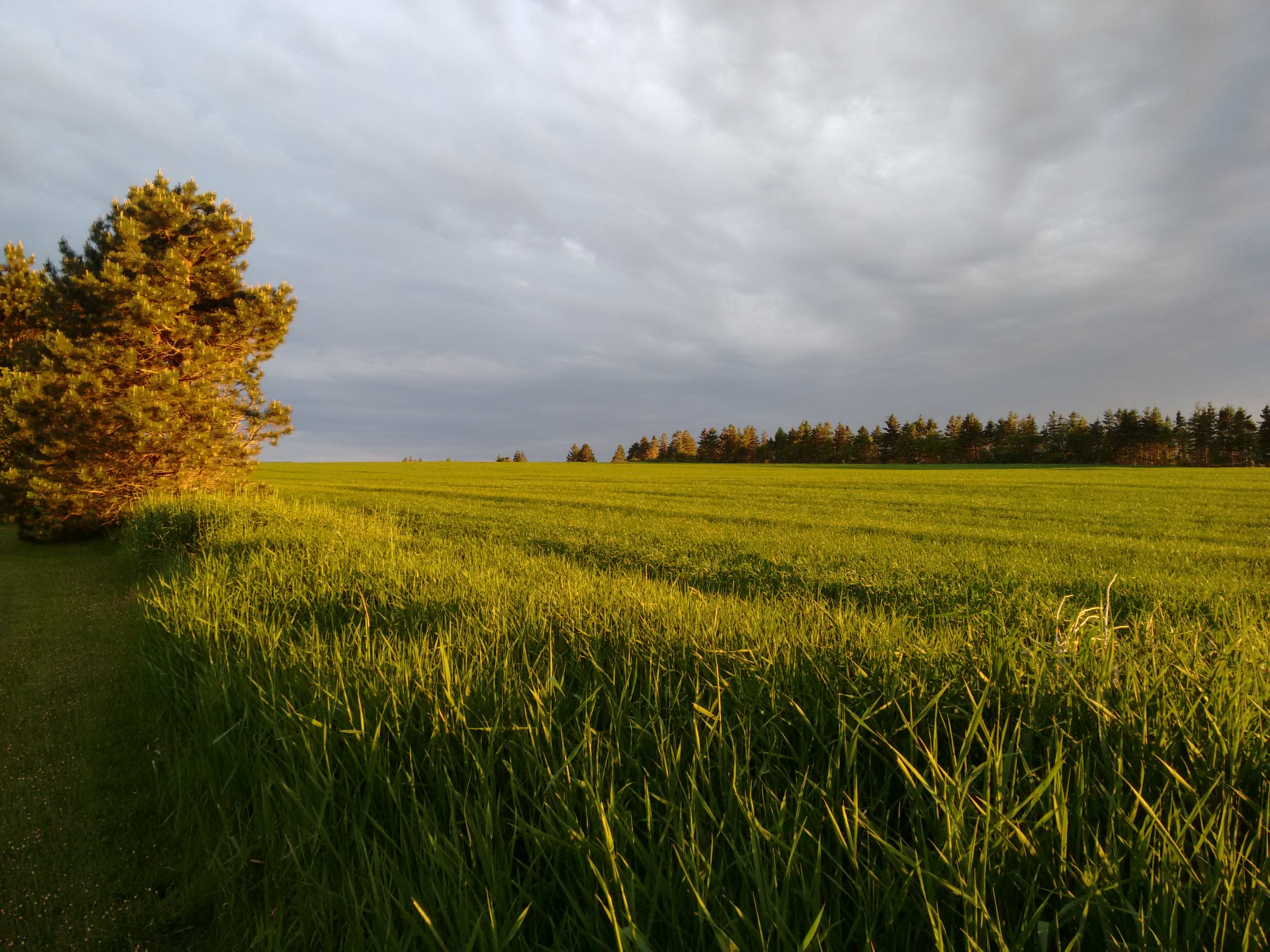
The Queen Elizabeth Hospital stops charging for parking on July 1st. So this morning, dropping off a friend for day surgery, is likely my last time paying.


The Queen Elizabeth Hospital stops charging for parking on July 1st. So this morning, dropping off a friend for day surgery, is likely my last time paying.
Oliver had his grade 9 graduation ceremony tonight. We’re very proud of him, and very thankful to the teachers, administrators and staff at Birchwood Intermediate who saw him through his three years at the school with flexibility, imagination and compassion.

I’ve been on something of a notebook-marking tear this week. Every once in a while I remind myself that it’s possible to actually make your own notebooks – it comes as a surprise to me every time!
This time around it’s all by way of beta-testing perfect-binding approach for my book of klischees: I’m experimenting with glue and covers and using ribbons and string as bound-in bookmarks.
For today’s project I took 20 sheets of letter-sized paper and cut them in half, and then folded each each into a signature for the notebook; I stacked the signatures together into a text block, added some end papers, clamped the result in a book press, and glued the spine with white glue (three coats).
For the cover I used an old issue of Volume magazine: I cut off its back cover, sized it to the book, and glued it – and a string for the bookmark — to the text block.


When Chrome 50 was released in April, my WhatsMyLot.com app stopped working because with that release Chrome would no longer allow use of the Geolocation API for non-secure sites.
The reasons for this are sound:
Location is sensitive data! Requiring HTTPS is required to protect the privacy of your users’ location data. If the user’s location is available from a non-secure context, attackers on the network will be able to know where that user is. This seriously compromises user privacy.
In other words, you probably don’t want your specific location, which WhatsMyLot.com needs to locate the township lot you’re standing in, flying around the Internet in the clear for anyone to intercept.
To make this work I needed to do two things:
First, I needed to purchase and install an SSL certificate. This cost me $34 wholesale from RapidSSL and took about 15 minutes to request and configure. I had to update my Apache server configuration to serve the site on port 443 instead of port 80, and I needed to ensure that any traffic going to port 80 got redirected to port 443.
Once that was done, the site was serving from https://WhatsMyLot.com/. But it still wasn’t working properly.
Chrome’s JavaScript console was reporting two errors:
Refused to execute script from 'https://whatsmylot.com/data/pei-lots-wgs84-simplified.geojson' because its MIME type ('') is not executable, and strict MIME type checking is enabled.
whatsmylot.com/:1 Refused to execute script from 'https://whatsmylot.com/data/lot-data.json' because its MIME type ('application/json') is not executable, and strict MIME type checking is enabled.
There are really two separate errors here – the MIME type of .geojson files wasn’t configured in Apache, and Chrome wasn’t executing JSON files – but there was a simple, common solution.
The app needs two objects define to work properly, metadata and lots. These are JSON objects that define the metadata about each lot and the geographic coordinates of each lot’s polygon respectively. For ease of management, I had these loaded from the index.html like this:
<script src="data/pei-lots-wgs84-simplified.geojson"></script>
<script src="data/lot-data.json"></script>
While this worked, it technically wasn’t correct, as these were JavaScript files, not GeoJSON nor JSON files. Chrome’s complaint, in a sense, reflects this. The fix was easy: I renamed the files with .js extensions, and changed the index.html to:
<script src="data/pei-lots-wgs84-simplified.js"></script>
<script src="data/lot-data.js"></script>
With that change Chrome users are again able to identify which of the Samuel Holland-surveyed townships lots on Prince Edward Island they’re in at any given time. The source code repository has been updated accordingly.
When Canadian Tire decamped for the far northern reaches of Charlottetown, HomeSense and Mark’s moved into its old location on Buchanan Drive and, as part of the renovations of the area associated with this, a new passageway, pictured below, was opened to the Staples parking, allowing traffic that, during the Canadian Tire years, was never allowed to pass.
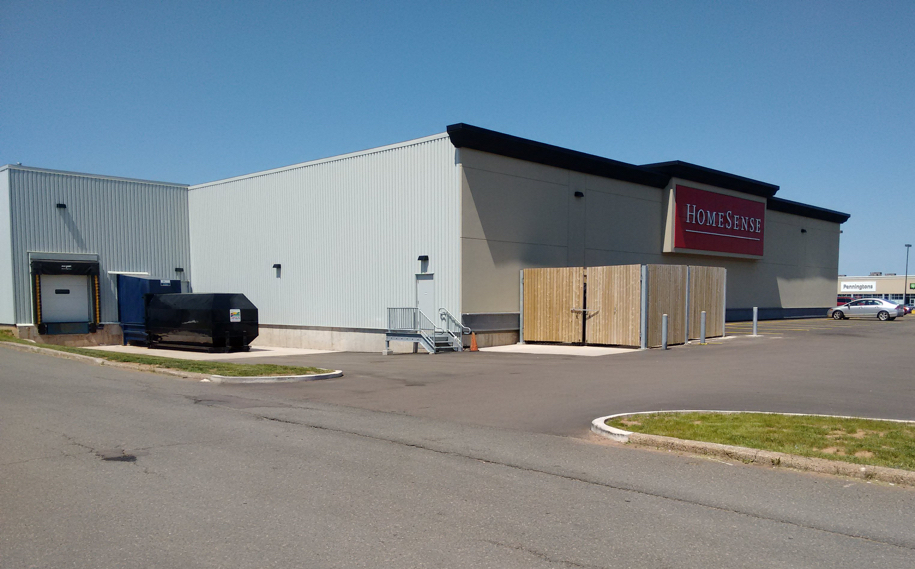
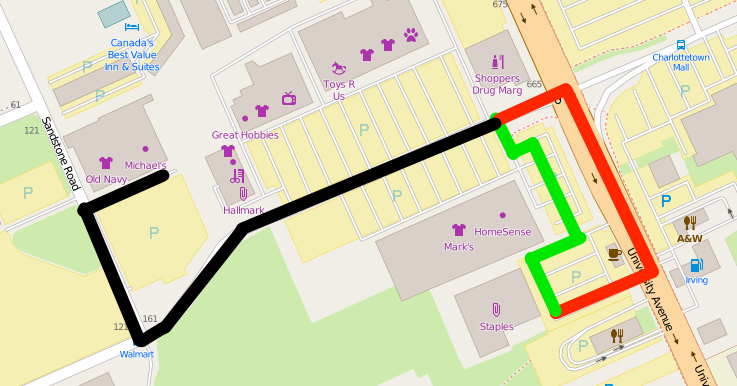
This small change has been transformative if you’re moving about the big box district of the city. Let’s say you’re at Staples, for example, and want to go around the corner to Michael’s. Before the change you’d have to make a tricky left turn onto University Avenue from the Staples parking lot, fighting busy traffic in both directions. Then you’d have to get in the left-turn lane at the corner of Buchanan and wait for the light to change, eventually turning onto Buchanan.
With the new passageway you can simply head out of the Staples parking lot into the HomeSense/Mark’s parking lot and onto Buchanan. It can shave 5 minutes off the journey, and a lot of hair-raising traffic-crossing.
I realize that such things shouldn’t loom so large in my consciousness, but they do.
An interesting profile of Toronto impresario Jeff Stober in Toronto Life:
Later, while looking at renderings for the hotel’s new ensuite bathrooms, Stober zeroed in on a sketch of a shower with an exposed pipe. “Why would you expose a fragile pipe? That’s a non-starter. What happens when people have sex in the shower? They’ll rip it off. They’ll burn themselves on it. No. I have zero interest in that. Next?”
Stober is the developer of the The Drake Hotel on Queen Street West in Toronto, a phenomenon I’ve missed completely during my 23 year sabbatical from Ontario.
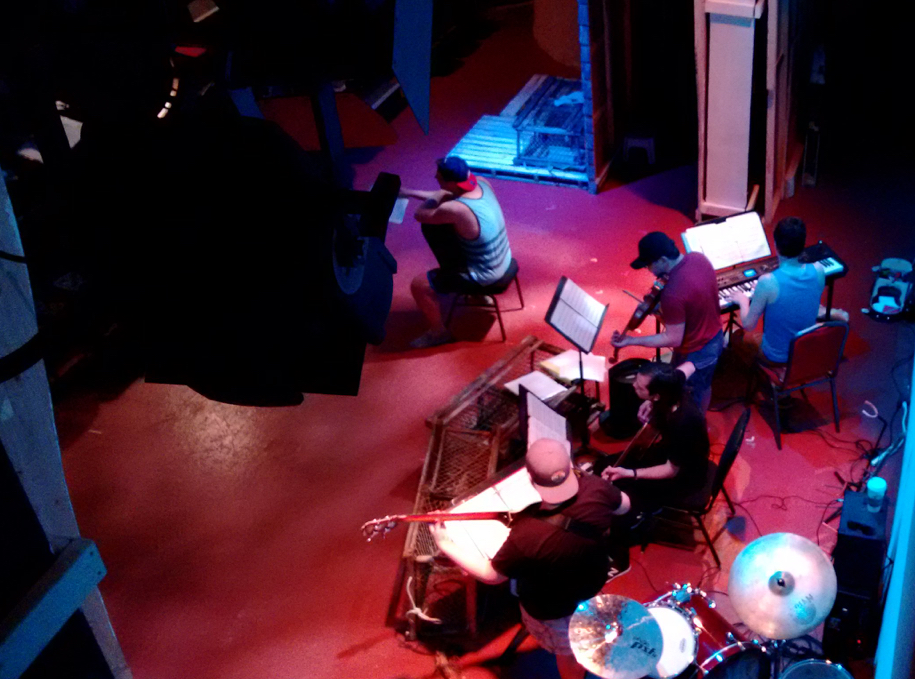
With a Stan Rogers musical in rehearsal next to the Reinventorium, my days are filled with novel interpretations of Rogers’ canon. It’s equal parts enervating and thrilling; regardless, I find myself whistling 45 Years on the way home most days.
In this light, Barrett’s Privateers Explored is an excellent read:
Stan Rogers basically made up an imaginary privateer to carry a 60s anti-war theme in a traditional folk setting. Having said all that, many of the details, ranging from the type of cannons mentioned to the letter of marque reference, are very authentic. Stan Rogers did a fair bit of reading about privateering and appears to have been influenced by the historian Archibald MacMechan, who wrote several books on Canadian privateers, as well as a privateering song of his own.
It’s a line by line breakdown of the song. The song that by summer’s end will be burned into my ears.
So I built myself this:
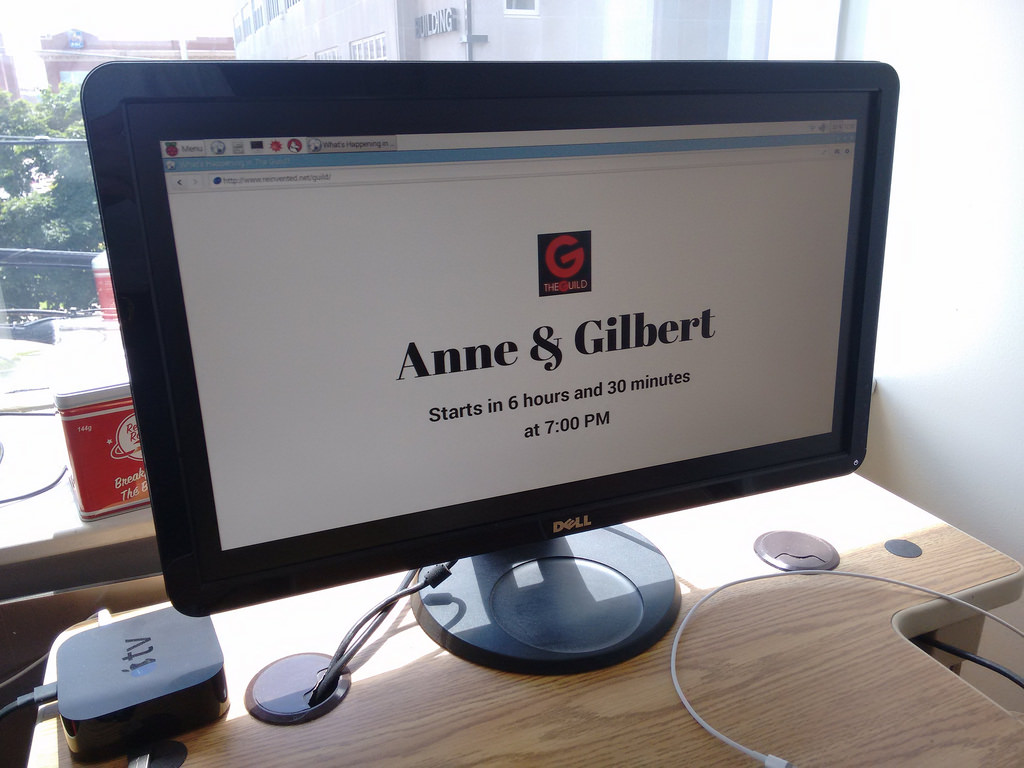
It’s an early warning system for performances in The Guild theatre, which sits mere inches from my office. It uses this schedule-harvesting code to pull an iCalendar version of the theatre schedule, and then this PHP iCalendar parser to look for what’s playing next. It runs in on a Raspberry Pi browser, and sits at the end of my office.
So now I’m never caught unawares by heartfelt belting outs of of passionate musical theatre anthems.
I developed a sudden surge of obsession this morning about whether the community I was in last night for Small Halls Songwriters’ Circle is called St. Peters or St. Peter’s. Or maybe St. Peters Bay? Or is it St. Peter’s Bay?
The community’s website features a logo that uses St. Peter’s Bay – with the apostrophe and with the Bay:

But, elsewhere on the website, you’ll find both St. Peters Bay (no apostrophe, with Bay) and St. Peter’s (with apostrophe, no Bay).
The Municipalities Act lists the name as St. Peters Bay (no apostrophe, with Bay):
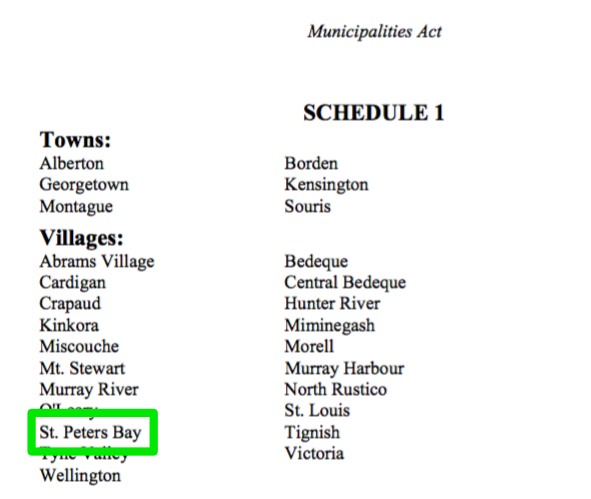
This agrees with the record in the Geographical Names Board of Canada database for the community:
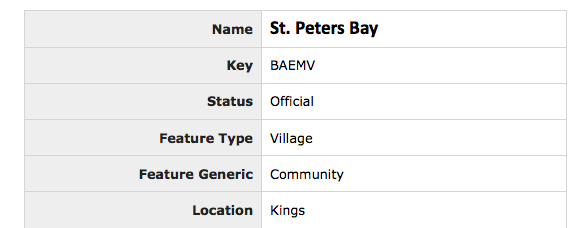
and with the Province of PEI’s PlaceFinder (which is derviced from that database), which provides the history of the name:
St. Peter (Sett.) was adopted in Place Names of PEI, 1925. Name changed to St. Peters (St. Peters Bay P.O.) (Village) 3 December 1946 on 11L/7. Village was incorporated in 1953. Village status changed to Inc. Community in 1983 by the Municipalities Act. Dual name changed to St. Peters Bay (Comm.) 31 Dec. 1989 on 11L/7.
Somewhat confusingly, the official civic addresses in the community are in St Peters (no period, as is standard for civic address communities, but also no Bay). The same applies to the name of St Peters Rd, which runs through the community. Which means that the civic address of the community office is:
Community of St. Peters Bay
5599 St Peters Rd - Rte 2
St Peters, PE
Canada Post, for reasons unknown, uses a dash between the “St” and the “Peters” and doesn’t use a period. But only for the name of the community; the name of the road doesn’t have a dash. Meaning that the mailing address for the same office is:
Community of St. Peters Bay
5599 St Peters Rd - Rte 2
St-Peters Bay, PE
To confuse matters somewhat, the Catholic parish in the community is known as St. Peter’s (with apostrophe):

Perhaps the name of the church falls under a different rule set than the name of the community, so this divergence can be explained — it is Saint Peter’s Basilica in Rome, after all, with an apostrophe.
Except that the name of the church on the church itself is St. Peter’s Bay Roman Catholic Church (with the apostrophe, with the Bay), which bridges heaven and earth in a most uncomfortable way:

Assuming the sign has it right, this would make the mailing address of the church, following everyone’s rules:
St. Peter’s Bay Roman Catholic Church
1843 Greenwich Rd
St-Peters Bay, PE
That just about breaks my brain.
Just in case your brain is also broken, here’s a cheat sheet:
| RULE MAKING BODY | COMMUNITY NAME |
|---|---|
| The Community | St. Peter’s Bay |
| Government of Prince Edward Island | St. Peters Bay |
| PEI Civic Addressing System | St Peters |
| Government of Canada | St. Peters Bay |
| Canada Post | St-Peters Bay |
Good luck.
 I am Peter Rukavina and this is my blog. I am a writer, letterpress printer, and a curious person.
To learn more about me, read my /now, look at my bio, listen to audio I’ve posted, read presentations and speeches I’ve written, see things I’ve favourited elsewhere, or get in touch (peter@rukavina.net is the quickest way).
I have been writing here since May 1999: you can explore the 25+ years of blog posts in the archive.
 You can subscribe to an RSS feed of posts, an RSS feed of comments, an RSS feed of favourites elsewhere, or a podcast RSS feed that just contains audio posts. You can also receive a daily digests of posts by email. I also publish an OPML blogroll.
Instagram • YouTube • Vimeo • ORCID • OpenStreetMap • Internet Archive • PEI.art • Drupal • Github.