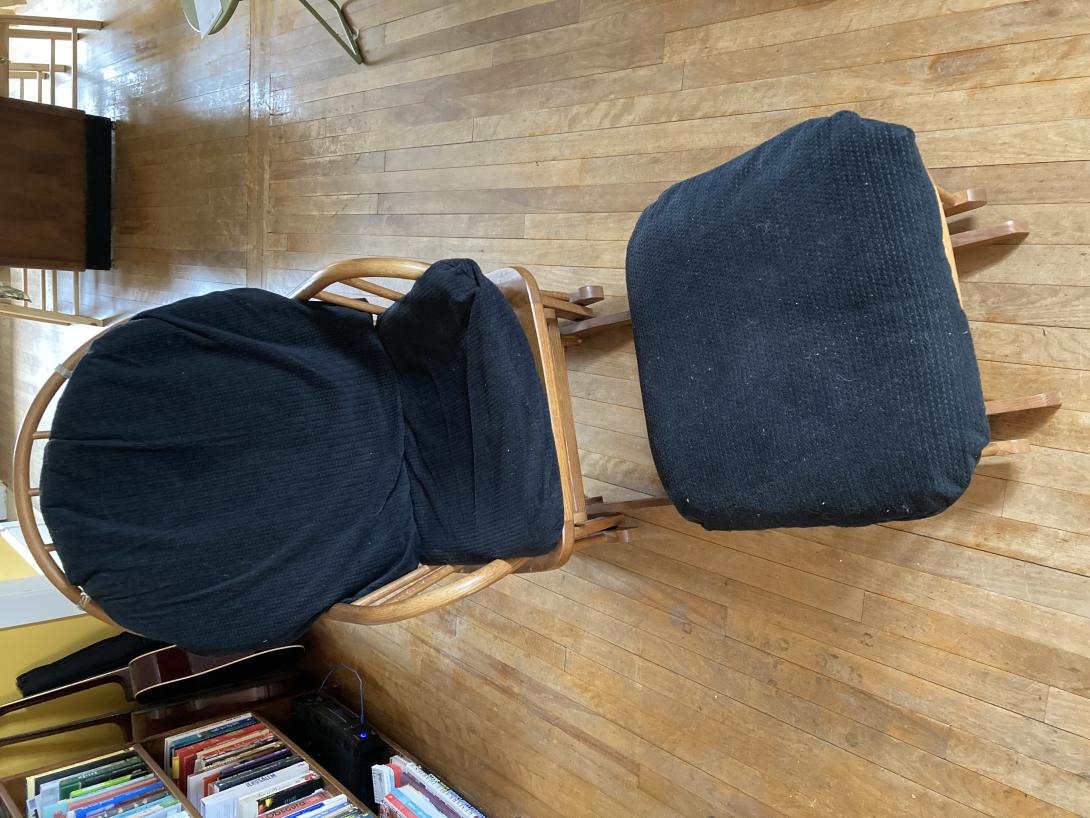
Twenty years ago, in anticipation of the arrival of our baby, a glider rocker was secured. It proved fantastically well-suited to its task of rocking-baby-to-sleep assisting, but, as baby evolved, it became less useful, and more like an annoying tippy chair (at least in my more strident eyes).
With my stridency now unfettered, I listed it on Kijiji a month ago, where it joined many other glider rockers for sale (perhaps also victims of growing children). For weeks I had no bites, but last week someone from Wellington pinged me; they retrieved it today. $30. A good deal for them, and a little less tippy clutter at 100 Prince Street.
Johannes Kleske wrote an ode to Readwise, and, knowing Johannes to be both wise and organized, I dove in. Without bogarting his description of the app and its place in the digital ecosystem, Readwise is quickly summarized as “highlights management.”
I fed Readwise my Kindle highlights and my iBooks highlights, which amounted to a lot of highlights for someone who long ago rejected the very notion of ebooks.
The result has been a surfacing of much interesting material I’d long forgotten about, thoughts I once felt useful enough to note, now fed back to me, outside of the original flow, living to inform another day.
Like The Journal of Best Practices: A Memoir of Marriage, Asperger Syndrome, and One Man’s Quest to Be a Better Husband, a book I loved. For paragraphs like this:
But that’s clubbing. At least you can stand for hours without saying a word in a club or sneak out without being noticed. But you can’t do that at a party. At a party, you have to be present. At a party, you have to engage. Mingle. This is where my game falls apart. The social situation at a party falls way outside of my normal daily parameters. Things are not on my terms; events unfold by the terms of the gathering itself. In the midst of this, I feel that all eyes are on me—my own included—monitoring and judging my performance from start to finish. Don’t do anything wrong or unusual, because everyone will think the worst of you for the rest of your life. It’s pretty fucked-up in my opinion.
Readwise is more than simple management of highlights: it’s got some light gamification built in, some very flexible highlight-sharing tools, and has proved simply fun to use.
As teacher, author and traveller, books, words and the power of imagination have always been central to Rachel’s life. She believes that everyone has a book inside them, and loves sharing the satisfying experience of creating unique artwork, in the most inspiring places.
Hazell is a part time resident of the Scottish island of Iona, and in the video there’s a quote that caught my ear:
The thing about islands is there’s less space between Heaven and Earth.
Living on an island as I do, I feel that to be intuitively true.
I emailed her to ask her more about this idea; she quickly replied, pointing me to George MacLeod, founder of the Iona Community, who, she related, she had paraphrased.
Here’s a passage, oft-quoted, from Ron Ferguson’s biography of MacLeod, George MacLeod(emphasis mine):
The cattle were certainly lowing in the ruins, but they were moved out of the choir as the rebuilding proceeded. By 1910, the Abbey church had been beautifully restored. A communion table of genuine Iona marble was placed in the sanctuary. The island continued to attract pilgrims, and students came for retreat. The first principal of St Colm’s College, Annie Hunter Small, dearly loved Iona and brought students to the island at least as early as 1913. George was to say later that Miss Small turned his attention to Iona. The Reports of the Schemes of the Church of Scotland for 1921 refers to a retreat held by divinity students the previous year.
The retreats had been started and funded in 1920 by Dr David Russell, who had enlisted the enthusiastic help of George MacLeod from the beginning. George was a popular lecturer at the annual Iona events. The potential of Iona for retreat, renewal and ministerial formation was obvious to him. The history of Iona and its special atmosphere – he described it as a ‘thin place – only a tissue paper separating earth from heaven’ – greatly appealed to him.
I went looking on YouTube to see if I could find any evidence of MacLeod discussing this, and found this excerpt of the 1960s film Sermon in Stone, narrated by MacLeod himself:
“We began to ask,” says MacLeod in the film, “could we make a permanent experiment of cooperation between Sunday and Weekday? ‘Come to Iona,’ a spirit seemed to say, ‘and do it in the large.’ Iona’s a very thin place, only a bit of tissue paper between things spiritual and things material.”
My relationship with the spiritual realm is weak, and so perhaps the tissue paper is more opaque for me than for others; but for reasons I do not completely understand, I am drawn the the notion of islands as portals between Heaven and Earth, and of MacLeod’s “thin places.”
Seventeen years ago today I was in Montréal, and brother Steve and I found ours way to Délices de l’île Maurice for supper.
Partially due coincidence, and partially due my love of leveraging coincidence for whimsy, today for lunch I cycled out to the equine district of town to lunch at The Dodo, the Mauritian takeout joint that opened three weeks ago.
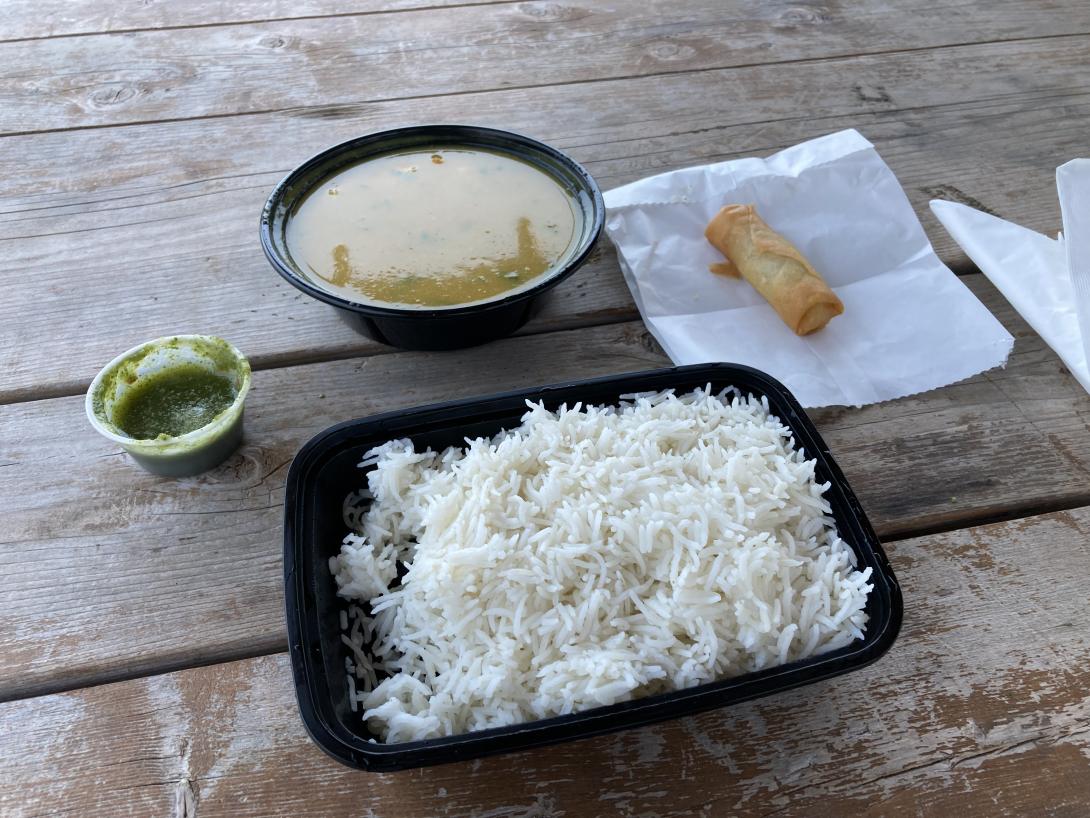
My order was ready for pickup when I arrived, and it neatly fit in my cycle carrier. I took advantage of my proximity to J. Frank MacAulay Park to scootch down Bills Lane and in the back door of the park, where I enjoyed my tasty lunch of spring roll, shrimp curry, basmati rice, and sparkling water under a gazebo beside the swale.
Lunch presented two mysteries: why The Dodo, and who was J. Frank MacAulay?
The first was easily answered in Wikipedia: the now-extinct dodo was native to Mauritius (its extinction seems to have been more due to humans introducing predators, and destroying habitat, than hunting the dodo itself).
The answer to the second question remains elusive: just who was J. Frank MacAulay (and why is there nothing in the park that bears his name to tell us)?
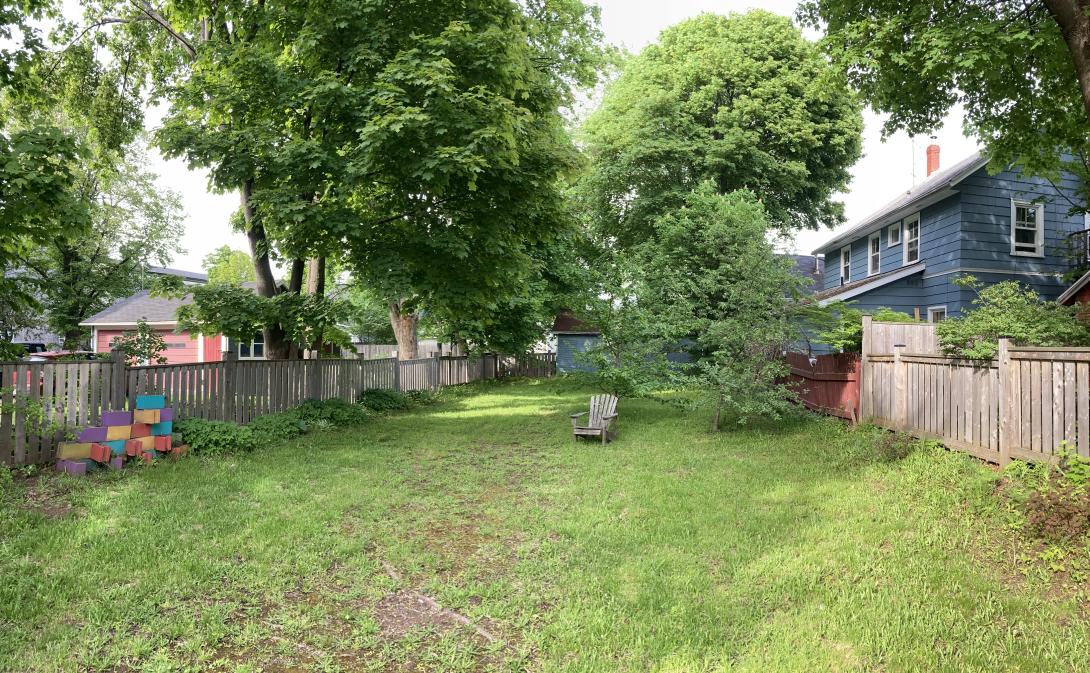
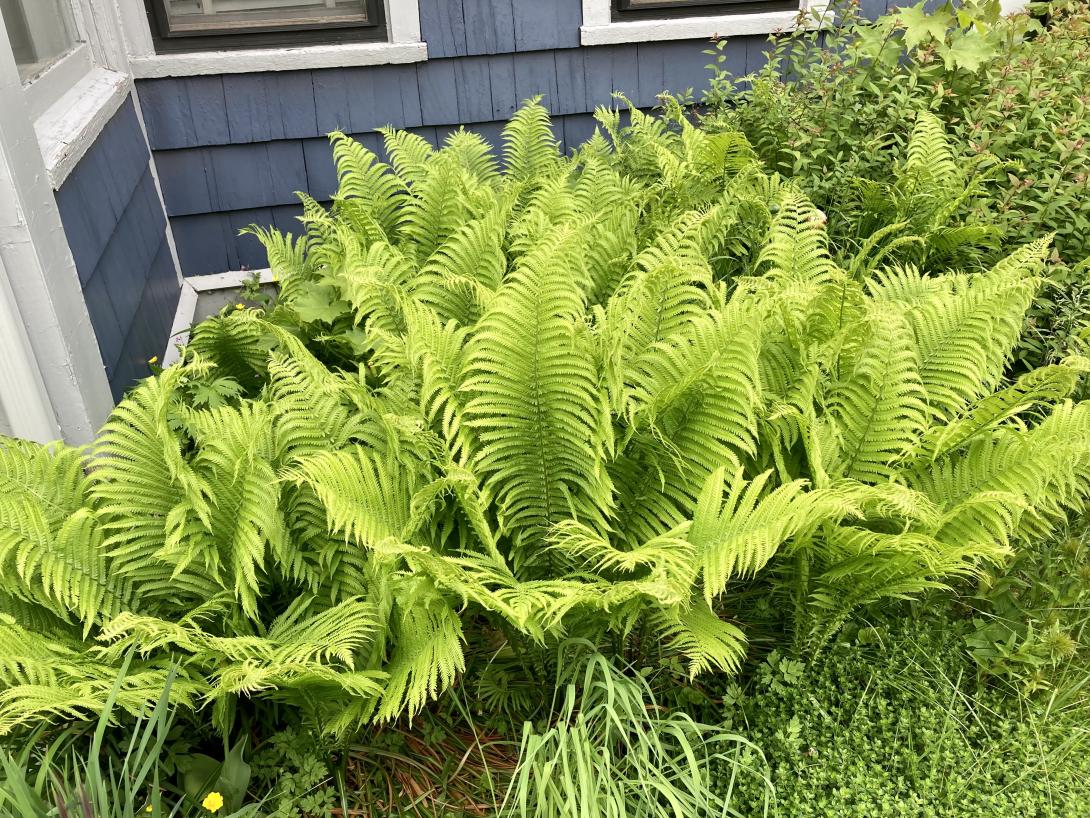
The large back garden is one of the great aspects of 100 Prince Street, and never is it more beautiful and verdant than in June.
Two years ago—can it really been have been so little and so long ago both?!—the back garden was filled with Crafting {:} a Life conversations and we were all feeling lucky to be alive.
I would have loved Barenaked Ladies’ new song New Disaster based solely on its creative rhyming of prestidigitation: they’re the only band on Earth that could get away with that with such aplomb.
But it’s also a catchy track, with lyrics on the needle of the zeitgeist, and a chorus that’s infected my ears:
Here comes the new disaster
Here comes the end of days
Next up the sweet hereafter
We’ll tell you all about it at the next commercial break

 ,
, 
 I am
I am  You can subscribe to an