
Just by chance, Catherine picked up a Tetra Pak of Iranian pomegranate juice from Kozy Korner Cafe on Prince Street (the former Eddie’s Lunch, Viva’s and Marinagrill space). I’ve avoided Kozy Korner: too many Ks, unappealing “Downy Fresh” smell from the laundromat, and too many memories of the greater days before. But man is the pomegranate good: add a little soda water and a lime and you could be, well, anywhere exotic you might wish to be.
The only publicly-aired complaint about OpenCorporations came last night on Compass in a comment from Tim Banks, who said, commenting on the availability of his home address:
I just don’t think under privacy laws that that should be something that’s out there. Unfortunately with this economy there tends to be a lot of people showing up at your door.
For the record, should you be one of the downtrodden who might seek financial assistance from Mr. Banks, there are a variety of ways of finding his home address; perhaps the simplest way is to look it up in the telephone book.
There are many completely valid reasons for debating the merits of OpenCorporations; being uncomfortable with the “release” of information that has always been available, both through the Corporate Register and otherwise, probably isn’t one of the better ones.
🗓️
Several reporters have asked me this week why I think Islanders have taken to the OpenCorporations project so enthusiastically — more than 250,000 searches by nearly 3,000 people in just 7 days. I gave a variety of answers, perhaps none really that accurate. Tonight my mind turned to history, and I recalled this passage from Canada’s Smallest Province, F.W.P. Bolger’s history of the Island. It’s from the chapter The Beginnings of Independence and concerns the divvying up of the Island to largely-absentee proprietors:
It is obvious, so far as the Board [of the Commissioners of Trade and Plantations] was concerned, the disposal of the land on St. John’s Island was regarded as nothing more than a cold and indifferent business venture. This approach was more than matched by a substantial portion of the original proprietors. Many of them disposed of their grants as rapidly as they could locate buyers; their interest in their property was as impersonal as the average modern stockholder’s in a major corporation. Within the next ten years, the ownership of fully one-fourth of the townships had changed hands. This rapidly changing proprietorship makes tracing the ownership of lots a veritable enigma.
And later in the same book:
Discontent and revulsion came from the urge for self-respect as well as the feeling of being exploited by alien landlords. All through North America the ownership of land was a mark of competence while tenantry was a badge of inferiority.
While it’s perhaps a bit of a stretch to attempt to draw a direct parallel, I think it’s true to say that Islanders are, by nature, wary of proprietors, and that the roots of this can be traced, in part, to the turmoil of the land question.
Yes Islanders are curious — nosy, even — and perhaps that’s what drives much of the interest in knowing more about our corporations and who controls them. But I’m sure that some of that curiousity is driven by a healthy suspicion about those who engage “cold and indifferent business ventures.” That’s a good kind of curiousity to have, and one that I was trying to foster.
🗓️
Today’s completely non-corporation-related question: when printing with a pen or pencil do you “cross” your Z or 7? Although I was never taught to do this, at some point in the murky past I started to unconsciously cross both, something I wasn’t really aware of until G. pointed it out this morning.
🗓️
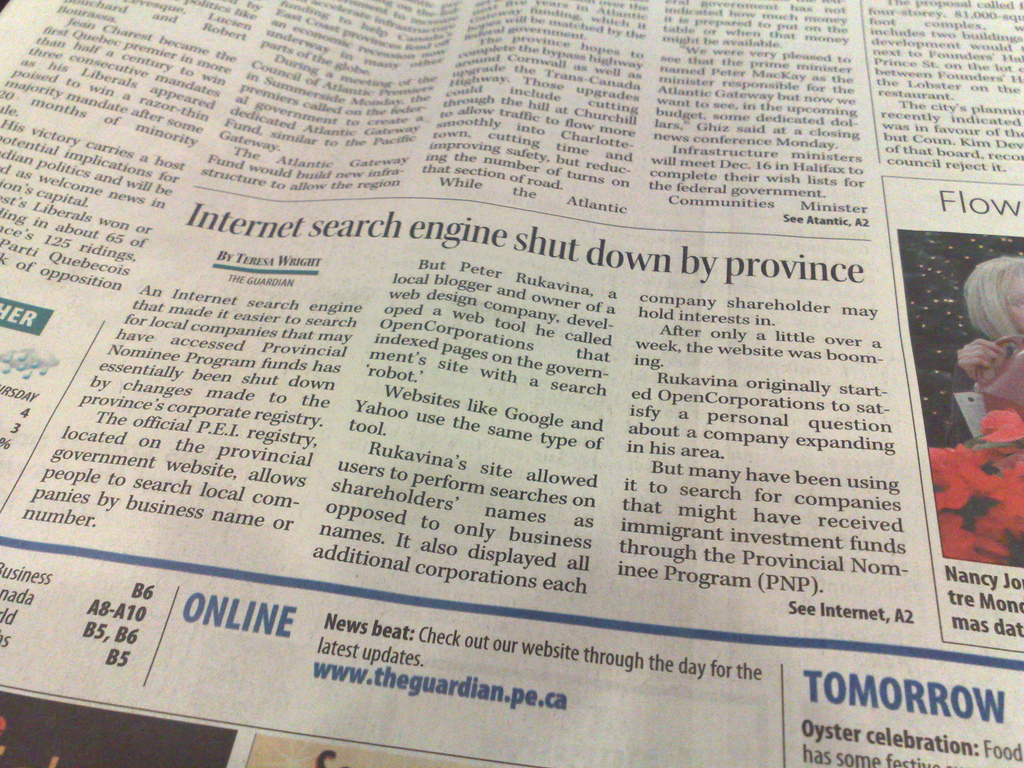
I’ve spent a good part of the day fielding calls from reporters about OpenCorporations.org and the changes that have led me to plan its demise — so far I’ve done phone interviews with The Guardian, the Globe and Mail and CBC Radio and I just finished taping a TV interview for Compass. Some points I’ve tried to make in those conversations:
- Search engines (like Google and Yahoo) index the pages on the Internet by having “robots” that visit all of the pages on the Internet: so Google can tell me where to go for pink ice cream cake because its robot visited this page and this page and this page — and 296,000 others — and found the words “pink ice cream cake” on them and added these words to its index.
- OpenCorporations.org has its own “search robot” that does exactly the same thing, albeit with the robot trained only on the Corporate Register pages.
- There was no robots.txt limitation on the Government of PEI webserver that prevented search engines from indexing the Corporate Register. There still isn’t. That’s where I took my “it’s okay if you index this content” cue.
- For years Google, and other search spiders, have been indexing PEI corporations data: here’s a Google search for ‘Homburg’ that shows this in action. So the changes not only shut off the tap for OpenCorporations, but also for the rest of the web.
- It’s completely within Government’s right to control the indexing of resources on their website and, even if it were possible, I wouldn’t try to circumvent the restrictions they’ve put in place, which clearly telegraph a “don’t index this” intent.
- Freedom of Information and Protection of Privacy legislation was not written to anticipate mashups like OpenCorporations: it’s an open question as to whether Government has a duty anticipate and act against potential remixing. I think the project was valuable if only for the focus it put on issues like this.
- I don’t think that Government acted with the aim of hiding anything, or preventing the lid from blowing off anything: I think they were forced to make an impromptu policy decision based on sudden focus on an unanticipated use of new technology; I happen to think they made the wrong policy decision, but I think their motives are pure.
If nothing else I’ve discovered through this experience that if you create a useful tool that’s especially useful for journalists, they will be especially interested if you have to shut it down. I happen to think that’s a good thing: and I’ve been generally impressed with the journalistic understanding of the subtleties of the story.
🗓️
A User’s Guide to Reykjavík Restaurants: The Vegetarian Edition from Iceland Express, the best airline-that-blogs I’ve encountered.
🗓️
The Province of PEI has modified its online Corporate Registry so that details of individual corporations are no longer exposed to search engines — there’s a new “are you human” check on the site, with the note:
Details of registrations in the Corporate Registry are available to the public. A security feature of this online service requires a key code authorization. To view details on any specific registration, please enter the key code below.
I will leave it to others to debate the merits of this move on the Province’s part, but the practical result of the change is that I’ll have to shutter the OpenCorporations.org service shortly, as without the ability to spider the Corporate Register the corporations information there, which is already almost three weeks out of date, would soon become unreasonably inaccurate.
I’ll leave OpenCorporations online until mid-week and then shut things down. I’ll continue to make the spider source code, and the raw data spidered on November 19, 2008 available for download.
Over the week that OpenCorporations has been live there have been over 150,000 searches from 2,100 unique visitors, the vast majority of them from Prince Edward Island. On average each visitor visited 46 pages, and spent 10 minutes on the site.
Of somewhat ironic interest, some of the most frequent users of OpenCorporations.org were within the Government of PEI network (3,927 searches), the Island Regulatory and Appeals Commission (2,016 searches) and Atlantic Canada Opportunities Agency (1,057 searches).
🗓️
Just leaving the Holiday Inn Boston at Beacon Hill to head back to Canada. The hotel was a 3-star get from Hotwire, and if this is typical of 3-star quality there, then I’d stick with 4-star or higher: room door opens only half the time, bathroom door hits the toilet on opening, stains on the chair, dowdy old furniture, lobby that feels like an Econolodge. The pillows are nice, but that’s about all.
A week ago I paid $30 more for a room at the InterContinental and that was a $30 well-spent.
I am now officially a hotel snob.

🗓️
I thought that Rob’s Boyd Conference was about the world-changing radical ideas of Jane, not John.
🗓️
About This Blog
 I am Peter Rukavina and this is my blog. I am a writer, letterpress printer, and a curious person.
To learn more about me, read my /now, look at my bio, listen to audio I’ve posted, read presentations and speeches I’ve written, see things I’ve favourited elsewhere, or get in touch (peter@rukavina.net is the quickest way).
I have been writing here since May 1999: you can explore the 25+ years of blog posts in the archive.
 You can subscribe to an RSS feed of posts, an RSS feed of comments, an RSS feed of favourites elsewhere, or a podcast RSS feed that just contains audio posts. You can also receive a daily digests of posts by email. I also publish an OPML blogroll.
Instagram • YouTube • Vimeo • ORCID • OpenStreetMap • Internet Archive • PEI.art • Drupal • Github.