
Massachusetts and Rhode Island are two jurisdictions that provide no-fee searching of incorporated companies by shareholder or director name. New Jersey has a slightly less convenient search-by-name service: you can associated names with corporations, but a complete record requires payment of a $5.00 fee.
You can include this content in an IFRAME to embed real-time energy monitoring of the Jean Canfield building in your own website, like this:
🗓️
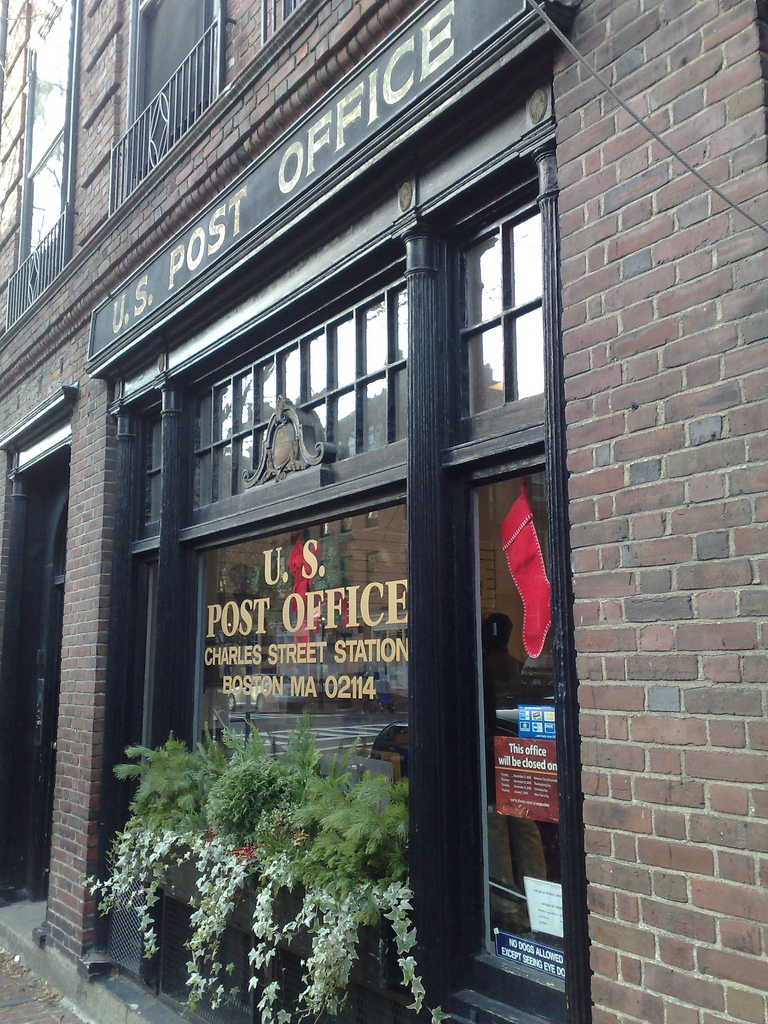
Say what you will about our American cousins, they know how to do post offices:
🗓️
I had a note about this in my original post about OpenCorporations, but it bears repeating, as I was just asked about it by a reporter from The Guardian: in addition to my daring exploits of late I was also, as it happens, the programmer who originally crafted the code for the Province’s Corporate Register, as part of a multi-year project developing www.gov.pe.ca that ended amicably five years ago.
I haven’t had access to the code that runs the register, or to the database that serves it, since 2003, however, and the “spidering” of the register that fed the OpenCorporations project was done simply by indexing public web pages. This is something that anyone could do (and, indeed, is something that other search engines did freely for many years until the register was modified last week).
Indeed I used a similar approach when I created spidering applications to index Charlottetown Building Permits and City Council Minutes in 2006.
🗓️
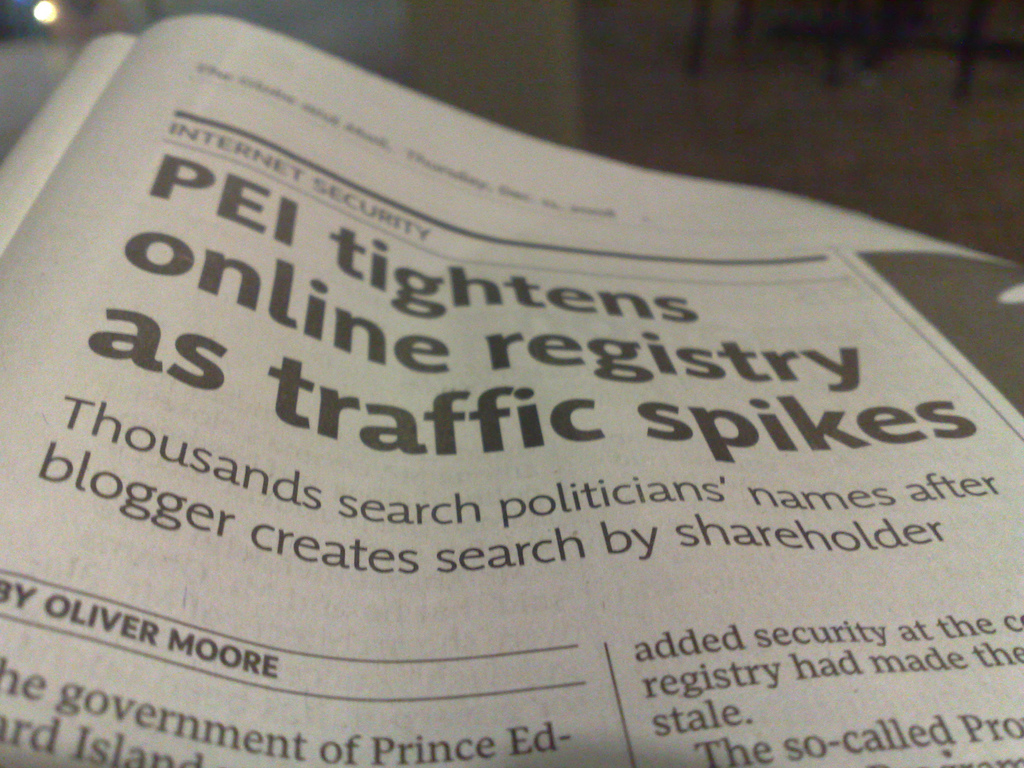
In the front section of today’s Globe and Mail is a report filed by Oliver Moore: PEI tightens registry access as traffic spikes: Thousands search politicians’ names after blogger creates search by shareholder:
🗓️
So on one hand you have the Province of PEI restricting access to information that can empower citizens to understand corporations better because it is, it says, this is “inappropriately using corporate data.”
On the other hand you have the Province of PEI defending its own sales of information that can empower corporations to better understand citizens:
Assistant provincial tax commissioner Jim Ramsay told CBC News Wednesday the Geolinc information is useful for doing business.
“It’s used by corporations, companies that have an interest in land, financial institutions, real estate [agents], law firms,” said Ramsay.
I’m just sayin’…
🗓️
In other Jean Canfield Building news, this boardroom booking website has an interesting manual of “Standard Operating Procedures” for the building. If you ever doubted the thoroughness of the federal government’s bureaucratic machine, you’ll be happy to know that, among other things, there are official policies on newspapers (“All newspapers, magazines and periodicals are to be delivered to each Department through the mailroom.”), plants (“No plants are allowed at the Jean Canfield Building.”), earthquakes (“Take immediate shelter and protect your face and head with your arms.”) and explosions (“Make an entry in the Post Logbook and submit an Incident Report to the Facility Manager.” — that’s only the last step, though).
Of additional interest is that the management of the building appears to have been outsourced to a company called SNC-Lavalin ProFac, a group that’s part of “the largest engineering and construction firm in Canada and one of the five largest in the world.”
Note to Jean Canfield Building operators: I think I may have accidentally booked the Port-La-Joye-Fort Amherst meeting room for 30 minutes on December 16 at 8:00 a.m. — feel free to remove my booking.
🗓️
This amazing tool provides real-time monitoring of the solar energy array on the Jean Canfield Building across the street from my office. As I write on this overcast Thursday it’s generating 1 kW of electricity.
🗓️
As I announced earlier in the week I’ve just switched off OpenCorporations.org. Rather than shutting off public access to the data entirely, however, I’ve created a new site: at ClosedCorporations.org you can access an archival (and “memorial”) version of the site, with the data frozen in time at November 19, 2008.
I’ve also written a history of the OpenCorporations project for posterity.
🗓️
About This Blog
 I am Peter Rukavina and this is my blog. I am a writer, letterpress printer, and a curious person.
To learn more about me, read my /now, look at my bio, listen to audio I’ve posted, read presentations and speeches I’ve written, see things I’ve favourited elsewhere, or get in touch (peter@rukavina.net is the quickest way).
I have been writing here since May 1999: you can explore the 25+ years of blog posts in the archive.
 You can subscribe to an RSS feed of posts, an RSS feed of comments, an RSS feed of favourites elsewhere, or a podcast RSS feed that just contains audio posts. You can also receive a daily digests of posts by email. I also publish an OPML blogroll.
Instagram • YouTube • Vimeo • ORCID • OpenStreetMap • Internet Archive • PEI.art • Drupal • Github.