Back at the dawn of the century, when the web was a new frontier and we were making it all up as we went along, a lot of what was written about in the nascent weblogs of the day (did we even call them that?) was blogging itself (we might have just called it “writing”). These days we tend to treat blogs as though they’ve always been here: there’s nothing novel about them, and the basics of the form — posts sorted in reverse chronological order written in a personal tone — has largely remained frozen for the last 10 years.

That’s a good thing — how long would your interest be kept up by a prime time TV lineup that consisted of shows about the prime time TV lineup? — but it’s also a bad thing, as it means that if you want to write on the web you basically do it in a blog-like format or you don’t do it at all.

Meanwhile, I just keep blogging along: it’s become part of the DNA of my everyday life, and it would be hard to stop doing it, as it’s an integral part of how I process my thoughts and ideas, and, increasingly, it’s how I remind myself of where I’ve been and where I’m going.

One of the things that has changed in this space is the degree of what they call “user engagement” in the business. As a reader, your opportunity to “participate in the dialog,” such as it is, has been through your ability to comment on each post (when we all thought that eventually everybody would have a blog we had visions of an interconnected network of cross-linked blogs; that idea has largely died out and comments are what’s left over). Here’s a graph of the number of comments per month here on ruk.ca from July 2003 to October 2001. The peak was that first month, with 532 comments; the valley was March, 2010 with 21 comments. And the trend is, unmistakenably, down.
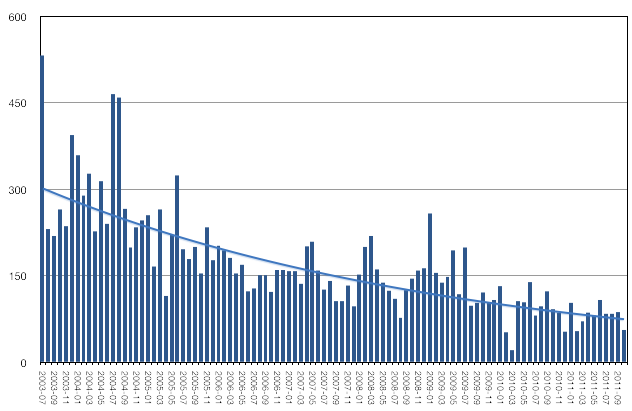
Graph showing comments, by month, from July 2003 to November 2011 on the ruk.ca website; graph shows comments decreasing every month, from a high of 532 in July 2003 to a low of 56 in November 2011

You’d think that this trend might simply reflect a decrease in the number of visitors to the weblog, but that has remained scarily consistent over the this period; here’s a Google Analytics graph of visitors by month from 2007 to present:

The number of visitors per month hovers just around 30,000 and the number of pageviews per month around 50,000.

So you’re all visiting and reading just as much as you ever did, you just have less to say. There are a whole host of reasons I imagine that this might be true:

  • I’m writing less interesting, or at least less-comment-worth (less inflamatory, less gripping) posts; it’s easy to chime in when I get coffee thrown at me; perhaps I’m the only person on earth with as intense an interest in Charlottetown building permits?
  • It’s become harder to comment: various anti-spam mechanisms that are in place now to combat the ceaseless torrent of comment-spammers may have the unintended side-effect of making it harder for real people with real things to say.
  • The Guardian and the CBC ruined commenting: it’s generally acknowledged that the comments section of both news outlets’ websites are fetid cesspools of ad hominem attack and anonymous name-calling; perhaps the very act of web-commenting has suffered as a result.
  • Facebook et al is where all the conversations are happening. It’s no secret that I think of Facebook, Google+ and all the other walled parallel Internets as a wrong turn on the information superhighway, but there’s no arguing that they’ve made “user engagement” painless and integrated into a whole host of other everyday activities (all with the goal to making us more highly-valued advertising targets, but that’s another story). Who wants to hang out on a creaky old blog in this new world?

At the risk of encouraging comments-about-commenting, I’d be interested to know more about what your actual reasons for reading-but-not-writing here are.
🗓️
Weblogs  •  Comments

I have mused in frustration several times over recent years, usually around this time of year, about my eyeglasses fogging up when I come in from the cold. This is usually met by either stony silence or suggestions that I walk into buildings backwards, which I’ve always taken as a practical joke (and which, in my experience, doesn’t work).

That is, until last week when the helpful Sara Roach Lewis replied to my frustration-tweet with:

@ruk you can get glasses cleaner that has an anti-fog ingredient. Works like a charm. Can get it at island optical.

And so, despite being a loyal Boyles Optical customer, I dropped in at Island Optical on my way to the office this morning.

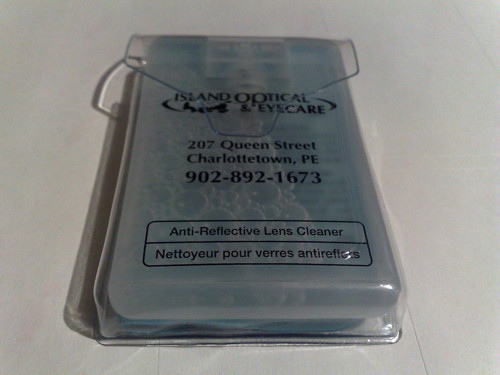
“Word is that you folks sell some sort of magic defogulant eyeglass cleaner here,” I exclaimed (apparently I talk like Garrison Keillor when dealing with local merchants). The friendly clerk climbed down from her ladder, reached behind the counter, and handed me this:

Island Optical Cleaner

“I’ll take it!”, I said. “How much?”

“It’s free!”, she replied.

I’m applying it to my eyeglasses now and I’ll report back — it’s a good day for this, cold and damp and blustery as it is — and let you know whether it is, indeed, a magic defogulant.

🗓️

Klara Harden walked across Iceland and returned to make a short film about her trek. It’s a nicely made film, and considerably more compelling than your average “towering mountains and surging streams” Iceland travel video. For a film largely without words, it’s gripping, and watching it through makes me want to do something terrifying.

🗓️
Walking  •  Video  •  Travel  •  Iceland

A few weeks ago the Supreme Court of Prince Edward Island announced that it would be holding courses for the public on court-related matters. Registration was to be limited to 50 people, and would begin today. I noted the date in my calendar and made a point to call early to ensure I’d get a seat, all the while having a sneaking suspicion that there would be little interest and the courses might cancelled.

I was wrong.

I was late calling today — the wind and the rain and a nasty cold got the better of me — and I didn’t get around to making the call until noon.

Too late, as it turns out: the courses are fully subscribed, and there’s a waiting list — also almost at its 50-person limit — for a repeat round in January.

While I’m frustrated that I won’t be able to attend in November, it’s extremely heartening to see Islanders taking such an interest in the courts; kudos to Chief Justice David Jenkins and his colleagues for having the imagination to set this up and the belief that there would be interest.

You can call Sheila Gallant at 368-6024 if you want your name on the waiting list for the new year.

🗓️

Following from yesterday’s resusitation of the Charlottetown Building Permits RSS feed, I decided that it was finally time to get around to seeing if there was enough data locked inside the City’s PDF files to create a map of building permit approvals. It turned out to be not that difficult to do using some open source wrangling. Here’s what I did.

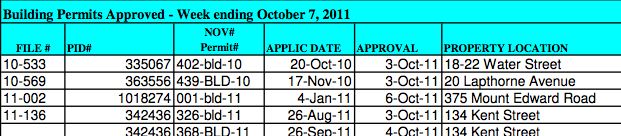
The goal was to take the 219 PDF files I was able to scrape from the City’s Building Permit Approval page that each look like this:

and to pull enough information out about each approval to be able to geocode it. I did this using the excellent pdftotext utility, part of the open source Xpdf package. Doing this:

pdftotext -raw Weekly_approvals_webpage_21_Oct_2011.pdf \
  Weekly_approvals_webpage_21_Oct_2011.txt

produces a plain ASCII text file that looks like this:

10-533 335067 402-bld-10 20-Oct-10 3-Oct-11 18-22 Water Street...
10-569 363556 439-BLD-10 17-Nov-10 3-Oct-11 20 Lapthorne Avenue...
11-002 1018274 001-bld-11 4-Jan-11 6-Oct-11 375 Mount Edward Road...
11-136 342436 326-bld-11 26-Aug-11 3-Oct-11 134 Kent Street...

From those files, because the Provincial Property Identification Number — the PID — is always a 6 or 7 digit number, and because such numbers rarely, if ever, appear elsewhere in the files, I was able to pull out the PID for every approval using some PHP:

preg_match('/\d{6,7}/',$line,$matches)

From there I looked up each PID in the freely-available Provincial Civic Address data, leaving me with a CSV file like this:

-63.12688,46.23066,22 WATER ST,"10-533 335067 402-bld-10 20-Oct-10...
-63.12606,46.24454,20 LAPTHORN AV,"10-569 363556 439-BLD-10 17-Nov-10...
-63.14558,46.27834,375 MOUNT EDWARD RD,"11-002 1018274 001-bld-11 4-Jan-11...
-63.12808,46.23572,134 KENT ST,"11-136 342436 326-bld-11 26-Aug-11 3-Oct-11...

This CSV contains geocoded record of the 1,985 building permits I was able to scrape out the PDF files. Finally I used the open source KMLCSV Converter app to convert the CSV file into a mappable KML file and from there it was simply a matter of doing any of:

I continue to hope that the City of Charlottetown will eventually release building permit data in an open format so that all the scripery-scrapery required to do this can be eliminated and we can all concentrate on doing interesting things with the data rather than on getting the data in the first place.

🗓️

Many awesome blog posts have been lost before they were even published here because Firefox, by default, binds Command+Left Arrow to Back. Everywhere else on my Mac this key combination binds to “go to the beginning of the current line.” And I do that a lot.

What to do?

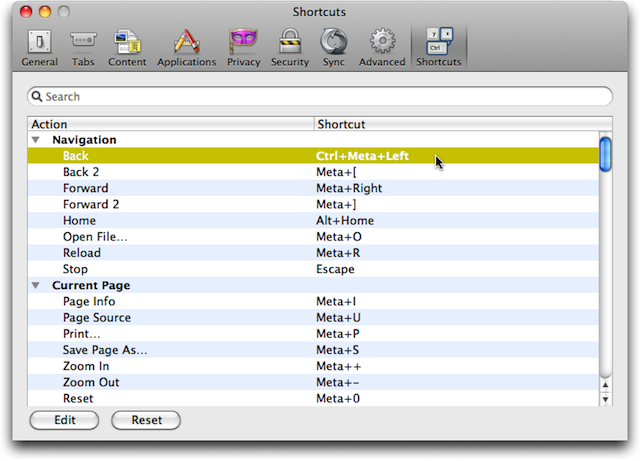
Fortunately, there’s a Firefox Add-on called Customizable Shortcuts that allows Firefox’s keyboard shortcuts to be changed, removing the dangerous implications of a casual Command+Left Arrow. Just install it and change the key combination that’s bound to Navigation | Back to something else:

🗓️
Mac OS X  •  Firefox

Five years ago I hacked together a little system to scrape data about City of Charlottetown Building Permit Approvals from the City’s website. But when the City updated its website, the system broke and I never got around to updating it. Now I have.

The RSS feed is not actually an index of approvals themselves – we’re all waiting on the City’s long-awaited system to do this – it’s simply an index that gets updated when the City releases a new PDF file. But it’s something.

🗓️
RSS  •  Open Data  •  Charlottetown  •  Building Permits

I was speaking with someone last week who expressed surprise that Google Translate had done a less-than-optimal job at translating a passage of text from English to French.

I’ve spent more than my fair share of time using Google Translate over the past two weeks as my Ukrainian-speaking Cousin Sergey is here and while he’s making quick work of learning English, we fall back on machine translation for more complicated conversations.

While Google does have a useful explanation of Google Translate’s limitations – “This process of seeking patterns in large amounts of text is called ‘statistical machine translation’. Since the translations are generated by machines, not all translation will be perfect.” – this is likely an explanation that few people ever see, and so, with lack of any evidence to the contrary, I think the general assumption from the lay public is that when you type something into Google Translate in English, what you get back in Ukrainian or Persian or French is “right.”

But that’s just not true.

While these translations may be “right enough” to get a point across, especially for less ambiguous statements, you should never rely on Google Translate for translating important materials – things intended for print, legal documents, invitations to marry, etc. – as the opportunity for machine-induced error or ambiguity, to say nothing of the absence of local colour or subtlety, is high.

🗓️

Remember how I was looking for a space to house and operate my newly-acquired letterpress? Well, I’m still looking. It turns out that Charlottetown, at least very-broadly-defined “downtown” Charlottetown, has very, very little surplus “light industrial” space.

So far I’ve had the kind offer to two spaces, for free, that, alas, didn’t pan out because of difficulty of access; everything else I’ve looked at has been either too expensive or too much space (I can’t spend $1000/month to feed what amounts to a equipment-intensive hobby, and I only need a couple of hundred square feet).

So, I’m calling on all of you in the local readership to plumb your networks for me to see if you can help drum something up.

(All of this makes me wonder how much creative pursuit is being held back because of real estate issues; I used to scoff at artists when they talked about the need for space: now I know just how real a challenge it is!)

🗓️
Letterpress  •  Golding Jobber  •  Charlottetown  •  Real Estate

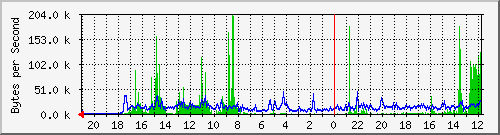
There was a 3-hour interruption in Eastlink Internet service this evening that affected service here to Reinvented HQ. So this site was offline, as was our email and telephone. Things seem to be returning to normal now, but if you were trying to reach me by email to tell me that you’d fallen into a well and needed my help, you should probably send your message again.

MRTG Graph showing death of Internet

🗓️

About This Blog

Photo of Peter RukavinaI am . I am a writer, letterpress printer, and a curious person.

To learn more about me, read my /now, look at my bio, listen to audio I’ve posted, read presentations and speeches I’ve written, see things I’ve favourited elsewhere, or get in touch (peter@rukavina.net is the quickest way).

I have been writing here since May 1999: you can explore the 25+ years of blog posts in the archive.

You can subscribe to an RSS feed of posts, an RSS feed of comments, an RSS feed of favourites elsewhere, or a podcast RSS feed that just contains audio posts. You can also receive a daily digests of posts by email. I also publish an OPML blogroll.

InstagramYouTubeVimeoORCIDOpenStreetMapInternet ArchivePEI.artDrupalGithub.