
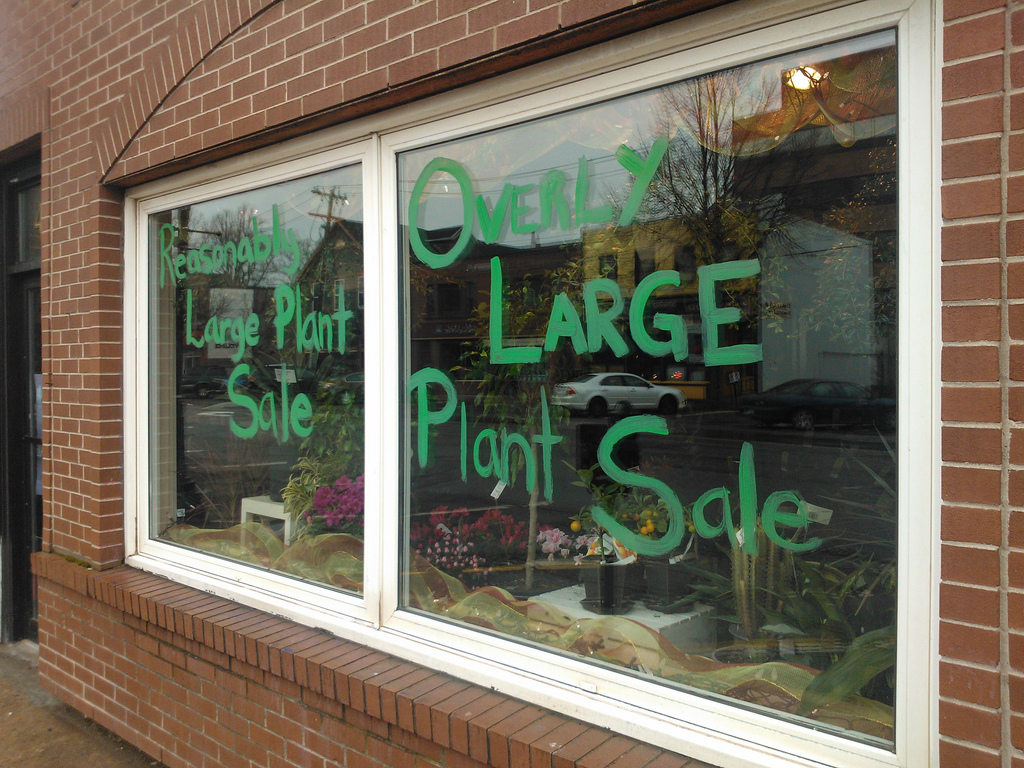
Last year I had the pleasure, along with Jenni Zelin, Rob Lantz and Laura MacPherson, of judging applications to the City of Charlottetown’s Community Microgrants program. After a long process of deliberation, we awarded grants to “Tulips for your Thoughts” (a project to plant tulips along Upper Prince Street; tulips that are about to spring into bloom any minute now), an after-school theatre program at the Murphy Centre, and a project to transform the section of Richmond Street from Pownal to Queen into a “sustainable streetscape.”
The streetscape project was supposed to happen last fall, but the weather intervened, and now it’s scheduled to happen from May 11 to 19, 2012.
I’d been thinking about this project over the winter — newly resident as we are overlooking Richmond Street — and about a month ago I had a sudden vision of a poster to promote the project — a black RICHMOND ST on top with a green RICHMOND ST below — and so in the time-honoured tradition of unauthorized advertising, I’ve been crafting this together for the past couple of weeks. Here’s the result:
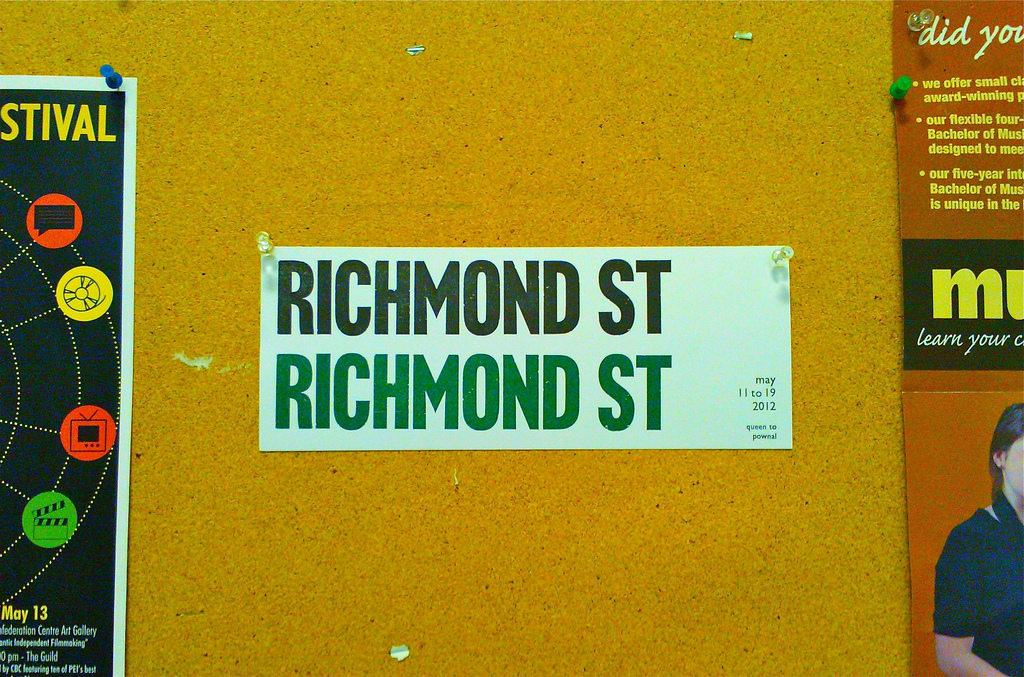
I dipped into the Holland College font of Akzidenz Grotesk for the large RICHMOND ST, and used M&H-cast Gill Sans in 18 pt. and 12 pt. for the date and location. Kwik Kopy in Charlottetown generously donated a Tim Hortons coffee cup of green ink. The paper is inexpensive white 110 lb. card stock from Staples.
Two recent arrivals to the print shop aided significantly in the printing of the posters, both ordered a few weeks ago from NA Graphics in Colorado.
First, a set of three Kort Adjustable Quad Guides. These aren’t cheap — about $10 each — but they are the Cadillac of gauge pins, and once I learned how to insert them into the tympan — there are handy instructions included that need to be followed carefully — I was left with a fantastic immovable paper-holding force:
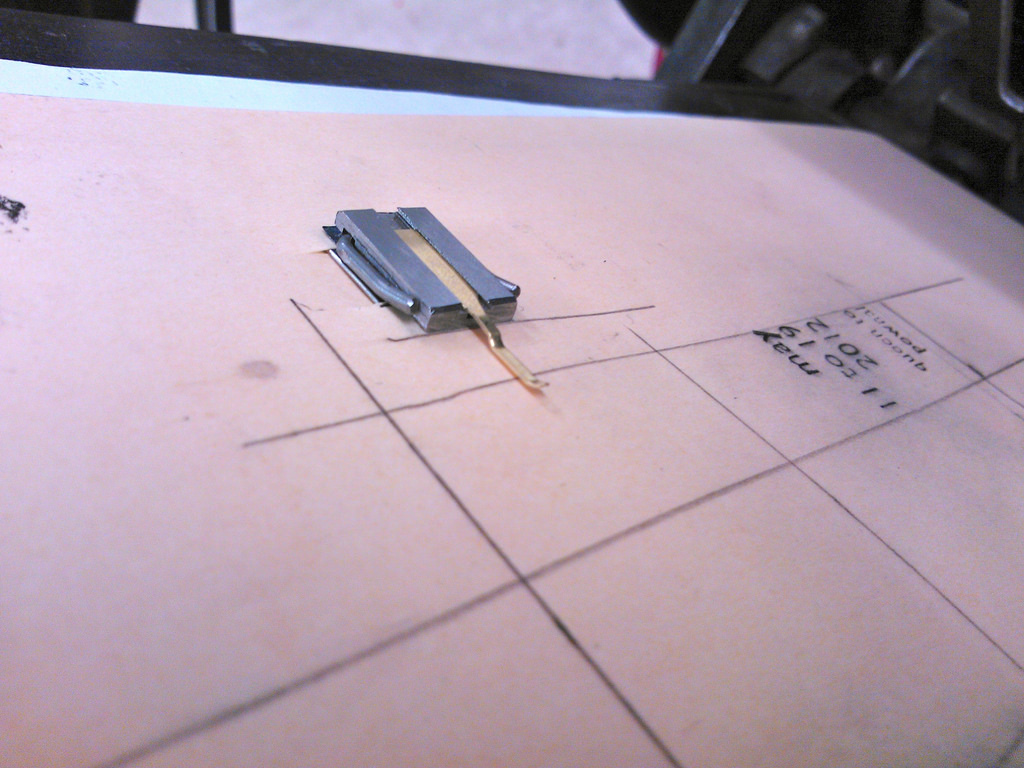
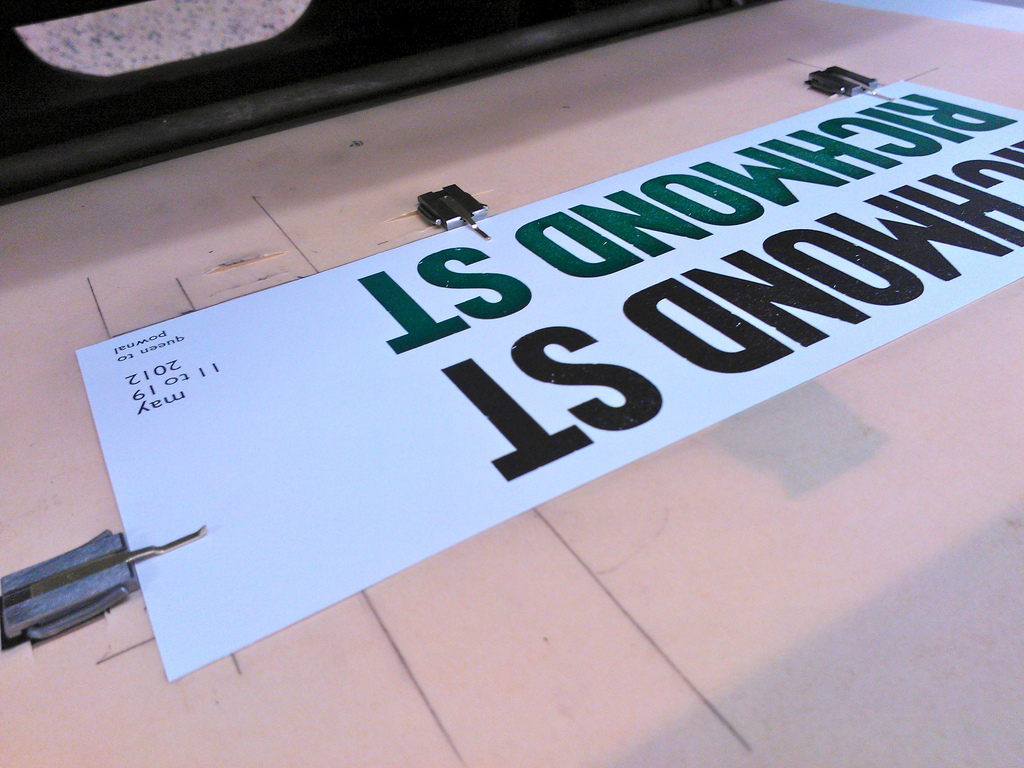
It’s hard to overstate what an aid to printing this is: in my early makeready experiments last week, using some aging and partially smashed spring tongue gauge pins to hold the paper in place, I lost as many copies of the poster to the inside of the press (falling off the pins from the sticky force of the inked type pulling off). With the new pins in place I didn’t lose a single one.
The other item from NA Graphics was a 100-sheet package of tympan — oiled paper that’s sits as the top layer of the “packing” that sits under the paper to be printed. It has the benefit of being stiff (which is great for inserted the gauge pins), sturdy (so it doesn’t easily rip) and its oily coating means that you can print a guide print on it, then wipe of the excess ink and not end up with ink on the underside of what you’re printing:
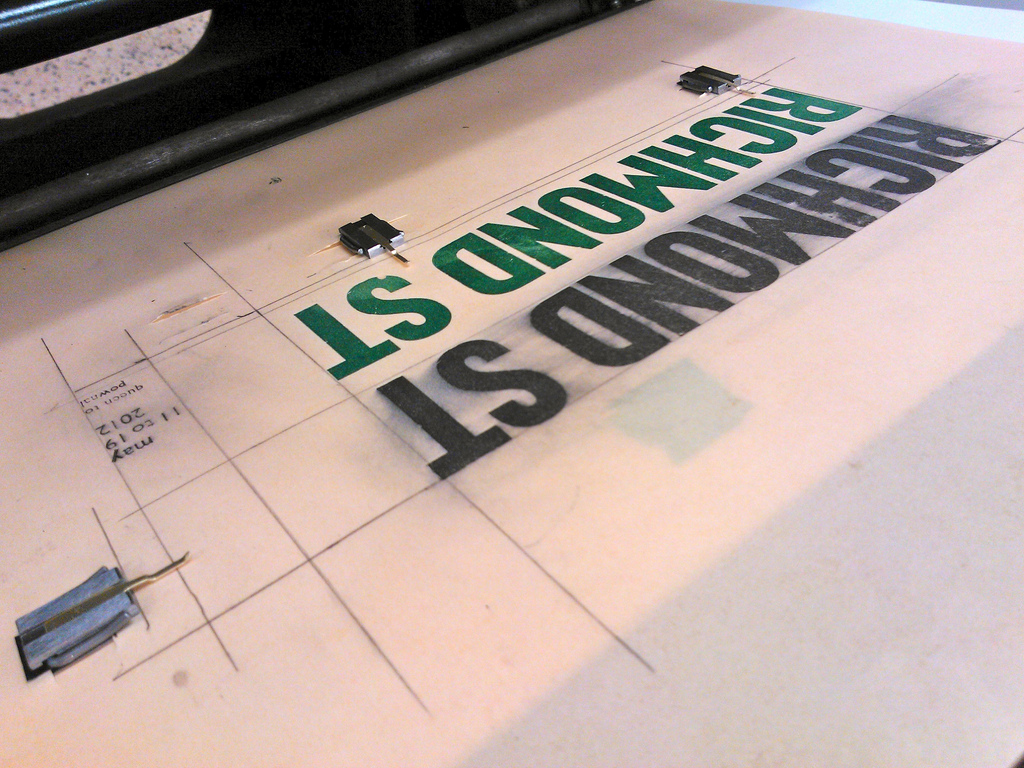
Other than an unfortunate tongue-clash incident (the brass tongue of one of the gauge pins was aligned so as to crash into the “S” in “ST”), quickly solved by some adjustments, the printing went well. I discovered that if I wear disposable latex gloves while printing it’s a lot easier to grip the paper, both from the table to the press and off the press to the table. Once I was set up and in a rhythm I was cranking out 10-15 impressions a minute.
I printed the black ink first, then the green (I’d laid out the type to facilitate simply popping out the date and location and sliding the “RICHMOND ST” down into position for the green).
Watch for the posters on a telephone pole or shop window near you. And do come out to participate in the event starting a week from tonight on May 11, 2012.
🗓️
I first read about Plazes, the pioneering geolocation site that consumed much of the late 2000s for me, from Joi Ito and I signed up for an account on September 26, 2004, eight years ago, and “plazed myself” from the old Reinvented office. I was user number 1185.
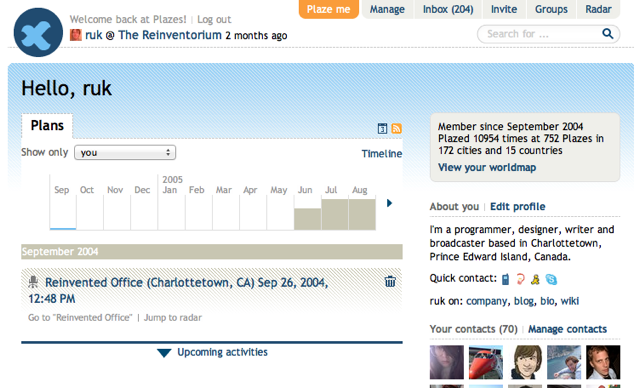
In the intervening years I visited 752 “plazes” in 172 cities in 15 countries and plazed myself another 10,954 times, which was slightly more than Plazes co-founder Stefan Kellner (9,948) and slighly less than Plazes co-founder Felix Petersen (11,822).
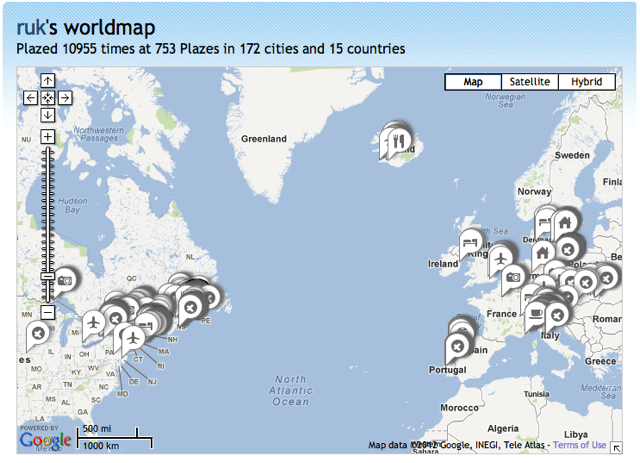
Although I signed up in the fall of 2004, Plazes didn’t really come into its own for me until the 2005 reboot conference in Copenhagen, where I had the seminal Plazes experience, meeting Ton Zijlstra and Martin Röll (who remain good friends to this day).
After several years of being a Plazes power-user, in November of 2006 I got hired on to develop an explanatory screencast about Plazes, which I just dug out of the archives and uploaded to YouTube and the Internet Archive for posterity (note the references to the hot social networks of the day — MySpace, Friendster and TagWorld).
In June of 2007, after I liveblogged a visit to Plazes HQ, I formally joined the Plazes team as a User Advocate, working remotely from Charlottetown, where I blogged, hacked (including working with Til on a skunkworks Plazes.net project), developed and organized PlazeCamp in January of 2008:
On the tail end of the reboot conference in 2008 it was announced that Nokia had acquired Plazes. I stayed on as a Nokia contractor for a few months, but eventually it was clear that Plazes was going to become something different — perhaps integrated into Nokia’s Ovi Maps product — and not a standalone product with a need for someone like me, and so I stepped back into power-user-hood.
In the intervening 4 years we of the Plazes faithful have been assuming that we’d simply wake up one day and find that Nokia had taken Plazes offline. This morning the email came, albeit with some advance warning:
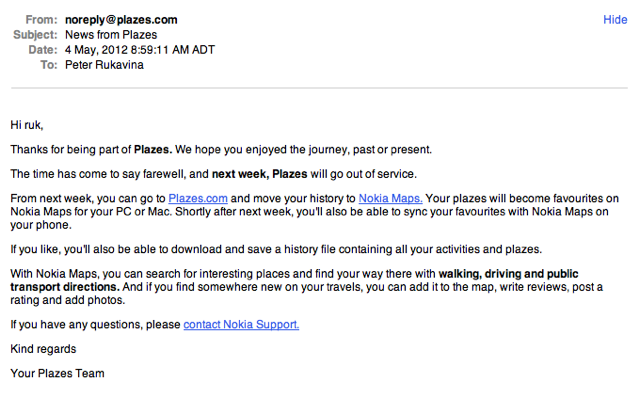
Logging in to Plazes one last time I joined members of the old team in one last plazing:
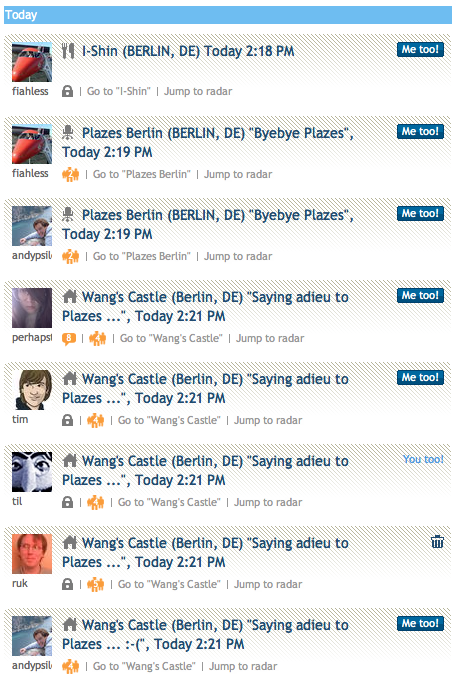
Good-bye Plazes; it was quite a ride.
🗓️
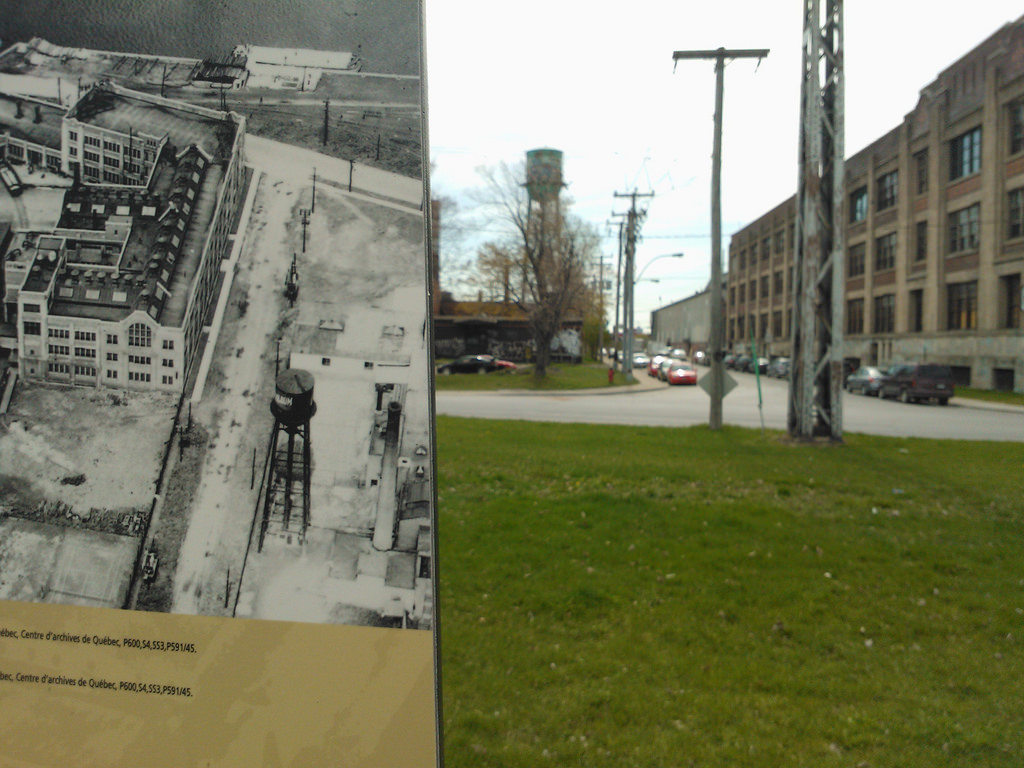
Across the road from La papeterie Saint-Armand is Lachine Canal National Historic Site which is filled with helpful signage about the industrial past of the area. Here’s a photo of one of the sign-boards with its subject, the water tower behind the former Congoleum plant — juxtaposed to the right. Saint-Armand’s shop is in the basement of the building just out of view in the modern photo on the left.
Parks Canada has a fascinating map of the historic North American north-east canal system; I learned, for example, that the Trent-Severn canal is a shortcut from Lake Ontario to Georgian Bay (something that, having lived 5 metres from the banks of the canal when I was in resident at Trent University, I should have known!).
🗓️
In a bid to learn more about the Confederation Centre of the Arts’ history, I sought out Frank MacKinnon’s book Honour the founders! Enjoy the arts! : Canada’s Confederation Memorial in Charlottetown at the public library. The book, which details the history of the Centre from conception to birth, is a fascinating primer on how to accomplish an impossible project. My favourite passage is this, relating the initial reaction of Premier Matheson to the idea:
The premier’s reaction was all that could be expected at the time: “It cannot be done but if it can we will not stand in your way. You are on your own. We trust it will not cost any money but we will provide the site. If it is a gift we will accept it.” “Will you maintain it?” I asked. “Of course,” was the easy answer when success was not expected. And the premier gave hostages to fortune when he agreed to keep politics out of the project and discourage the interference that so often has ruined local enterprise on the Island and elsewhere. On several occasions he warned that I alone would take the blame should anything go wrong.
For anyone seeking to carry out a project that seems so absurd as to be dismissed out of hand at the mere mention of it, MacKinnon’s book is a must-read, for he provides, in compelling detail, how he managed to assemble the political will required to build the Centre. We owe him a debt, both for the Centre itself, but also for his willingness to lift the curtain and show how it was done.
🗓️
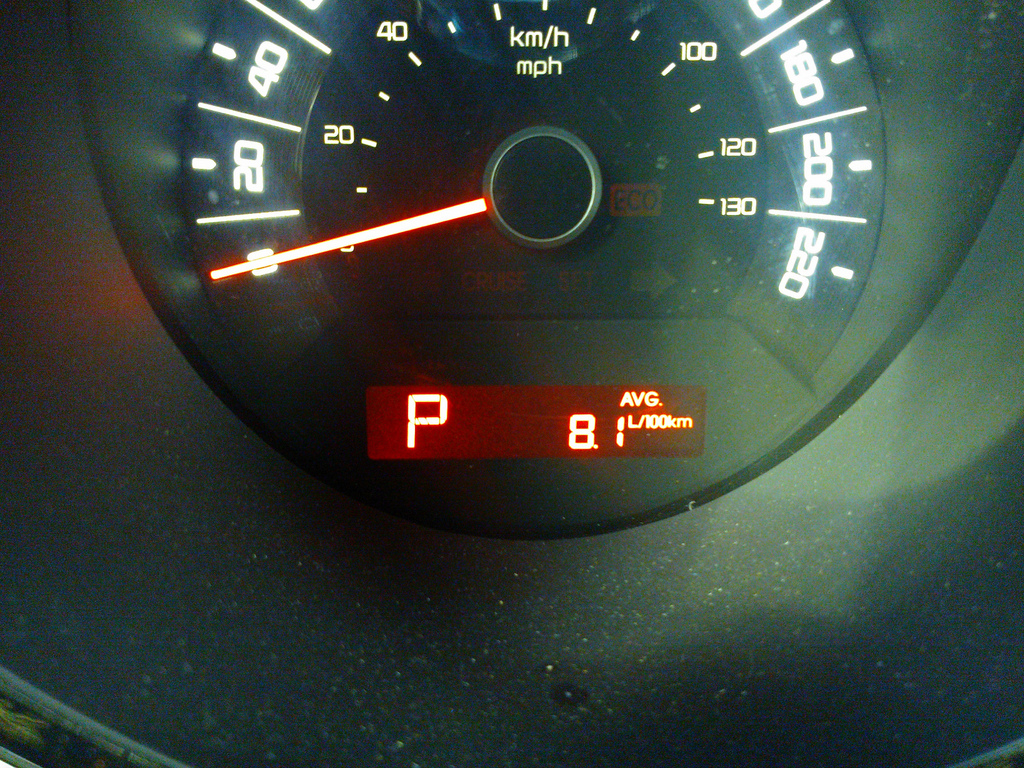
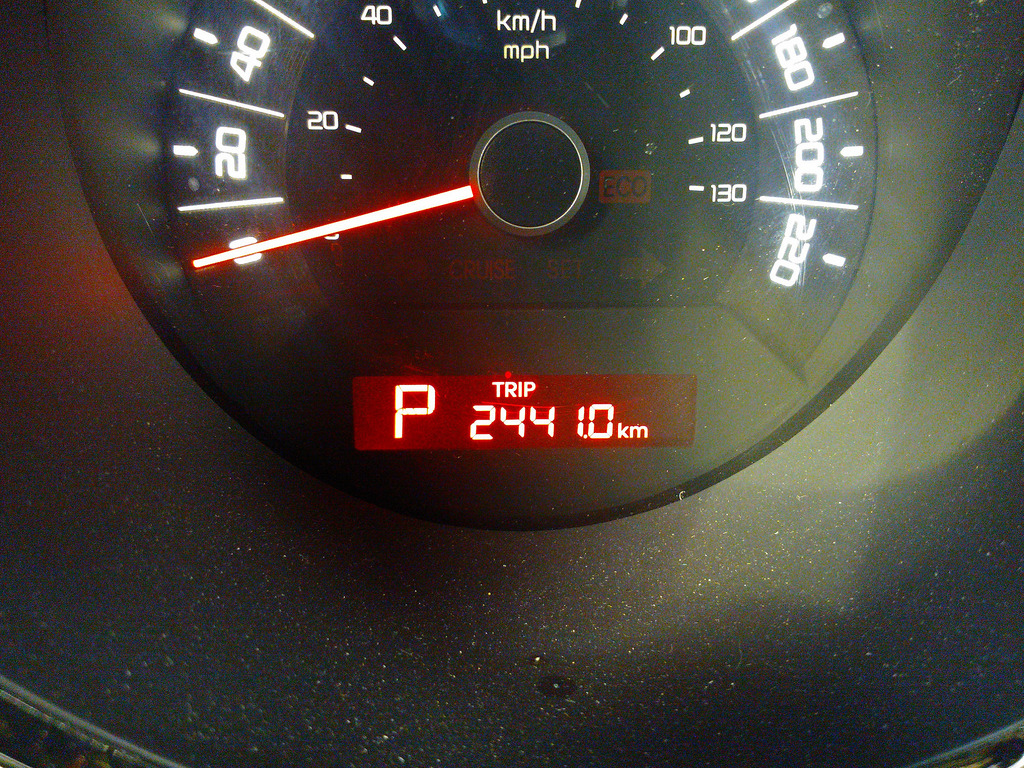
When we picked up our Kia Soul rental last Thursday it was full of gas. We drove from Charlottetown to Montreal, drove around Montreal a bit, and drove back. Total driven from door-to-door was 2,441 km and the Soul reported that it used 8.1 litres/100 km of gasoline when I return it; actual gasoline purchased:
- Hartford, NB - 37 litres at $1.337 for $50.68
- Deschambault, QC - 44 litres at $1.394 for $61.47
- Brossard, QC - 11 litres at $1.359 for $16.24
- Levis, Quebec - 35 litres at $1.394 for $49.51
- Hartford, NB - 39 litres at $1.337 for $52.16
- Charlottetown, PE - 38 litres at $1.281 for $49.38
So we used a total of 204 litres of gasoline which cost me $279.44. This comes out to a slightly higher 8.36 litres/100 km, or about 28 miles per gallon. Which is right around what the U.S. Department of Energy reports.
Our carbon footprint for this trip was either 0.38 tonnes or 0.40 tonnes or 0.46 tonnes depending on who’s doing the calculation. This is 60-70% of our emissions if we had flown (0.65 tonnes).
🗓️
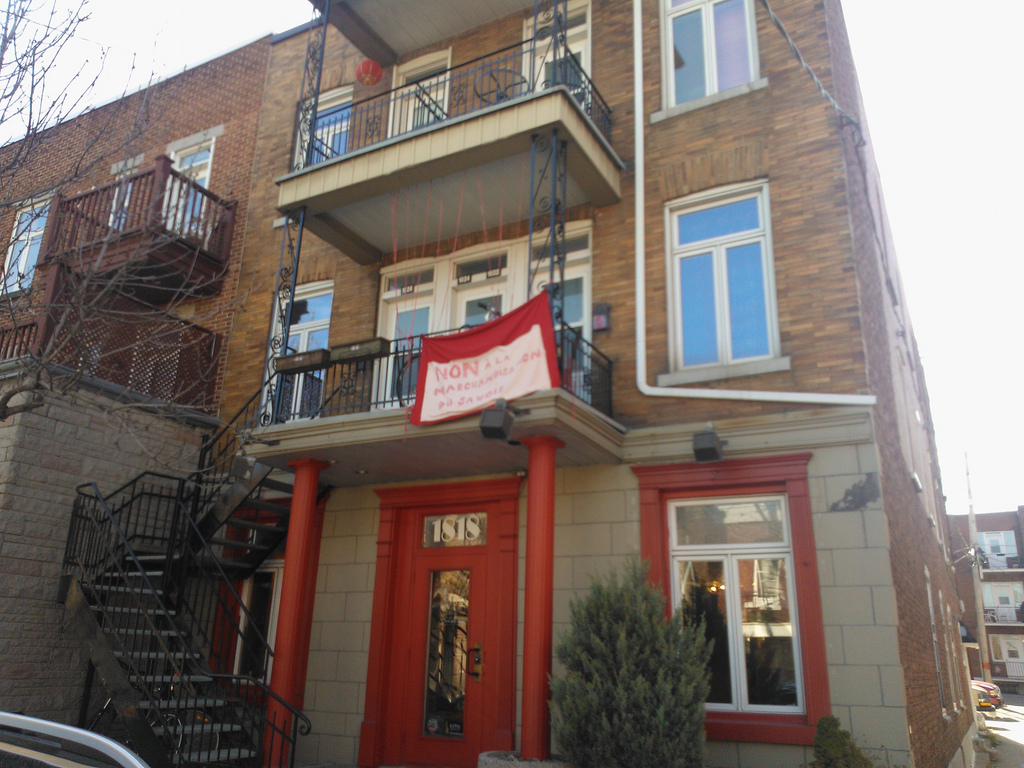
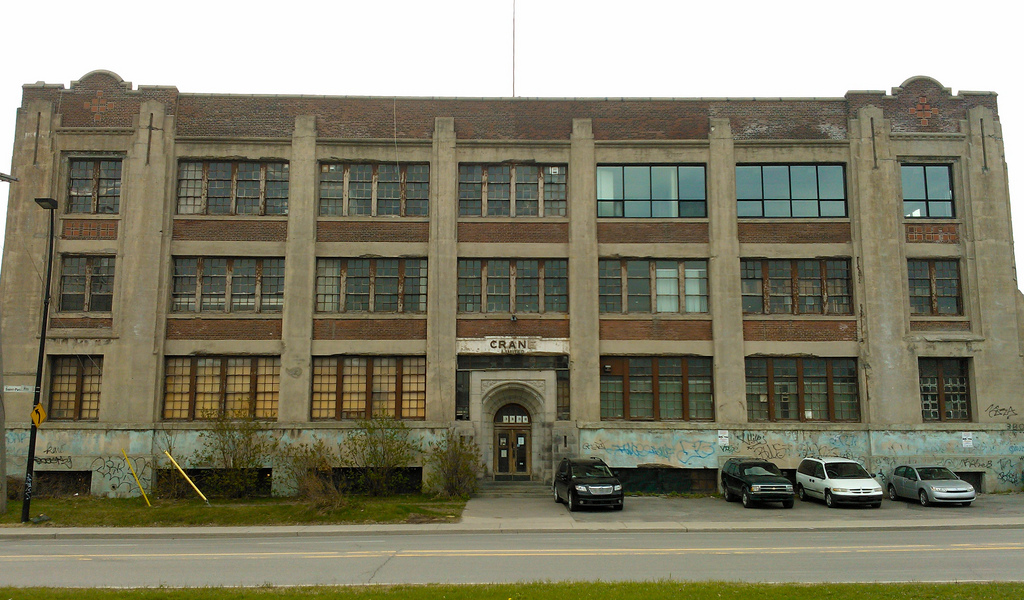
When you see beautiful industrial builings like this (the former Crane cast iron pipe and valve plant on the Lachine Canal in Montreal), and realize that we’re capable of making substantial, striking, well-built commercial infrastructure, it makes the snap-together-from-a-catalog tissue-paper-and-aluminum buildings that APM et al are building all over Charlottetown even more depressing to regard.
🗓️
It’s been quiet here for a week, mostly because of a last-minute trip that Oliver and I took up to Montreal. The trip had a variety of purposes beyond simple “father and son road trip” (which was a good purpose in its own right). Oliver had a new cousin to visit; Alain at Atelier Domino, a letterpress shop in the city, was selling off a collection of metal type; I needed paper from Saint-Armand and some accessories for the office from IKEA.
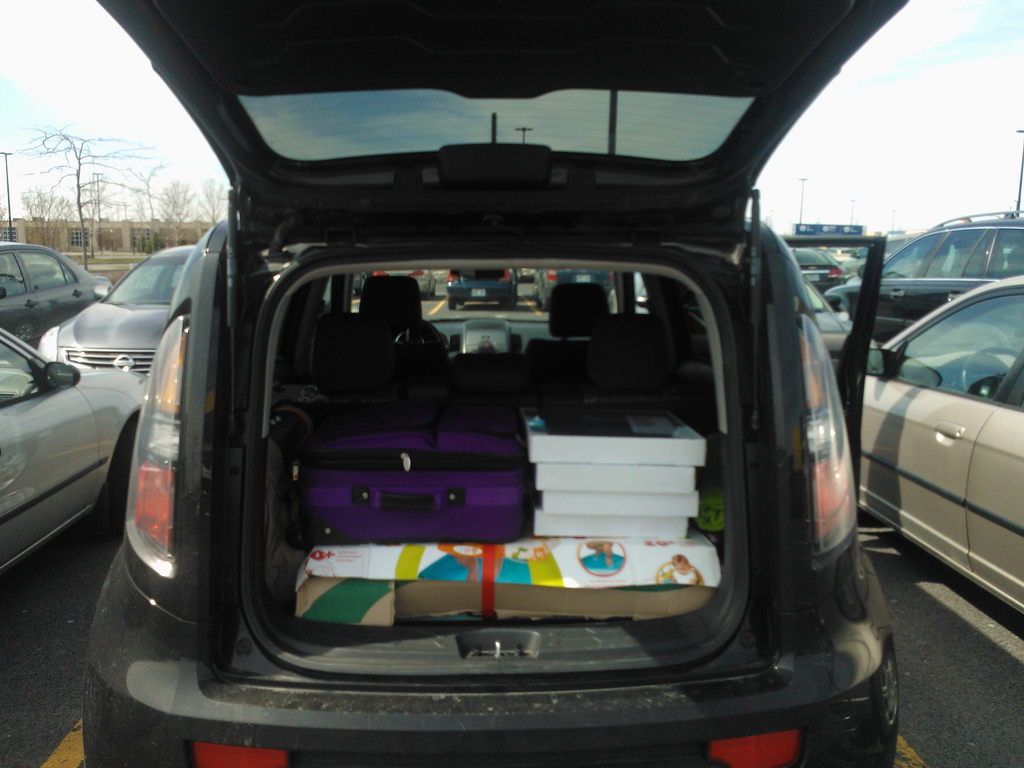
Because of the need to haul cargo, and a desire not to tax the aging VW Jetta, I rented a car for the weekend. As chance would have it we ended up with a Kia Soul, which was the perfect car for the job: not the most comfortable car in the world, but spacious and well-laid-out for holding lots of stuff (in addition to the type and the IKEA goods we made a stop at Adonis to fill up on exotic foods).
We rented an apartment from Airbnb — it was a block from Atelier Domino, close to my brother’s place, in a nice neighbourhood, and only cost us $84/night. We never met Carole, the owner, but she was quick with the email communication and the place worked out really well.
In additional to family visiting and shopping, otherwise we did the usual “father and son go to Montreal” things — visited some of the installations from the International Digital Arts Biennial, Vietnamese sandwiches in Chinatown, went to the movies (John Carter on the 3D Imax), went to the theatre (RH Thomson and Michelle Giroux in Same Time Next Year), make-your-own frozen yoghurt, fantastic Mexican food, and several very good coffees.
The driving was a killer (younger Pete would think nothing of driving almost anywhere in North America on a moment’s notice, but times have changed); we ended up doing just over 2400 km round-trip. We stayed in Riviere-du-Loup on the way up at Hotel Universel (clean, inexpensive, and seemingly teleported from 1974 design-wise) and in Edmundston on the way back at the Best Western (possibly the best roadside hotel I’ve ever stayed at — really).
I’ve spent the night unpacking the Soul, putting together IKEA accessories and getting the Charlottetown operation back in action; regular programming resumes tomorrow.
🗓️
Here’s an undated postcard from the PEI Museum and Heritage collection showing the Confederation Centre of the Arts:
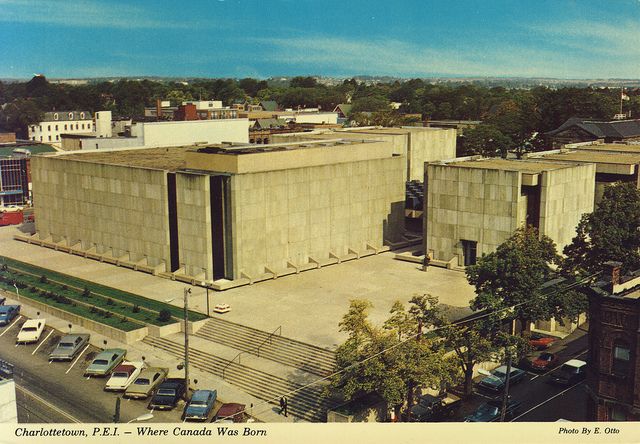
The Centre is in the Brutalist style that was typical of institutional buildings in the 1960s, a style described as valuing “truth to materials”:
This “truth to materials” approach was anti-aesthetic, but, the Smithsons believed, more honest and true to Modernism’s basic principles. Reynar Banham dubbed the school ‘the New Brutalism’, a movement which aimed, in his words, to “make the whole conception of the building plain and comprehensible. No mystery, no romanticism, no obscurities about function and circulation.”
The buildings that were torn down to make way for the Centre were decidedly non-Brutalist; here’s another postcard from the PEI Museum and Archives collection taken from the same perspective, but in an earlier day:
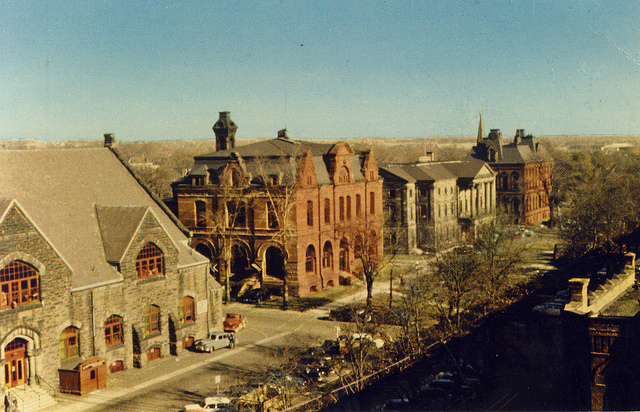
Full of mystery, romanticism, and with much left to the imagination about function and circulation. Tearing down those beautiful buildings and replacing them with something tantamount to a nuclear fallout shelter took courage; it may have been misplaced, deranged courage, but it was courageous nonetheless.
Almost everything that has been done since — as the building has, as Stewart Brand would say, “learned” — has been backing away from that courage, trying to mute and soften the Brutalism. Here’s a photo I took from my office this morning, from a slightly different angle, but capturing the same area of the Centre:
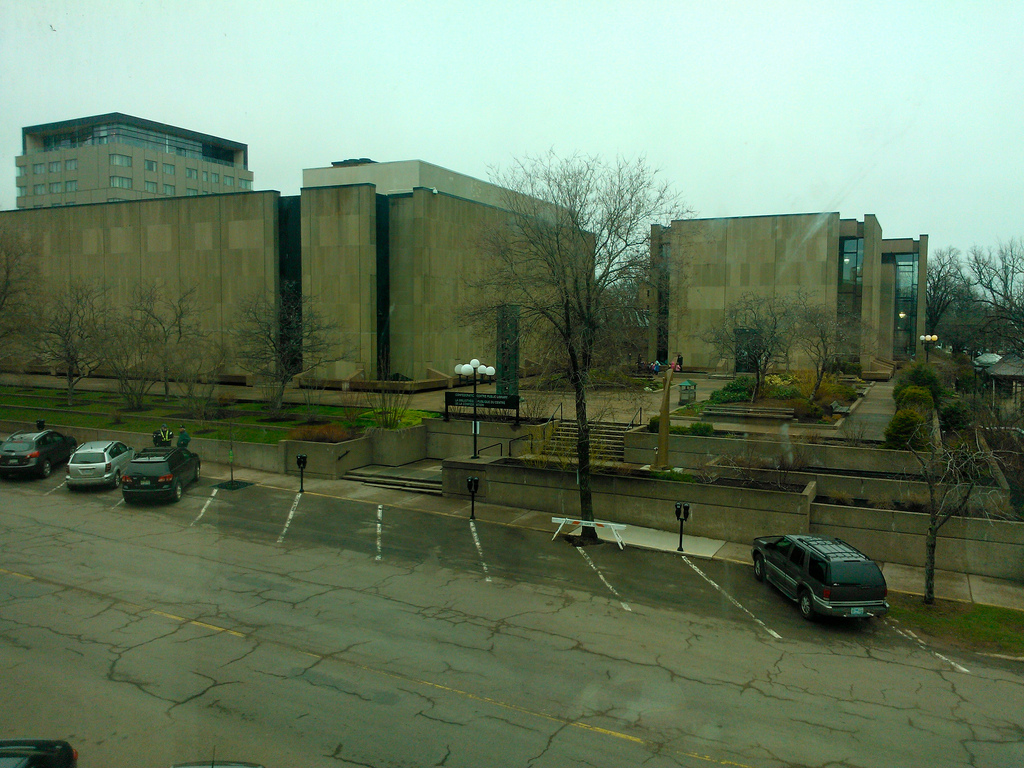
The trees could be expected to grow up. But everything else — the planters, the replacement of the broad staircase, the public art, the lamp-posts, the garbage cans — has had the effect of obscuring architectural intent of the building. It hasn’t exactly added “mystery” or “romance,” but the eye is deflected, and the truth is no longer in the materials.
🗓️
About This Blog
 I am Peter Rukavina and this is my blog. I am a writer, letterpress printer, and a curious person.
To learn more about me, read my /now, look at my bio, listen to audio I’ve posted, read presentations and speeches I’ve written, see things I’ve favourited elsewhere, or get in touch (peter@rukavina.net is the quickest way).
I have been writing here since May 1999: you can explore the 25+ years of blog posts in the archive.
 You can subscribe to an RSS feed of posts, an RSS feed of comments, an RSS feed of favourites elsewhere, or a podcast RSS feed that just contains audio posts. You can also receive a daily digests of posts by email. I also publish an OPML blogroll.
Instagram • YouTube • Vimeo • ORCID • OpenStreetMap • Internet Archive • PEI.art • Drupal • Github.