Back at the dawn of Receiver Coffee, when Sean was still working the coffee machine, he developed The Sean for me, a refreshing coffee-over-ice beverage.

Then Sean moved into upper management, and The Sean was only available on those rare occasions he emerged from the basement or the roastery.

Fortunately, young Tristan Gray stepped into the void and came up with The Tristan, his own take on the genre. Over the last year he’s refined it to the point of excellence.

Alas now, after today, The Tristan too will be retired into the Receiver Hall of Fame, as Tristan moves out from behind the counter and into a new job at DME.

Tristan, and The Tristan, will be missed: I came in this afternoon for one last; I’m happy to say that it reached its zenith, a perfect blend of ice, milk and coffee.

Addio mio ottimo barista.

🗓️

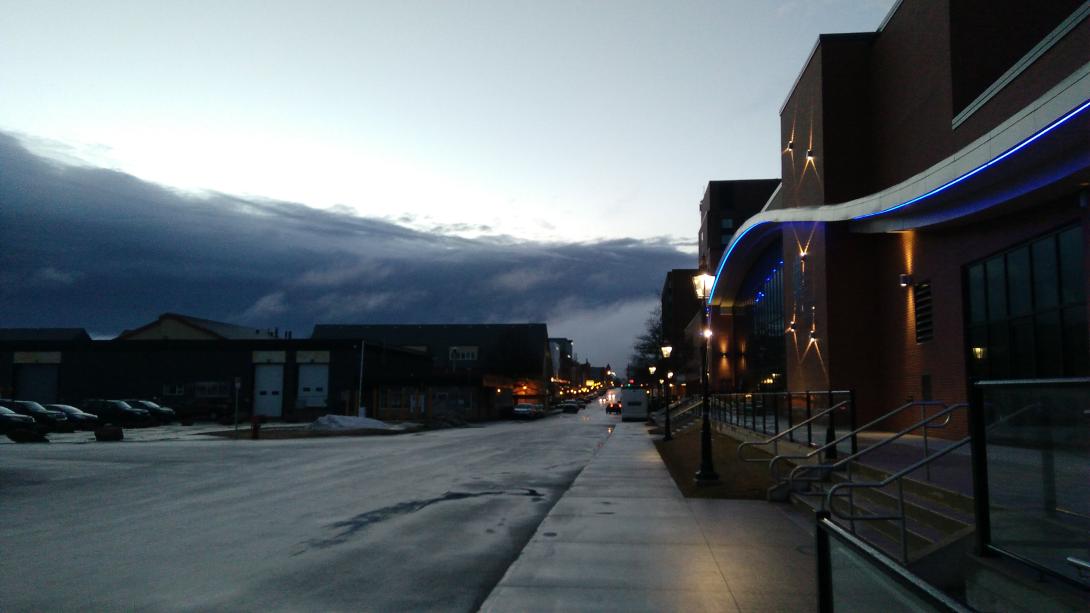
A bizarre twilight tonight in Charlottetown: warmer than it’s been in months, light rain, banks of fog rolling around, and a very, very high tide.

🗓️

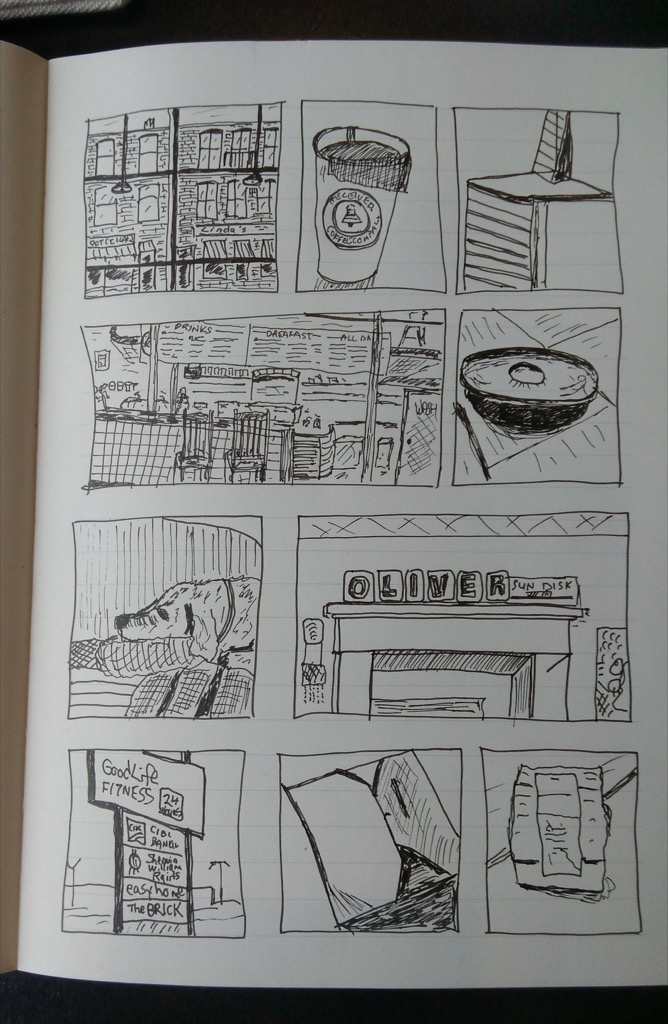
The latest exercise I’ve tackled in the How to Draw Without Talent online course I’m working through is my favourite so far. It’s called “Squares” and the remit is as follows:

With this exercise, we’re just going to go around our homes, drawing the equivalent of little Instagram snapshots of different corners. If you have a frame, just hold it up until you find some random composition and copy it down into a square on your page. It doesn’t matter if objects are cut off or hard to identify. In fact, the more abstracted the slice of life you depict, the easier it may prove to draw.

The most useful piece of advice for this exercise, well-communicated in the accompanying video, is “Each individual drawing may not shine by itself, but when it’s placed alongside another, equally imperfect pal, they all work together.” And it turns out to be true. I’ve filled up three pages so far of “little Instagram snapshots of different corners,” and they variously work and don’t work:

Sample page from my sketchbook.

I’m rather proud of the top-right drawing, a scene looking out the front windows of Mad Wok at the building across the street. The one in the top-left, though, is an attempt to draw my type case which failed completely because I got all the angles wrong (if there’s a challenge I face with drawing it’s an inability to translate angles from eye to paper; what I’ve learned is that it’s possible to learn this, but it’s hard learning to retrain old eyes!).

The number one of lesson of this lesson is that drawing is something you only get better at through practice and practice and practice. Which, of course, is true of most anything. So you will see me these days, more often than not, carefully sketching away in the coffee shop where I would have once been browsing my RSS feeds or updating Twitter.

🗓️

Oliver and I were watching Casey Neistat’s latest video this morning before school, and we wondered about the “fast motion” effect that he frequently uses.

So we decided to see if we could make a VLOG with fast motion in it. This is the result. Consider it a sort of video companion to yesterday’s play-by-play.

We shot the video on my Nextbit Robin Android phone. The driving parts were shot with the phone clamped into a suction-cup-window-mount. I did the editing here in the office on my MacBook Air using iMovie.

It’s rough and ready, but it encapsulates our morning school run in 4 minutes and 19 seconds.

And it does use “fast mo,” which was our goal.

Music is Japanese Spiderman Mix by DJ RX-78 from SoundCloud, Creative Commons Attribution 3.0 Unported license.

🗓️
Video  •  YouTube  •  Fast Motion  •  Colonel Gray High School

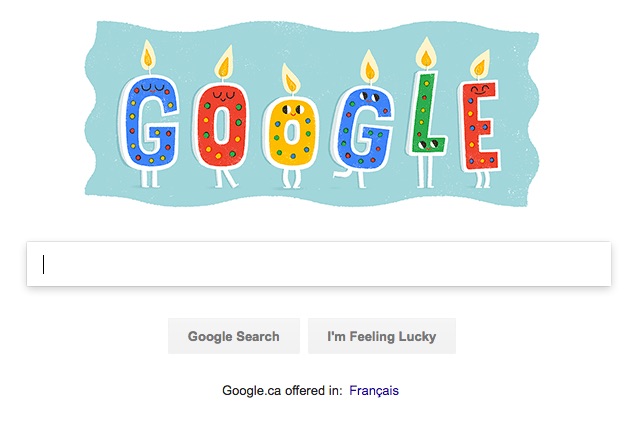
I thought it was super-generous of Google to celebrate my birthday, globally, by displaying a birthday Google Doodle on its home page:

Google.com with my birthday doogle

Then I logged out of Google and realized it was showing the doodle only to me.

Probably for the best.

🗓️
Google  •  Birthday

I started my 51st birthday at 7:00 a.m. when the alarm on my Android phone, sitting plugged in on the ottoman beside my bed, went off with its Palace of Fine Arts sound.

As is my habit, I leaned over and fired up the CBC Radio app, and listened to the national news and the first bit of Island Morning (generally I listen until Mitch finishes reading the morning news headlines).

I woke up Catherine, showered, shaved, brushed my teeth, and got dressed.

By about 8:00 a.m., I was in Oliver’s room, waking him up. Picked out his clothes (choice-making being one of his challenges), and then sat on the edge of his bed, did the New York Times “Daily Mini” crossword puzzle with him (1-across, clue was “overly sentimental” with answer “sappy”), and waited for him to power up for the day.

Oliver self-reliant for getting dressed, I was downstairs by 8:10, I made myself an espresso macchiato, received a happy birthday kiss from Catherine, and scooped out a bowl of porridge that she had prepared, and sat down to watch an episode of The Good Place.

By this time Oliver was downstairs at the dining room table eating his porridge, and going through his daily digital routine in front of his MacBook Air. He got briefly distressed because our friend Cindy didn’t react positively to his suggestion, on Facebook, that she send a letter to the editor of the Charlottetown Guardian in addition to the one she’d sent the Saskatoon Star-Phoenix. We had a brief chat about this.

Porridge, coffee and The Good Place complete, I returned to Oliver, and gently (but unhurriedly–hurry is not good for Oliver in the morning) encouraged him to eat some of his breakfast. Which he did. Eventually.

Meanwhile, Catherine had made Oliver’s school lunch, and fed and watered Ethan and let him out to pee.

We are, right now, a relatively well-oiled morning machine.

By 9:15 a.m. we were all dressed and ready to head to Colonel Gray High School.

I put Ethan into his seatbelt in the back seat of the car while Oliver put his backpack and lunch in the trunk.

We drove up Prince Street to Euston, down Euston to Queen, up Queen to Pond, along Pond to Spring Park, and up Spring Park to the staff parking lot of the school, arriving at 9:32 a.m., a little later than usual.

Upon arrival, I texted Oliver’s educational assistant “we are here,” to prompt him to come out and commence the daily walk that he and Oliver take at the start of each school day. Once they were on their way, I dropped Oliver’s things into the room inside the school that he uses as his work space and headed back to the car.

Leaving the school, I headed across town–down Kirkwood Drive and Allen Street–to the Parkdale Medical Centre for my annual physical, which was, by coincidence, scheduled for this morning.

I write “annual,” but, mostly because of preoccupations otherwise, I haven’t had a physical since the fall of 2014, so this was more like my “triennial physical.”

I was early, so I waited in Dr. Peter Hooley’s waiting room, idly surfing the net, for about 15 minutes, until I was ushered into the back and greeted by Cheryl, his perpetually cheerful and straightforward nurse. Cheryl ushered me into the urine-sampling room, and then, that completed, took my height (6 feet, 1 and 1/4 inches, unchanged) and weight (197 pounds, also unchanged). She then showed me into an exam room.

I waited in the exam room for about 20 minutes while Dr. Hooley worked through his backlog of patients; I occupied my time studying the models of the reproductive system on the shelf (once I realize that the fun-looking “hook and loop kids game” was, in fact, an IUD tutorial model) and reading a 2012 issue of Golf Canada that was lying on the exam table.

Dr. Hooley came in about 10:30 a.m., and we chatted for about 20 minutes. I ran through the details of a recent bout of vertigo that’s ongoing but not debilitating (he thinks it will likely pass on its own), we talked about the day-to-day stresses of care-giving, and he ran through my blood test results (everything was fine; my “good cholesterol” especially, which was up). I finished up by asking him about immunizations; turns out I have a “natural immunity” to measles because I was born before 1970, but that I can get a TDP shot from Public Health if I want to. And he finished up by asking Cheryl to walk me through the process of doing a home colon-cancer screening.

There’s nothing like updating my personal analytics on my birthday for a data-curious person like me; I think I should schedule my physical for my birthday every year.

I drove from Parkdale Medical Centre back to our house downtown, swapped my car for our house cleaners’ van in the driveway, left the car keys at home and walked to work.

As it was 11:35 by this time, I decided to pop into Receiver Coffee for lunch before going into the office; I had a Buddha Bowl and a decaf macchiato while reading a fascinating article online about satellites and their promise and limitations for “last mile” Internet.

I was in the office by noon (I know this because my exchange on arrival with Sarah, at the front desk, was:

Me: Good Morning

Sarah: Good Afternoon!

Me: It’s afternoon already?

Sarah: Well, it’s noon.

Me: Well, top of the noon to you.

Sarah: Top of the noon to you!

Not a profound way to start the day, but surely a demonstration that if I’ve learned anything in my almost-25-years on PEI it’s the beginnings of how to make small talk.

It is now 12:35 p.m. as I type this, recording my day to this point in detail because, looking back at birthdays past (50, 484745, 43424140, 3938, and 36), I find no hint of what my daily life was like at those points, and I anticipate that it might be useful, if only for sentimental reasons, to reflect back in 15 years on what a few hours on a Wednesday morning on the day I turned 51 went like.

So there you go.
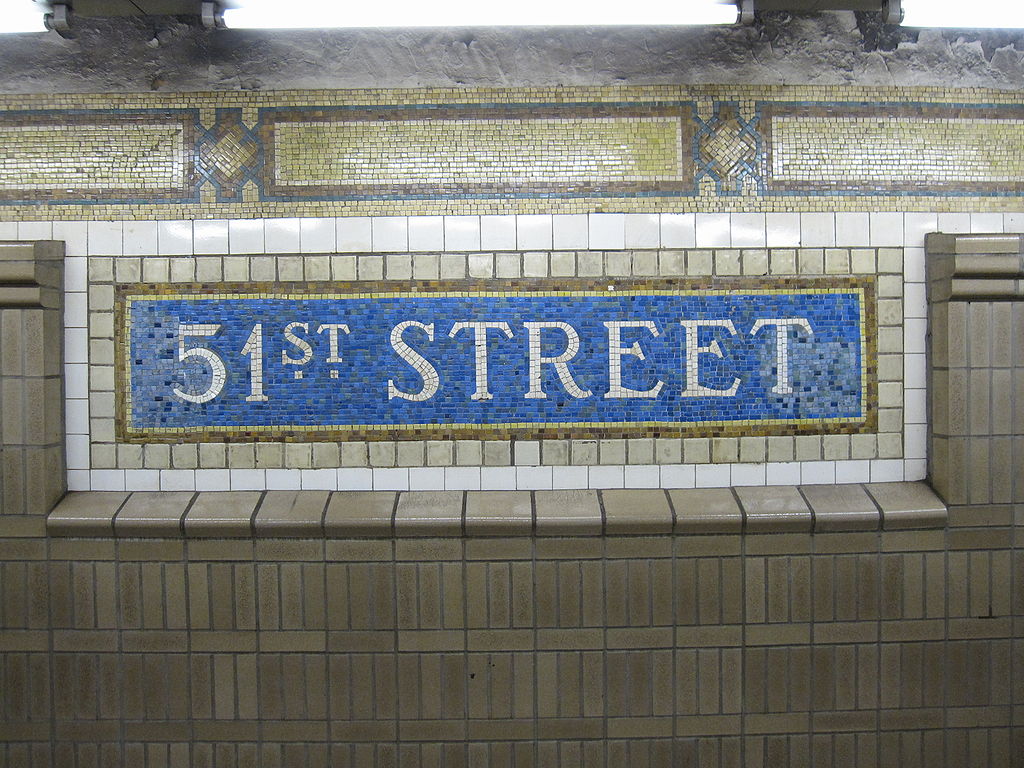
51st Street (IRT Lexington Avenue Line)

Photo from Wikimedia Commons; licensed under the Creative Commons Attribution-Share Alike 3.0 Unported license.


🗓️

I’ve currently got five speech-recognizing digital assistants in my life: an Amazon Echo Dot in the living room at home, in the office a Google Home, along with a MacBook Air and an Apple TV (both with Siri), and Google Assistant running on the Android phone in my pocket.

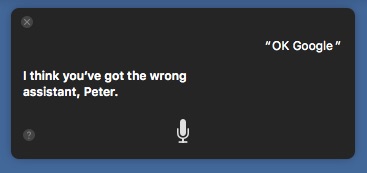
This leads to some confusion as I go about my day: saying “OK Google” to Siri, for example, or “Alexa, ask City Cinema what’s playing tonight” to my Google Home.

At least Siri has a sense of humour about it:

Screen shot of Siri telling me I have the wrong assistant when I say OK Google.

Each of these assistants does different things.

Sometimes they can do the same thing.

And sometimes the results of the same thing are the same, and sometimes they’re different.

Turn on the television

For example, both the Echo Dot and Google Assistant can control the television and lamp in our living room at home, via a paired Wemo Switch. And so when I’m sitting on the couch I can say either “Alexa, turn on the television” or “OK Google, turn on the television” and the television will turn on (I default to Alexa because I don’t have to remember whether it’s nearby or not; it’s fixed in one place, whereas my phone could be out of earshot).

Send a text to Catherine

In the office, my Google Assistant often sits, plugged in, inches from my Google Home. You might think that they share a common brain on the back end, and it’s clear that they have some knowledge of each other. But custom “Google Actions” that I’ve developed only work on the Google Home and not in Google Assistant, whereas an attempt to say “OK Google, send a text to Catherine Miller,” in the office will, more often than not, result in “sorry, I can’t send texts yet” from the Google Home, even though the phone it shares a brain with is sitting right beside it, and the phone certainly can send texts.

What’s the capital of Alabama?

If I ask Siri on the Apple TV “What’s the capital of Alabama?”, it tells me “I can’t help you with that,” whereas Siri on my MacBook Air tells me it’s Montgomery.

The Echo Dot gives me Montgomery too, as do Google Home and Google Assistant.

If I follow up with “What’s the population?”, both Google Home and Google Assistant tell me the population of Alabama whereas Siri on my MacBook Air gives me the population of Montgomery (which seems like the right answer to a follow-up like this). The Echo Dot doesn’t understand follow-up questions, and so responds “Sorry, it looks like I didn’t hear you correctly.”

Who’s the Star of the Blacklist?

If I ask Siri on my Apple TV “Who is the star of the Blacklist?”, it first asks me which Blacklist (showing me thumbnails of four options), and when I select the current TV show, it shows me a list of stars, starting with James Spader. Asking the same question of Siri on my MacBook Air opens up iTunes and takes me to the Blacklist page, but doesn’t tell me the star.

Google Assistant and Google Home both answer “James Spader, Megan Boone, and 20 others” while my Echo Dot answers “Jason Butler Harner, Harry Lennix, Campbell Scott, Isabella Rossellini”, all of which have been guest stars, but none of which would be considered “the star” of the show.

What’s the Weather for Tomorrow?

Siri on both the Apple TV and the MacBook Air tell me “it doesn’t look so nice tomorrow, down to -3 degrees” when I ask “What’s the weather for tomorrow?”

Google Home says “cloudy with a high of 4 and a low of -2”, and the Echo Dot tells me to look for “intermittent clouds with a high of 4 and a low of -1”.

So I know it’s going to be -3 degrees tomorrow.

Or -2. Or -1.

Compuserve 2.0

We’re back to the days of Compuserve and AOL and Prodigy; pre-Internet when you dialed into a service provider’s walled garden, used its own peculiar user interface, and communicated only with other users of the same service.

Can you imagine if Firefox, Chrome, and Safari each had a different way of entering a URL. Or were only able to access certain sections of the Internet.

That’s where we’re at with digital assistants: there’s no openness, no interoperability (“Siri, tell my Google Home to close the garage door”, “Alexa, install Skype on my MacBook Air” – nope).

As someone who’s built an entire career on the back of open source and open standards, this is a disturbing trend.

And as someone charged with providing the curious with important information, a bleak landscape of maintaining code branches for each service’s particular way of working isn’t something I’m excited about.

I can’t imagine that we’re going to give over our future to a single provider of hardware, software and services–Google, Apple nor Amazon appear in danger of giving up this game–and so surely we would all benefit (and by “we”, I mean users) from requiring our devices to use open standards, to work with each other, and to leverage the network and its etiquette as we’ve done elsewhere.

Otherwise I’m going to be 70 years old and locked in the back yard because I can’t remember whether to say “Hey Siri,” “OK Google” or “Alexa” to unlock the door.

🗓️
Siri  •  Google Home  •  Alexa  •  Amazon Echo

I first stumbled across VoiceBase back in 2015 when I was looking for a cheap way to produce a transcript of the PEI Home and School Federation Leaders Debate on Education. While I didn’t end up using their automated transcription system (I opted for  human transcription from Rev.com), returning to look into where VoiceBase excels has been in the back of my mind since then.

It was jogged out by a recommendation by Mark Frauenfelder in last week’s Recomendo newsletter:

Dirt Cheap Transcription

VoiceBase takes audio recordings and turns them into text. It also analyzes the text to identify subjects and keywords, and can play back the audio as it highlights the text. It’s not as good as a human transcriber, but it does a decent job and is much cheaper (2 cents a minute compared to $1 a minute for a human). You get $60 in free credit to try it out, too. — MF

While Mark is right that VoiceBase isn’t as good as a human transcriber, the interface to its machine transcription is very interesting in that it presents a novel way to experience audio.

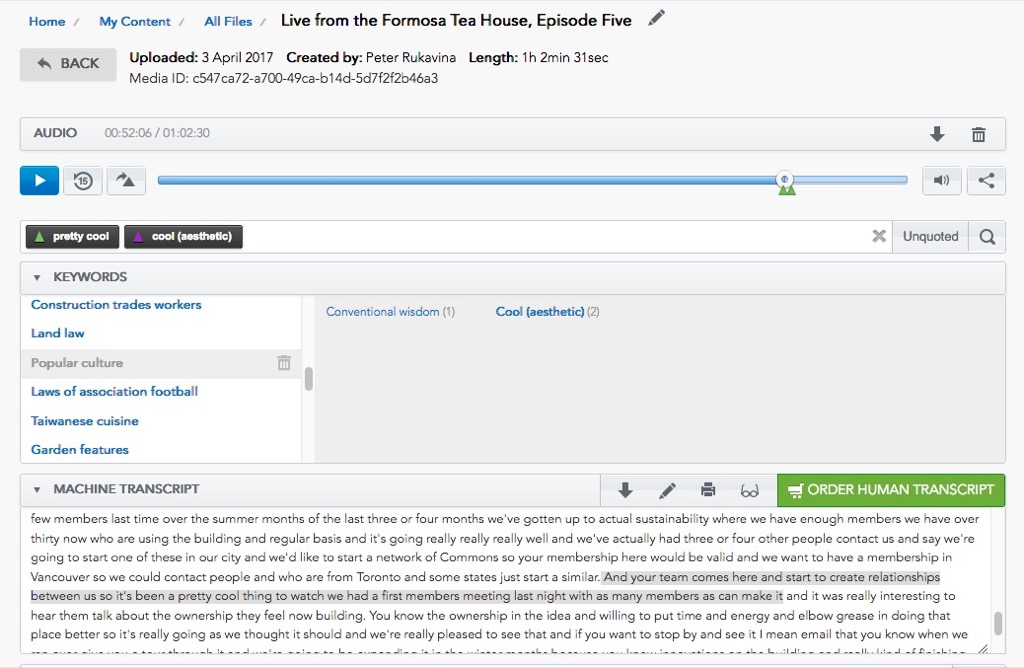
Witness this view into Live From the Formosa Tea House, Episode Five.

VoiceBase not only transcribes the audio, but it analyzes and tags the text by subject.

In the screen shot below, I’ve navigated to the keyword category “Popular culture,” and then clicked on “Cool (aesthetic).” The timeline of the audio highlights places identified with that tag, and I can click on any of them to both jump to that place in the audio, and in the text:

Screen shot of VoiceBase showing transcript of Live From the Formosa Tea House, Episode Five

The first snippet tagged with “Cool (aesthetic)” came at 00:52:06, when Dan James described something as “a pretty cool thing” when talking about the Queen Street Commons:

And your team comes here and start to create relationships between us so it’s been a pretty cool thing to watch we had a first members meeting last night with as many members as can make it and it was really interesting to hear them talk about the ownership they feel now building.

The tagging is extremely detailed, including categories like “Populated coastal places in Canada” (Charlottetown and Vancouver in our episode), “Standards,” “Companies listed on the NASDAQ,” “RCA Record Albums,” and “Street Furniture.”

For long audio recordings from long ago, where the details have long been forgotten, diving in via VoiceBase provides a quick way to find the sections I’m looking for, and to easily copy and paste text for other purposes.

Of course all of this has a more Orwellian aspect to it: VoiceBase’s marketing isn’t focused on the obscure-podcast transcription market, as witnessed by the use of copy like “quickly identify ‘Hot Leads’ vs. ‘Non Prospects’ and determine the quality of your leads” and “phrase spotting allows a business to create custom groups of specific terms that will be automatically tagged when present. Simple logic can be applied to trigger an automated business process.”

It’s not difficult to imagine that this is exactly the sort of technology that intelligence agencies are using right now to process the collected telephone conversations of the world; if nothing else, VoiceBase provides a cheap way to get a visceral sense of how easy and effective it is to vacuum up and analyze audio.

🗓️

When Oliver was a baby, just learning how to talk, I remember reading in a parenting book that young kids find it confusing when you give them more than one name for an object.

I’ve no idea whether this is true or not, and we certainly paid it no heed. But it certainly is confusing for me. Especially where place names are concerned.

I remember the first time I saw Canada rendered in German as Kanada: it didn’t make any sense to me, any more sense than someone in France calling me Pierre. To my mind, a name is a name is a name.

But the world doesn’t agree with me, and so places have different names in different languages.

And, besides, where exactly to I get off, referring to Deutschland as Germany and Sverige as Sweden. I’m so Anglocentric.

So I must acclimate and broaden my mind. Here, for example, are the many names for Charlottetown, taken from Geonames alternatenames field:

  • Baile Shearlot
  • Baile Sheàrlot
  • Carlotauno
  • Carolinapolis
  • Sarlotetaunas
  • Sarlottaoun
  • Sarlottaun
  • Sharlottaun
  • Sharluttaun
  • carlattavun
  • saralatata’una
  • sharottotaun
  • syalleostaun
  • tsharlwt tawn
  • xia luo te dun
  • Ĉarlotaŭno
  • Şarlottaun
  • Šarlotetaunas
  • Σάρλοτταουν
  • Шарлоттаун
  • Шарлъттаун
  • שרלוטטאון
  • تشارلوت تاون
  • شارلوت‌تاون
  • شارلٹٹاؤن
  • ਸ਼ਾਰਲਟਟਾਊਨ
  • சார்லட்டவுன்
  • შარლოტტაუნი
  • シャーロットタウン
  • 夏洛特顿
  • 샬럿타운

Can we agree that the Latin Carolinapolis is an awesome name? I think we should consider changing.

Did you know, by the way, that there’s a Wikipedia in Latin. Except it’s called Vicipaedia.

🗓️
Charlottetown  •  Geonames  •  Language

The Henry Jamison song Real Peach popped onto my radar a month ago, and if the number of plays worn into my Spotify is any indication, I really like it.

I would no more call a romantic partner “baby” than I would chew off my right arm, so it’s hard to reconcile its centrality to the song with how much I like it.

But how often do you come across a song with this good a melody that also has turns of phrase like “lioness-esque woman” and “I was writing something elegiac, that I never learned to sing”. (And, for that matter, if I’m going to go to war on baby in popular music, my headphones will be mostly silent).

So I grit my ears, and press play again. Listen here.

Well nighttime passes, but the dark remains
and I was feelin’ like a little child, but I am loathe to place blame
on that lioness-esque woman, who will go here unnamed
she was looking in me for a lion, when she found it so tame

On that erstwhile May morning, I took the 6 downtown to Spring
and I was writing something elegiac, that I never learned to sing
but I think that it was this song, just four years premature
and I remember crossing out the line - “all is fair in love and war”

Well if all is fair in love and war
then I don’t know what we’re fighting for

Cuz my baby she’s a real peach
even when the night come crashin’ down
real peach
and the nighttime rolls away, alright
and we’re comin’ back to the demon-killing work of love
(my god)

Well nighttime passes and the dark retreats
I hand it over to my upper angel who visits me in sleep
we’re in the field beyond the right and wrong and the fallacy of form
you can call it what you wanna call it, I just say “all is fair in love and war”

Well if all is fair in love and war
then I don’t know what we are fighting for
So if we don’t care to fight no more
let’s go upstairs and let’s shut the door

Cuz my baby she’s a real peach
even when the night come crashin’ down
real peach
and the nighttime rolls away, alright
and we’re comin’ back to the demon-killing work of love
(my god) illuminate

🗓️

About This Blog

Photo of Peter RukavinaI am . I am a writer, letterpress printer, and a curious person.

To learn more about me, read my /now, look at my bio, listen to audio I’ve posted, read presentations and speeches I’ve written, see things I’ve favourited elsewhere, or get in touch (peter@rukavina.net is the quickest way).

I have been writing here since May 1999: you can explore the 25+ years of blog posts in the archive.

You can subscribe to an RSS feed of posts, an RSS feed of comments, an RSS feed of favourites elsewhere, or a podcast RSS feed that just contains audio posts. You can also receive a daily digests of posts by email. I also publish an OPML blogroll.

InstagramYouTubeVimeoORCIDOpenStreetMapInternet ArchivePEI.artDrupalGithub.