Speaking of Oliver, one of his favourite websites is YouTube Doubler, which allows you to mash together two YouTube videos to play at the same time.

His use of the tool to create this mashup is (in reaction to this post), perhaps, the most brilliant use of digital technology I’ve ever witnessed.

Sometimes you can do with a little Charlie Brown hacking what mere words cannot do justice.

🗓️

The bane of the existence of anyone charged with supporting digital systems is receiving incomplete bug reports (“that thing on that page is busted!”)

Fortunately, I have bred a digitally literate son, so when something’s broken on ruk.ca, I not only hear about it, but I hear about it with clarity.

Witness the email I received 5 minutes ago:

Subject: Problem Commenting on ruk.ca

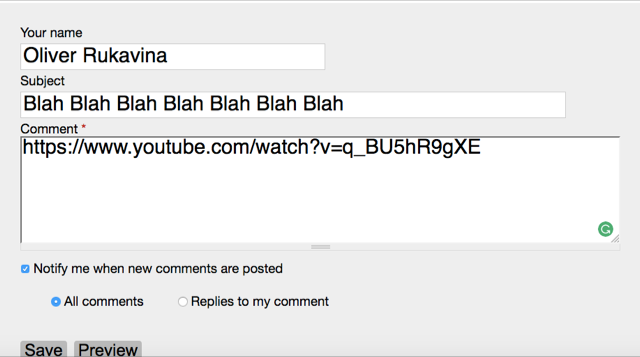
There’s a problem commenting on ruk.ca (there’s no email address)

Oliver included a helpful screen shot showing the lack of email address on the comment form:

Screen shot of the comment form on ruk.ca showing lack of and email address field.

And, sure enough, when I checked the post in question, there was no email address on the comment form (in technical terms, for the Drupal content type “sound,” the “Anonymous commenters must leave their contact information” setting wasn’t selected).

The result was that although commenters could comment, checking the “notify me when new comments are posted” checkbox was rendered moot because there was no way to enter an email address.

I’ve fixed this, and Oliver’s been able to comment as he would like.

This familial bug reporting helpfulness is obviously genetic, as my mother pointed out last week that there was no facility for comments at all on Oliver’s blog. We fixed that yesterday by enabling comments in his Drupal (along with Mollom to mitigate against comment spam).

🗓️
Oliver  •  Drupal  •  Bug Reports

The North Pole, by Robert E. Peary, details the author’s 1909 controversial expedition to the top of the world, 108 years ago this week.

Chapter 22 describes the last steps of the journey, “We Reach the Pole,” and begins:

The last march northward ended at ten o’clock of the forenoon of April 6. I had now made the five marches planned from the point at which Bartlett turned back, and my reckoning showed that we were in the immediate neighbourhood of the goal of all our striving. After the usual arrangements for going into camp, at approximate local noon, on the Columbia meridian, I made the first observation at our polar camp. It indicated our position as 89° 57’.

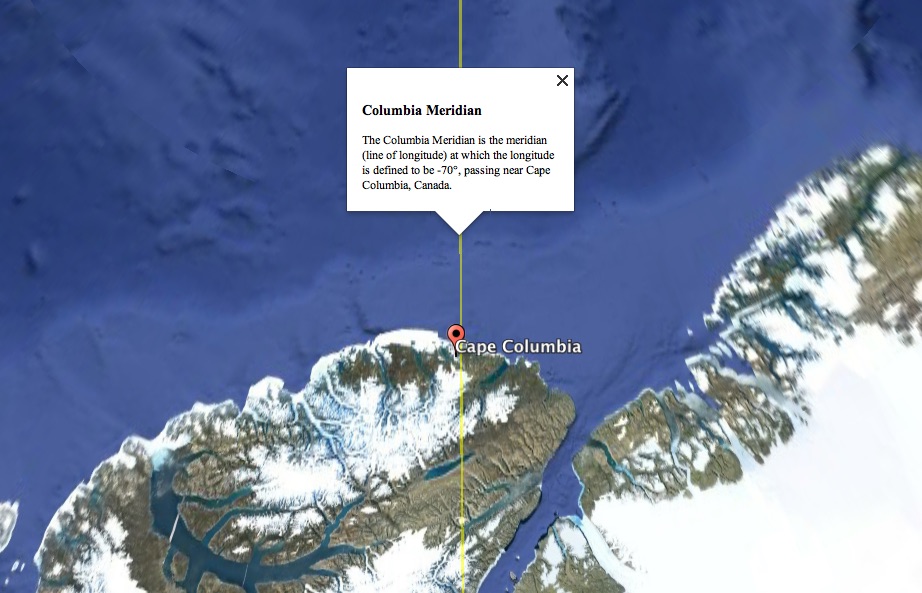
This reference to the “Columbia meridian” intrigued me, as I’d never heard of it. And, indeed, it appears to be a reference of Peary’s creation, derived from the proximity of the 70th meridian west to Cape Columbia–the northernmost point of land in Canada–at 83° 6′ 41″ N, 69° 57′ 30″ W. Cape Columbia is only about 6km west of the meridian (here’s a KML file you can load into Google Earth to see for yourself):

Columbia Meridian in Google Earth, next to Cape Columbia

All of which had me thinking about longitude: I figured that if Peary could make up the “Columbia Meridian,” I should feel free to conjure the “Charlottetown Meridian.”

And so I will.

The best source for setting the longitude of the Charlottetown Meridian can be found in The Interpretation Act of 1939 (3 Geo. VI, c. 23, s. 6), where we find:

(m) a reference to time is to be deemed a reference to Atlantic Standard Time, (sixty degrees west longitude) being twelve minutes and twenty-nine seconds fast of the local time of the meridian which passes through the Provincial Clock on the Law Courts Building in Charlottetown.

As I detailed here, this clock–in what we now call the Coles Building–is at 46.23536, -63.12549.

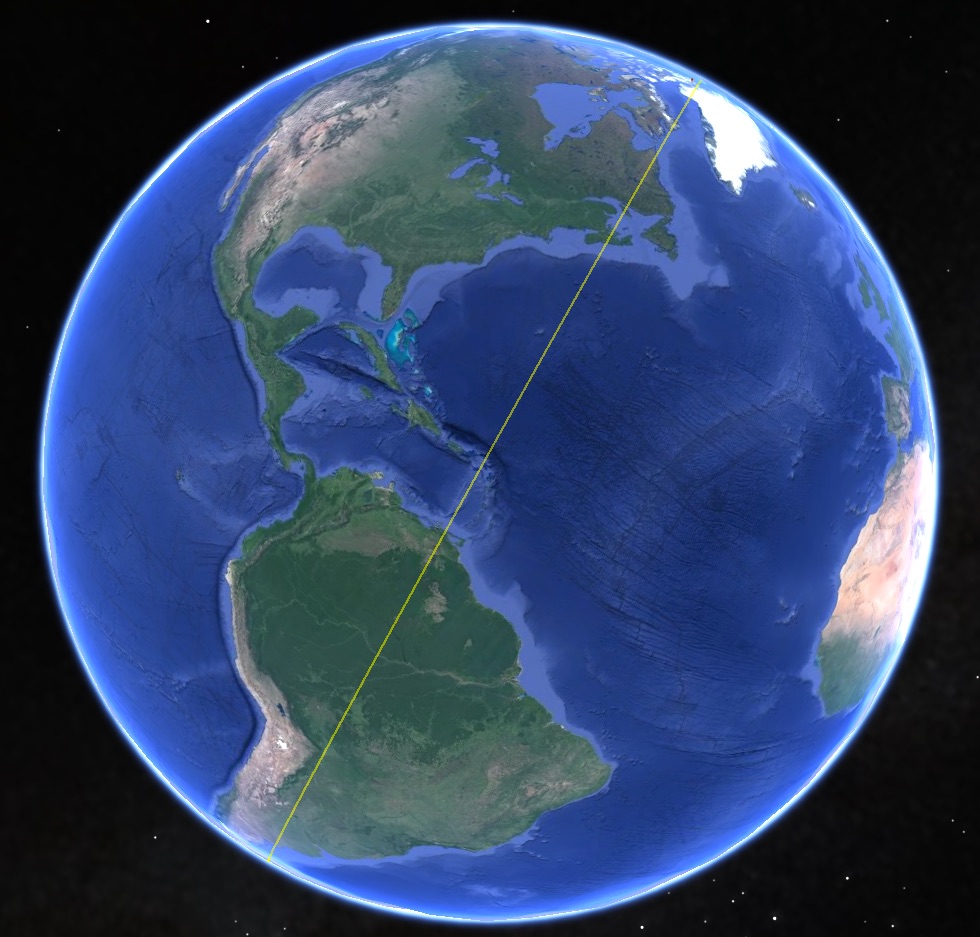
And so the Charlottetown Meridian is the line of longitude that starts at the North Pole (90°N, 0°), passes through the Coles Building, and continues to the South Pole (90°S, 0°).

It looks like this on Google Earth (here’s a KML file):

The Charlottetown Merdian overlaid on Google Earth

One of the nice features of Google Earth is that you can see the elevation of any feature of the map, including a path like this (just right-click on the feature in the sidebar and select “Show Elevation Profile”).

So, following the Charlottetown Meridian from the North Pole, through Charlottetown, to the South Pole, clamped to the sea floor, looks like this:

Elevation Profile of the Charlottetown Meridian

The Charlottetown Meridian passes through the following countries and territories:

  1. Canada (Ellesmere Island)
  2. Greenland
  3. Canada (Baffin Island)
  4. Canada (Labrador and Quebec)
  5. Canada (Anticosti Island)
  6. Canada (Prince Edward Island)
  7. Canada (Nova Scotia)
  8. Anguilla
  9. Saint-Martin
  10. Sint Maarten
  11. Venezeula (Los Testigos)
  12. Brazil
  13. Bolivia
  14. Argentina
  15. Antarctica

From North Pole to South Pole is a distance of 20,036 kilometers; Charlottetown is about 4900 km along that route, so about 25% of the way around the Earth from the North Pole.

It’s fascinating to me to look at the Earth and how we slice and dice and measure it, especially when we take the slices in unusual ways like this.

The next step in the evolution of the Charlottetown Meridian, I suppose, is to organize an expedition to traverse it.

🗓️
Charlottetown  •  Longitude  •  Geography  •  North Pole  •  Peary
Audio file

Michael Enright interviewed Preston Manning this morning on The Sunday Edition about populism.

I’ve always had a lot of time for Manning, even though, on paper, our politics don’t overlap very much; he made an excellent point in this interview, one that resonates with something I’ve been thinking a lot about in the age of Trump:

Enright: How do we gauge or measure the fact that people, elites so-called, are not listening to what the grassroots are saying?

Manning: Well one way, Michael, is to look at their communication style. I’m not knocking elites, I’m just trying to reflect on the points you’re trying to get to. Why is it that so many people no longer listen or are impressed by them. And the communication style of elites, whether it’s academics, or high business executives, or government executives, is that they’re source-oriented communicators. They say what they want to say, in the language they want to say it, with the media that they are most comfortable with, and that’s a perfectly fine method of communication when you’re dealing with your peers. But the opposite of that is a receiver-oriented communicator, who doesn’t start with what I want to say, and my view, who starts with “who are these people in this audience, what are they thinking, what are their attitudes, what is their vocabulary, what is their preferred media.” Taking that into account, then getting around to saying what you want to say. The later one is the style of a small-d democrat politician; the other is a different style that doesn’t resonate with rank and file people.

So much of what rankles me about how our democracy operates comes down to this notion of communication style. Here, for example, is a sentence pulled from the 2016 Prince Edward Island Budget Address by Hon. Allen F. Roach, Minister of Finance:

At the same time, we must remain mindful of the continued volatility in the global economy. Vast fluctuations in the pricing of resources and other market conditions have placed pressure on government and private industry alike. These pressures, in turn, have impacted both personal and public finances. We, as Islanders and as a Government, are not isolated from these economic realities.

The budget address is the most concrete statement that government has to make each year about how it will govern.

And yet what does that sentence mean?

Nothing. It is entirely without meaning for the regular everyday person–Manning’s “rank and file people”–among which I count myself. While “vast fluctuations in the pricing of resources and other market conditions” might mean something to an economist, to most people this sounds like “blah blah blah, blah, blah blah.”

Compare this to a section from President Donald Trump’s inaugural address:

From this moment on, it’s going to be America First.

Every decision on trade, on taxes, on immigration, on foreign affairs, will be made to benefit American workers and American families.

We must protect our borders from the ravages of other countries making our products, stealing our companies, and destroying our jobs.  Protection will lead to great prosperity and strength.

I will fight for you with every breath in my body – and I will never, ever let you down.

In both cases the speakers are making a macroeconomic point; setting aside whatever you might feel about Trump’s “America First” approach, he is speaking in clear language that anyone can understand. Is it any wonder that he’s capable of making a connection with many electors, even those who don’t share his politics.

You might argue that Manning’s “receiver-oriented communication style” is nothing more than “telling them what they want to hear,” and certainly in Trump’s case there appears to be much of that; but note that Manning finishes his description with “Taking that into account, then getting around to saying what you want to say.”

He is, in other words, saying “listen, then talk” and, further, “when you talk, talk in a way that people can relate to.”

And that doesn’t seem to be asking too much of those who we charge to conduct the public business.

Our current administration here in Prince Edward Island has suggested in past that it will heed this notion; in one of Premier MacLauchlan’s first statements upon assuming office he summarized this as follows:

We must continuously look for new ways to obtain input from citizens and the community, to inform government decisions and priorities. By listening carefully to citizens, we will make better decisions about public policy and its administration. Further, a properly grounded approach to listening will sustain government on a strategic policy course.

Setting aside that this description of a more populist approach was, itself, written in decidedly non-populist language, the spirit appears true.

Too often, though, these “new ways to obtain input from citizens and the community” are conducted, as Manning outlined, in a “source-oriented” way: “they say what they want to say, in the language they want to say it, with the media that they are most comfortable with.”

What results is either “we must remain mindful of the continued volatility in the global economy”-style gobbledegook.

Or neo-populist videos that have all the appearances of being plainspoken but that are, in fact, written in tone-deaf marketingspeak:

We’re the one thing that, despite our size, gives us a leg up: call it scrappy, call it persistent, we call it mighty. It’s the kind of might that makes us an Island of dreamers and doers; it’s guided us from the beginning, with a will and a belief that we can do anything.

To be clear: I’m not speaking about policy here. I’m neither seeking to praise Trump’s administration nor to condemn MacLauchlan’s. I’m not talking about the ideas behind their speech and their approach; my praise and criticism is about style, medium, language, spirit and tone.

The danger in all of this for Prince Edward Island is that we will, eventually, see a leader with a combination of populism, credibility, and crazy ideas, who will lead us, despite our better judgement, into dangerous waters; perhaps all that’s prevented this from happening, to this point, is the absence of a skilled-enough actor, and long-term habituation to the gobbledegook.

Of course it need not tilt that way: it’s possible that we’ll see the emergence of a populist leader, with credibility and laudable ideas, who will guide us in an entirely more positive way.

Whichever way things go, we ignore Manning’s wise words at our peril.

🗓️
Populism  •  Politics  •  Canada  •  Preston Manning

CBC reporter Rosemary Barton mentioned, at the recent forum on the future of news here in Charlottetown, that she’s started to read Breitbart and similar sources:

After American election, Barton realized she wasn’t reading any of the media sites that people who liked Donald Trump were reading.

“That’s a problem. That’s a problem for me, because then it means that my lens on what was happening was limited.”

So she started following the far-right American news, opinion and commentary website Breitbart, and other “further right” letters and papers.

I’ve found that it’s far more useful, and challenging, to read views that are less out of phase with my own, views that strike me not as crazy, but rather at, or just over, the edge of what my progressive social group would consider acceptable.

Quillette, from Australia, is a one such source. Its tag line is “a platform for free thought,” and the themes of its collected essays often run contrary to Canadian-style progressive canon law.

See You Are Not Important: Defund Identity Culture, for example:

Narcissistic philistinism is a condition of today’s identity culture. If one ceases to believe in the existence of profound truths, sublime terror, Art, gods, muses or geniuses (defined classically as inhuman spirits), then one’s self or identity acquires a hyperbolic sense of importance. Contrary to what is often said in Cultural Studies departments, art’s supreme function is not the expression of a middle-class self or the construction of a millennial identity; it is the forgetting of the self. In ancient Greece, Dionysus’s followers lost themselves through music; today, Selena Gomez’s followers find themselves. This does not count as progress.

Quillette makes me think, and forces me to examine my assumptions and my biases. Sometimes it strengthens them, sometimes it causes me to consider setting them aside. Isn’t that what good writing is supposed to do?

🗓️

Matt Blumberg, writing about expense reports, points out a universal truth:

Most of the work we do involves some level of being organized, being on time, prioritizing work and working efficiently, and caring about money (whether the company’s money or our own money).

When I think back to work situations that have gone sideways, it’s seldom had anything to do with specific job skills and, more often than not, has been a result of someone on the team having deficiencies in one of the above.

People who don’t show up on time for meetings. Or are late all the time. Or who leave email festering in their inboxes unanswered. Or who can’t see the forest for the trees. Or who think their organizational​ system should trump the group’s long-established one.

When you read help-wanted ad references to “motivated” and “high energy” it’s a coded reference to these skills. Here, for example, is a snippet from the first ad that showed up in a Google search for jobs this morning:

Core competencies: customer focus communication team work quality orientation problem solving accountability and dependability operating equipment ethics and integrity

Boiled down, these amount to “you are not an idiot” and they are also another way of saying that you care about “being organized, being on time, prioritizing work and working efficiently, and caring about money.”

The reason that I am a one-person company is largely because I have almost no ability to intuit these skills in others (hiring brother Johnny allowed me to route around this; I knew he was a stand up guy because I was around for his early years).

It’s easy to spot the carnage after hiring someone without these fundamentals; it’s much more difficult to spot people without them during a hiring process. At least for me.

🗓️
Work  •  Design  •  Communications  •  Human Resources

While we are on the topic of the Rukavina family crushing it in the digital media space, I would be remiss if I didn’t remind you that Oliver has a blog.

For a long time that was a Tumblog, but we migrated it over to Drupal earlier this year, and his posting frequency has taken an uptick since. So now he’s crushing it open source.

It’s been fascinating for me to watch Oliver grok Drupal, the platform where I spend most of my working life: he developed immediate facility for it, and can throw up a new post about twice as fast as I can.

If you’re a node on Oliver’s broad, international social graph, you’ll know well that he often uses YouTube videos to express feelings; that too is fascinating for me to watch: it’s now in his expressive muscle memory to the point where it’s as natural for him as writing is for me.

Whenever I become cynical about how the Internet has turned into a SEO-driven remarketing capitalist hell-hole, I remind myself that it is a transformative force in Oliver’s life: it’s the place he spends most of his time, his gateway to a worldwide network of friends and ideas, and a powerful tool through which he can make his mark on the world.

Follow along.

🗓️
Oliver  •  Weblogs  •  YouTube  •  Parenting

My brother Steve is hosting a new podcast for the CBC called Montrealpolis, “inside the spaces of people making modern Montreal.”

The podcast launches on Monday, April 3, and you can listen to a trailer right now.

From Steve’s introduction:

Montreal, the Canadian city with the most potholes, the thickest construction zones, and the latest last call. Whether you’re born here, or you flocked here, you’re probably staying for Montreal’s rich soundtrack of complementary languages, its lifestyle, flair, what some would call it’s perfectly dysfunctional charm. I’m trying to figure out what exactly that is.

Heretofore our access to reporter-Steve from here on Prince Edward Island has been limited to times when something of so much national import strikes Montreal that he shows up on the national news talking about it; it will be nice to have brother-on-demand-audio for a change. It will feel so Ledwellian.

The Montrealpolis podcast artwork.

🗓️
Montreapolis  •  Steve Rukavina  •  CBC  •  Podcasting

My Nextbit Robin Android phone has NFC capabilities; for practical purposes, this means that it can, with supporting software, do for me what Apple Pay can do for an iPhone. It also means, though, that it can read the contents of other NFC devices, and it turns out that credit cards themselves, at least those with “contactless” support, fall into that category.

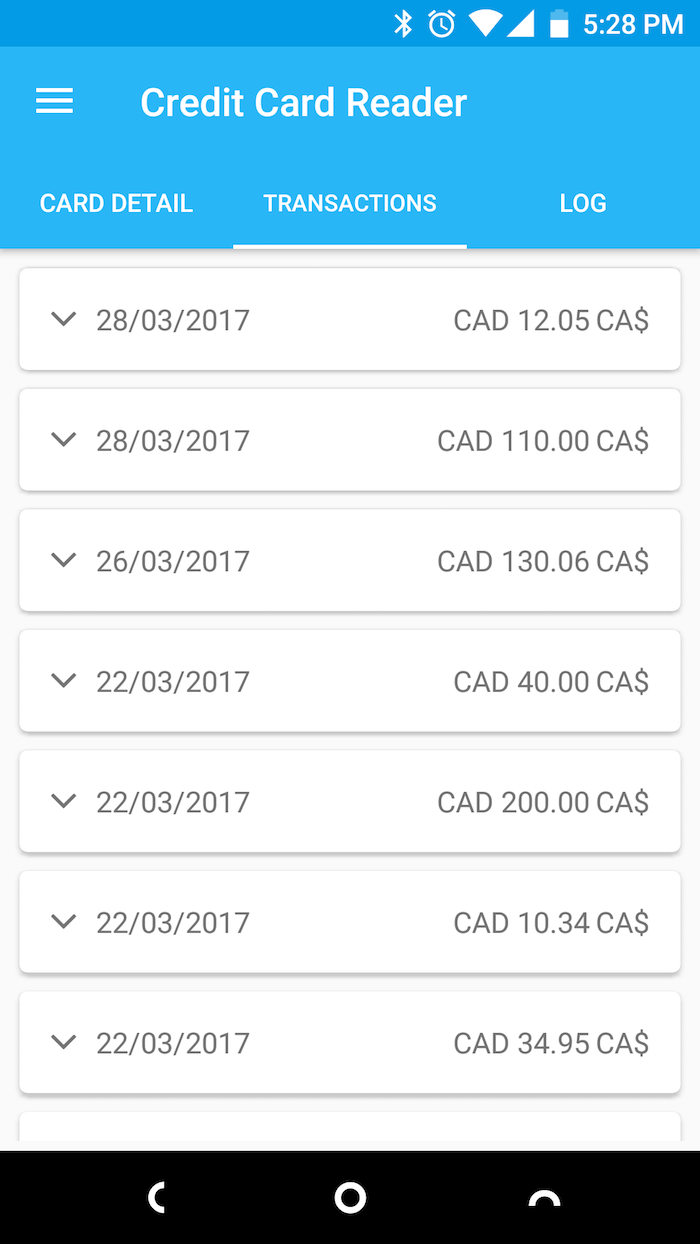
To explore this, I installed the Credit Card Reader NFC (EMV) app on my phone, and held my MasterCard up underneath it to be scanned.

As expected, the phone was able to read the credit card number; to my surprise, however, it also read the last nine transactions processed with the card:

Screen shot of my Android phone showing the results of an NFC read of my credit card transactions

So, for example, that transaction for $130.06 on March 26, 2017 is when I did the weekly grocery shop at Sobeys; it shows up on my credit card transaction report like this:

Snippet from my MasterCard transaction report showing $130.06 paid to Sobeys

The standard that drives all of this is, I’ve learned today, called EMV:

EMV is a technical standard for smart payment cards and for payment terminals and automated teller machines that can accept them. EMV cards are smart cards (also called chip cards or IC cards) that store their data on integrated circuits in addition to magnetic stripes (for backward compatibility). These include cards that must be physically inserted (or “dipped”) into a reader and contactless cards that can be read over a short distance using radio-frequency identification (RFID) technology. Payment cards that comply with the EMV standard are often called Chip and PIN or Chip and Signature cards, depending on the authentication methods employed by the card issuer.

Because I can read my transaction history from my card, anyone can read the transaction history from my card. This means that if we’re beside each other in the coffee line, you can, if you can get your card-reading-device close enough to my card, read my transaction history. It also means that every time I pay with my card, the merchant I’m paying can read my transaction history.

While this stored transaction information doesn’t appear to include anything about the merchant, there’s a lot that can be derived from my last 10 transactions. Look at mine, for example: from just those 7 transactions you can see, you can tell how often I use my card, how much I tend to charge to the card, and what countries I’ve visited (because the currency is recorded along with the amount). If I was a merchant processing hundreds of thousands of cards per day, I could skim all of this data, aggregate it, and start to develop fingerprints that would demographically tag card presenters based on their history.

As far as I can tell, there’s no way to turn this “feature” off on your card; I’m hunting for my MasterCard privacy statement to see whether it’s existence is mentioned there.

🗓️

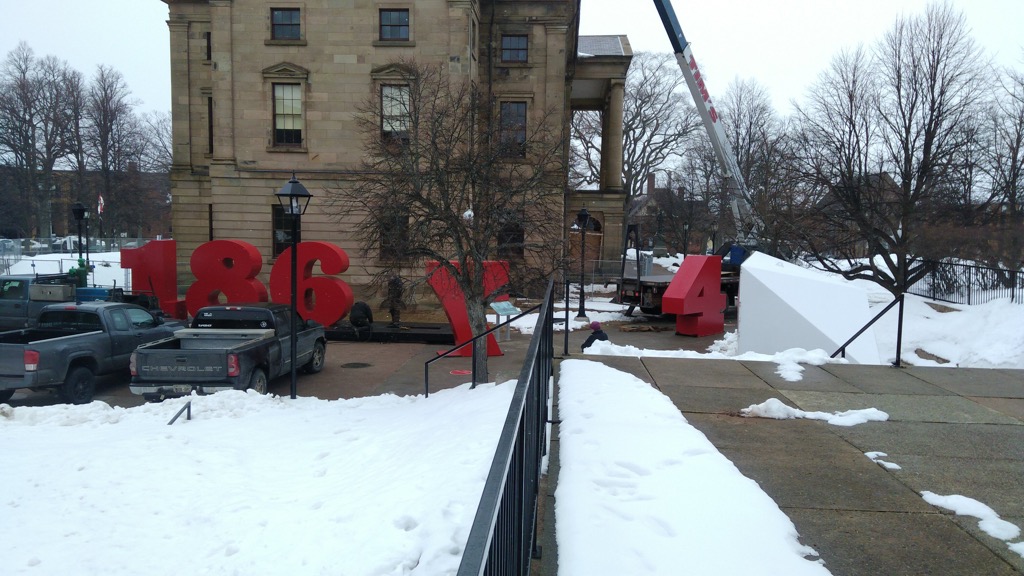
Photo of Province House showing crane swapping a giant 7 in for a giant 4

🗓️
Province House  •  Photos  •  Confederation

About This Blog

Photo of Peter RukavinaI am . I am a writer, letterpress printer, and a curious person.

To learn more about me, read my /now, look at my bio, listen to audio I’ve posted, read presentations and speeches I’ve written, see things I’ve favourited elsewhere, or get in touch (peter@rukavina.net is the quickest way).

I have been writing here since May 1999: you can explore the 25+ years of blog posts in the archive.

You can subscribe to an RSS feed of posts, an RSS feed of comments, an RSS feed of favourites elsewhere, or a podcast RSS feed that just contains audio posts. You can also receive a daily digests of posts by email. I also publish an OPML blogroll.

InstagramYouTubeVimeoORCIDOpenStreetMapInternet ArchivePEI.artDrupalGithub.