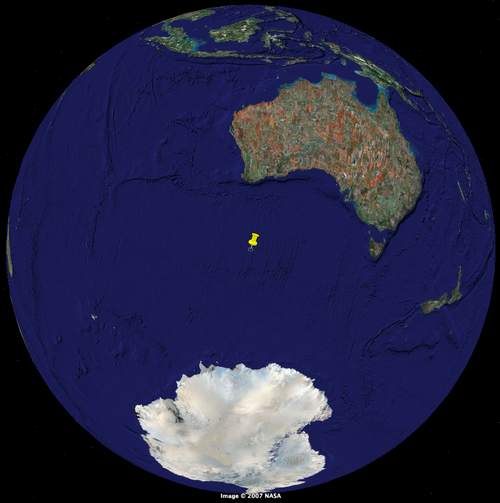
This compact single-purpose web page is a useful tool for finding your antipode — the point on the earth that you’d hit if you poked a stick through the middle of the earth from where you’re standing. Here’s mine:

My Antipode

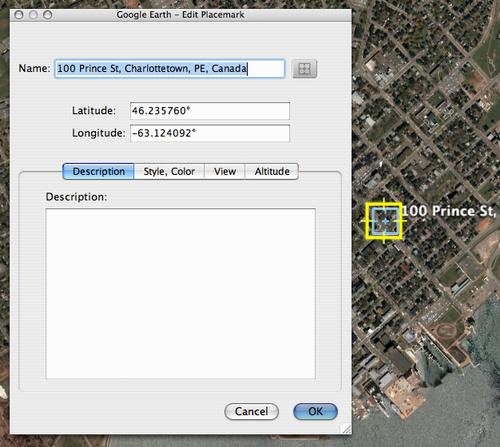
To find your own antipode, simply load up Google Earth, search for your street address, and then right-click on the map once it’s zoomed to your location and select “Get Info.” You’ll see something like this:

Google Earth Screen Shot

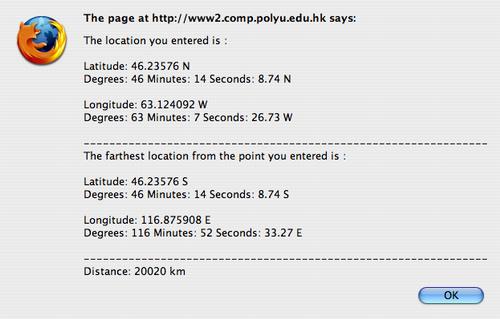
Next, enter the values for latitude and longitude into this conversion tool and you’ll get a new latitude and longitude as a result:

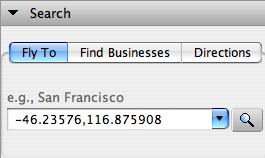
Finally, go back to Google Earth and enter these values in the “Search” field, latitude first followed by a comma and then longitude. You can enter this using positive values for northern latitudes and negative values for southern ones (i.e. “-46.23576” for “46.23576 degrees south”) or you can append “N” or “S” to a positive value as appropriate (i.e. “46.23576 S”). Same thing for longitude: use positive values or “E” for “eastern” longitudes and negative values or “W” for western longitudes:

Google Earth Search

If all goes according to plan, the globe should spin around a half-turn and you’ll end up about as far away from where you’re standing as you can possibly get.

🗓️

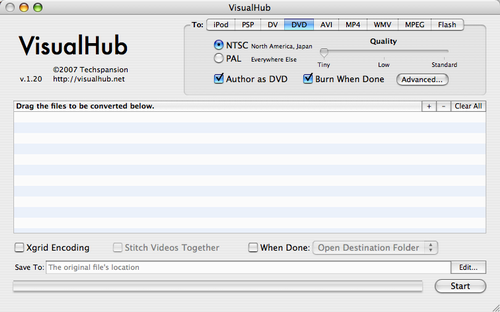
VisualHub is a Mac OS X application that, says its website, can “Fit up to 18 hours of video on one DVD. Play it in any standalone DVD player.”

This is one of those claims that, on the surface, seems preposterous: we’re used to DVDs holding a 2 hour movie at most. Just like we’re using the CDs storing 74 minutes of music. 18 hours!? That’s absurd.

Or not.

It seems that the “DVD Video” standard — the standard that allows us to create DVDs that can be played “in any standalone DVD player” — allows for more video to be stored at lower quality. The “two hour movie” we’re used to is simply the approximate capacity when storing so-called “DVD-quality” video. In other words “high quality.”

But it you’re willing to accept lower quality video, you can squeeze more on a standard DVD. A lot more.

This is where VisualHub comes in:

VisualHub Screen Shot

You just drag digital video into the main window, select the “DVD” tab and “Burn When Done,” click “Start,” and after lots of re-compressing and DVD magic, you end up with a DVD with lots of video on it. There are no complicated settings to choose from: it just works.

Indeed the user’s manual says “The 18 hour limit is a soft limit. You can actually make longer DVDs, but quality will really start to suffer.”

I ran a test yesterday just before I left the office: I dragged seven 44-minute long TV episode AVI files into the application, clicked “Start” and when I came in this morning I had a DVD burned containing all of them. While I haven’t tried looking at it on a standard DVD player, the Apple DVD player has no problem with it, and the video quality is at least “VHS quality” if not better.

🗓️
DVD  •  Mac OS X  •  Technology  •  Video

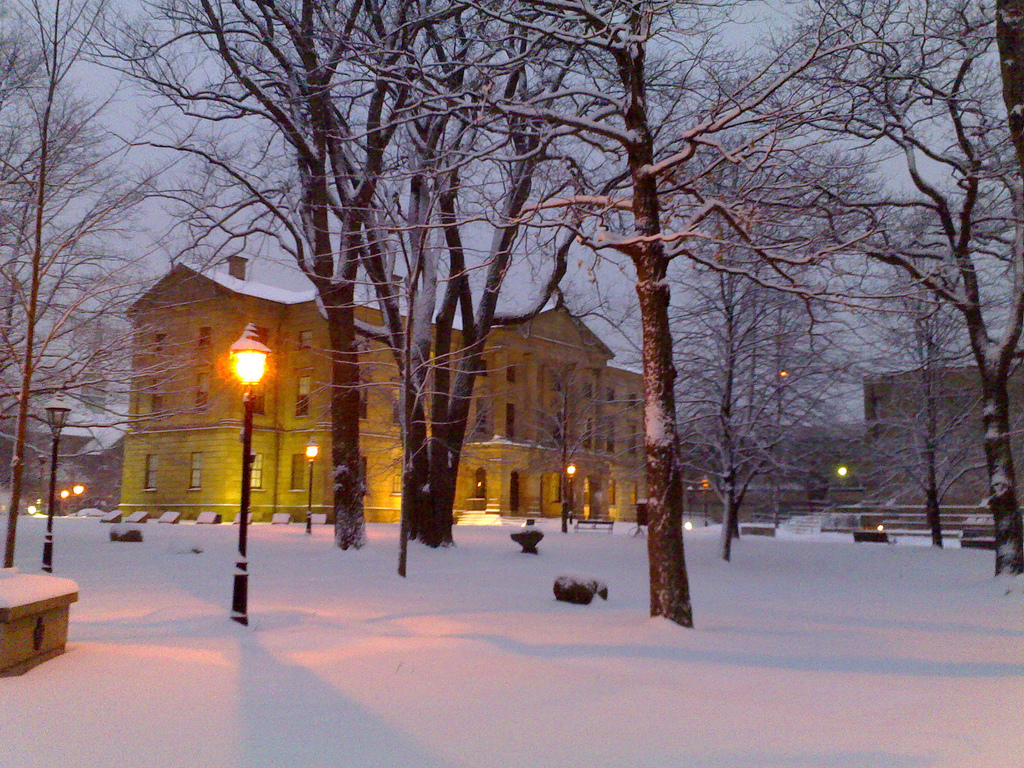
While I’m wary of crowing about it, lest my bravado lead to some sort of rupture in the time-space continuum, this week represents one month of the new “early to bed, early to rise” lifestyle that I started when I returned from Italy in mid-December. Here’s what my early rising afforded me the opportunity of seeing this morning:

Province House at Sunrise

Province House is one of my favourite buildings: I like its no-nonsense way of just rising up out of nowhere; I like its symmetry; I like how it’s a building that’s at once regal and understated. I walk by Province House at least twice a day, and I see something new every time.

The key to the “early to rise” part of the lifestyle, I have discovered, is the “early to bed” part. Previous attempts to move my day earlier have all failed, I think, because I just kept on going to bed at midnight and tried to will myself up earlier. Willpower is no weapon against tiredness, and so it didn’t work.

For the past month it’s been a rare day that I haven’t been in bed by 10:00 p.m., and often it’s earlier. This makes Saturday night dates with Catherine more challenging, and defeated any hope of staying up to see the new year on December 31, but the upsides are worth it.

Not only do I get to the office earlier and get a lot of work done before anyone else comes in (I’m generally here by 8:00 a.m., which is 2 hours before my Yankee colleagues start work), but I’m also sleeping a lot better, eating a lot better, and I’m home for dinner about 98% of the time (my former success rate was in the 50-70% range).

This morning I found myself going back and forth on a possible trip to the west coast in part because I was worried about the implications for my sleep schedule. Perhaps I’m taking things a little far.

🗓️

In light of this now-famous Steve Jobs quote about the iPhone as an open platform (from this Newsweek interview):

“You don’t want your phone to be an open platform,” meaning that anyone can write applications for it and potentially gum up the provider’s network, says Jobs. “You need it to work when you need it to work. Cingular doesn’t want to see their West Coast network go down because some application messed up.”

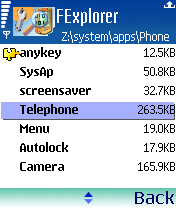
…I find it worthy to note that the “telephone” in my Nokia N70 is simply another application running on what is, in essence, a small computer:

Nokia N70 Screen Shot
🗓️

For those of us in the eating-out-for-lunch crowd, downtown Charlottetown has been difficult terrain this month: Interlude is closed until January 16, the Formosa Tea House closed for a week, the Thai food place on Kent Street is closed until March. I’ve been forced to explore new terrain.

Today it was The Maple Grille, the recently renovated restaurant on University Avenue just north of Kent Street.

Every earlier visit I’d made to The Maple Grille had been disappointing. The space was cramped — tables too close to the benches in the booths, no place to hang coats — the food mediocre and the service sometimes shockingly slow.

Today’s visit erased all of those bad memories.

The space has been entirely transformed: the wall to the space next door, now a blues club operated by the same owners, has been opened up, the booths re-designed, the interior has been redecorated, and there’s even a heated coat rack near the door.

The food was excellent.

There are few places in Charlottetown that can cook vegetables properly — Cedar’s and the Delta Hotel are two that come to mind. And now The Maple Grille: the baby red potatoes were perfectly cooked; the side of celery, carrots, onions and broccoli hit the sweet spot of al dente without being too crunchy.

The meatball sandwich on a kaiser — something I ordered despite the fact that I’d never ever had a meatball sandwich before — was hot, tasty and had just the right amount of cheese.

The chocolate cheesecake, which I was warned before ordering was “more like a chocolate caramel cake” was indeed exactly that. And it was fresh and very tasty.

Service was warm, attentive, and friendly.

Recommended.

🗓️

The summer of 1983 was an interesting one for me.

After several years of working at the Hamilton YMCA as a summer day-camp counsellor, I graduated to the big leagues and took a position at a real “overnight” summer camp at Lakefield College School north of Peterborough.

The camp — Lakefield Computer Camp — was a startup operation, poised to capitalize on the growing popularity of small computers and the attendant desire of those in the upper middle class to educate their kids in their operation.

That said, there was surprisingly little geeking around, and the camp — operated by a scion of the Southam family with a deep summer camp background — had all the swimming, capturing the flag, campfires and dining hall fun that any proper summer camp might have.

That the camp was in its first year of operation gave we staff the added fun of being able to make things up as we went along; many of us had been to summer camps ourselves, so the result was a hearty melange of camp traditions from across Ontario. Our leader was the great Molly Lawson, Trent University alum, and perhaps one of the best summer camp people I’ve ever encountered.

Tuesday was my day off. Lacking a car, and being stuck out in Lakefield, this didn’t offer much opportunity for fun diversionary activities. Fortunately Molly had a bicycle, and with a crude map of the route down to Peterborough, I set off early one Tuesday morning for some big city fun.

The ride, on the road parallel to the Otonabee River, is quite gentle and very scenic, and at the Peterborough end I had my first encounter with Trent, an encounter that sowed the architectural seeds that would later take me there for college.

Alas it was also there that things went horribly awry.

The bike got a flat tire.

Fortunately I had $10 in my pocket, which gave me access to some resources. I figured out how to catch the city bus south, found a Canadian Tire, bought a patch kit and a pair of pliers (which I figured were the handiest and most universal of the tool family), caught the bus back, and went to work. After about an hour of fiddling and prying and patching and fiddling, I was back in business. Just in time to head back up to Lakefield.

The ride back up, in the heat of the summer afternoon, was slightly up hill. To take the edge off, I decided to stop for a swim in the river; I pulled over to the side of the road when I spotted a house-sized Island just off the shore, hid my bike in the bushes, waded over, and had a pleasant dip and a little rest in a shady green glen.

Alas it was there, at the time unbeknown to me, that things again went horribly awry.

I dried myself off, rode back to camp, returned the bike to Molly and went on to finish up the remaining week of the camp season before returning home to Carlisle.

Shortly after returning home for the summer, I started to develop a red rash. All. Over. My. Body. The kind of red rash that not only itches, but that oozes and spreads and generally makes life a living hell. A trip to the well-tempered Doctor Hunt revealed that I had a severe bout of poison ivy. It seems that the “shady green glen” where I’d had a rest after swimming in the Otonabee was a shady green glen of poisonous plants. Some summer camp counsellor I was!

The second half of that summer I had another job lined up: a freelance programming job working for my high school vice principal, Mr. Japp, crafting a new computer-based student records system.

While such systems are commonplace today, and available off the shelf, small computers were a novelty in those days, and not much used for office work. The machines on the desks of the school secretarial staff were IBM Selectric typewriters, not IBM PCs. But Mr. Japp, for some reason, thought that we should harness the awesome power of the Commodore PET computer to keep track of the 600-odd students that would be attending Waterdown Distict High School that fall.

WDHS was about 10 km from our house. I didn’t have a car, so the only way to get to work was to ride my bike. Every day. 20 km round trip.

While certainly healthy exercise, if you’ve ever considered riding a bicycle for 20 km when your body is covered with oozing red sores. And the temperature is in the mid-20s. I would not recommend it.

I persevered however and, with the help of modern medicine, the poison ivy died down after a week.

The programming job turned out to be an interesting one. While my first freelance job involved modifying code, this one was a “from scratch” project. The Commodore PET 4032, with a 1MHz chip (yes, 1MHz), 32 kB of memory (yes, 32 kB), although unbelievably under-resourced in modern terms, was all I knew at the time, and the possibilities it offered seemed infinite.

My strongest memory of that project was that I ended up typing the names of the 600 WDHS students into my nascent system about a dozen times. As a result, every time I heard someone’s name on the PA system that fall, I felt like I already knew them.

The job also afforded me an opportunity to work with the vice-principal and the secretarial staff as peers, which did wonders for my self-confidence, and also served me well through the school year when I needed favours.

The summer of 1983 was also the summer that War Games, starring Matthew Broderick and Ally Sheedy, came out. Without that movie my summertime job would have been regarded as an entirely nerdy experience; although it didn’t exactly make me captain of the football team, War Games gave my chosen occupation a slight sheen of cool, and that too helped with my grade 12 self-image as the year played out.

While my virginity was still solidly intact, and I didn’t have a drink of alcohol for another 3 years, that summer I was seventeen years old — the summer I had my first job away from home, crafted my first piece of real useful stuff (and suffered my first embarrassing malady) — was the summer I came of age.

🗓️
History  •  Jobs  •  Lakefield  •  Musing  •  Peterborough  •  Technology

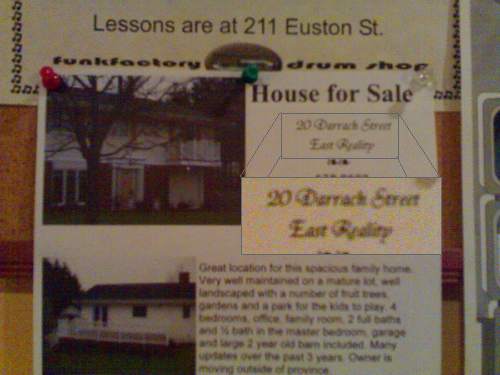
Spotted on the bulletin board at Beanz this morning, an ad for a house for sale in East Reality: House for Sale Poster at Beanz in Charlottetown

For those of you not familiar with the Greater Charlottetown area, there is a community of East Royalty here in the city.

Frankly, the idea of living in East Reality has strong appeal for me; I imagine that it would be close to the outer suburbs of reality, and that one could go for rather Jungian walks with the dog.

🗓️

Bobby Clow - CBC PhotoEarlier this week I heard that Bobby Clow has suffered a stroke; this morning I was deeply saddened to learn that he died last night.

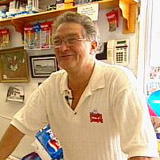
When we moved to Kingston, PEI in 1995, going up to Clow’s Red & White became a regular part of our life: we bought our gasoline there, rented videos, bought groceries and hardware, and learned what was up in the community. The first time it snowed after we moved into our new house I drove up to Bobby’s to buy a snow shovel, and when I needed to do some emergency plumbing one Saturday afternoon, his wife Verna sold me 4 inches of metal strapping for 37 cents. And when the emergency plumbing didn’t work out, I got a recommendation for which plumber to call.

When my parents came to the Island for the first time for Christmas, I took my mother up to pick up our fresh turkey. Bobby greeted my mother like royalty, and he proudly took us into their house — attached to the store and reached by walking through the post office — and showed us his Christmas display.

Many refer to Clow’s as the “last of the old-time general stores” on PEI. But once you scratch below the surface you quickly realize that there’s nothing “old-time” about Clow’s: the store has succeeded by constantly evolving: adding products, dropping products, re-merchandising the store. What is old-time, however, is the service: consistently helpful, willing to go above and beyond the call of duty, and truly the centre of the community. And, with Bobby in the room, often incorporating some straight-talking wit that would either entertain you, or floor you, and often both.

When Dave Moses and I needed to hire a programmer to craft the Vacancy Information Service for, we ended up hiring Bobby and Verna’s son Gary. Not only did we receive the gift of a talented and irreverent programmer, but I also learned a little bit about what growing up in the middle of the maelstrom was like.

Bobby was perhaps the best-known contemporary Islander: I don’t think, in 14 years here, I’ve yet to meet someone, from down east to up west, who didn’t know Bobby. I remember flipping through the channels several years back and stopping at Cable 10 when I saw he was a guest on the Point of View call-in show. The calls didn’t let up, and everyone who called had some sort of connection to Bobby; it was an amazing sight.

Matthew Rainnie interviewed Bobby’s friend Gordie Lank this afternoon and shone more light on Bobby’s life.

My thoughts are with Bobby’s family tonight.

🗓️
Prince Edward Island  •  Matthew Rainnie  •  CBC  •  Bobby Clow

When they give out the awards for well-designed, comprehensive and truly useful making public data public[er] web applications, can someone please make sure that Automated Genealogy gets one.

This volunteer-produced website took on the truly amazing task of transcribing the 5.6 million lines of the 1901 Census of Canada and making the result freely available, with links to the original documents, in an easy-to-use web search. Not only that, but they’re closing in on completing the 1911 Census of Canada too.

Not only is the scale of such a volunteer effort a testament to the tenacity of genealogists with a mission, the interface to the data is stellar example of how very “Web 1.0” techniques, combined with no need to accommodate advertisers or graphic designers, can lead to a very usable web application.

I found my great-grandmother’s sister and brother-in-law, for example, about 15 seconds after arriving at the site. The search is easy to use and provides clear results, with helpful sound-alike suggestions, and there are hyperlinks galore, linking everything to everything else (the fact that is remarkable says a lot about how un hyperlinked a lot of modern web content is).

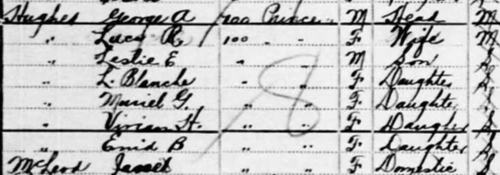
Another search, and I found the eight (!) residents of 100 Prince Street in 1911:

1901 Census Clip

If you’re curious about Canadian ancestors who would have been in the country in either 1901 or 1911, Automated Genealogy should be your first stop.

🗓️

I’ve just had a manila envelope slipped under my door: when the CBC Television news for Prince Edward Island returns to an hour-long format this February, it will be re-branded as Compass (history of the name).

And they say dogged persistence doesn’t pay off.

🗓️
CBC  •  Compass

About This Blog

Photo of Peter RukavinaI am . I am a writer, letterpress printer, and a curious person.

To learn more about me, read my /now, look at my bio, listen to audio I’ve posted, read presentations and speeches I’ve written, see things I’ve favourited elsewhere, or get in touch (peter@rukavina.net is the quickest way).

I have been writing here since May 1999: you can explore the 25+ years of blog posts in the archive.

You can subscribe to an RSS feed of posts, an RSS feed of comments, an RSS feed of favourites elsewhere, or a podcast RSS feed that just contains audio posts. You can also receive a daily digests of posts by email. I also publish an OPML blogroll.

InstagramYouTubeVimeoORCIDOpenStreetMapInternet ArchivePEI.artDrupalGithub.