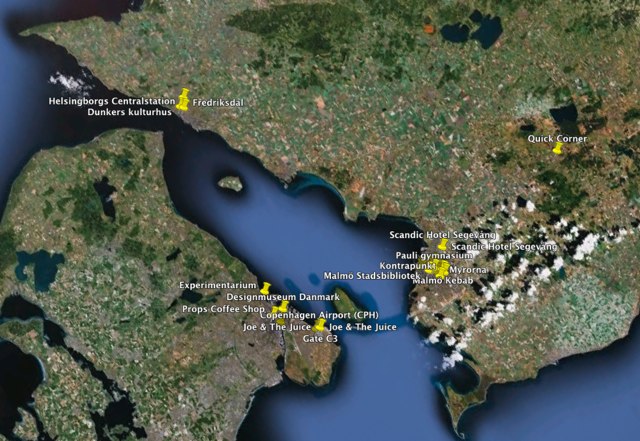
When we picked up our Kia Soul rental last Thursday it was full of gas. We drove from Charlottetown to Montreal, drove around Montreal a bit, and drove back. Total driven from door-to-door was 2,441 km and the Soul reported that it used 8.1 litres/100 km of gasoline when I return it; actual gasoline purchased: 

  • Hartford, NB - 37 litres at $1.337 for $50.68
  • Deschambault, QC - 44 litres at $1.394 for $61.47
  • Brossard, QC - 11 litres at $1.359 for $16.24
  • Levis, Quebec - 35 litres at $1.394 for $49.51
  • Hartford, NB - 39 litres at $1.337 for $52.16
  • Charlottetown, PE - 38 litres at $1.281 for $49.38

So we used a total of 204 litres of gasoline which cost me $279.44. This comes out to a slightly higher 8.36 litres/100 km, or about 28 miles per gallon. Which is right around what the U.S. Department of Energy reports.

Our carbon footprint for this trip was either 0.38 tonnes  or 0.40 tonnes or 0.46 tonnes depending on who’s doing the calculation. This is 60-70% of our emissions if we had flown (0.65 tonnes).

Mileage

🗓️

NOKIA Lumia 800_000794

🗓️

When you see beautiful industrial builings like this (the former Crane cast iron pipe and valve plant on the Lachine Canal in Montreal), and realize that we’re capable of making substantial, striking, well-built commercial infrastructure, it makes the snap-together-from-a-catalog tissue-paper-and-aluminum buildings that APM et al are building all over Charlottetown even more depressing to regard.

NOKIA Lumia 800_000802

🗓️

It’s been quiet here for a week, mostly because of a last-minute trip that Oliver and I took up to Montreal. The trip had a variety of purposes beyond simple “father and son road trip” (which was a good purpose in its own right). Oliver had a new cousin to visit; Alain at Atelier Domino, a letterpress shop in the city, was selling off a collection of metal type; I needed paper from Saint-Armand and some accessories for the office from IKEA.

Because of the need to haul cargo, and a desire not to tax the aging VW Jetta, I rented a car for the weekend. As chance would have it we ended up with a Kia Soul, which was the perfect car for the job: not the most comfortable car in the world, but spacious and well-laid-out for holding lots of stuff (in addition to the type and the IKEA goods we made a stop at Adonis to fill up on exotic foods).

Loaded Kia Soul

We rented an apartment from Airbnb — it was a block from Atelier Domino, close to my brother’s place, in a nice neighbourhood, and only cost us $84/night. We never met Carole, the owner, but she was quick with the email communication and the place worked out really well.

In additional to family visiting and shopping, otherwise we did the usual “father and son go to Montreal” things — visited some of the installations from the International Digital Arts Biennial, Vietnamese sandwiches in Chinatown, went to the movies (John Carter on the 3D Imax), went to the theatre (RH Thomson and Michelle Giroux in Same Time Next Year), make-your-own frozen yoghurt, fantastic Mexican food, and several very good coffees.

The driving was a killer (younger Pete would think nothing of driving almost anywhere in North America on a moment’s notice, but times have changed); we ended up doing just over 2400 km round-trip. We stayed in Riviere-du-Loup on the way up at Hotel Universel (clean, inexpensive, and seemingly teleported from 1974 design-wise) and in Edmundston on the way back at the Best Western (possibly the best roadside hotel I’ve ever stayed at — really).

2441 km, Charlottetown to Montreal Return

I’ve spent the night unpacking the Soul, putting together IKEA accessories and getting the Charlottetown operation back in action; regular programming resumes tomorrow.

🗓️

Here’s an undated postcard from the PEI Museum and Heritage collection showing the Confederation Centre of the Arts:

Confederation Centre of the Arts Postcard

The Centre is in the Brutalist style that was typical of institutional buildings in the 1960s, a style described as valuing “truth to materials”:

This “truth to materials” approach was anti-aesthetic, but, the Smithsons believed, more honest and true to Modernism’s basic principles. Reynar Banham dubbed the school ‘the New Brutalism’, a movement which aimed, in his words, to “make the whole conception of the building plain and comprehensible. No mystery, no romanticism, no obscurities about function and circulation.”

The buildings that were torn down to make way for the Centre were decidedly non-Brutalist; here’s another postcard from the PEI Museum and Archives collection taken from the same perspective, but in an earlier day:

Full of mystery, romanticism, and with much left to the imagination about function and circulation. Tearing down those beautiful buildings and replacing them with something tantamount to a nuclear fallout shelter took courage; it may have been misplaced, deranged courage, but it was courageous nonetheless.

Almost everything that has been done since — as the building has, as Stewart Brand would say, “learned” — has been backing away from that courage, trying to mute and soften the Brutalism. Here’s a photo I took from my office this morning, from a slightly different angle, but capturing the same area of the Centre:

Confederation Centre Today

The trees could be expected to grow up. But everything else — the planters, the replacement of the broad staircase, the public art, the lamp-posts, the garbage cans — has had the effect of obscuring architectural intent of the building. It hasn’t exactly added “mystery” or “romance,” but the eye is deflected, and the truth is no longer in the materials.

🗓️

Back in 1999 Malcolm Gladwell wrote an article for The New Yorker, Six Degrees of Lois Weisberg, an article that factored prominently in his book The Tipping Point. In the article Gladwell profiled Chicagoan Lois Weisberg, a person seemingly at the centre of every crossroads in that city. Gladwell coined the term “connector” to describe Weisberg:

Why is it, for example, that these few, select people seem to know everyone and the rest of us don’t? And how important are the people who know everyone? This second question is critical, because once you begin even a cursory examination of the life of someone like Lois Weisberg you start to suspect that he or she may be far more important than we would ever have imagined — that the people who know everyone, in some oblique way, may actually run the world. I don’t mean that they are the sort who head up the Fed or General Motors or Microsoft, but that, in a very down-to-earth, day-to-day way, they make the world work. They spread ideas and information. They connect varied and isolated parts of society. Helen Doria says someone high up in the Chicago government told her that Lois is “the epicenter of the city administration,” which is the right way to put it. Lois is far from being the most important or the most powerful person in Chicago. But if you connect all the dots that constitute the vast apparatus of government and influence and interest groups in the city of Chicago you’ll end up coming back to Lois again and again. Lois is a connector.

I have never wanted to be an astronaut or a race-car driver or a politician or an artist, but the life of a connector, since I read Gladwell’s article more than a decade ago, has always seemed like something to aspire to.

Living here in Prince Edward Island is both bad and good for this aspiration: good because there are fewer social strata here than elsewhere and so it’s easier to connect across them; bad because, as a relative newcomer, I can never possibly hope to catch up with connectors who have been connecting all their lives. So I am an amateur cross-pollinator at best.

But, by applying Prince Edward Island-style learned behaviour to the broader connected world, sometimes it’s possible to make connections that resonate. And when they come together, it’s a great feeling.

Five or six years ago at the reboot conference — a conference that was instrumental in helping me confront the effects of connector-disabling shyness — I met Alex and Eric, two Swedes who shortly thereafter moved to Berlin and founded SoundCloud.

When I was in Berlin last February to the Cognitive Cities conference (organized, in part, by reboot alumnus Igor) I renewed my aquaintance with Eric and visited the SoundCloud office; when I went back to Berlin last summer I visited again, and ended up meeting David and Parker after being misdirected to the remote SoundCloud enclave office that houses the Community Team.

Fast-forward to this spring: my old friend and occasional Prince Edward Islander Cindy was going to Berlin with her son Cal. Cal, among other things, spent a year in Norway studying snowboarding and video production, and I knew he was interested in music and had a SoundCloud account so I reasoned he might be a good person to connect with SoundCloud, so I sent off an email to David and this morning, it seems, Cal dropped by.

I know this because of the following in Natalie’s Twitter stream:

Cal Visits SoundCloud

(Full circle: Parker introduced me to Natalie at the SoundCloud party I made best efforts to attend last summer.)

I love it when a plan comes together.

🗓️

The great corporate patron of my letterpress project continues to be Kwik Kopy in Charlottetown, just 4 blocks north up Queen Street. This week I’m plotting a poster for a May event, and I needed some green ink. Not much green ink, just a couple of tablespoons. A quick email to Rob at Kwik Kopy; an couple of hours later the reply: “there’s some green 348 in a Tim Hortons cup on my desk waiting for you to pick up.” Which I just did.

NOKIA Lumia 800_000715

🗓️
Audio file

All week long students from the Holland College School of Performing Arts have been rehearsing for in the theatre next to the Reinventorium, readying for this weekend’s showcase event Love and the Lack Thereof (April 20th & 21st, 7:30 p.m., tickets $14.00 general, $12.00 students, at the box office or online).

Here’s what they sound like through the (thin) wall that separates our office from the theatre.

I’ve heard so many bits of the show, puntucated by starts and stops and stage directions, that I feel compelled to attend a performance this weekend. Maybe you should too?

🗓️

In The Guardian of December 30, 1899 was the following review of a concert at Prince Street School (I’ve broken the text into paragraphs to improve readability, but this is otherwise verbatim, thanks to IslandNewspapers.ca):

The interest taken in Prince Street School concerts is not confined to the pupils alone but to those who since its institution have gone forth and have become the parents of many of those whose names are today enrolled on its class books. For some time past in fact since the opening of the school intense interest has been taken in the Prince St. School concert, and the teachers and pupils vied with each other in their desire to make the affair a success.

It might however, be mentioned that the Principal, Mr. J. D. Seaman has spared neither time nor trouble to perfect the many numbers on the programme. Misses McMurray, Bremner and James also did all possible to aid in making the concert a success and valuable assistance was given by Messrs. Arthur Peake and B. Bremner.

Shortly after eight o’clock the curtain rose and sixteen young ladies in costume emblematic of Britain, each carrying a Union Jack performed the intricate figures of the Columbia Drill. Toward the close the recitation on by one of the sixteen “Only a small bit of Bunting,” received patriotic rounds of applause, after which the whole company joined in singing the “Red White and Blue.”

The absent minded Beggar was cleverly rendered by little Hilda Sentner. Harry Smith followed with another of Kipling’s selections “Tommy.” Harry was compelled to respond to an encore.

The Gossip Pantomime by 14 little girls was the gem of the evening. The motions or the little girls was almost perfect, as they by mute language gossiped and noted the effect. The Cantata “Little Gypsy” by 45 performers came next. The scene on the Village Green, where all the young people were enjoying themselves in sport was  very real, while the dialogue and acting were very good amateur work.

The solo by Mary Norton who took the part of the gypsy, was sweetly rendered. The duet by Winnie Holbrock and Pearl Hunter was good. Victor Anderson’s (the gypsy boy) song sustained his reputation as a soloist. Particularly good was the marching, while the costuming was tastefully done. The story of the Cantata was then told in three tableaux, first the child stolen afterwards ill-used, in each of these the gypsy was surrounded by the school children, then came the restoration of the child to her sisters which was a climax to a series of truly realistic pictures. The pictures were illuminated by electric lights through different colored-shades, the effect of which was beautiful.

The grouping of the tableaux was done by Mr. Thos. May and the lights managed by Mr. W. P. Douil. In a clear distinct voice Jean McIsaac described the sorrows, and trials of an inventor’s wife. Master Victor Anderson’s singing of Tommy Atkins elicited long and loud applause. The audience persisted in hearing him again.

The closing number of this admirable programme was the dialogue Britannia, in which Britannia as a piece of statuary, presented an admirable picture and throughout the the entire dialogue and tableaux was as immovable as the marble she represented. Ceylon, Cape Colony, India, Gibraltar, Australia, China, Canada, Yukon, New Zealand, Ireland, Scotland and England, richly costumed placed their several gifts of natural wealth at Britannia’s feet. The effect of this as presented in the tableau that followed was beautiful.

The patriotic tone manifested throughout the entertainment reached a climax when the audience rose to their feet and joined in the chorus of Rule Britannia followed by the National Anthem.

We are not giving this entertainment undue praise when we say that it was one of the best given in the city, and we are glad to announce that the management has decided to repeat it this afternoon at 3 o’clock to give the mothers and children who were unable to be present an opportunity to enjoy this rare treat. Admission to the matinee will be 10c. for children, 15c. for adults. 

What’s remarkable from that day’s paper — the last of the 1800s — was that there was no mention at all of the turning of the millennium. For those of us who lived through the melee of Y2K that seems quite strange. 

🗓️

The uncanny valley is a “hypothesis in the field of robotics… which holds that when human replicas look and act almost, but not perfectly, like actual human beings, it causes a response of revulsion among human observers.” In other words, we get turned off by almost-but-not-quiteness.

Over the last 18 hours, since the delivery of the Prince Edward Island budget yesterday afternoon, I have heard members on the government side utter the phrases “low and modest income Islanders,” “new fiscal reality” and make reference, in interviews with TV and radio reporters, to “people like you and I” enough times to know that there are media-training puppeteers lurking behind the scenes with a carefully crafted playbook designed to help the goverment sell its budget to we citizens.

Members on the government side are not unique in this regard: media training is very obviously a part of opposition politics  as well. And its something — recall “Canada’s New Government” — that exists at all levels of government.

It’s hard to argue with the notion that politicians be trained to effectively communicate ideas to constituents: talking and listening is, in essence, their job, and being able to distill concepts so that we can all understand them is important if our collective pulse is to be gauged and reacted to.

But at some point “hewing to the playbook” crosses over from “effective communication” into a sort of trance-like ceaseless reptition of stock phrases and drains the humanity out of politicians to the point where they appear almost robotic.

Hon. Wes Sheridan, Minister of Finance, has, for me, crossed over this divide, and it’s his pronunciation of the word chasm — with a soft “ch” like “cherry” instead of a hard “ch” like “kiosk” — that’s taken him there. I’ve got nothing against the metaphorical chasm he’s referencing, it’s just that, now having heard him repeat the metaphor three times in various media in less than a day, I’m now acutely concious that he’s just saying the same thing over and over and over again.

“Low and modest income Islanders.” “New fiscal reality.” “The six provinces without resources in the ground.” “People like you and I will pay more.” 

Perhaps it’s unreasonable to expect politicians to be able to extemporaneously speak from the heart at every turn. But, as this is a trend that will only continue unless we offer feedback, I think it might be the time to suggest to our politicians that we’re not as much interested as being sold to as we are interested in gaining insight, and to gain insight requires that we help them out of the uncanny chasm and back into a less-well-trained, conversationally honest way of communicating.

🗓️

About This Blog

Photo of Peter RukavinaI am . I am a writer, letterpress printer, and a curious person.

To learn more about me, read my /nowlook at my bio, listen to audio I’ve posted, read presentations and speeches I’ve written, or get in touch (peter@rukavina.net is the quickest way). 

I have been writing here since May 1999: you can explore the 25+ years of blog posts in the archive.

You can subscribe to an RSS feed of posts, an RSS feed of comments, or a podcast RSS feed that just contains audio posts. You can also receive a daily digests of posts by email.