Scribie is an audio transcription company with lofty aspirations:

At Scribie.com, our big vision is that eventually all audio/video content created by man will be available as text and the knowledge capital therein will be unlocked for the greater good of humankind. To further this vision we are offering our transcription service free of charge to podcasters. The files will be transcribed whenever we are able to schedule it in and we will send you the transcripts once it’s complete. We will also post the audio and transcript on our blog.

I decided to take them up on their offer of free podcast transcription, and the result is Live from the Formosa Tea House, Session Three, transcribed.

Buried deep inside the transcript you’ll find my architectural aspirations:

0:36:10 PR: Well, I’ve ran into a very similar thing. I was watching Charlie Rose last week and Philip Johnson, the architect had died, and they were talking a lot, they interviewed Frank Gary and they talked about Philip Johnson and I realized that deep in my heart of hearts I had always maintained the illusion that I will someday gonna be an architect. Because I had sort of toyed with the idea of coming out of high school…

0:36:29 DJ: Just like George from Seinfeld.

0:36:32 PR: I had toyed with the idea coming out of high school maybe I would go to architecture school but I didn’t, I went into a general arts program. But I’d always sort of thought deep in my mind that eventually I’d be done with this computer stuff and I’d go on to do the real thing and it would be architecture. And then just listening to Frank Gary talk and Philip Johnson talk and thinking about architecture and why I hadn’t done it yet, I realized that first of all I have none of the basic skills required to be an architect. Like I can’t think in three dimensions. I’m not particularly… I like buildings and I appreciate a good space but I have no idea how you would go about creating that. [chuckle] And I can’t deconstruct it and I’m interested in buildings but I’m not passionate about them. And then I realized with the few exceptions I don’t really like architects as people.

0:37:15 SG: You’re the worst architect ever. [chuckle]

0:37:17 PR: So I decided that maybe I should let that dream go now.

I’m happy to report that in the 12 years since I’ve managed to befriend an unusual number of architects, and find them to be delightful people. So I was wrong about that. But Steven was right: I’d be the worst architect ever.

As it happens, Oliver and I are off to Halifax for March Break next week, and we’ve plans to see the film The Sense of an Ending, playing at the Oxford; the plot, says Wikipedia, is:

When the past catches up with Tony, he reflects on the paths he and his friends have taken.

Reading a transcript of what amounted to a casual conversation among friends recorded more than a decade ago is similarly bracing.
🗓️

We have a “change bucket” in our dining room where all the loose change in our household ends up. Over the weeks and months it gradually bulges toward overflowing, and, eventually, we must face up to its need to be emptied and turned into real money.

Today was that day.

There are two approaches we can take to this task: secure coin wrappers, spend a few hours sorting and rolling coins, then haul them up to the bank and deposit them.

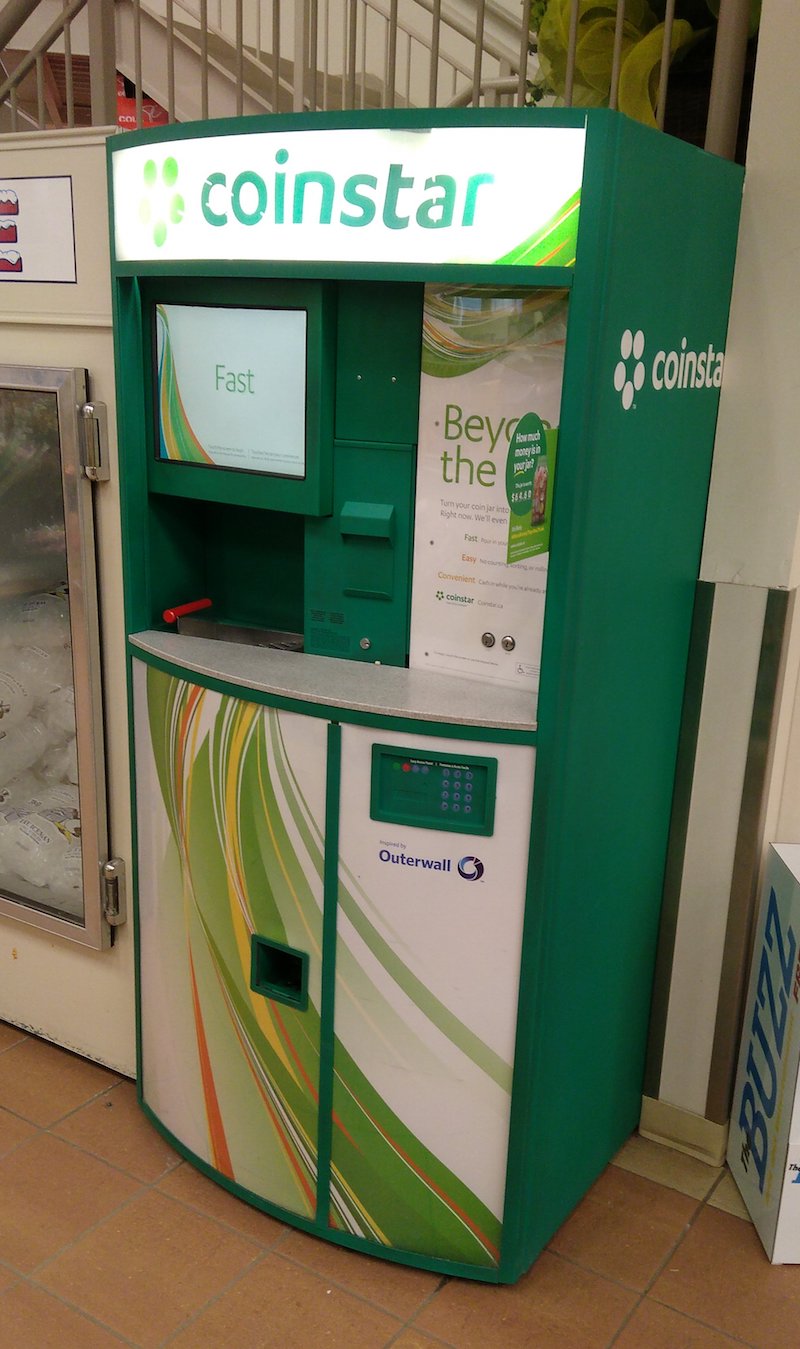
Or we can take the change bucket out to the Atlantic Superstore, and use the “Coinstar” machine to magically–if expensively–turn them into paper money.

Photo of a Coinstar Machine

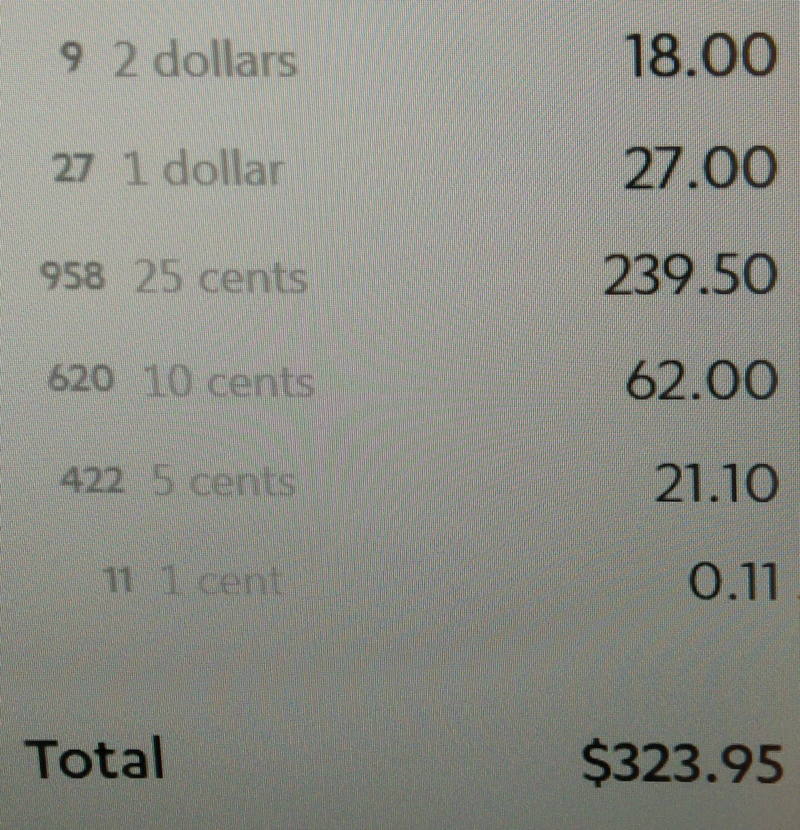
So this morning after dropping Oliver off at school, I hauled the change bucket into the Superstore, and gingerly ushered its contents into the Coinstar, When I was done, the screen gave me the total of $323.95 along with the breakdown by coin denomination:

Screen shot of Coinstar machine showing totals per denomination

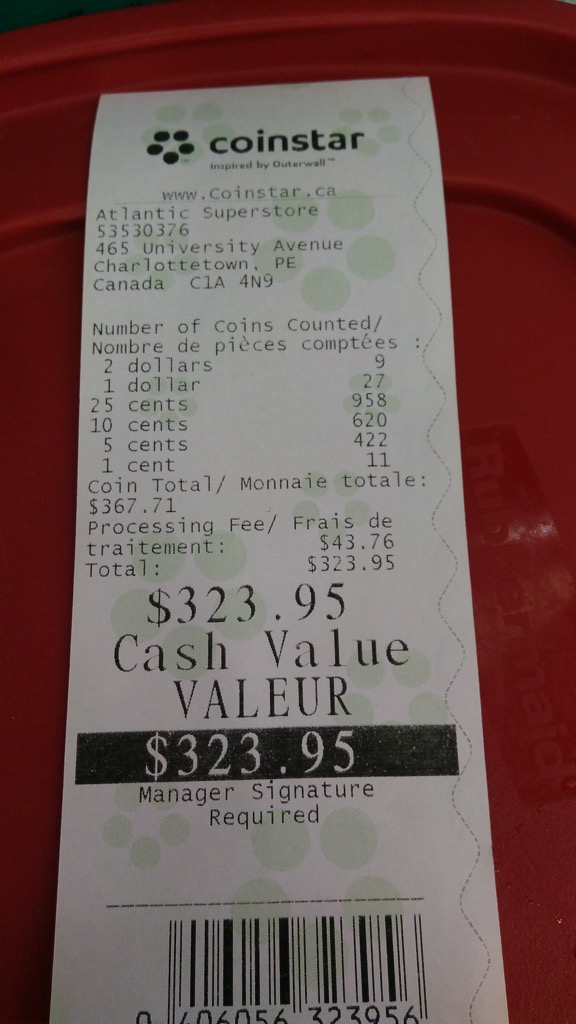
Sharp-eyed math whizzes will note that the total of the coins does not, in fact, add up to $323.95: that’s the total minus the 11.8% Coinstar commission of $43.76.

The actual total coinage was $367.71. Like I said, all that labour-saving magic the Coinstar machine does is not cheap.

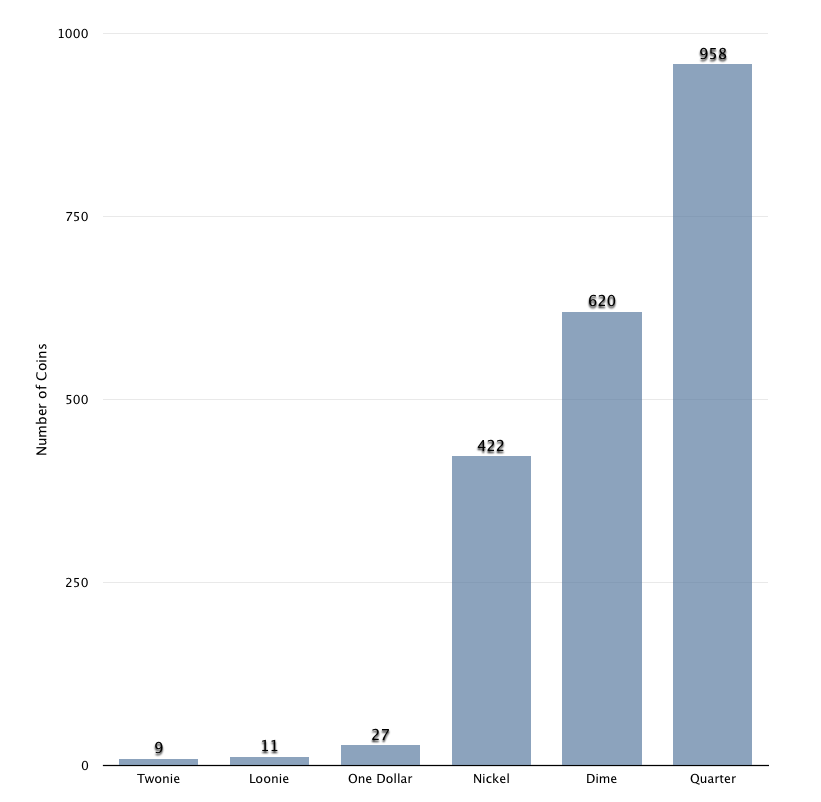
There were 2,047 coins in all; the distribution of denominations looks like this:

Bar graph showing coin distribution

Quarters were the motherlode: they end up in the change bucket because, hey, they’re only worth 25 cents and they weigh down the pockets. But take 958 of them together, and all of a sudden you have $240!

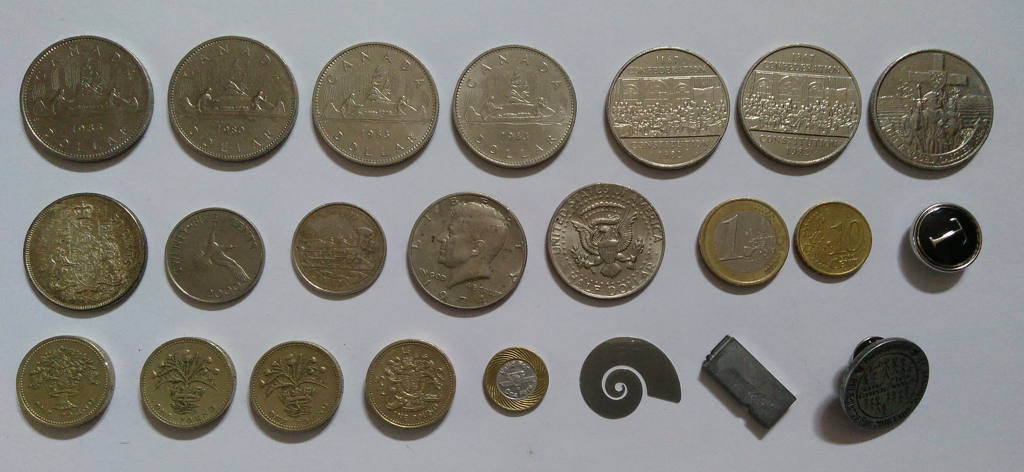
What was most interesting to me, however, were the items in the change bucket that were not coins. Or that, at least, were not coins that the Coinstar would accept (it warns you that it might not accept and may not return non-acceptable coins, but it seems to have done a pretty good job). Here’s what the leavings looked like when the process was done:

Picture of leftover coins from Coinstar machine process

What was left over was:

  • 7 Canadian silver dollars: 4 “canoe” variants, 2 “Fathers of Confederation,” and a single “Jacques Cartier.”
  • 1 Canadian 50 cent piece from 1934.
  • 2 Canadian quarters, one with a bird from 2000 and one with a locomotive from 1999.
  • 2 U.S. 50 cent pieces (“half dollars”), sporting JFK on one side and an eagle on the other.
  • 1 Euro coin.
  • 1 European 10 cent piece.
  • 1 button with a letter “T” on it.
  • 4 British pounds.
  • 1 TTC subway token.
  • 1 interesting paperclip.
  • 1 piece of metal type: an exclamation point in Futura 30 pt.
  • 1 participation pin from the PEI Science Fair.

These are the leavings of about a year’s worth of change-bucket-collection; it’s an interesting archaeological dig through our year, with a collection of unanswered questions left over. Like “wait, Canada has a 50 cent piece?!” and “how did we end up with 7 silver dollars in the change bucket?”

As much as Coinstar’s commission seems like highway robbery, I did emerge with $323 more in spendable paper money than I had before I walked in the door, and I saved myself the drudgery of sorting and rolling, and that’s worth something. Maybe not $43.76. But something.

When all was done, the Coinstar machine spit out a voucher:

Photo of Coinstar receipt showing total and commision

I took the voucher to a cashier in one of the regular checkout lanes, and she cleaned out every last bill in her till to pay me what I was owed.

And now the cycle begins again. There will be 95 cents in the change bucket tonight as a start.

🗓️
Coins  •  Coinstar  •  Atlantic Superstore

I’m pretty sure the person who purchased “API console” as a Google AdWords keyword didn’t count on the traffic for Google API Console searches.

Screen show of a Google AdWords ad showing an API 2488 Console 1973 mixing board for $94,047.10

(That’s not an actual ad; don’t click on it.)

🗓️

I think I may have a new favorite page on the Internet: Diagnostic Sounds is a collection of sounds from John Muir’s How to Keep Your Volkswagen Alive VW Engine Sounds, a cassette companion to his seminal book.

John Muir is a hero of mine—you can tell by the number of times I’ve mentioned his book over the years—and if I ever invest in a vintage VW Beetle, it will be because of his book. And, now, his cassette.

🗓️
John Muir  •  Volkswagen  •  Books  •  Sounds

Late last week I added an Eddystone beacon to the Reinventorium; today I added a beacon to myself.

So when I open the PhysicalWebScan app on my Mac, this is what I see:

Screen show of a beacon scan in my office.

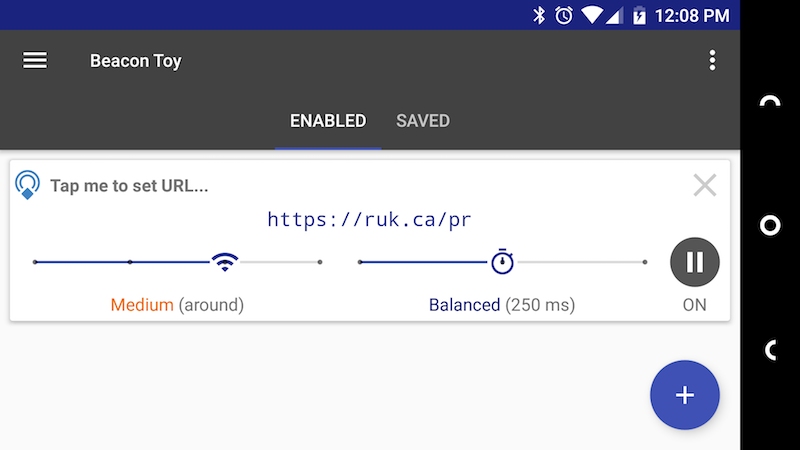
The personal beacon runs on my phone, powered by the free Beacon Toy app for Android. Beacons can only hold a limited number of characters for an URL, so I created a Drupal redirect, https://ruk.ca/pr, that leads to my About Peter Rukavina page, and I set the redirect as the beacon URL. The result looks like this:

Screen shot of Beacon Toy app running on my phone.

This means that should we be in proximity of each other, and you’ve got some sort of Physical Web scanning device in your pocket, you should be alerted that I’m nearby.

🗓️
Eddystone  •  Bluetooth LE  •  Android  •  macOS

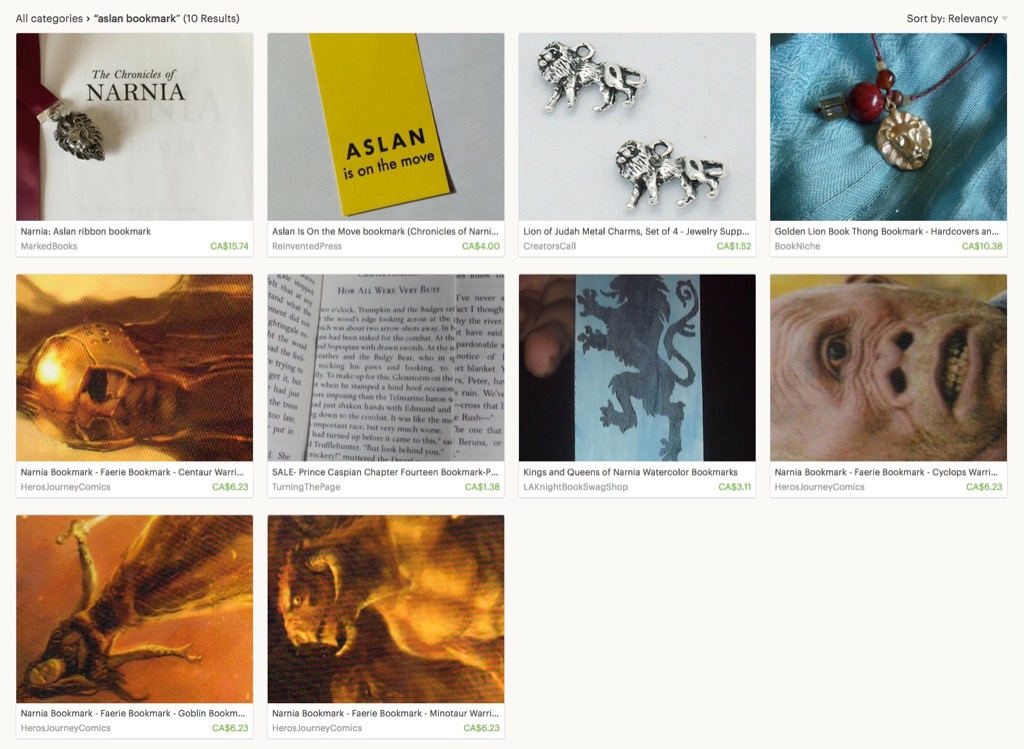
If I don’t say so myself, I think I own the “Aslan bookmark” category on Etsy, with the recent addition of the recently-printed Aslan Is On the Move piece. Get yours today!

Screen shot of a search for Aslan Bookmark on Etsy

🗓️
Etsy  •  Letterpress  •  Aslan  •  Chronicles of Narnia

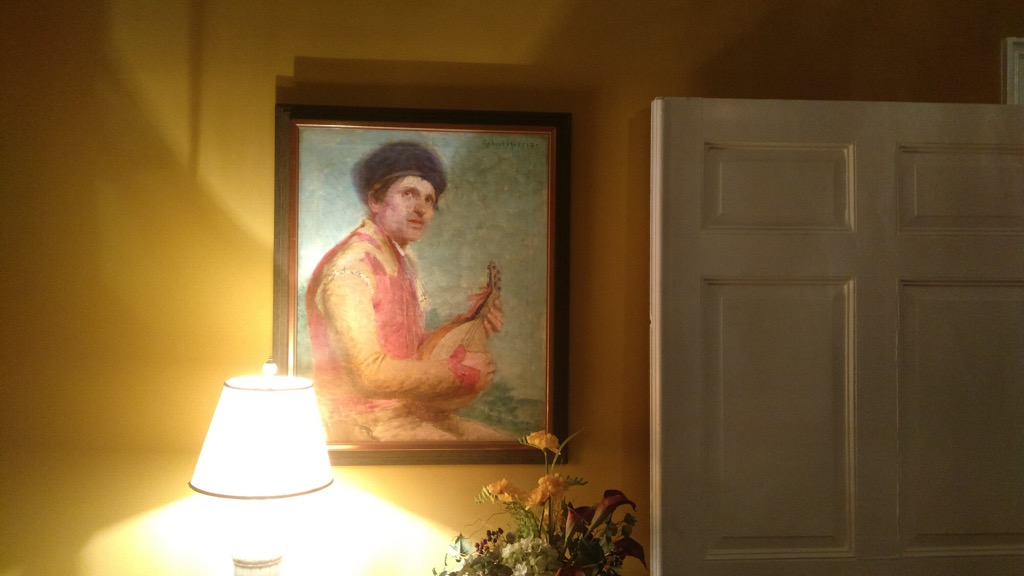
I spotted this Robert Harris painting, Study For Composing His Serenade, in a room at Government House in Charlottetown recently; it’s on loan from the Confederation Centre Art Gallery (Oil on canvas, Gift of the Robert Harris Trust, 1965, CAG H-250).

Robert Harris, Study For Composing His Serenade, undated

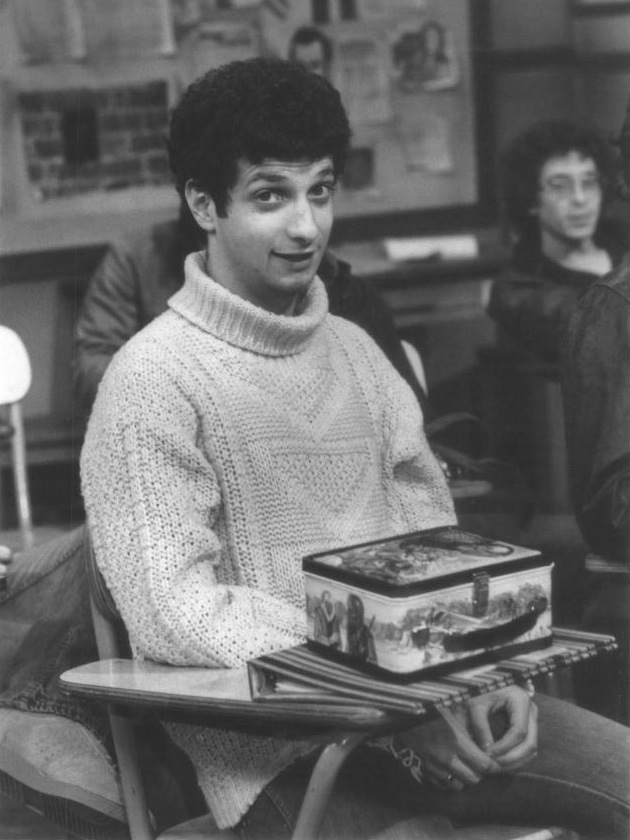
It’s disquieting how much the mandolin player in the painting resembles Ron Palillo’s character Arnold Horshack from the 1970’s television show Welcome Back Kotter:

Ron Palillo as Arnold Horshack (from Wikipedia)

Regardless of the Horshack-doppelgänger coincidence, it’s a lovely painting.

If, like me, you are somewhat of a Kotter-o-phile, be sure to listen to this final episode of the ill-fated podcast Mystery Show, an episode that, ironically given the photo of Horshack above, is all about lunch boxes.

🗓️
Robert Harris  •  Government House  •  Painting  •  History

Robin Sloan writes about deep-learning-assisted-writing, and captures something I’ve been thinking about for a long time:

That’s all buoyed by a strong (recent?) culture of clear explanation. My excited friend claims this has been as crucial to deep learning’s rise as the (more commonly-discussed) availability of fast GPUs and large datasets. Having benefited from that culture myself, it seems to me like a reasonable argument, and an important thing to recognize.

You could argue that the web itself could not have happened without a culture of clear explanation (supplemented greatly by View Source).

It’s why I believe so passionately in the obligation to explain.

🗓️

My friend Dan the Cartographer came along to the Reinventorium with his children this afternoon for a tour of the letterpress shop. I took the opportunity to set a brief passage from The Lion, the Witch and the Wardrobe, a line from the eighth chapter, where the children encounter the Beavers for the first time (emphasis mine):

“That’s right,” said the Beaver. “Poor fellow, he got wind of the arrest before it actually happened and handed this over to me. He said that if anything happened to him I must meet you here and take you on to—” Here the Beaver’s voice sank into silence and it gave one or two very mysterious nods. Then signalling to the children to stand as close around it as they possibly could, so that their faces were actually tickled by its whiskers, it added in a low whisper—

“They say Aslan is on the move—perhaps has already landed.”

And now a very curious thing happened. None of the children knew who Aslan was any more than you do; but the moment the Beaver had spoken these words everyone felt quite different. Perhaps it has sometimes happened to you in a dream that someone says something which you don’t understand but in the dream it feels as if it had some enormous meaning—either a terrifying one which turns the whole dream into a nightmare or else a lovely meaning too lovely to put into words, which makes the dream so beautiful that you remember it all your life and are always wishing you could get into that dream again. It was like that now. At the name of Aslan each one of the children felt something jump in his inside. Edmund felt a sensation of mysterious horror. Peter felt suddenly brave and adventurous. Susan felt as if some delicious smell or some delightful strain of music had just floated by her. And Lucy got the feeling you have when you wake up in the morning and realise that it is the beginning of the holidays or the beginning of summer.

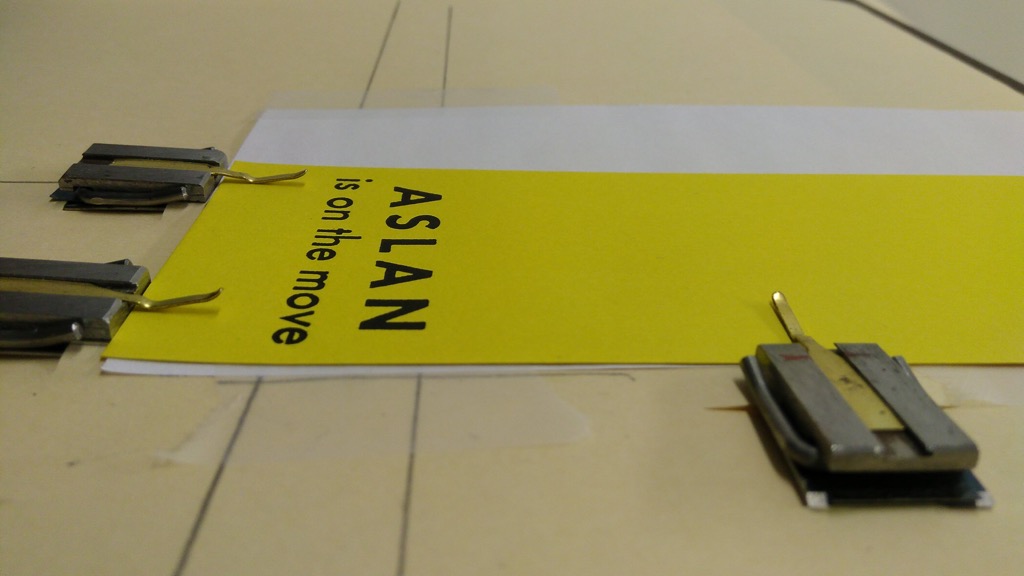
I set ASLAN in 30 pt. Futura Bold, and “is on the move” in 24 pt. Futura; the paper is yellow card I purchased while I was in Japan.

I walked Dan’s family through the process of setting the type, setting up the Golding Jobber № 8, doing makeready, and printing. A good time, I think, was had by all.

Aslan is on the move, freshly printed on the letterpress.

🗓️

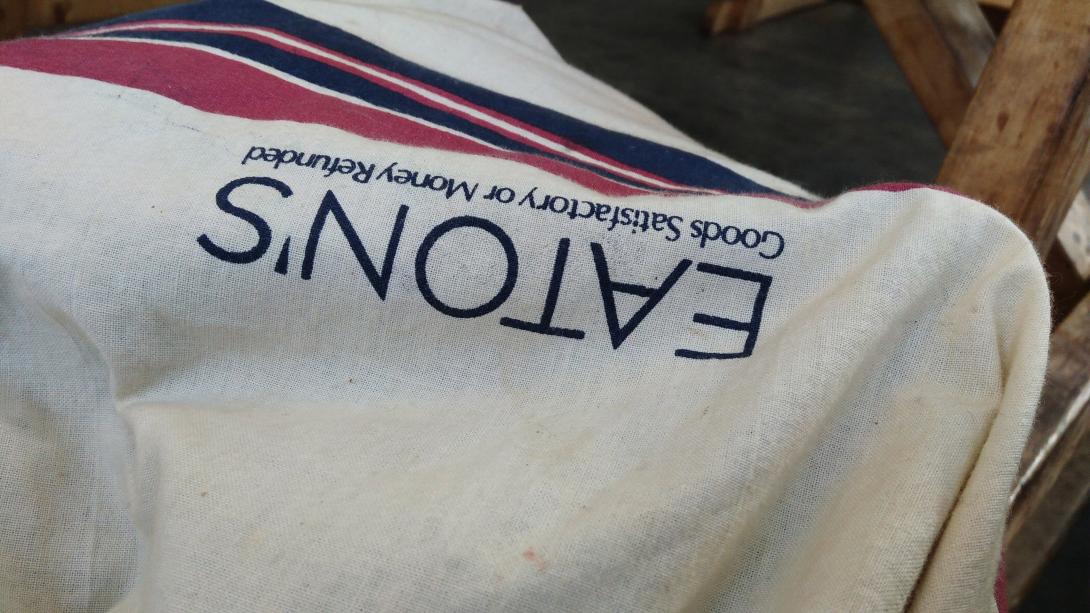
I’m pretty certain we can lay claim to the oldest cloth shopping bag at the market.

🗓️

About This Blog

Photo of Peter RukavinaI am . I am a writer, letterpress printer, and a curious person.

To learn more about me, read my /now, look at my bio, listen to audio I’ve posted, read presentations and speeches I’ve written, see things I’ve favourited elsewhere, or get in touch (peter@rukavina.net is the quickest way).

I have been writing here since May 1999: you can explore the 25+ years of blog posts in the archive.

You can subscribe to an RSS feed of posts, an RSS feed of comments, an RSS feed of favourites elsewhere, or a podcast RSS feed that just contains audio posts. You can also receive a daily digests of posts by email. I also publish an OPML blogroll.

Instagram • YouTube • Vimeo • ORCID • OpenStreetMap • Internet Archive • PEI.art • Drupal • Github.