
Menu planning by Oliver. Execution by Catherine.
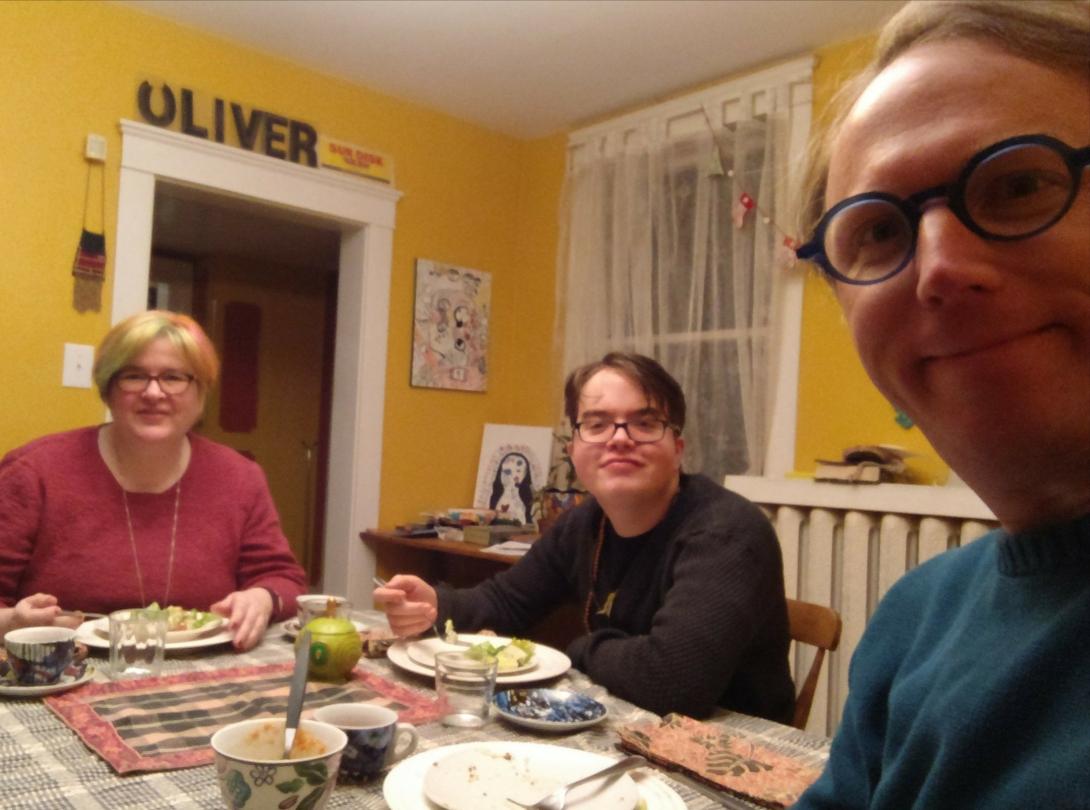
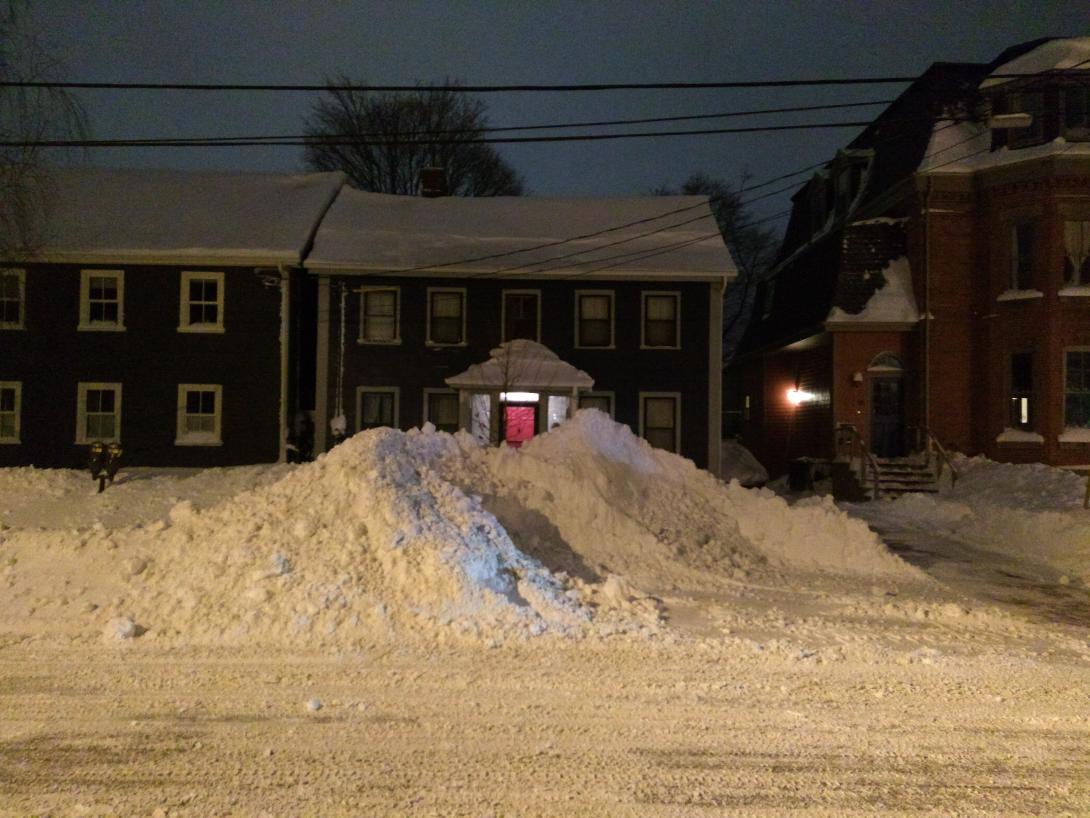
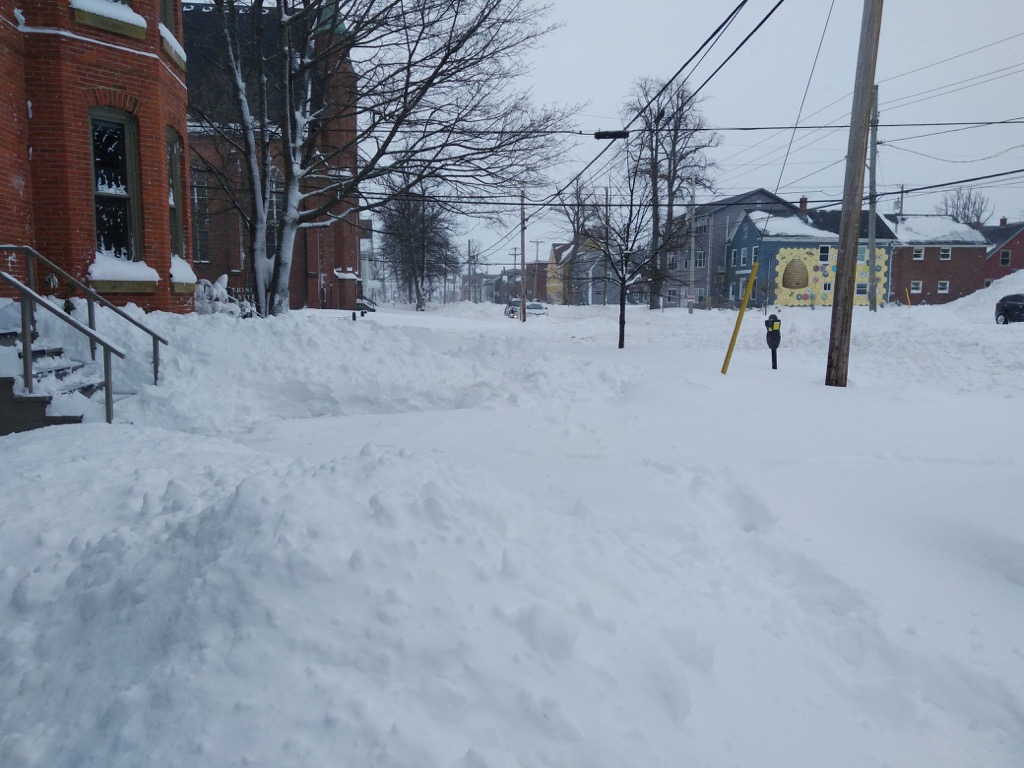
Monday and Tuesday brought a lot of snow to 100 Prince Street. And our new snow plowing contractor, from Kinkora, proved their worth by doing a thorough clean-out (with a follow-up after I managed to extricate the car).
🗓️
Who among us has not spent time on the telephone with a friend or family member experiencing audio issues with their Mac.
The sound isn’t coming out of the headphones. Or it is coming out of the headphones and they don’t want it to. Or they can hear a Skype call, but the person on the other end can’t hear them.
Most of the solutions to problems like this on a Mac require the mysteriously-named application called Audio MIDI Setup, something that should have been replaced (and renamed) by Apple years ago. It’s got a cryptic user interface and all sorts of controls that are of practical utility to almost nobody.
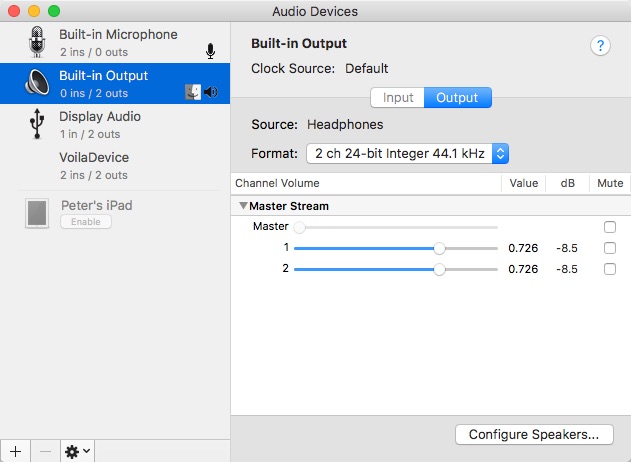
Enter the new app SoundSource from Rogue Amoeba, with utility that should have been baked right into macOS from the beginning.
Now what you used to need Audio MIDI Setup for, you can now do right from your menu bar:
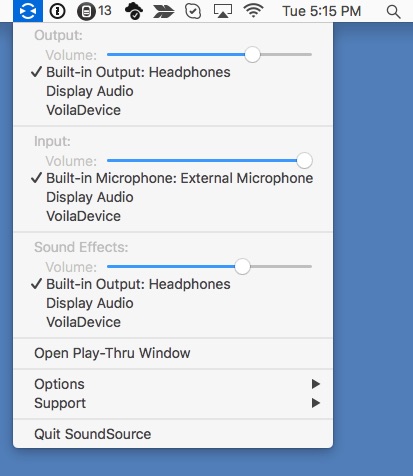
SoundSource is only $10, and if you’ve got another licensed Rogue Amoeba product–and you should probably own at least Audio Hijack–you can get a SoundSource license for free (I was so impressed by that offer that I paid $25 to update my Audio Hijack to the latest version just so I could do that; it’s a great idea).
🗓️
I like the fact that Environment Canada weather alerts are obviously written by humans. Witness the one that was just issued, which begins like this:
The reprieve is short lived as the next weather system is expected to impact Prince Edward Island Wednesday night into Thursday.
They clearly realize their responsibility to capture something of the weather zeitgeist in their prose.
🗓️
Back in 2003 there were a series of “blogger meetups,” held in the back room at the old Formosa Tea House on University Avenue, and organized by Will Pate. I brought Rob Paterson along to one of these, and Will captured the moment and posted it to his erstwhile web gallery (that’s me, in my green-cardigan-wearing phase, on the far right; Rob’s across the table, in the middle):
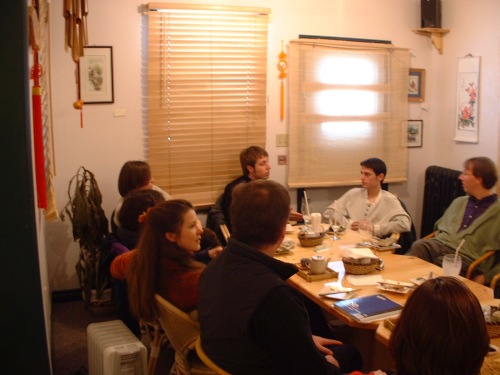
I believe it was that same meetup where Will boldly proclaimed that “blogging is dead,” a notion that was greeted as a great joke by all present, as at that time blogging was in full voice and the notion that bloggers would stop blogging was absurd as suggesting we’d stop breathing.
Down at the end of the table in that photo is Young Dan James, and Dan’s CEO Blues blog was then, and for a long time thereafter, a welcome and compelling slice of the local blogosphere.
Indeed, they of silverorange were, collectively, a good chunk thereof: Steven Garrity’s Acts of Volition, Daniel Burka’s Delta Tango Bravo, Stephen DesRoches’s New Recruit, and silverorange labs’ blog itself, to choose just a few.
And then a decade passed. Bloggers got married. Bloggers had children. Bloggers changed jobs. Bloggers moved away. Bloggers started writing on Facebook. Or Twitter. Or Medium.
And today my feed reader reported to me that Dan’s blog’s RSS feed couldn’t be reached. I emailed Dan, and he let me know that he’d let his blog wither on the vine during a server retirement. It’s 404. Done.
Blogging’s not dead–Steven’s just migrated to WordPress, Stephen’s Focused on Light now. And I’m still here.
But the death of Dan’s blog is a watershed moment, I think. I will miss his words.
🗓️
There have been two high-profile technical meltdowns in the last while, one at GitLab and another at Instapaper.
In both cases the underlying issues causing the problems were database related, and in both cases there were significant issues with both the backup regime and the emergency response routine.
Fortunately for the rest of us, in both cases the companies involved have responded, once the dust cleared, with detailed postmortems.
GitLab posted Postmortem of database outage of January 31:
On January 31st 2017, we experienced a major service outage for one of our products, the online service GitLab.com. The outage was caused by an accidental removal of data from our primary database server.
And Instapaper posted Instapaper Outage Cause & Recovery:
The critical system that failed was our MySQL database, which we run as a hosted solution on Amazon’s Relational Database Service (RDS). Here we’ll cover what went wrong, how we resolved the issue and what we’re doing to improve reliability moving forward.
This is a laudable trend, and one that’s of tremendous utility to the broader digital community. All digital systems fail. All disks fail. All DNS setups go wrong. Having procedures in place to deal with this is all you can do; and because it’s hard to imagine, in advance, how and why things will go wrong, gaining insight from the real world failures of others with a similar setup is some of the best education you can get.
I learned actionable things from both GitLab’s issue and Instapaper’s.
For example, I’ve added more redundancy to regular MySQL backups and, following the example of Marco Arment, have added an automatic process that, every day, launches a new EC2 instance, installs MySQL, imports the data dumped from Amazon RDS, and performs tests to check data integrity.
And, from Instapaper’s issue, I’ve learned about a hard limited of 2TB for older Amazon RDS instances, and about some of the challenges of migrating from legacy MySQL setups into Amazon’s Aurora.
Being open about failure, especially when the failures are as much human as technical, isn’t easy, and it goes against our natural impulses to try to contain and control information. So GitLab and Instapaper’s engineering teams and management deserve our thanks for realizing that being open is ultimately not only good for their business, but it’s good for the wider web.
🗓️
It snowed and snowed. It’s only just now stopped. Because there was a lot of wind, we ended up with a lot of snow in the front yard and relatively little in the back yard. So I spent 30 minutes raking snow off the front roof and 2 minutes raking snow off the back roof. But we are happy and warm and well-fed and having nothing to complain about.
🗓️
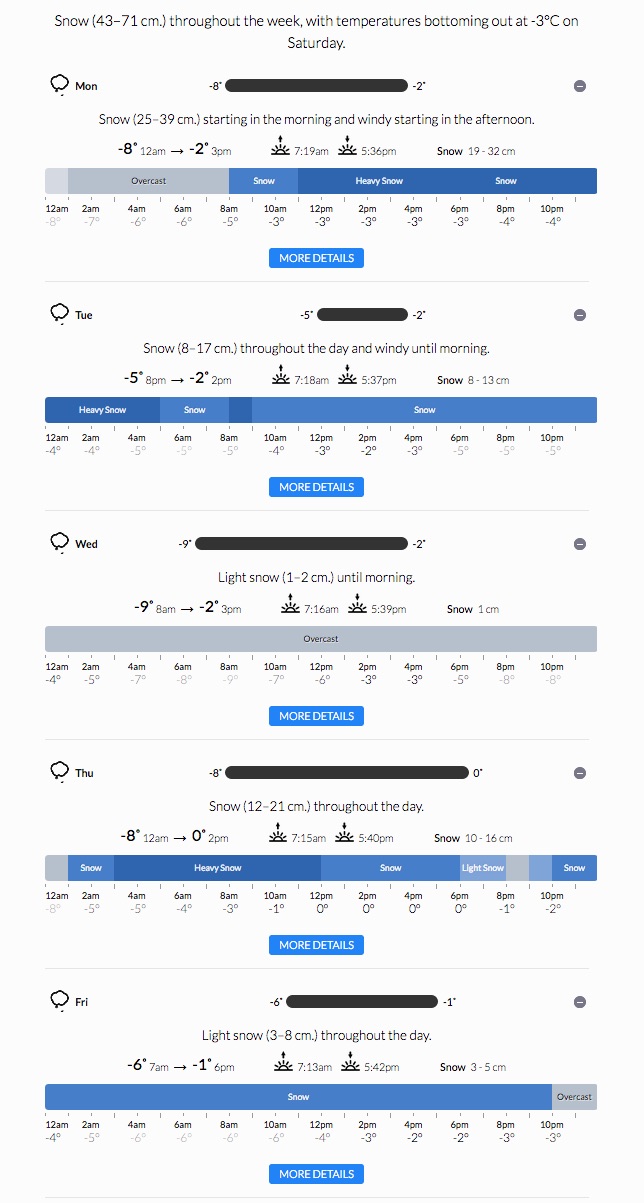
After a late start, today’s blizzard has started in earnest now.
And, says Darksky.net, it’s going to snow and snow, then take a day off on Wednesday, and then snow and snow some more.
🗓️
In the post Rands Response Hierarchy, the author outlines his response window and probability of reply to various methods of communication:
There are a great many ways to get in touch with me. With the establishment of Slack as a primary means of communication, I realized that I had updated the prioritized hierarchy to how likely I will respond to a piece of communication. From least likely to most likely, this is the hierarchy:
For a long time my Contact Peter Rukavina page has included the hint “I prefer email.” Sometimes people read that. Sometimes people read that, call me on the phone, and apologize for not following it (which is okay; it doesn’t say “don’t call me”).
Here’s my own “response hierarchy”:
Spam < Twitter < Email < Slack < Phone < SMS < Face to Face < The Post
- Spam: I never respond. Like Rands, I ignore spam. Some of it still slips through, but it’s mostly of the easily-identifiable “I can write a highly targeted post for your blog,” “We couldn’t deliver your UPS package,” or “Outstanding Invoice!” type that I can blow through.
- Twitter: I respond slowly. I still have a Twitter account, even though I’ve stepped away from it practically. So I’ll see your direct message, but it might not be for a while.
- Email: I usually respond the same day. I’m not one of those people with an unmanageable inbox, and I do a decent job of “inbox zero” at the end of every day. So I usually respond quite quickly, unless I’m flummoxed.
- Slack: I respond right away, if I work with you. I don’t use Slack as a broad interest-based chatting tool as others do: I chat with my coworkers only. And if I’m in the office, or I hear my phone go off, I’ll respond immediately.
- Phone: I almost always answer. The only exception is “Unknown Caller” or mysterious toll-free numbers, which I will ignore, especially if I’m busy. I don’t screen my calls otherwise, so if you call me and I don’t answer it’s most likely because I’m away from my phone or I’m asleep.
- SMS: I respond right away. Generally I get texts from family, from Oliver’s school, or from colleagues. I include Signal and Google Hangouts in this category, although I’ve only got a limited list of people I’m connected to that way.
- Face to Face: My contact page should really say “I prefer face to face,” as I really do. I have more fruitful conversations on street corners and in the coffee line than anywhere else. If I don’t stop to talk to you it’s only because I’m in a hurry to get somewhere.
- Letter in the Post: If you mail me a letter, there is a near-100% chance that I will respond, as long as you’re a human being and you’ve mailed the letter only to me. I throw away all junk mail, though, especially from charities that I’ve donated to that want me to donate again.
Missing from that list are Facebook (I resigned), LinkedIn (it has chat? I’ve never used it), legacy IM services (AIM, MSN Messenger, Yahoo! Messenger) which I’ve stopped monitoring.
So, there: go mail me a letter right now!
🗓️
Oliver and I went to a screening of Harmony Wagner’s new film Singing to Myself at City Cinema yesterday.
On our way in the door, Harmony cautioned me that the film is “unrated,” which is to say that the Nova Scotia Film Classification Section hasn’t reviewed it yet, so it doesn’t have an age classification and cautions like “coarse language.” She wanted to make sure that I understood there are “mature themes,” and some swearing, in the film, and I appreciated the caution: I’m virulently anti-censorship, but I appreciate knowing what I’m getting myself into, Oliver or no.
Two hours later, Oliver summed things up well when I asked him, on the way out of the cinema, whether he felt the movie was inappropriate for him.
His reply: “Of course not: it’s a film about the human condition.”
Singing to Myself is a good film, and saying that doesn’t need to be couched in asterisks of “made for only $1000” or “made right here on Prince Edward Island.”
It is a film about the human condition: about friendship and gender and violence and independence and landscape.
You should see it.

🗓️
About This Blog
 I am Peter Rukavina and this is my blog. I am a writer, letterpress printer, and a curious person.
To learn more about me, read my /now, look at my bio, listen to audio I’ve posted, read presentations and speeches I’ve written, see things I’ve favourited elsewhere, or get in touch (peter@rukavina.net is the quickest way).
I have been writing here since May 1999: you can explore the 25+ years of blog posts in the archive.
 You can subscribe to an RSS feed of posts, an RSS feed of comments, an RSS feed of favourites elsewhere, or a podcast RSS feed that just contains audio posts. You can also receive a daily digests of posts by email. I also publish an OPML blogroll.
Instagram • YouTube • Vimeo • ORCID • OpenStreetMap • Internet Archive • PEI.art • Drupal • Github.