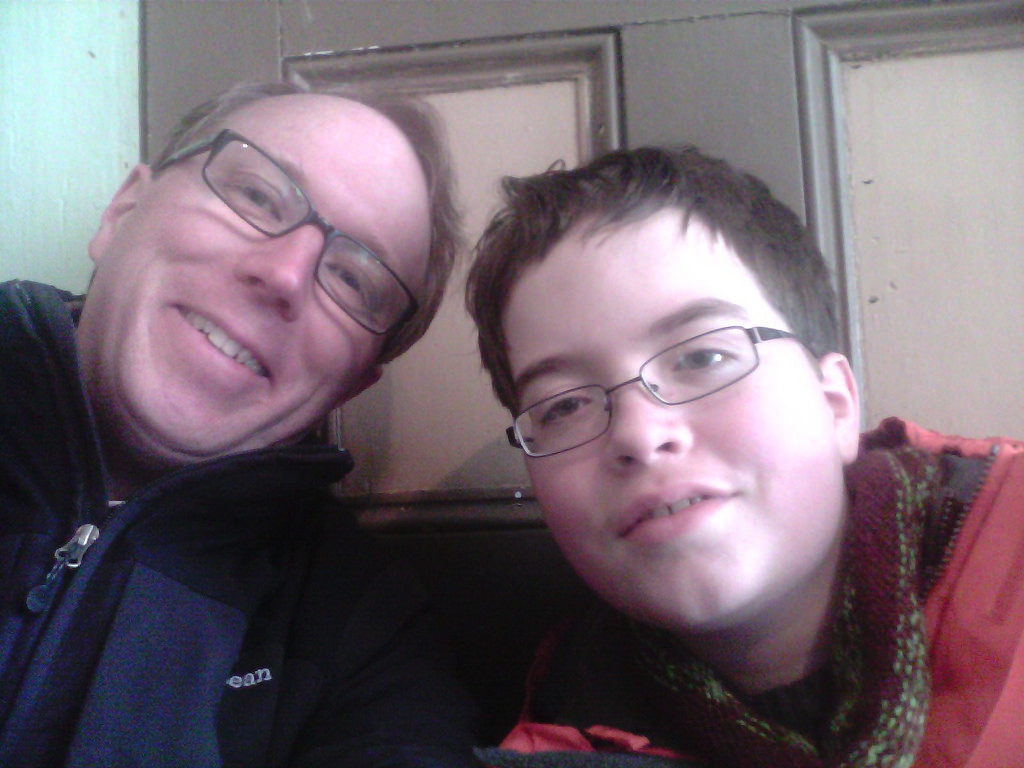
There’s nothing like seeing your horrible hair on Compass to inspire an immediate trip to the barber. Oliver, too, had been too long since a trip to Ray’s. So, it being a day off school today, we went along together. Some people say we look alike; frankly, I don’t see it ;-)
Here’s an interesting and somewhat cautionary tale of how things become “news” in Prince Edward Island.
On Tuesday I attended the launch of Prince Edward Island’s updated school calendar at Spring Park School on behalf of the PEI Home and School Federation. Along with Federation president Pam Montgomery, I represent English parents on the School Calendar Committee, and was invited in that capacity.
After the launch, which was well conducted and communicated the school calendar and the rationale behind it effectively, there was an opportunity for the media to ask questions and interview those present. Pam and I were interviewed by Ryan Ross from The Guardian, and that interview supported the story he published later, where Pam was quoted like this:
For Pam Montgomery, the P.E.I. Home and School Federation’s president, she said her organization had a lot of input in the calendar and expressing parents’ input on maintaining the amount of instructional time.
“I think we’ve been very successful in doing that,” she said.
A large part of our interview with Ryan focused on the need to communicate to parents about professional development, about how every home and school meeting should include a discussion of what’s been happening on professional development days, and how it’s important that if we’re going to invest the sacrifice of instructional time in professional development it needs to be high quality and relevant. We obviously didn’t express that forcefully or creatively enough, as it didn’t make it into print.
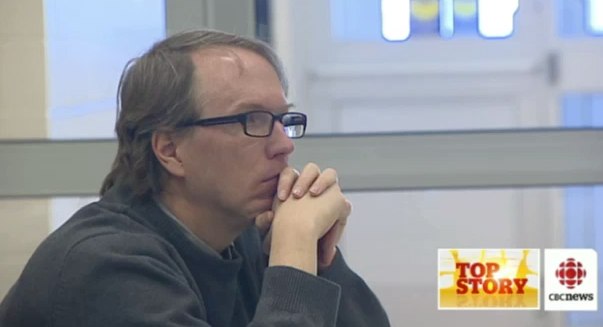
Later that afternoon, after I’d returned to the office, I got a call from Sara Fraser at CBC. She was having difficulty connecting with Pam to do an on-camera interview and wondered whether I could pinch-hit for her. I agreed, and 30 minutes later Sara was in the basement of my office with a camera operator to do an interview. She cautioned me up front that they were only looking for a short clip, and that I should keep that in mind.
In my interview with Sara I talked, again, about the importance of communicating about professional development to parents, and about some of the challenges that the school calendar committee faced in its deliberations. One of those challenges, I mentioned, was that the structure of the school calendar is limited by two currently-immovable walls: September 1 and June 30, which are the negotiated start and end of the school year for teachers. I suggested that if we really want to get serious about adding instructional time and professional development time to the calendar, we were going to have to address that issue. And that’s the clip that made it to air:
Sara: PEI’s Home and School Federation would like the school year even longer.
Peter: …to really take professional learning and the school calendar out for a ride and get more instructional days and more professional learning days, we’ve got to address that issue and that’s sort of the next hill to climb.
Unfortunately what was missing from the clip was the sentence before in which I explained what “that issue” – the immovable start and end of the school year – was. Without that sentence for context, it seemed like our “message” was dissatisfaction with the school calendar modifications because the school year wasn’t lengthened.
Now, fortunately, the notion that the school year should be longer reflects almost all of the feedback we’ve had from local home and schools on this issue: parents, in general, want their children to be spending more time in the classroom, not less. So it’s not like I was quoted as saying something untrue or not reflective of parents’ collective feelings.
What has happened next, however is that that comment that went to air has been quoted in anotherCBC story, held up beside an opposition call for more instructional time that you probably heard on the local news this morning:
The Home and School Federation also says it’s time to look at adding more instructional time for students.
Well, yes, that’s, in essence, what I said. But is it what I meant?
Is it an effective distillation, in a single sentence, of what “parents of PEI feel about the school calendar”?
No.
Presumably this is why people who speak in public take “media training”: to understand that it’s about what you say and don’t say and how you say it that will determine what appears on TV and what the public hears. If I hadn’t made an honest but, in the grander scheme of things, “off message” comment about why making a school calendar is hard, then the CBC headline might have been “Parents say communication is key to implementing school calendar changes.”
Speaking of eyeglasses: when I was in Boston last month, my friend Tom took me to see the Warby Parkershop on Newbury Street. They are a boutique maker of high-fashion, low-cost eyeglasses and have positioned themselves as the “we’re mad as hell and we’re not going to take it any more” competition to the old-line Big Eyeglass cartels. From the team of enthusiastic, fresh-faced young eyeglass zealots that staffed the place, and the crowds milling about, it’s working.
One of the bizarre aspects of the eyecare industry is that the person who tests your eyes and writes you a prescription – despite having all the equipment at the ready – doesn’t tell you what your pupillary distance (distance between your pupils) is; rather it’s part of the “dispensing” that happens where you actually buy your glasses. This makes it a lot harder to mail order for glasses because, well, it’s hard to measure your eyes over the phone.
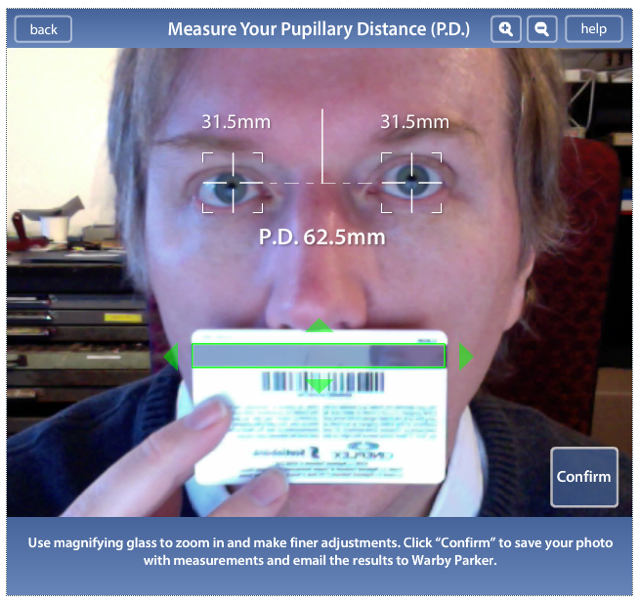
Or it was. The rise of online eyeglasses retailers has created a need for DIY pupillary distance calculators. Warby Parker has a very slick one that gave me a measurement of 62.5 mm (over 5 tests the range was 62 to 64 mm). They have you hold a credit card up under your nose and use your webcam, which is a smart way of getting an everyday object that most everyone has that has a standard size into the frame to use as a benchmark:
The slightly-less-elegant online tool at FinestGlasses.com calculated the distance at 64 mm (part of the reason it’s less elegant is that you need to measure your glasses to get a baseline, and that’s hard to do if (a) you don’t have a ruler and (b) you can read without your glasses so you can’t see the ruler).
For the record, recognizing that online eyewear is a thing, the place where I go to get my eyes tested, Charlottetown Vision Centre, will measure your pupillary distance for $69, something they advertise with many “we can’t be held responsible if the cut-rate back alley shop you get your glasses at screws things up”-style language.
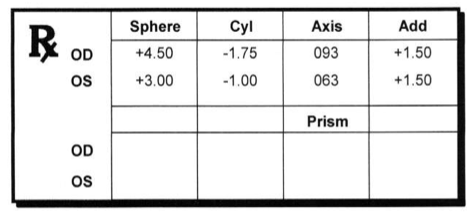
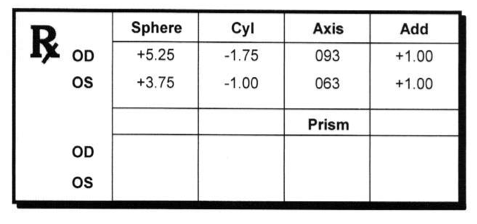
As I’ve done before – 2008, 2012 – I’m posting my new eyeglasses prescription here, because it’s the single most useful and lasting way of ensuring that when I need it I can find it again (something that paid off for me in 2009):
This year I’ve an added bonus, a prescription for “computer glasses” that come with the special note to the glasses maker of “if computer lens design not available in this Rx, then use a good PAL with intermediate and near.”
I was out for most of the morning today – a quick coffee with a friend I hadn’t seen for a while turned into a 2-hour long coffee-and-lunch – and when I returned to the office I noticed that my email was offline and there was a Tweet from Timothy Cullen alerting me that this website was offline:
Sure enough, not only was the site down, but our phone service and email (hosted on the same server) were offline as well.
I placed a quick call, on my cell phone, to Keith over at silverorange where our server lives, and asked him to reboot the server, as I couldn’t reach it from here over the network. He mentioned they’d had a brief power outage earlier that had taken everything down – a rare occurrence for silverorange, which prides itself on crazy-redundancy – and that was likely why things were awry.
Unfortunately a reboot didn’t do it, so I got my coat on and hiked up to Fitzroy Street to look at things from the inside.
Along the way I stopped in at Computer Dynamics, the folks who built the box that was offline, to pick up a replacement fan, as Keith had let me know a few weeks ago that the fan was shot. This gave me a chance to finally meet Marty MacLeod, who I’ve been buying computers and accessories from for more than a decade, whose shop is 3 minutes walk from my office, but whom, until today, I’d never met face-to-face.
Once I arrived at silverorange I set about replacing the fan, and then once everything was plugged back in found that I was still offline. Scratching our heads together, Keith and I tried various things until I remembered that the OpenWRT router I use as a gateway for the server, which has two outside-facing IP addresses, sometimes – not for many years now, but sometimes – gets itself into a state where I need to switch the primary and secondary IP addresses to get everything upstream to work. As soon as I did that, blamo, everything started to flow and I had web, email and phone back.
The cause of the brief power outage? There’s construction happening in the basement at silverorange, and somehow the vibrations of a jackhammer were enough to cause a circuit breaker to blow.
In the end analysis, then, a jackhammer in a basement in Charlottetown causes Timothy Cullen to tweet. We live in a strange world.
Three years ago I set out to answer what I thought was a simple question: how much do I cost the health care system? I sent a Freedom of Information request to Health PEI, the public service body that manages the health system in Prince Edward Island, and what ensued was an almost-three-year back and forth – detailed in part here – between Health PEI, the Information and Privacy Commissioner and me that, as time wore on, achieved a level of absurdity that surprised me given the simple question I was asking.
My most recent communication from the Information and Privacy Commissioner on the adjuication of my appeal of Health PEI’s decision not to release cost information to me was a letter I received on January 16, 2014 informing me that the expected decision date on my case was being pushed forward to September 19, 2014 (from the originally-extended-to February 13, 2014).
Until today.
When I received an unexpected communication from Health PEI’s Privacy and Information Access Coordinator telling me that they had reconsidered and asking me to confirm my email address. A few minutes later I received an Excel file with the details of almost every medical procedure I had from 1996 (when their data starts) to June 2011, along with the name of the doctor, the location of the procedure and how much was paid to the doctor. It’s almost every medical procedure because, as Health PEI had informed me earlier, if “the service was provided by a non fee-for-service physician or was provided through a hospital (e.g. emergency department or day surgery) there are no individual payments.”
There are 58 procedures in total, ranging from “ALLERGICRHINITIS” to “X-RAYABNORMAL,” performed by 22 individual doctors. In total $1901.88 was paid out to doctors. While the amounts paid to physicians don’t reflect the total cost of my health care, it’s useful information nonetheless. Here, for example, are 10 items related to a the diagnosis and eventual removal of my gallbladder – an epic journey I related here – in the winter and spring of 2003:
Doctor
Location
Date
Procedure
Paid
CHAMPIONPAULINE
OFFICE
January 8, 2003
ABDOMINALPAIN, COLIC
22.94
CHAMPIONPAULINE
OFFICE
February 19, 2003
ABDOMINALPAIN, COLIC
22.94
CAMPBELLCLARENCE M
QEH
February 25, 2003
X-RAYABNORMAL
38.60
FLEMINGBARRY D A
OFFICE
February 28, 2003
ABDOMINALPAIN, COLIC
63.15
GILLISLISA A
OFFICE
March 17, 2003
CHOLELITHIASIS
22.94
FLEMINGBARRY D A
OFFICE
March 24, 2003
ABDOMINALPAIN, COLIC
22.61
FLEMINGBARRY D A
QEH
April 8, 2003
CHOLELITHIASISNOS
432.55
KENNEDYRALPHDOUGLAS
QEH
April 8, 2003
CHOLELITHIASISNOS
108.14
FARMERSTEPHEN R
QEH
April 8, 2003
OTHSPECPROBINFLUENCHEALTH
145.50
FLEMINGBARRY D A
QEH
April 8, 2003
DAYSURGERY - HOSPITALPAYMENT
NIL
The total paid to the six physicians for my gallbladder issue was $879.37, and that table is a good blow-by-blow of how it was diagnosed: two visits to Dr. Champion, my family doctor at the time, a referral for an X-ray at the Queen Elizabeth Hospital followed by an office visit with Dr. Fleming, the surgeon who would eventually remove my gallbladder and then the operation itself on April 8, 2003 (“Cholelithiasis” is “the presence of gallstones”).
There are a host of other costs involved with taking out my gallbladder – nurses, machinery, heat, light, etc. It would be interesting to know what slice of the QEH budget my gallbladder removal was responsible for, but that figure seems impossible to determine, so the $879.37 will have to stand in.
Using pivot tables in OpenOffice allows me to do all sorts of analysis on my medical history: which doctors have I seen the most, what medical complaints do I seek assistance with the most, how often do I see a doctor. It’s an insight into my health care that I really value.
It really is absurd that it took almost 3 years to provide me with this information; indeed, perhaps my next request should be an accounting of the time and cost for Health PEI and the Information and Privacy Commissioner to take so long to say no before they said yes.
I’m a big believer in public health care; I consider it one of the distinguishing benefits of being Canadian. But I don’t think that not having to pay out of pocket for our health care necessarily means we all shouldn’t know how much our health care is costing the health system, if only because understanding more about the nitty-gritty costs of health care makes us more responsibile citizens when it comes to electing our politicians to make large-scale decisions about health spending.
I first got to know Karin as a customer of her food stall at the Charlottetown Farmer’s Market. From the time Oliver was a year old, every Saturday morning, after having our smoked salmon bagel, we would have our second course from Karin’s ever-changing selection of healthy food. And she made a mean iced tea to boot – also every-changing, and unsweetened the way I like it. Karin was unfailingly kind to both of us, especially to Oliver: she was always tucking a Hallowe’en fridge magnet, or some such thing, into his pocket. Visiting her stall was one of the highlights of our week.
Gradually, Saturday by Saturday, I got to know Karin a little more. After learning of my trips to southern Sweden, she would lend me Wallander-series books, knowing that I knew the terrain. She would always tell us tales of her travels, or of her family, during those few minutes while we were waiting for something to cook or warm or cool.
After she received a diagnosis of terminal cancer in 2008, Karin asked me if I could help set her up with a blog so that she could write about her experiences, and the result was Mastering the Art of Living while Dying. There are only 34 posts there, covering the period from the spring of 2010 to the summer of 2012. But in those posts you’ll learn a lot about Karin, and a lot about her take on, well, living while dying. Two years ago she wrote Would She Just Die Already?, one of my favourite of her posts because it captures the humour and joy that Karin brought to everything she did:
It has been more than 3 years since the doctors have told me that there is no story. No cure, no treatment, Nothing, Nada!. That was pretty harsh news. So my friends and I gathered around and comforted one another and decided we should all live our days like they are our last days. So here I am three years later, doing just that. I’m living my life like it is my last days. Now my friends are like…o.k. it’s been three years, would she just die already. I’m no longer on their “pitiful friends” list.
This Karin person is having way too much fun living her last days. I’m a pain in the butt! Sure we need to live our lives like it our last but you can only do that so long. Especially if you have a family to raise and bills to pay. But here is Karin, having lots of fun, going on trips while my friends are trying to pay the mortgage and raise their children. Most of my friends have forgotten that I have cancer. They have moved on to their sicker and needier friends.
But seriously, I am so blessed to still be here after 3 years of getting a terrible diagnosis and I am enjoying my life. Every day of it. If I die tomorrow, I would be high-fiving someone and thanking them for giving me these wonderful and precious days. And… just for the record, it’s kind of cool that my friends and I have forgotten I’m dying. Better run and pack my suitcase for my next adventure! Blessings!
Somehow, amidst treatment and recovery and despite myriad challenges of world-travel-health-insurance – the kind of thing you never think about until you need it – Karin and her intrepid partner Mike saw a lot of the world in the last few years. She published a cook book. She met a grandson. She did live while she was dying. She would probably say that she didn’t master it; but she sure gave it a good chance.
Karin died this weekend. I hadn’t seen her in a few months, and she had been not dying for so long that it came right out of the blue for me. She was a good person, someone who we were all the better for knowing, and she will be missed.
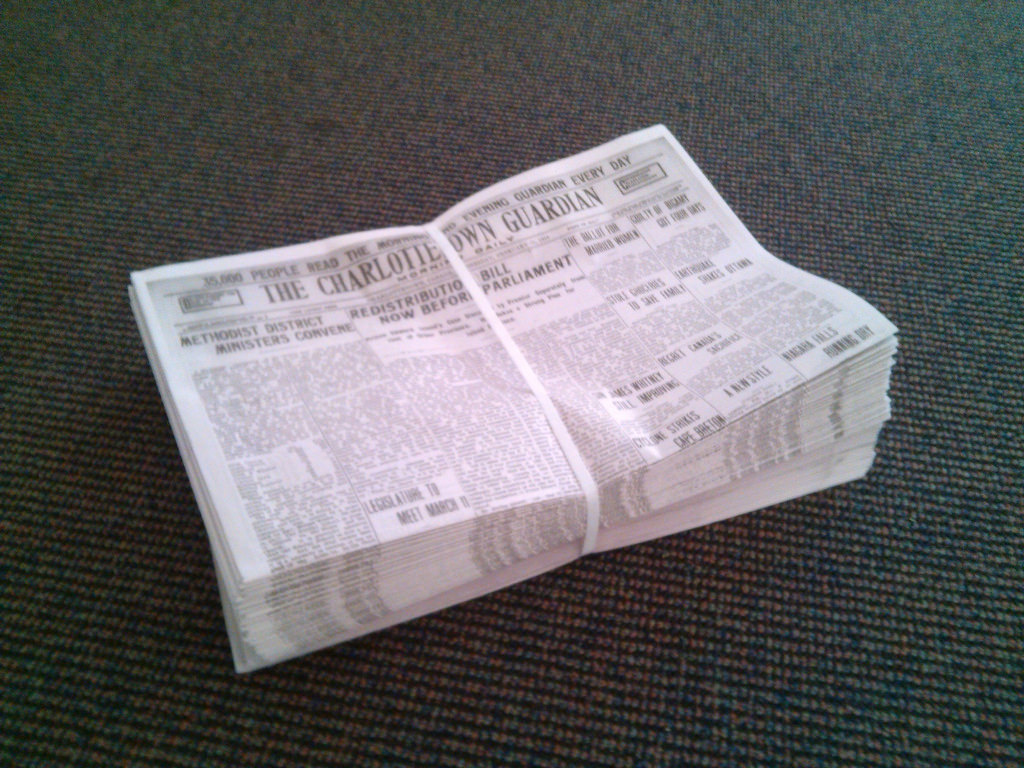
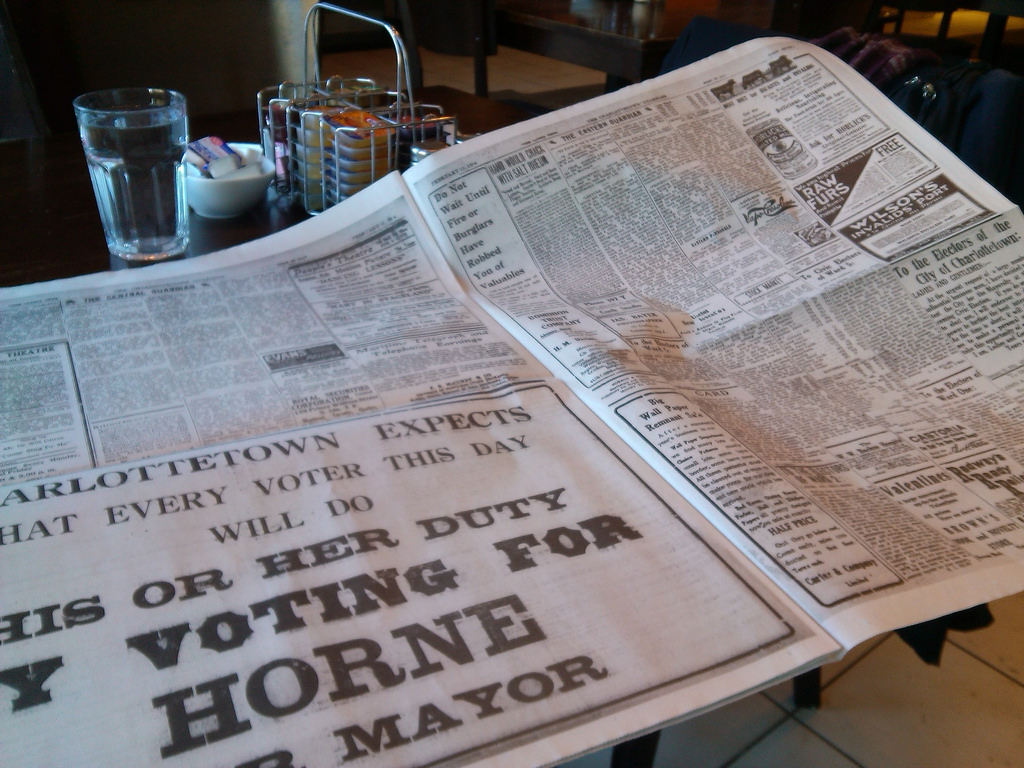
As part of the launch of the IslandNewspapers.ca project today, we arranged to have Transcontinental Printing in Borden – the branch of TC that prints The Guardian and the Journal-Pioneer – produce a facsimile of the February 11, 1914 newspaper, printed first 100 years ago today.
The process turned out to be rather simple: I grabbed high-resolution TIFF files from the IslandNewspapers.ca page for this date, uploaded them to Dropbox where the composing room in Borden could grab them, they sent along a proof press to the Guardian office in Charlottetown the next day, we agreed on a price and 500 copies showed up in Charlottetown this morning. Magic.
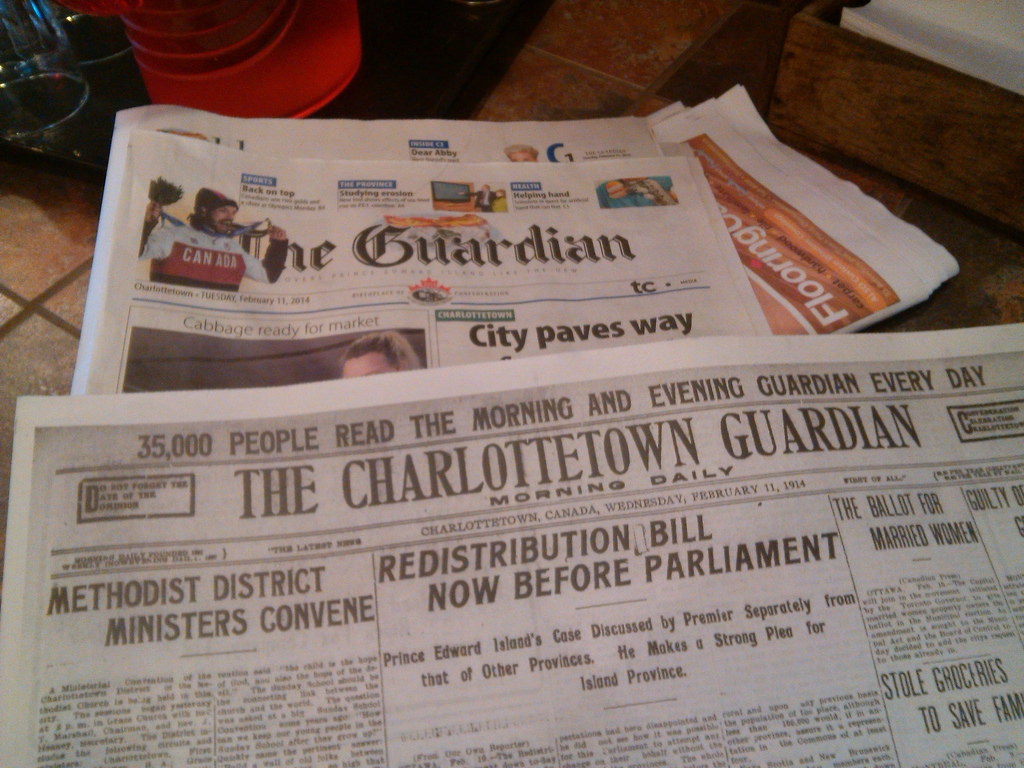
I’m very, very happy with the result: they were able to recreate the historical wide-broadsheet size of the 1914 paper, and while the source material – scans of microfilm of originals – wasn’t perfect, the paper is eminently readable and, for most intents and purposes, just like reading The Guardian 100 years ago.
Knowing we’d have more than enough copies to meet the demand at our launch event, I spent the late morning walking all over downtown Charlottetown delivering copies: the Coles Building, City Hall, coffee shops, the public library. My favourite stop was Hyndman & Company on Queen Street, my own car insurance broker and a company that was already established – and a regular Guardian advertiser – by 1914.
When I was done making my rounds, I sat down for an early lunch at Casa Mia Café and enjoyed the experience of reading the paper, 100 years on, as if it was today.
You can pick up a copy of the 1914 Guardian at the The Guild box office, at Confederation Centre Public Library or at ROW142 coffee on Richmond Street while supplies last.


 I am
I am  You can subscribe to an