While Catherine was off acquiring quality Swedish clothing yesterday afternoon, Oliver and I were left to our own devices. As we wandered about the Grünerløkka neighbourhood we came upon a building labeled Deichmanske bibliotek. Being a bibliophile, I was naturally curious. But also wary: what was this “Deichmanske,” I wondered: perhaps some sort of Norwegian religious cult? We didn’t want to get wrapped up in something.

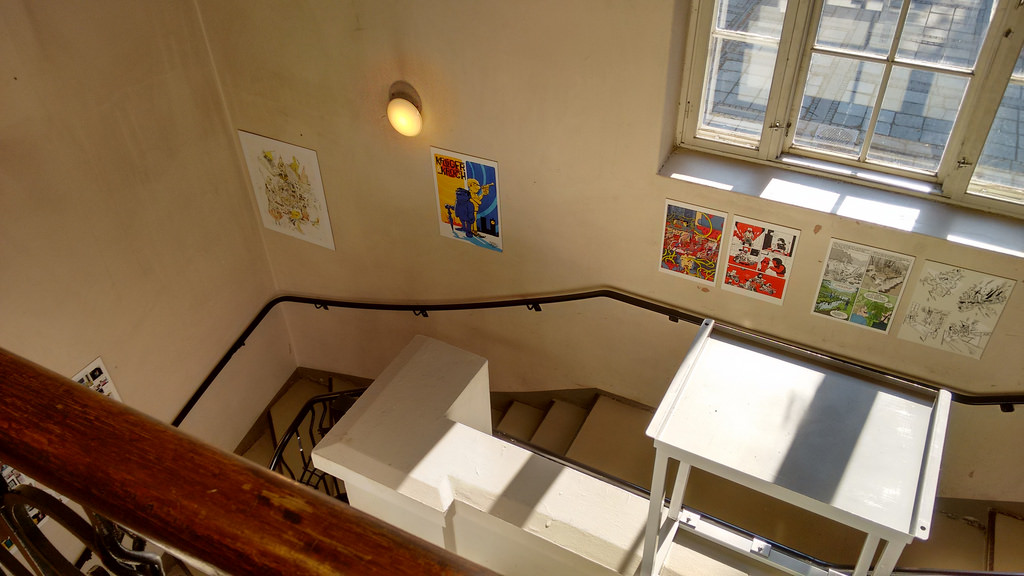
But, wandering around to the other side, we spotted a sign suggesting that there was an exhibition of comics inside. So, cult-be-damned, we tentatively walked in the front door and found a series of panels lining the stairway:

Comic Display at the Comic Library

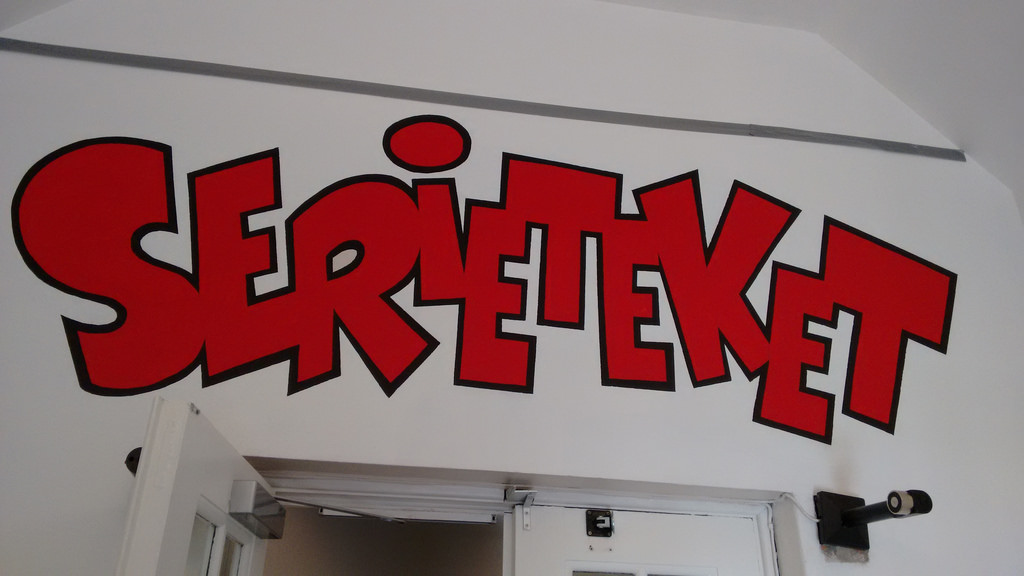
Still somewhat apprehensive – cult? trespassing? – we made our way up the stairs and at the top we were greeted with this sign:

Comic Library in Oslo

So, maybe still a cult. But a cult with some graphics chops.

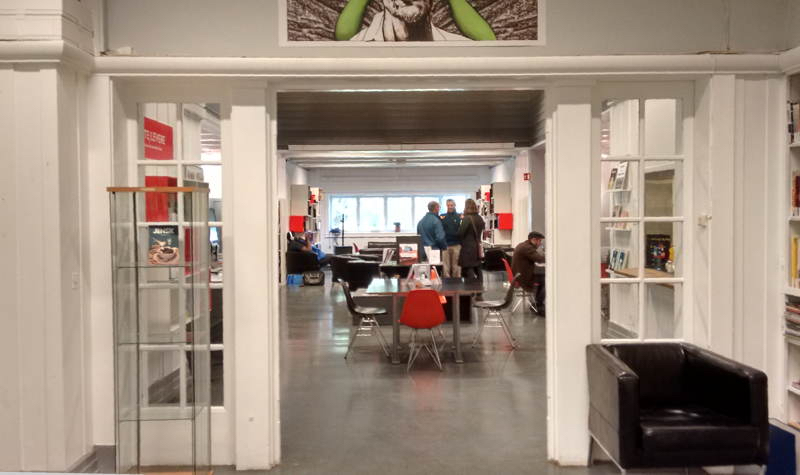
Continuing in – we were commited now – we came upon this scene:

Comic Library Entrance in Oslo

It was a room – a large, interesting room – lined with what appeared to be comics and graphic novels, and filled with people reading them. Bravely making our way across the transom, we inquired at the desk: “Is this a comics library?” “Yes, was the reply. Let me know if I can help you find anything.”

Wow.

What a library it is: the collection includes everything from Donald Duck to Seth. There is also – you can see it in the right, just a bit, in the photo above, a canteen. So, basically, you never have to leave.

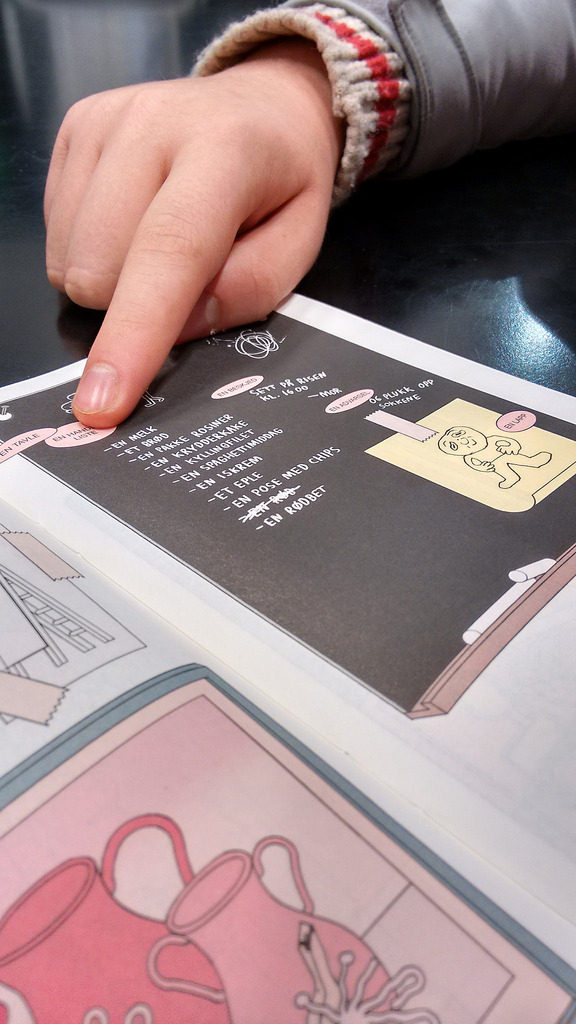
We spent a very pleasant hour browsing the collection, including Omrokering, a rather intriguing book that helped us learn the Norwegian words for many parts of the house:

Learning Norwegian

The Deichmanske label, it turns out, extends from the original patron of the Oslo library system, Carl Deichman, whose 1785 donation of 6,000 books established the library.

Sometimes it’s worth walking through the front door, even if you’re afraid of what’s inside.

🗓️
Travel  •  Comics. Libraries  •  Oslo

My high school biology teacher, Judy Libman, taught me many things. Some of them, I’m sure, were about biology. But the most valuable lesson she taught me is that people like to talk about themselves.

For a naturally curious person like me this was a fantastic gift: I became suddenly aware of an entirely new way of satisfying my curiousity; all I had to do was talk to people.

Brian Grazer says much the same thing in his book A Curious Mind:

First, people—even famous and powerful people—are happy to talk, especially about themselves and their work; and second, it helps to have even a small pretext to talk to them.

This notion has served me well over the years, and is responsible for getting me into most of the interesting diversions I’ve taken in life.

In recent years it has turned out that being a printer – even a nascent printer just finding his way – provides the “small pretext” I need. And if not being a printer, being a Hacker in Residence is good too. It’s not as though I can phone up Warren Beatty and be put through because I’m a well-known printer-hacker, but rather that when I phone or email interesting-sounding people cold, I have a way of introducing myself that’s better than “um, I’m a guy, from Canada, um, and…”

I used this secret superpower this week when I tracked down Ane Thon Knutsen, seemingly Norway’s only letterpress printer.  I asked her if it might be possible to drop by her studio for a chat while I’m in Oslo; she got back to me quickly with the apology that she’s on maternity leave, and her studio isn’t active right now.

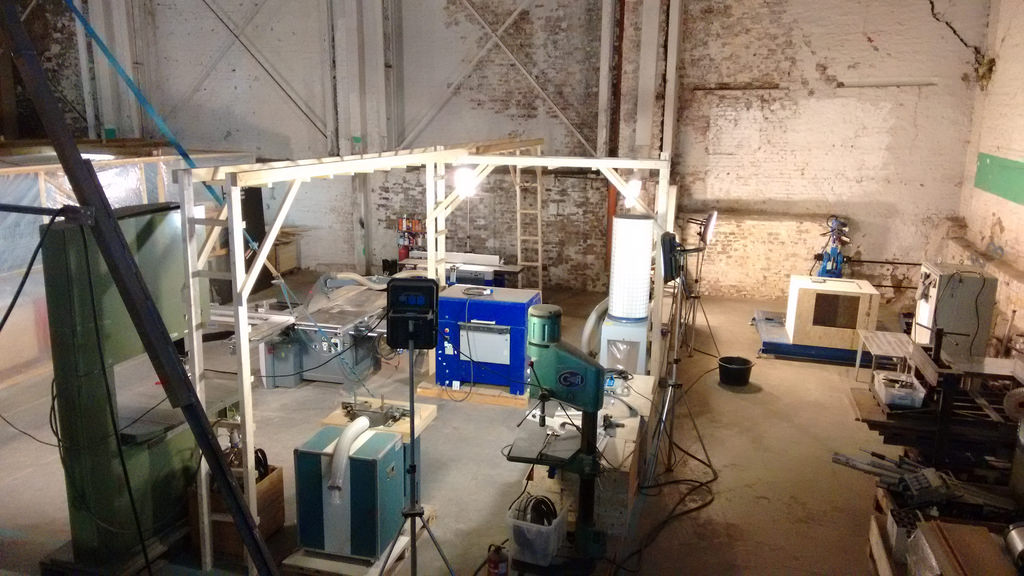
But she did suggest that I try to visit its former home, in Fellesverkstedet, a cooperative workshop in central Oslo. So I dropped Fellesverkstedet a line, and project leader Graham Hayward invited me to drop by the shop this afternoon we had a great chat.

Fellesverkstedet is, in its current “pilot” incarnation, equipped with a wood shop, digital fabrication shop and a screen printing shop; they’re deep into the process of moving to a newly-acquired home, and the pilot site is, among other things, a way of testing out layouts and facilities for the new place.

More so that anything infrastructural, though, Graham’s greatest insight was about hiring staff: to allow users of Fellesverkstedet’s facilities to receive training in a non-threatening, supportive manner requires hiring non-threatening, supportive staff, and they have found that hiring people like bartenders and restaurant servers generally works out much better than hiring technicians. Technical skills can be taught; the skill of making someone at ease when they walk in the door for the first time is much more difficult to train for.

This echos my own experiences visiting maker spaces and community print shops: those with a host at the helm are successful and engaging; those with a technician at the helm feel like spending time in a customs line-up.

“Welcome, how can I help?”, in other words, trumps “Where’s your USB stick?” every time.

Wood Workshop at Fellesverkstedet

🗓️
Musing. Travel  •  Lettepress  •  Makers  •  Oslo  •  Fellesverkstedet

Here’s a screen shot of my Moto G mobile phone at this hour. I draw your attention to two items: first, the battery (the tiny icon in the top left next to the time) is at about 50% and, second, I have 39 megabytes left of the 250 MB that were included in my 99 NOK Netcom 14 day plan:

Screen shot of Moto G phone showing battery and MB remaining on data plan.

Something I’ve noticed on recent travels, where I’ve relied on my phone more than ever before to direct me, is that as my battery life dwindles (and, in this case, as my amount of available data dwindles), a background level of travel stress increases in reverse proportion: it feels a bit like I’m Batman locked in a Plexiglas box the oxygen of which is slowly being withdrawn by Penguin.

As I mentioned in 2013 when we returned from a trip to Japan, Google Maps is now an indispensable part of our travel kit: it’s how we navigate public transit and, on this trip, with a minivan ferrying my family around, it’s how we navigate the confusing highways and byways of major cities. On this trip we’re staying in an Airbnb out in the suburbs, perched high in a confusing rabbit warren of streets overlooking Oslo Fjord, and so getting anywhere without getting hopelessly lost has required Google Maps’ calming voice at my side – “In 300m, at the roundabout, take the 3rd exit…”

But what if the battery goes dead! What if I use up all my data! How will I know which exit at the roundabout to take?

How will I call Catherine to arrange a post-art-gallery rendevous?

How will I take pictures?

How will HQ text me when the server needs help?

The aforementioned minivan has been a help on this trip in this regard – not only can it ferry 7 people, but it can charge my phone too. But even with that, out and about in the city, as the sun sets and the battery dips below  30%, I get a feeling in the pit of my stomach.

Presumably this is an interregnum issue only: batteries will eventually last forever. Or at least until the end of the day. And mobile data will be free and ubiquitous (the young folks wouldn’t believe me if I tried to explain how we used to be billed by the minute for the Internet).

But for the time being, as useful and indispensable as phones have become for travel, they also add a dose of their own stress to the mix.

Perhaps I should carry a backup sextant.

🗓️

Here are seven great things I found in Oslo today:

  1. Coffee at Fuglen. Twice. Very, very good.
  2. Comic book shopping at Tronsmo. Indeed any book shopping, as they have a stellar selection of books the likes of many of which I’ve not seen elsewhere. In a lovely, bright space.
  3. Travel book shopping at Nomaden. Bought a book on Mongolia. Best travel book shop since the late, great Globe Corner Bookstore in Boston.
  4. Stationery shopping at Norway Designs. The basement papir shop has an excellent selection of paper, envelopes, pens, bookbinding tools, paperclips and more.
  5. A cheese and salami sandwich, with clementine juice, at Baker Nordby on Hambros Plass 7.
  6. The Arkitekturstriper – Architecture in Comic Strip Form – exhibition at the National Museum – Architecture. Oliver and I spent a couple of hours at it. Fantastic.
  7. Frogner Park at sunset. Who would have thought a sculpture park could be so moving. But it is.

Frogner Park

🗓️
Oslo  •  Norway  •  Travel

We spent the day at the Norsk Folkemuseum – The Norwegian Museum of Cultural History – and it was the kind of museum that scratched all the right itches for me: a museum focused almost exclusively on how regular everyday people live their regular everyday lives. In other words houses, farm yards, gardens, apartments, shops, barns; a collection spanning hundreds of years.

While the collection of grass-roofed farm buildings was impressive, and the stave church was awe-inspiring, my favourite sections of the museum concerned history since 1960 – my history, in other words, albeit in Norway. There was a gasoline station. An apartment block with each apartment decorated for a different era. A corner shop. A working farm. The attention to detail was remarkable, the interpretation well-done (in English and Norwegian) and, given the beautiful weather today for our visit, the afternoon walk a welcome respite from urban tourism.

Standard Bensin

"As a result, people wandered about..."

Stone Roof

Stave Church

TELEFON

The Folkemuseum is located in a museum-rich district of Oslo: nearby is the Viking Ship Museum is right next door, and that’s where we spent the late morning. I found myself unexpectedly moved by the Viking burial ships on display there, and, especially, by the artifacts found within them (leather shoes, cooking implements, sledges, fabric).

Viking Ship in the Sun

Viking Ship Museum

Viking Ship

🗓️
Norway  •  Travel  •  Vikings  •  Museums

Did I mention that we’re going to Oslo? It’s a trip that started with “hey, we should spend Thanksgiving in Iceland with my parents!” that evolved, once Iceland’s 4-week service dog quarantine became evident, into an alterative Nordic adventure. So my parents booked YYZ-PHL-MAN-OSL and we booked YHZ-YOW-LHR-OSL.

And it’s LHR where I type to you today, as our afternoon layover draws to a close.

Best decision we made was to get a day room here at the Thistle Hotel near Terminal 5. It was only 45 pounds ($90 CDN at today’s rate) for 8 hours, and although it’s a tiny, plain room, it has a bed and a shower and free, fast wifi. It’s also strikingly close to Terminal 5, from which we depart in a few hours.

Plan A for this afternoon was that Catherine would nap and relax here in the hotel while Oliver and I repeated our 2010 movie-going adventure, with plans to go to the same Cineworld Feltham to see The Martian.

This plan got scuttled when a series of three cab drivers either flat-out refused to take Ethan in their cabs, or wanted an extortionate price – $60 each way – to take us the 20 minutes to the cinema.

So we fell back on Plan B, which was to wander around the neighbourhood.

You would think that the area around a Heathrow Airport hotel would be a stark wasteland of concrete. And there is certainly some of that. But, it turns out, there’s also lots that’s more interesting.

In a wander of a few hours around the hotel we encountered a bridge constructed in 1834 bearing the crest of King William IV, the Heathrow Special Needs Farm (filled with all manner of horses, sheep, goats, and donkeys), Waterside (the world headquarters of British Airways), relaxed in the sun at the Peggy Bedford Biodiversity Site, and had lunch at The White Horse Pub. At the pub we learned that at a British pub there is no table service (after waiting for table service for 15 minutes I Googled “how to order at a British pub” and helpfully found a guide that sent me to the bar to order).

Now we’re off to Oslo.

WR IV

Lunch

Heathrow Special Needs Farm

Plane

🗓️
Heathrow  •  London  •  Travel

The annual Quilt Show is happening inside St. Paul’s Anglican Church in downtown Charlottetown. Catherine is one of the organizers, and our 2000 VW Jetta is the platform for the “car quilt” that’s out on the lawn (the presence of our car there prompted City Police to phone me last night, concerned that I know that my car was on the lawn of the church).

The artistry and technique of the quilts, rugs, hangings and other fiber pieces in the show is stellar; it’s the best $5 you’ll spend this week. And you get to see the inside of St. Paul’s too.

Car Quilt

Quilts in Church

🗓️

It has been the year of talking about open data.

It all started back in February when I was invited to present to a meeting of ARMA Prince Edward Island, a comity of public servants working in “recorded information management.” This was a “hands-on” workshop (blog | slides), and I used my work with electricity data as the jumping off point for a tour of open data technical concepts from a records management perspective.

Attending that session was Mike Fagan, Queen’s Printer for Prince Edward Island, and subsequently Mike invited me to speak to the Queen’s Printers Association of Canada at their national meeting here in Charlottetown in June (blog | slides).

For my presentation to Queen’s Printers, I reshaped my presentation to focus on open data “from a user’s perspective.” My goal was to communicate something about what it’s like to be a longtime consumer of open data, with the hopes that I could take the open data conversation beyond the realm of “you need to do this because it’s right” and, by showing concrete examples of how open data can lead to citizen engagement, show public servants how open data can improve public policy making. I shaped the talk around 7 “open data principles” based on my own experiences.

As chance would have it, my talk to Queen’s Printers was ready to go when I received a call from Gary McLeod, Chief Electoral Office of Prince Edward Island wondering if I might present on much the same topic to Chief Electoral Officers of Canada at their annual meeting, to be held in Charlottetown in July.

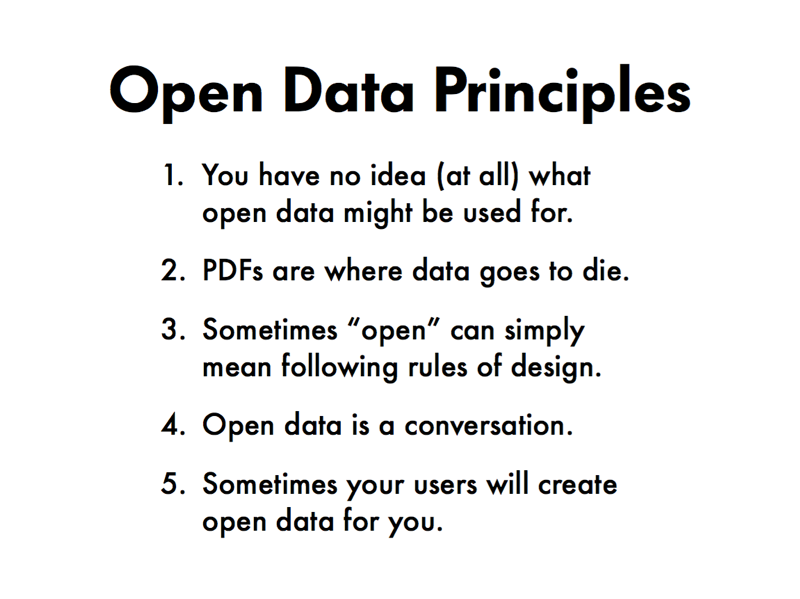
I further-refined my talk for Chief Electoral Officers (blog | slides), distilling my “open data principles” from 7 down to 5:

  1. You have no idea (at all) what open data might be used for.
  2. PDFs are where data goes to die.
  3. Sometimes “open” can simply mean following rules of design.
  4. Open data is a conversation.
  5. Sometimes your users will create open data for you.

With a new government in place here in Prince Edward Island, and open data a part of the election campaign platform, in one form or another, of all the parties, I suggested that my presentation might find a receptive audience within the public service, and this led to a presentation to deputy ministers in late August (slides), a presentation that engendered 30 minutes of engaging discussion afterwards. That session was, I believe, as useful for me as for deputies, as I learned a lot about how, from a high-level policy perspective, the challenges and opportunities of open data are regarded.

Attending that session was Wendy MacDonald, Clerk Assistant to Executive Council. Last week I ran into Wendy on Upper Prince Street while we were out walking our respective dogs, and our street corner conversation led to a suggestion that there might be a wider audience for my presentation in the broader public service. And so this Wednesday I’ll present to a group of public servants over the lunch hour as part of a regular series of lunchtime sessions that are held for those working in policy and planning.

And before that, I’m presented to a “civilian” group tomorrow evening, the Open Data Book Club, a special interest group of the PEI Developers. While I am presenting the same material as I’ve presented to public servants, this is an audience of eager open data consumers, and so I’m looking forward to the opportunity to engage with them about what I’ve learned from the public service, and to help point the way forward from here. This session is free and open to the public; you can RSVP here. It will be held at the Charlottetown Yacht Club starting at 7:00 p.m. on Tuesday, September 22, 2015.

🗓️

Fraser McCallum, personable communications manager at the Confederation Centre of the Arts (and Charlottetown’s foremost cardigan-wearer) flagged me down on the street earlier this week.

“Would you be interested in tickets to a preview of Evangeline?” he asked.

Evangeline being the second-coming of the Ted Dykstra-created grand dérangement musical, launched originally in 2013 and back at the Centre this fall for a revivified production.

Fraser was brave in making this offer, no doubt aware that I have a conflictual relationship with my bedmates here at The Guild, Anne and Gilbert, whose carrying on I am subjected to delighted by several times a week during theatre season.

I love Anne and Gilbert like siblings. And yet often wish they were dead. Such is life in as closely packed a family as ours.

I am not, in other words, a universally well-regarded appreciator of musical theatre.

And yet Fraser was confident (or foolhardy) enough to invite me to voluntarily inflict musical theatre upon myself.

Which is how I found myself sitting beside Catherine in Row J of the main stage at the Confederation Centre on Wednesday night waiting for the lights to dim and the rousing choruses to begin.

Going in, there was a roughly equal chance that I’d either hate it with the very core of my being or that I’d irrationally fall in love with it.

Spoiler: I irrationally fell in love with it.

IMG_20150918_104916326

This has been a season of grand dérangement for us: in May we accidentally happened upon Grand Pré, Nova Scotia while on a weekend trip and learned, through Parks Canada’s excellent interpretation, the story of the Acadian expulsion. And, what’s more, got to experience the stunning landscape of the area and come to understand more about why it might once have been regarded as a paradise on earth.

Grand Pré

Evangeline is a story that starts in Grand Pré and follows history through the expulsion, and eventual return, knitting everything together against the canvas of the thwarted love of Evangeline and Gabriel.

And it is epic.

Both as a story, and as a production.

The performances are epic. The music is epic. The costumes are epic.

The staging – whirling roundabouts and raising sails and wharfs that turn into huts that turn into mountains – is epic too.

But things didn’t start off well for me.

While I understand the necessity of speaking in distilled essences rather than finely drawn characters, the “here are the happy people of Acadie in their happy fiddle-playing idyll” was too much of a caricature for my taste, and didn’t sufficiently establish why Acadie was such a unique place with a long history. As so much of the drama of the tale depends on this, I wished that this part of the story had been stronger.

But things improved from that misstep, and by intermission, with the Acadians expelled and Evangeline and Gabriel pulled apart, I was left eagerly wondering what would happen next.

There were, in other words, no thoughts of escape during intermission.

The second act is where the real heart of Evangeline lies. In some ways it seems like an entirely different musical, and could almost exist as a self-contained piece.

The set is more inventively used, the music is more finely woven into the plot, the trekking back and forth across the eastern United States, which could have been plodding and dull, was, through imaginative staging, thrilling.

I unreservedly loved the second act, from opening until the rousing close.

And yet, it was musical theatre. What was happening to me?

What I realized, halfway through the first act, is that to enjoy musical theatre at all requires a suspension of the sense of its core absurdity, that being the notion that it’s a completely normal thing for song to break out at the drop of a hat.

It also helped to realize that what in a documentary about the grand dérangement could be communicated through narration must be telegraphed through other means in a musical, and so getting comfortable with the musical theatre tropes that are used for this, and relaxing into them, was a great help as well.

Which is also, perhaps, why my comfort with the second act was much greater than with the first: I was putting on a new set of clothes, and I needed to get used to them.

All epic, rousing, consuming, dramatic panorama aside, there’s another very good reason to love Evangeline, and that is because it’s an engaging musical about Canada, and a work of art that, perhaps for the first time in a generation, sees the Confederation Centre theatrically living up to its mandate to “celebrate the origins and evolution of Canada as a nation.”

Evangeline runs until October 10 at the Confederation Centre of the Arts (tickets); it also runs October 31 to November 22 at Edmonton’s Citadel Theatre (tickets).

You really should go and see it.

Evangeline

🗓️

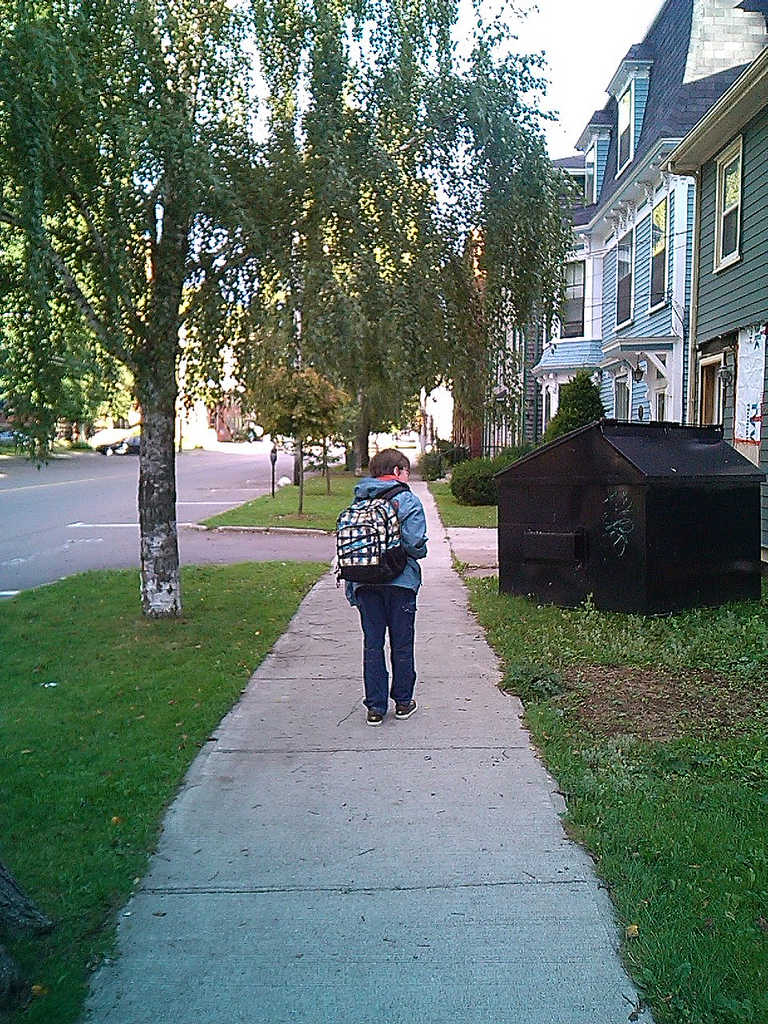
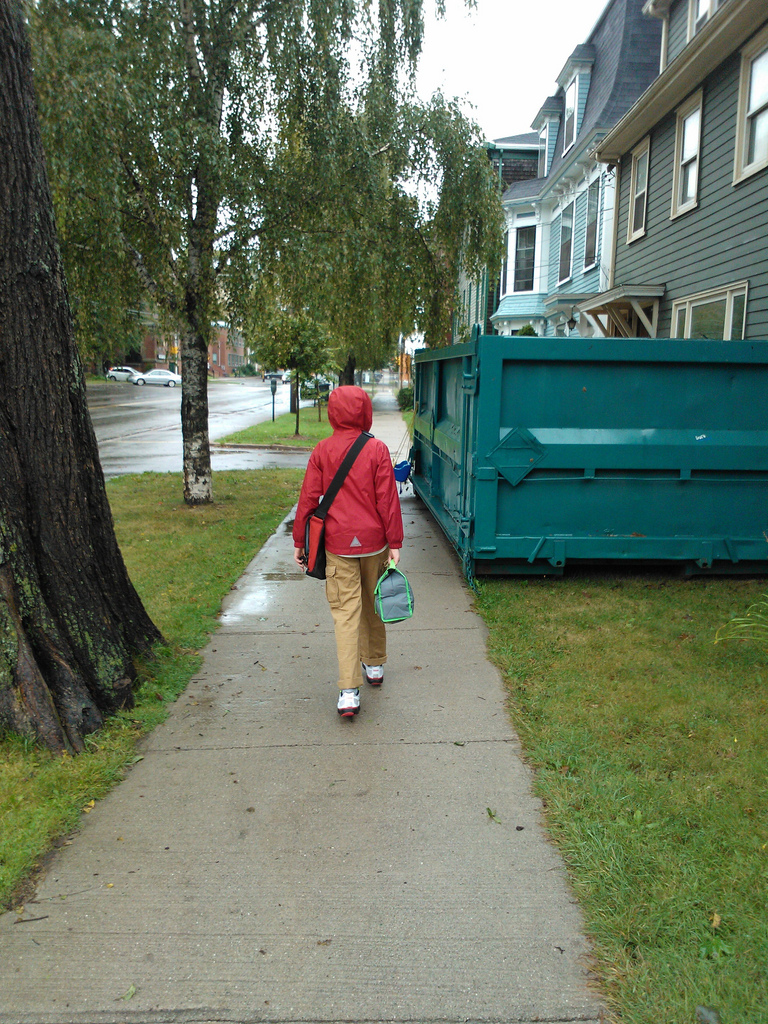
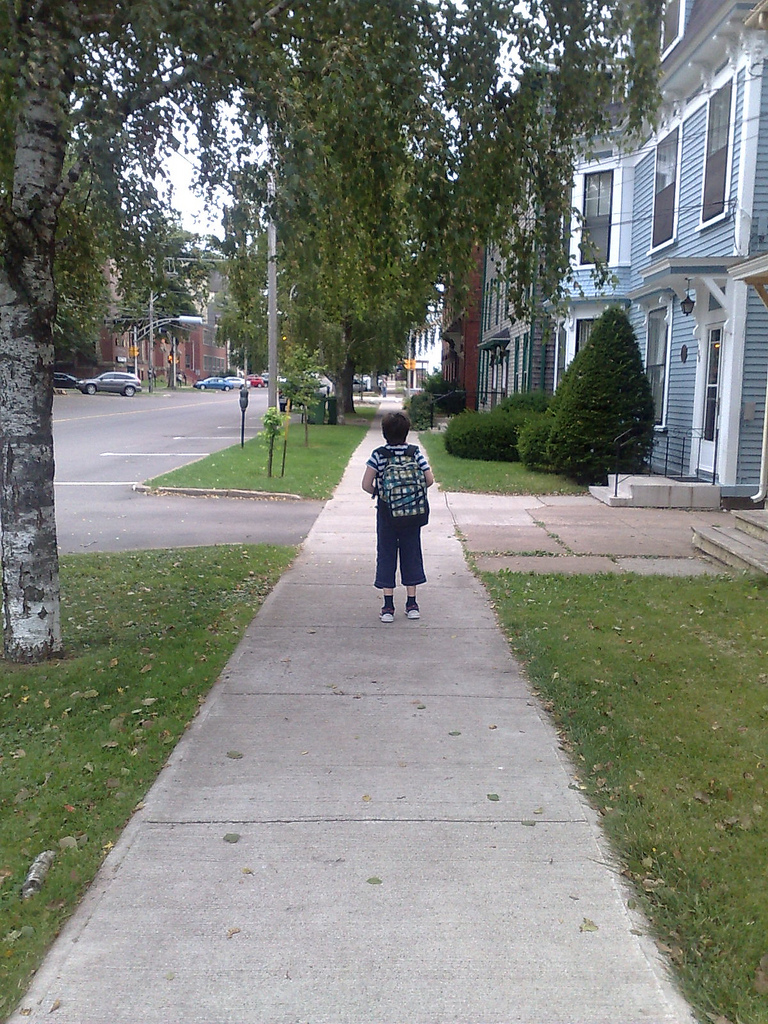
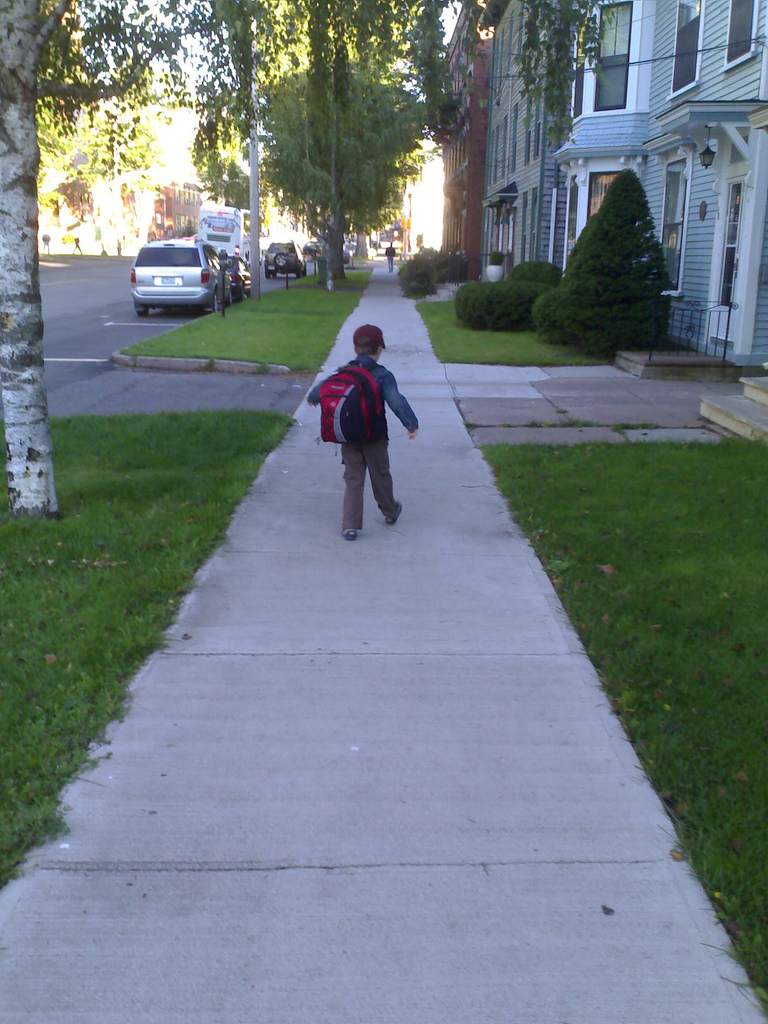
Oliver started grade 9 at Birchwood this week, his last year at intermediate school, and the 9th year we’ve been walking up Prince Street together every morning.  As with last year, Ethan’s not quite ready to start school yet (soon; very soon!), but he still walks to school with us every morning.

Nine years, 180 days a year, 2 km there and back every morning: that’s 3,240 km of walking. Our morning walk is the most important time we spend together every single day; I wouldn’t trade those kilometers for anything.

Grade Nine, 2015

Oliver (and Ethan), on the first day of Grade 9

Grade Eight, 2014

First Day of Grade Eight

Grade Seven, 2013

First Day of Grade 7

Grade Six, 2012

First Day of Grade 6

Grade Five, 2011

First Day of Grade 5

Grade One, 2007

The King of Prince Street

🗓️
Oliver  •  School  •  Ethan

About This Blog

Photo of Peter RukavinaI am . I am a writer, letterpress printer, and a curious person.

To learn more about me, read my /now, look at my bio, listen to audio I’ve posted, read presentations and speeches I’ve written, see things I’ve favourited elsewhere, or get in touch (peter@rukavina.net is the quickest way).

I have been writing here since May 1999: you can explore the 25+ years of blog posts in the archive.

You can subscribe to an RSS feed of posts, an RSS feed of comments, an RSS feed of favourites elsewhere, or a podcast RSS feed that just contains audio posts. You can also receive a daily digests of posts by email. I also publish an OPML blogroll.

Instagram • YouTube • Vimeo • ORCID • OpenStreetMap • Internet Archive • PEI.art • Drupal • Github.