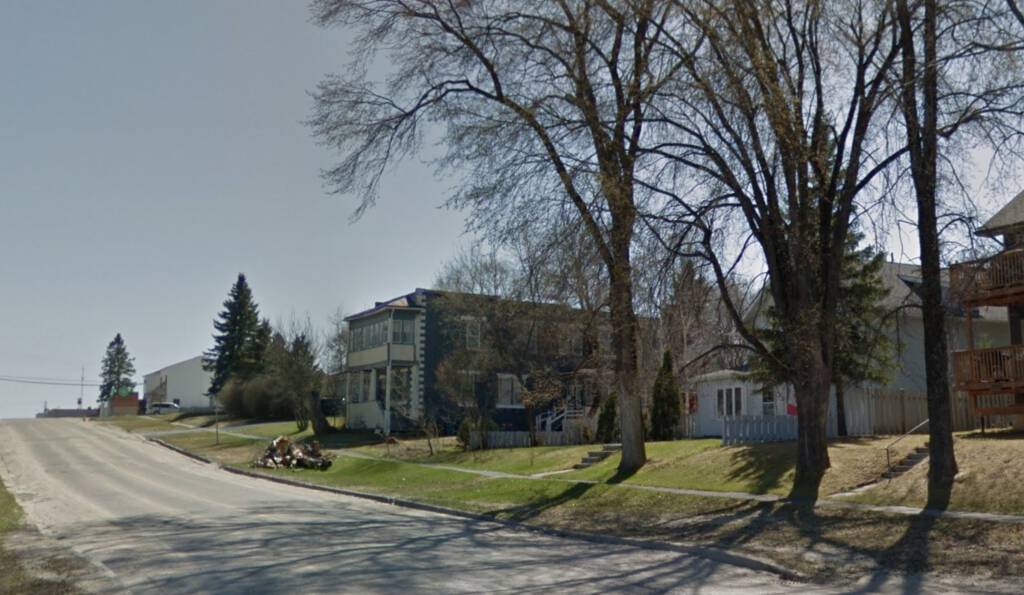
My mother grew up in a building on 233 5th Avenue in Cochrane, Ontario, a former bottling plant that was converted into apartments. You can see it in Google Street View, albeit from a distance:

Photo from Google Street View up 5th Avenue in Cochrane, Ontario, showing a rectangular concrete-block building in the distance.

The building is in the distance because the Google Street View coverage for Cochrane, inexplicably, does not include 5th Avenue:

Screen shot from Google Maps showing the Street View coverage for the town, with no coverage on 5th Avenue.

Here’s a “look around” view from Apple Maps, which does cover 5th Avenue:

Apple Maps Look Around view of 233 5th Avenue, Cochrane, ON

Here’s a photo, closer up, that my mother took on a trip to Cochrane in 2015:

Photo of 233 Fifth Avenue, Cochrane, Ontario, taken from the street. It's a rectangular building with open porch below and glass-in porch above.

I have many fond memories of visits to that house; strongest among them is the feeling of hiding under my step-grandmother’s fur coats in the upstairs apartment during games of hide and seek with my brothers.

🗓️

Last week I wrote about the Cochrane, Ontario typhoid epidemic of 1923, after reading my great-grandfather Edgar Caswell’s reflections on it. Today, that’s to Dick  Bourgeois-Doyle’s biography of Edgar, I learned that typhoid affected our family directly.

First-affected was Edgar’s brother Bob:

Dad they begun the annual transport of stones in December 1905 and been away from home at a distant quarry, Bob Caswell might have tried to shrug off his sore throat and fever and kept working. But it was the slow time before Christmas, and the family insisted he rest while they sent word for a doctor to come up on the train from Ottawa to check his tonsils. Bob was only thirty-seven years old. His death would be formally attributed to typhoid fever presumably due to drinking “dirty water.” But for over a century, a persistent story flowed through the family that tied Bob’s death to the infections resulting from a sloppy, candlelight, kitchen-table surgery performed by the Ottawa doctor, who had stopped at the pub on the way to the farm. Either way, Bob’s death from infection was miserable. It was the days long before antibiotics and sober doctors or not, there was little that could be done in such circumstances but to hope, pray, and wait. the family felt powerless.

Eight years later Edgar was stricken himself:

At this time in 1913, Ed Caswell was back in Cochrane recovering from typhoid, the disease that had reputedly killed his brother just eight years earlier. Ed picked up the disease trying to make some extra cash working out of town with construction crews on the transcontinental. The diarrhea and fevers of typhoid infection are not helped by the lack of first aid and the rugged ambiance of bugs, heat, tents, and cots out on the rail lines. 

Bourgeois-Doyle writes, later, about the affect of typhoid on Edgar:

Of course, ed Caswell had special reasons to be sensitive to the threat aside from his official duties as a municipal manager. The typhoid-linked death of his best friend, partner, and brother Bob in 1905 left an enduring mark on Caswell’s soul, and Ed’s personal brush with typhoid led him into his job with the town and ultimately into his role as fire chief. events flowing from typhoid defined almost everything about Ed’s life now. He was, therefore, among the most vigorous voices warning residents of Cochrane against taking drinking water from the small lake north of town, the one deceitfully and enticingly named “Spring Lake”: the one just next to the town’s lake-like sewer pond. People usually drew their water from a chain of springs near the lake. but when the springs ran low or were clogged by ice, it was just too easy to dip a bucket into the open water of Spring Lake. In the early months of 1923, the sewer lake backed up and overflowed, possibly due to blockages of ice or unexpected runoff. Its toxic waters flowed along the ground and dripped into water that too many people were drawing for their homes. The town had been booming and growing, and this meant greater and greater water consumption.

Today the Town of Cochrane has a robust and, by all appearances, well-monitored and regulated water and sewer utility.

If you’re interested in learning more of the story of Edgar Caswell, track down Stubborn: Big Ed Caswell and the Line from the Valley to the Northland.

🗓️
Typhoid  •  Cochrane  •  Edgar Caswell

I found this in a shoebox of things from my childhood. I’m fairly certain it came from a booth at the Canadian National Exhibition in Toronto in the early 1980s.

Since that time I’ve dramatically changed my signature, so I assume none of the analysis stands.

A signature card laid on top of a computer print-out, all caps, with horoscope-style advice.
🗓️

Someone, let’s refer to him as “the other person who lives in this house,” left the tap running in the downstairs sink last night, something I’ve didn’t discover until this morning, meaning it was running on a slow trickle for 12 hours. 800 litres of water was wasted.

Given that this is data that’s logged every few minutes, it occurs to me that I should send myself alerts when aberrations like this show up, before they have a chance to go on for so long.

🗓️

The near-identical widgets for date and weather on my iPhone’s home screen are a constant source of confusion for me. Today, at least, they spell a Rush album.

🗓️
Rush  •  Music  •  iOS

Last night at Grief Club (the monthly drop-in on Zoom hosted by Hospice PEI), this quote from John Green was read at the end:

Maybe there’s something you’re afraid to say, or someone you’re afraid to love, or somewhere you’re afraid to go. It’s gonna hurt. It’s gonna hurt because it matters.

I’ve never been one for weighty aphorisms, especially those from 43 year old YA authors (who aren’t named Dave), but this one held some weight for me.

I’m a little in awe of how much I get out of Grief Club: having a place to go every month where it’s not weird to talk about the dead we loved is such a privilege.

🗓️

Paul Capewell posted this in the comments, but it bears the stronger light of a bona fide post: A Mile an Hour is a film by and about Beau Miles:

A different kind of marathon; running one lap an hour for 24hrs around my perfectly mile long block. The rest of the time I do as much as possible; making things, odd jobs, fixing stuff. It’s about running, doing, and thinking- the potentials of single day.

It’s an inspiring film on many levels (I love the indoor-outdoor workshop/fire/kitchen), and one that prompts me to think, at the very least, that I should set out to walk at least a mile every day, and to accomplish at least one thing every day. Because one mile leads to two, and one accomplishment leads to another. 

Indeed, counting up today’s accomplishments, I found myself unusually accomplished. I only walked a couple of kilometres, but I accomplished a lot:

That doesn’t include my day-job-work; while it continues to be fulfilling, and involves accomplishments, its mandatory quality exempts those from consideration, at least measured against the Beau Miles yardstick.

🗓️
Beau Miles  •  Video  •  Paul Capewell

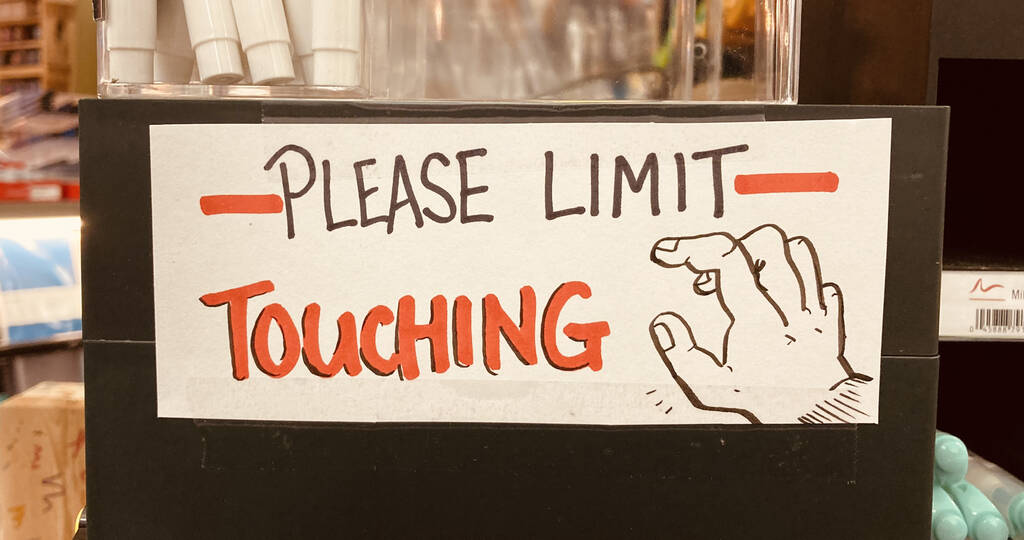
The Bookmark has this delightfully-lettered sign on the end of a shelf in their pen and pencil section:

"Please Limit Touching" hand-lettered sign in The Bookmark, with a cartoon-like drawing of a reaching hand beside,

It’s hard to write this without appearing, well, pervy, but the world of human contact in my life has receded to that offered by haircuts and plasma donations and, frankly, I’ll take what I can get.

This has nothing to do with the sexual realm–I’ve no interest in sex with my phlebotomist–but rather with simple human contact, a need I heretofore never saw as something distinct unto itself, and certainly never felt comfortable writing about.

I started the year off right, when I hugged hundreds of people at Catherine’s Celebration of Life, and the memory of that has buoyed me ever since.

I’m not shopping around for hugs, especially during these times when hugs can kill, just stating something out loud so that I can admit its absence to myself. And, perhaps, to suggest, as my friend Frances is fond of writing, “hold those you love close,” cause you won’t know what you got ‘til it’s gone.

🗓️
Touch  •  Catherine  •  COVID-19

Mandatory mask wearing in indoor public spaces kicked in at midnight here, and the evidence is clear, as walking downtown this afternoon, even though the requirement applies only to indoor spaces, near everyone was wearing a mask outside too.

I’m not sure whether this is from an abundance of caution, or due misinterpretation of the rules, but I can’t say that I mind, as many of the sidewalks in town don’t allow a 2 metre separation when passing.

I was downtown on my way to get a haircut (87 days after my last one for those playing the home game); the haircut itself, by a new barber at Ray’s Place, was expertly conducted without need to remove my mask at all.

From my new barber I learned about “hair splinters.” Freshly cut hair is very sharp, i was told, and, just like a wooden splinter, but perhaps even more insidiously, can worm its way into the skin. A constant occupational hazard for barbers, apparently, and a bit like working with fibreglass insulation. I had no idea.

If you see me walking around town, masked and with a new haircut, I wouldn’t mind at all if you said “hey, you got your haircut!” It turns out that one of the many things I miss about Catherine is her exclaiming exactly that when I’d come home after an unexpected one.

🗓️
Haircut  •  COVID-19  •  Catherine

Phoebe Bridgers new album, Copycat Killer, dropped today: four tracks of Bridgers covering her own work, with an orchestral background. At least a couple of them are, to my ears, more satisfying than the originals.

Sometimes covers, whether from the original artist like this (and Joni Mitchell’s orchestral covers of her own classics), of by others, can be improvements over the original: Jonatha Brooke’s 2004 cover of The Alan Parsons Project’s 1982 Eye in the Sky, for example, is clearly an improvement (although the original has its place in the 1980s musical canon).

Randy Newman’s original I Think It’s Gonna Rain Today, you would think, is impossible to top. Did Sidsel Endresen and Bugge Wesseltoft’s cover do it? Perhaps not. But their cover is wonderful nonetheless.

Depending on your tastes, you might find Eddie Berman and Laura Marling’s cover of Bruce Springsteen’s Dancing in the Dark better than the original. Or you might find the mere suggestion sacrilege. 

Others?

🗓️
Phoebe Bridgers  •  Music  •  Covers  •  Joni Mitchell  •  Jonatha Brooke

About This Blog

Photo of Peter RukavinaI am . I am a writer, letterpress printer, and a curious person.

To learn more about me, read my /now, look at my bio, listen to audio I’ve posted, read presentations and speeches I’ve written, see things I’ve favourited elsewhere, or get in touch (peter@rukavina.net is the quickest way).

I have been writing here since May 1999: you can explore the 25+ years of blog posts in the archive.

You can subscribe to an RSS feed of posts, an RSS feed of comments, an RSS feed of favourites elsewhere, or a podcast RSS feed that just contains audio posts. You can also receive a daily digests of posts by email. I also publish an OPML blogroll.

Instagram • YouTube • Vimeo • ORCID • OpenStreetMap • Internet Archive • PEI.art • Drupal • Github.