
Annie Mueller’s What feminism means to me is a stunning piece of writing.
🗓️
Tyler Crane was a presence in our Saturday morning life for years and years: behind the counter (or out in front) at Riverview Country Market, he was universally helpful, funny, kind, generous, a case study in how to be a gentle, present human being.
Tyler died on October 21.
And the thing about that is that until I read the announcement of his death, I didn’t know his name.
Scores and scores of interactions, and I’d never thought to ask.
I should have: it would have only been right to be able to say “thanks Tyler!” when he offered a bag, made a particularly good cappuccino, told me about the night market, filled my laundry soap container for me, gave me the inside scoop on the Ritter Sport chocolate deliveries.
I can’t change that. But I can change the future, and how I behave in it.
And so, in Tyler’s memory, I’m going to start asking people their name.
This morning at The Shed I asked the barista who’s made me some excellent iced lattes this week for his (it’s Adrian—he’s the fellow with the hat).
And, even (or especially) if it’s awkward, I’ll keep at it.
It’s a little thing, but it’s a human thing, and it seems like a helpful way to allow Tyler’s spirit to carry forward.
Excuse me, can you tell me your name?
🗓️
To be able to volunteer in public schools in Prince Edward Island, policies now dictate that a criminal record check be completed:
6.1 A person wanting to volunteer in a school is required to provide the school principal with a valid Criminal Record Check with a Vulnerable Sector Inquiry (CRC/VSI) prior to volunteering.
This is a new requirement since Olivia was a student (or one that was routinely ignored?): I served as a volunteer innumerable times at Prince Street Elementary and Birchwood Intermediate, running movie nights, selling brownies, facilitating Minecraft Club, with nothing other than my interest in doing so required.
It’s the Fall Fair this weekend, and Lisa suggested that we volunteer. So we signed up, and started the paperwork to get a Criminal Record Check: this meant getting a letter from the principal of the school, taking it to the police station along with photocopies of two pieces of ID and an application form; we were promised turnaround in a few days.
Lisa’s check is clear, and ready for pickup today, just a day after it was submitted.
Mine is not.
This is because the “Vulnerable Sector Inquiry” part of the check kicked back a record of a male who shares my birthdate who was pardoned for a sexual offence. The clerk who called me—an incredibly patient and helpful clerk—told me that although this offender isn’t named “Peter Rukavina,” or anything similar, the matching gender and date of birth mean that I need to get fingerprinted before I’m cleared, so as to eliminate the possibility that I am that person, and simply changed my name to avoid detection.
So, I’m out on a technicality for the Fall Fair this weekend, alas. I’ll go and get fingerprinted so that I can live to volunteer another day.
🗓️
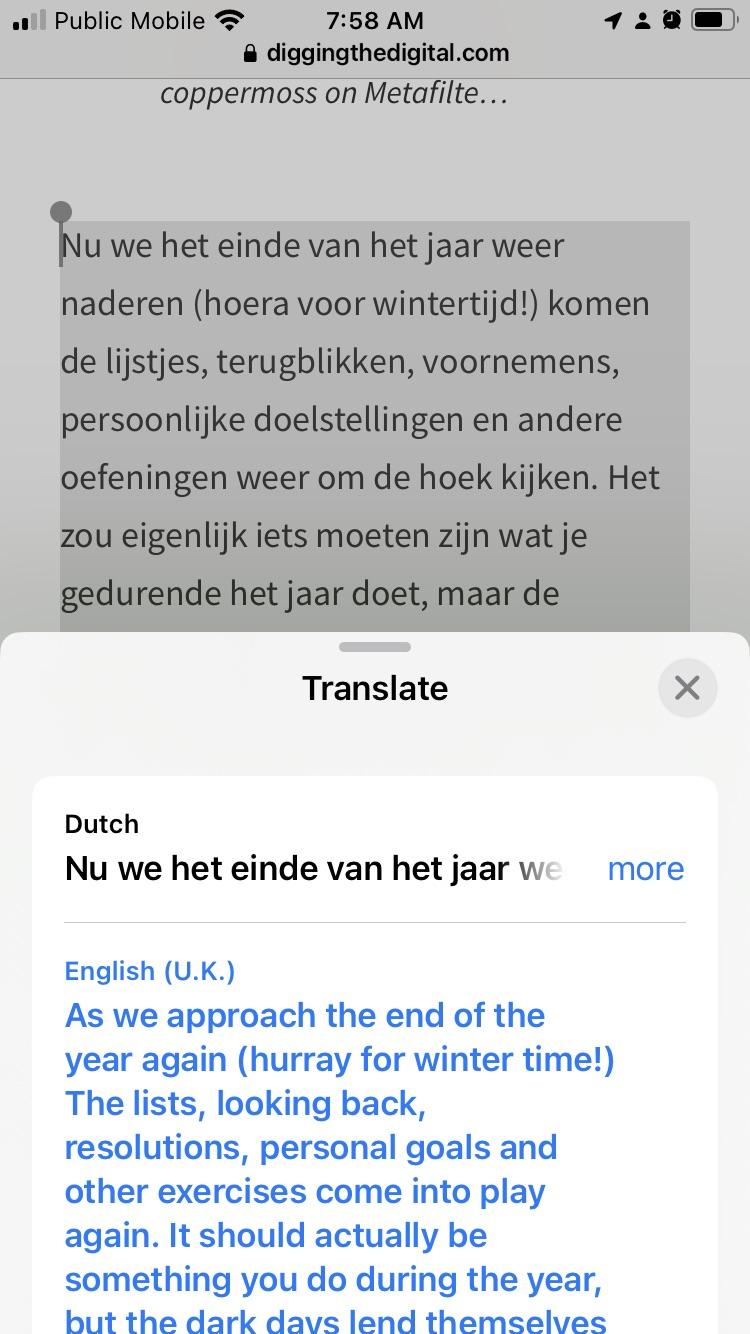
When the built-in translation features for iOS were first launched the list of language pairs was limited, to the point where I stopped even trying to use the feature, as Dutch, Swedish, Danish, German weren’t on the list.
I discovered this morning that, although Swedish and Danish are still absent, Dutch and German have showed up. Which makes it a little bit easier to read the blogs of friends like Frank.
🗓️
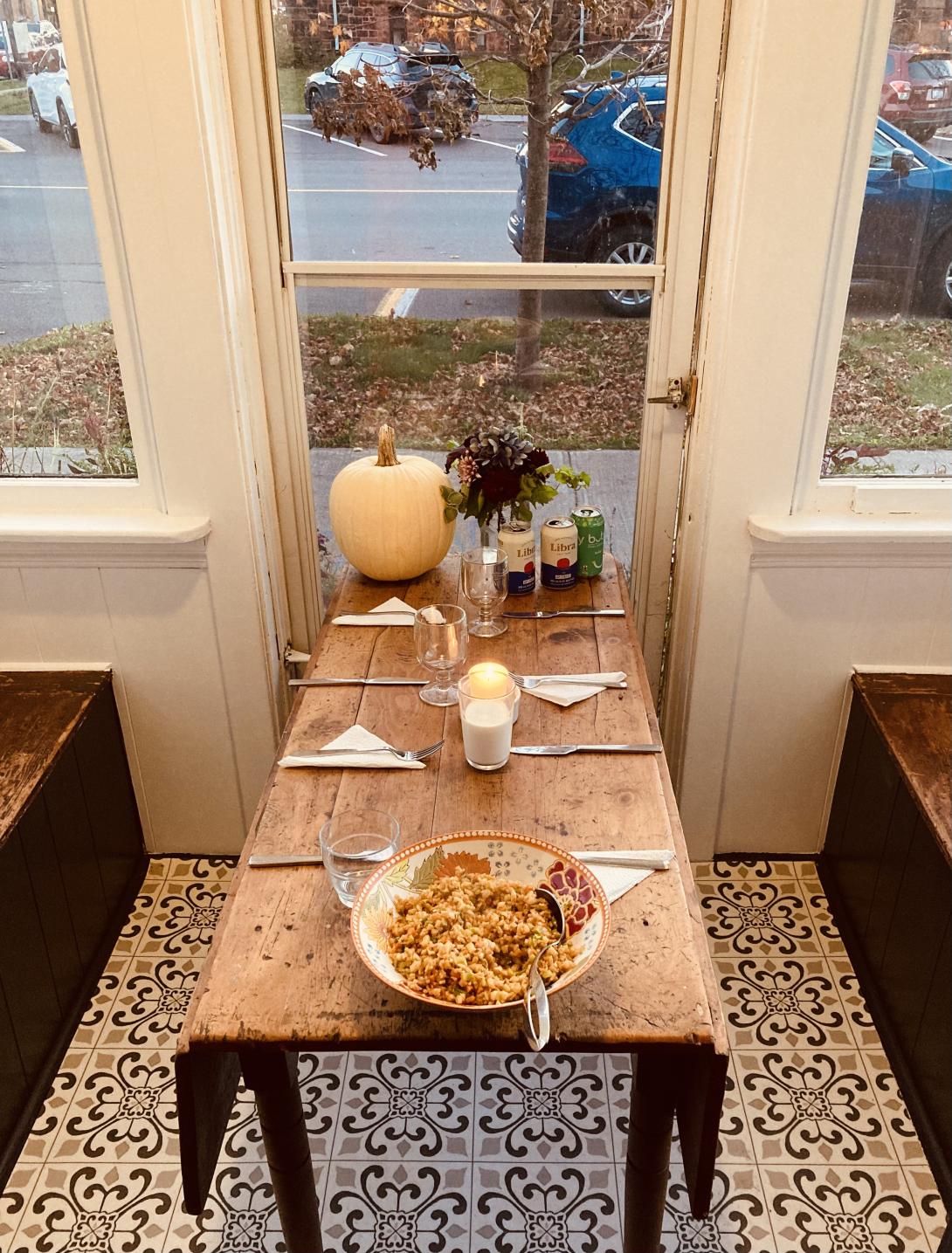
With the dining room table taken up with Hallowe’en-related activities, we needed an alternate place to eat supper.
🗓️
In Travel, the autism spectrum, and the pandemic, Edward Hasbrouck writes, in part:
Re-emerging from our COVID-19 cocoons is disorienting and stressful. This psychological phenomenon was anticipated almost 50 years ago by Isaac Asimov (often assessed, in retrospect, as having been on the autism spectrum) in his prescient pandemic must-read novels of physical distancing and virtual meetings, “The Naked Sun” and “The Robots of Dawn”.
This aspect of the return to a post-pandemic “new normal” is true for everyone, but perhaps especially true for people on the autism spectrum.
For more than a year after the outbreak of COVID-19, I was never further from my home in San Francisco than I could get, and return, in a day, by bicycle. I resumed travelling only after I was vaccinated, at first only to see elderly and ailing relatives.
The first time I travelled to a gathering of strangers in a distant city was for the annual meeting of the Peace and Justice Studies Association in October 2021. After a year and a half in the familiar environs of my home, previously routine travel experiences such as walking down a street in Milwaukee and eating with a group of strangers at a campus conference-center buffet seemed exotically unfamiliar and induced an almost overwhelming sensory overload, as though I were on some psychedelic drug.
My last trips outside Atlantic Canada were three years ago: a work trip to New Hampshire by air and EV in September 2019, followed, two months later, by a trip to Ontario when my father died. I haven’t been outside of North America since the fall of 2018, when Olivia and I travelled to Europe.
Previous to that I enjoyed a privileged life of regular travel to the US, Asia, and Europe; indeed my emotional resilience as a individual, father and partner on this small island was, to a great extent, predicated on being able to regularly leave this small island. Robbed of that opportunity by circumstance (illness, death, grief, caregiving, and the stretch goal of COVID) has changed the foundations of my life in ways that I’m just now beginning to realize.
There is a strong undercurrent of wanting to get out on the open road running through me; it’s a mix of wanting to throw off the shackles of confinement and a need to feed my hungry mind. And yet the complexity of my current situation — partner, kids, school, work, in their various permutations and combinations — makes getting out on that road, especially in a way that affords some spacious clarity, an often-insurmountable-seeming task. To say nothing of the emerging-from-fallout-shelter fears of what the world out there might look and feel like when I’m able to get there.
Edward finishes his post with a question:
As you begin travelling again, or begin travelling further afield, plan to travel more slowly, with rest days and breaks. Leave your plans more flexible. Avoid package tours or cruises that lock in your pace and itinerary. Give your brain a chance to gradually get back into its travel groove. Celebrate the chance to experience the world anew and to see the world with a fresh eye!
Are you travelling again? What seems different than before? Is that because the world has changed, or because your perspective has?
There is no question that my circumstances have changed, fundamentally; at the same time, vestigial perspectives—loneliness, fear, isolation, resignation—remain baked inside me.
I want to emerge into the world, as Edward suggests, and seize a ”chance to experience the world anew and to see the world with a fresh eye.” I want to take this new edition of me on tour, and the prospect of that is exciting, thrilling, hopeful.
And yet I’m afraid that those baked-in perspectives are baked in to an extent that a simple change of scenery isn’t enough to affect.
The only way to find out is to get outta town. I hope to do that. Soon.
🗓️
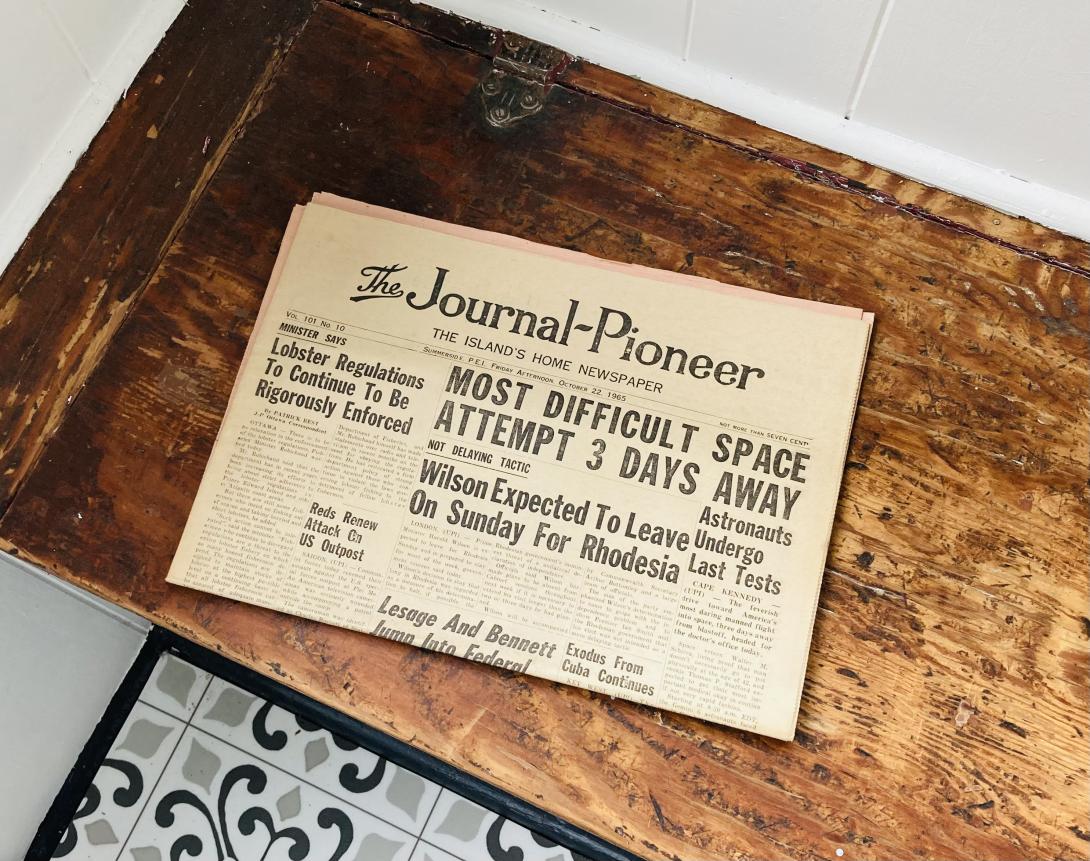
A copy of the Journal-Pioneer for October 22, 1965 appeared in my vestibule this afternoon.
“Most Difficult Space Attempt 3 Days Away.”
You read it here first.
🗓️
I bought a smart new MacBook Air M2 earlier this year: it’s a lovely machine, fast and sleek and better in almost all ways than the 11 year old MacBook Air it replaced (I get good mileage out of big expensive things).
One of the things the sexy new machine has prompted me to do is to work in places other than my church basement office: I’ve spent more time working from my dining room table, from the camper, from the library, from the coffee shop, in the last two months than ever before.
To enable this new work mobility, I bought a PKG laptop case from Staples last month. It’s a great case: just the right size for the MacBook and it’s power brick and cable, with a comfortable carrying handle on the top.
The one downside is that the laptop enters the case through a zipper on the short edge.
This downside isn’t entirely a downside: keeping the insertion point away from the top handle area makes things much cleaner and less complicated.
But it’s a downside inasmuch as when I forget to zip the zipper closed, when I place the MacBook inside the case, there’s a 50% chance that sometime shortly thereafter, as I walk about town, the computer is going to come shooting out the end and land on the sidewalk.
It’s happened twice.
Fortunately the computer hasn’t been damaged, other than mild scratching, when this has happened.
But evasive action was needed.
For reasons I don’t completely understand, I have a difficult time “defacing” things I own: I never put stickers on laptops, bumper stickers on cars, etc. I want to change this, to become less precious in my relationship with stuff, and to unleash my inner customizer, but it’s a struggle.
In this case, though, I struggled and I won.
In the model of the Neistat brothers, who label and customize everything, I took a “whiteout pen” and wrote CLOSE ZIPPER! on both sides of the case, near the zipper:
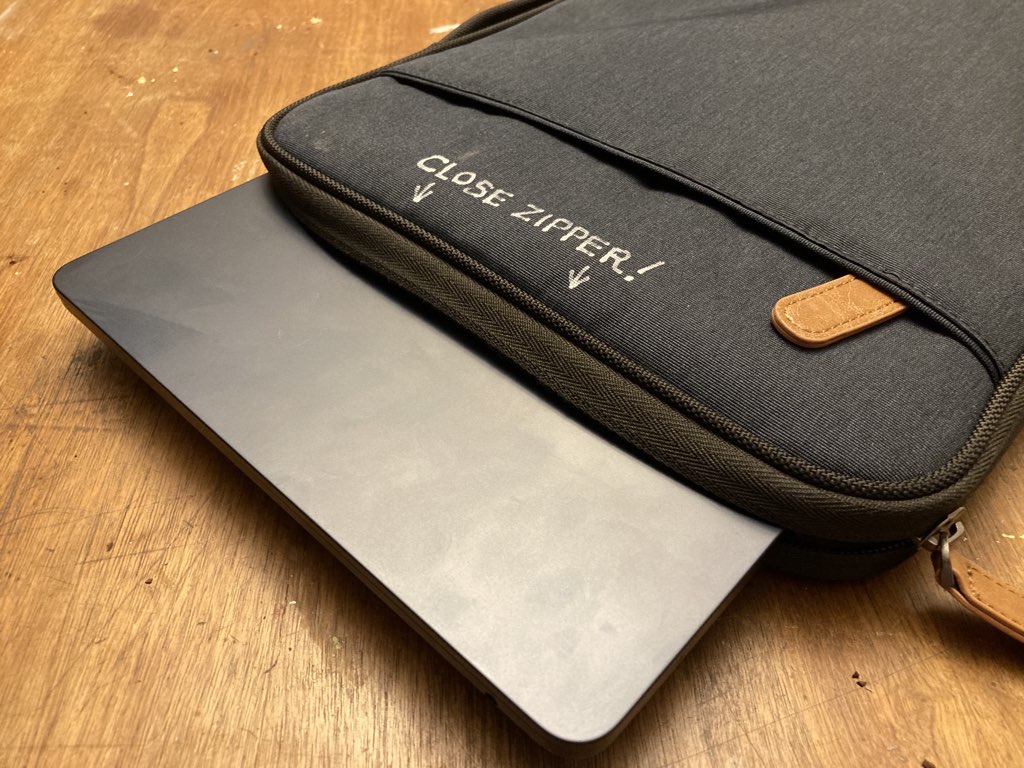
Doing this goes against all my anti-defacement tendencies. But I also love it a lot. And I’m hopeful that it will help keep my MacBook Air from an early death.
🗓️
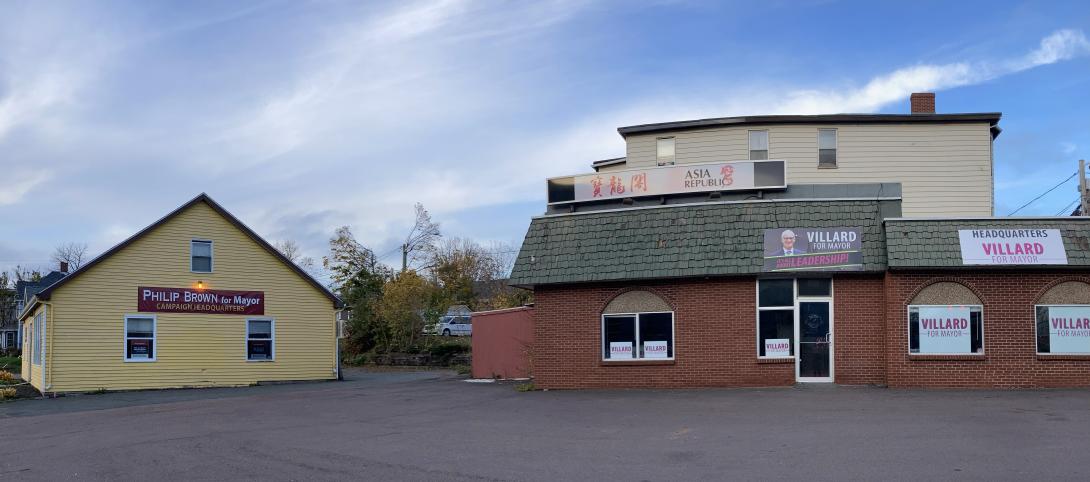
Two of the declared candidates for Mayor in Charlottetown have located their offices directly beside each other.
Incumbent Philip Brown’s campaign is in the former My Plum, My Duck; next door, Cecil Villard is in the former Seatreat.
Let the entertaining parking lot rumbles ensue!
🗓️
In the pantheon of Hurricane Fiona stories, I got nothing, relatively speaking, on the hardship file. Yes, my back yard lost a lot of trees, but with the help of neighbours, friends, and family, they were quickly despatched.
Being on the same circuit as the Queen Elizabeth Hospital and the Irving oil tank farm meant that restoring our power was, indirectly, a priority. As this chart from the RIPE Atlas probe in my office across the street—on the same electrical circuit—shows, we lost power at 7:00 a.m. on the September 24, 2022—the morning the hurricane was at its most intense—and it was restored at 4:00 p.m. on September 25, the next day:
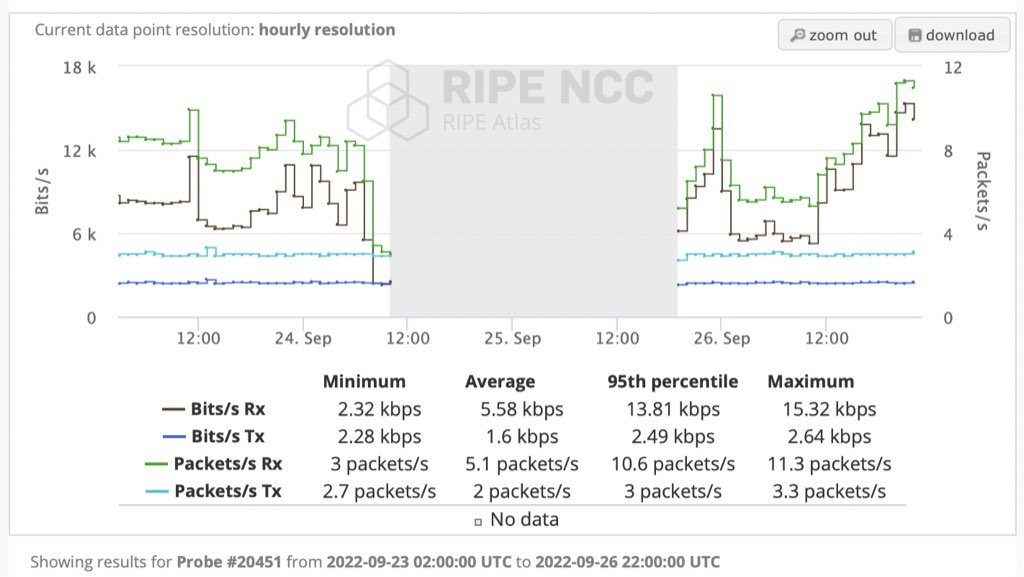
We were without power for 33 hours, a duration that, compared to what others endured, was akin to not having lost power at all.
Twenty-three days later, the Maritime Electric outage map shows 21 customers remain without electricity (I suspect that, in the annals of GIS web apps, the outage map will, for a long time, be the one that recorded the most traffic and bore the most scrutiny):
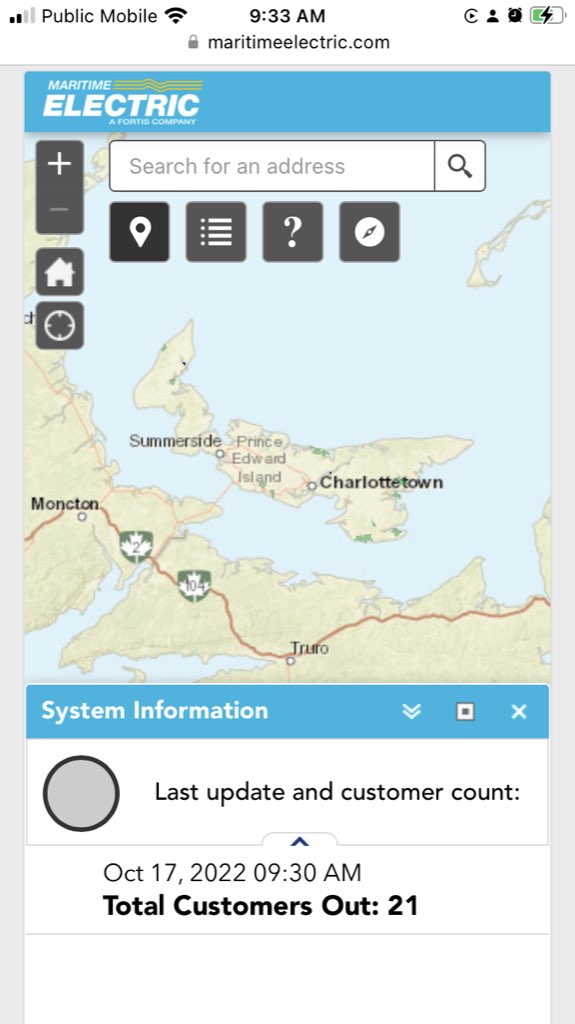
This means that, sometime soon—today? this week?—some household will be the final one to have power restored. If Premier King isn’t at their doorstep with valuable cash prizes, an Order of PEI, and the enduring thanks of a grateful province for withstanding powerlessness until the very very very end, there’s something wrong with the world.
🗓️
About This Blog
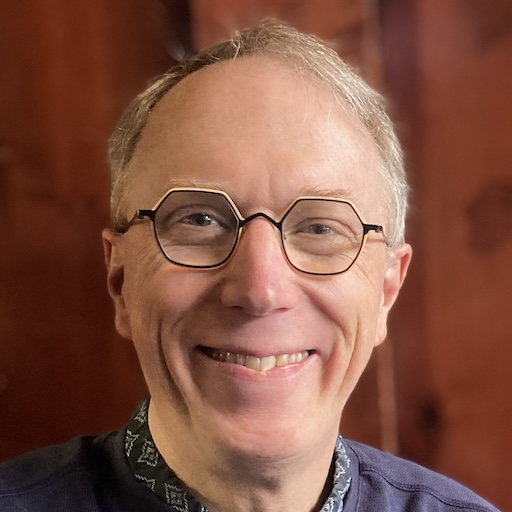 I am Peter Rukavina and this is my blog. I am a writer, letterpress printer, and a curious person.
To learn more about me, read my /now, look at my bio, listen to audio I’ve posted, read presentations and speeches I’ve written, see things I’ve favourited elsewhere, or get in touch (peter@rukavina.net is the quickest way).
I have been writing here since May 1999: you can explore the 25+ years of blog posts in the archive.
 You can subscribe to an RSS feed of posts, an RSS feed of comments, an RSS feed of favourites elsewhere, or a podcast RSS feed that just contains audio posts. You can also receive a daily digests of posts by email. I also publish an OPML blogroll.
Instagram • YouTube • Vimeo • ORCID • OpenStreetMap • Internet Archive • PEI.art • Drupal • Github.