
Not to turn this into an all-Leonhard’s all-the-time blog, but I would be remiss if I didn’t point out that their tea biscuits elevate the species to a new level, and that the mustard cream soup with meatballs is, well, just amazing.
If you’ve heretofore been intimidated by Leonhard’s because you haven’t been able to fathom making your way through an entire loaf of hearty dark bread, may I suggest you get yourself some of their rolls instead? We’ve had them two weeks in a row and they are simply fantastic: full of flavour, hearty by not brick-like and the perfect accompaniment to a stew or pasta dish. And at 90 cents each, they’re a bargain.
🗓️
The Eastern School District is closing school one hour early today. This midday-closure thing has got to be one of the most confusing part of a parent’s life: not only does it mean last-minute logistics juggling, but it also means that on any day where weather is sketchy you have to listen to the radio all the time.
I’m not a Patersonian “all of the world’s problems can be solved through Twitter” person, but it does seem to me that some sort of push solution would aid in the struggle here.
🗓️
 To the untrained eye, the CARI Complex and the UPEI Sports Centre would seem to be the same facility. After all, they are housed in the same building on the campus of the University and both involve athletic endeavours.
And thus you might think that after an exhausting run on the treadmill, or a punishing game of basketball, you might cool off with a bracing swim in the pool, and that you’d do this simply by walking through the door parked “Pool” in the locker room.
But there is no such door.
The two facilities are completely separate.
There are two completely separate sets of locker rooms. Two membership schemes. Two sets of hours. Two front desks. Two sets of informational brochures. Two websites. There are even two parking lots.
So if you, naive member of the public, want to swim after a run you must get dressed, walk out of the Sports Centre and into the CARI door, pay another fee, go into another locker room, and so on.
Does this not seem crazy to anyone but me?
I assume things are as they are purely for reasons of administration and control: CARI was tacked onto the side of the Sports Centre with no thought of integrating its operations into the Sports Centre because those making the design decisions decided to have recreational infrastructure recapitulate bureaucratic infrastructure (the UPEI Sports Centre is run by UPEI; CARI is controlled by a non-profit Board of Directors).
Oh how much more useful a facility this would be if some systems thinkers had intervened at the beginning of the CARI planning process and suggested that a single door through which we could all walk, pay, and recreate would the smartest way to proceed. Now it’s too late: the design flaw is frozen forever in concrete.
🗓️
Speaking of iPhoto, something I didn’t realize is that iPhoto has its own “Trash,” separate from the main Mac OS X “Trash.” This means that if you delete a photo, it doesn’t actually get deleted, it goes into the iPhoto Trash, and stays there until your empty the Trash (right click on the Trash in the sidebar and select “Empty Trash”).
Because I never realized this, every photo I’d ever deleted was hanging around in my iPhoto Trash, sucking up disk space — 7.5 GB of disk space as it turns out, as there were more than 6,000 photos there.
🗓️
My copy of iPhoto ‘09 arrived this week, and I sat down this morning to take its new facial recognition features, branded Faces, out for a ride. While it’s not perfect, it’s pretty good. You train it for a while — not too long, as it turns out — and then it starts to be able to guess at the identity of faces on its own:

Some observations after an hour of work:
- So far it’s been unable to identify Oliver in any photos, perhaps because he’s growing so fast so he looks different in every photo.
- My father has proved the easiest to consistently identify: he has a distinctive beard, so this isn’t surprising, and I can imagine the only way iPhoto would get confused is if I threw a lot of David Suzuki pictures into the mix.
- I have twin brothers. This is problematic.
See also Polar Rose if this sort of thing interests you.
🗓️
You may recall that I presented a talk-cum-performance piece last summer called Working for Free at reboot in Copenhagen. Somewhere between now and then video of my talk got released along with videos of all the other talks (my talk has its own Internet Archive page, as does the entire collection of reboot10 videos).
I was really happy with the way the talk worked out, mostly because I'd worked obsessively shaping and practising it for the days leading up to presenting it; I still have vivid memories of pacing around my Copenhagen apartment in the middle of the night working out my timing.
Featured at the beginning is Raise the Dead of Wintertime by Allan Rankin, who also features in the talk as a sample case. As do Casa Mia, City Cinema, Casa Mia, Brackley Drive-in Theatre, Charlottetown Transit, The Guardian, and Mark Leggott.
🗓️
The best piece of junk mail I’ve ever seen came to a colleague of mine, a paleontologist at the ROM in Toronto who received a Publishers’ Clearing House-like package emblazoned with Mr. Royal O. Museum, you may have won $1 million! or some-such offer.
I thought of that this morning when the following email arrived in my in-box because I’m a subscriber to The New Yorker:
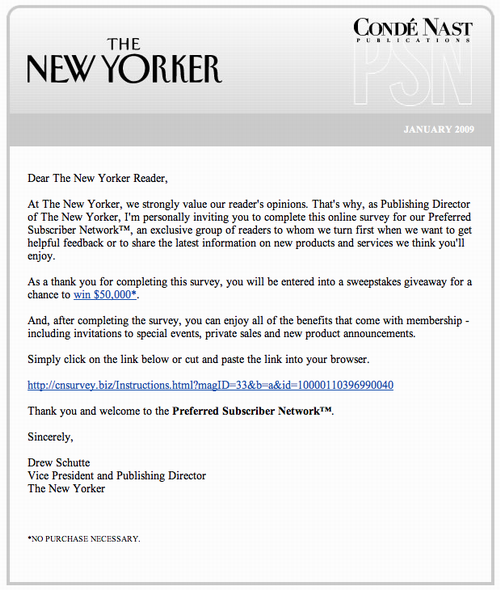
I usually throw email like this away without reading it, but I am, so to speak, unusually engaged with The New Yorker brand, so I read through it. What jumped out at me was the incentive offer:
As a thank you for completing this survey, you will be entered into a sweepstakes giveaway for a chance to win $50,000*.
Fifty thousand dollars seemed like an awful lot of money to spend to bulk up a list of “preferred subscribers.” I could understand $500. Or a chance at an iPod Touch. Or a free T-shirt. But $50,000 — from The New Yorker? And then I read the fine print (emphasis mine):
NO PURCHASE OR SURVEY COMPLETION NECESSARY. To enter and for full rules, including alternate method of entry, click here. Starts 12:01 AM ET January 12th, 2009 and ends 11:59 PM ET March 31st, 2009, when all entries must be received. Open to legal residents of the 50 United States/DC, 13 years of age or older as of the date of entry, except employees of Sponsor, Administrator, Promoter and their immediate families. Odds of winning depend on the number of Creative Presentations. If this Creative Presentation is selected, the odds of winning depend on the number of entries received through this Creative Presentation. Void outside the 50 United States/DC and where prohibited. ARV of Grand Prize: $50,000. Sponsor: ePrize, LLC, One ePrize Drive, Pleasant Ridge, MI 48069. Administrator: Equation Research, LLC, 453 E. Wonderview Avenue, #250, Estes Park, CO 80517. Promoter: The Condé Nast Publications, 1166 Sixth Avenue, 19th floor, NY, NY 10036.
So, setting aside that I’m not a US resident (something that The New Yorker should know, given that they mail me a magazine to my house in Canada every month), there’s the curious sentence “Odds of winning depend on the number of Creative Presentations.” But what exactly is a “Creative Presentation?” For this you have to turn to the contest rules. These say, in part:
Sweepstakes is offered in conjunction with multiple companies (“Promoters”) through different Web sites (“Creative Presentations”), announcing many different prizes. The Promoter for this particular Creative Presentation is The Condé Nast Publications, 1166 Sixth Avenue, 19th floor, New York, NY 10036. One (1) winner will be selected in a random drawing from among all entries received across all Creative Presentations. The prize for which an entrant is eligible depends on the Creative Presentation through which the entrant entered the Sweepstakes. All applicable federal, state, and local laws apply. ONLY ONE (1) GRAND PRIZE ACROSS ALL CREATIVE PRESENTATIONS WILL BE AWARDED IN THE SWEEPSTAKES.
If I’m reading this correctly it means that a whole bunch of companies are throwing in to run a contest together, with a single prize. And the prize is different depending on what door you walk in to sign up for it — presumably The New Yorker’s “a chance to win $50,000” could be “a chance to win $250” attached to a bag of potato chips, or “a chance to win a bag of potato chips” attached to a hot dog.
What’s even freakier is the way they pick the winner: first they randomly select one of the participating “Creative Presentations”, then they randomly select a winner from all the entrants who entered that way. The rules describe the odds of winning like this:
The odds of this Creative Presentation being selected depend on the total number of Creative Presentations. If this Creative Presentation is selected, the odds of winning depend on the number of entries received through this Creative Presentation.
Because information about the Promoters and the Creative Presentations, and how many of each there are is hidden it’s completely possible that there are 5,000 companies with 10 websites each, with hundreds of thousands of entries through each website.
In other words, the offer from The New Yorker that I will be “entered into a sweepstakes giveaway for a chance to win $50,000” is, essentially, a fake offer. Even if I were eligible to receive it, the possibility of millions and millions of other entrants makes my odds of winning small enough that it’s not really an offer at all.
So I’m not filling out the survey.
🗓️
After watching Eric Idle talk about John Cleese, I realized that in my mind I’ve been treating John Cleese and Michael Palin as one person. I know this is a serious Python crime, but it’s true.
🗓️
About This Blog
 I am Peter Rukavina and this is my blog. I am a writer, letterpress printer, and a curious person.
To learn more about me, read my /now, look at my bio, listen to audio I’ve posted, read presentations and speeches I’ve written, see things I’ve favourited elsewhere, or get in touch (peter@rukavina.net is the quickest way).
I have been writing here since May 1999: you can explore the 25+ years of blog posts in the archive.
 You can subscribe to an RSS feed of posts, an RSS feed of comments, an RSS feed of favourites elsewhere, or a podcast RSS feed that just contains audio posts. You can also receive a daily digests of posts by email. I also publish an OPML blogroll.
Instagram • YouTube • Vimeo • ORCID • OpenStreetMap • Internet Archive • PEI.art • Drupal • Github.