Here’s a recipe I adapted from one presented by Jamie Oliver. The ingredients:

  • Olive oil.
  • A handful of olives, green or black, pitted.
  • A couple of tablespoons of capers.
  • Some red, green and/or yellow peppers.
  • A can of tomatoes, whole or chopped.
  • A splash of hot sauce.
  • Pasta — spaghetti, linguine, or other.

Splash some olive oil into a frying pan and bring it up to medium heat. Chop the olives and peppers and add to the frying pan along with the capers. Cook for a while. Add a splash of hot sauce, to your taste. After a while add the tomatoes — if you use whole tomatoes chop them up with a knife while still in the can. Add whatever spices you have handy — oregano, basil, etc. to taste. Cook for 15 to 20 minutes, allowing the sauce to reduce.

Boil salted water, add pasta, cook per instructions on the package. When the pasta is done to your taste, drain most of the water, but not all of it (this is key) from the pot, leaving the pasta in the pot. Then add the olive-tomato mix from the frying pan and mix well.

Serve into large bowls. If you run some how water (and then remove) into the bowls before you add the pasta they’ll be nice and hot and won’t cool off the pasta. Sprinkle salt and ground pepper to taste.

The result is quite unlike standard pasta with sauce, and has a nice bite to it. It’s a flexible enough recipe that you can substitute for whatever ingredients you happen to have on hand, although the olives and the capers are central.
🗓️

Nigel Armstrong at The Guardian is doing great work with things like his maps of Charlottetown City Council meeting decisions. This is what newspapers need to do to remain relevant.

🗓️

Mitch and Kerry have tested you. And you have failed.

All season long CBC Radio One’s morning show here on Prince Edward Island has been outsourcing their music programming to their listeners in a jiggle they call “All Request Winter.”

Setting aside the obvious abrogation of editorial responsibility this involves, it was possible to imagine that the wisdom of the Island Morning crowd would take us in unanticipated musical directions. So I was willing to temporarily suspend my curmudgeonliness.

And then yesterday at 8 minutes to 7 o’clock the clock radio alarm went off and I found myself waking up to a Captain & Tennille song.

Perhaps, I thought, a rare misstep.

And then while making coffee they played Could I Have This Dance by Anne Murray. And I realized things were going down hill.

But they lost me entirely this morning with Lady In Red: as I made my way to have a shower I found myself literally wanting to gnaw my own ears off.

So here’s the thing, Island Morning listeners: I know that you and Donalda-Jean Gallant stared into each others eyes at the Colonel Gray Valentines Dance in 1986 while Chris De Burgh crooned and the disco ball splashed waves of light that made the gym seem like a Las Vegas showroom.

But I don’t care.

And even if I did care, it’s absolutely no justification for inflicting your musical memories on contemporary Islanders.

Nowhere in the CBC Mission Statement does it say anything about playing dreadful nostalgic music, and I think it’s hard to squeeze morning after morning of Anne Murray and the Captain & Tennille and the like out of “distinctive programming of the highest quality.”

Even if you set taste aside, surely the job of stoking the musical nostalgia fires falls to private radio: the role of the CBC, musically speaking, should be to take us all in unexpected directions.

That doesn’t mean we need to wake up to acid punk. Well, at least not exclusively.

But it does mean that maybe music programming is best left the experts, that DJing should be recognized as a professional skill, and that turning morning radio into some sort of dreadful collectively-programming iPod was a hideous unfortunate mistake.

(Oh, and as long as you’re asking, I’d like to hear For Wanda by the Thee Silver Mt. Zion Memorial Orchestra & Tra-La-La Band).

🗓️
CBC  •  Music  •  Radio

Did you know that when advertisements on television say “pet stains” they actually mean “the stains from where your pets peed on the carpet”? I didn’t. I think I have a genetic mutation that makes me incapable of grasping common euphemisms. I thought “pet stains” were like when your dog knocks over a bottle of red wine or your cat tracks mud in from the garden.

🗓️

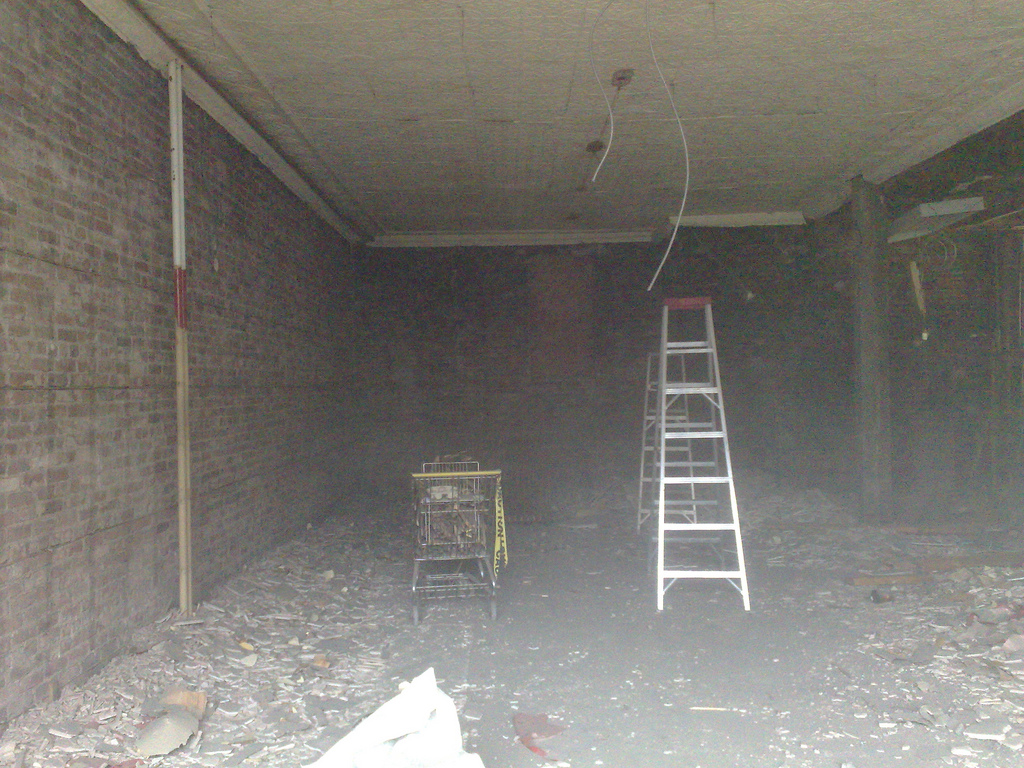
Almost a year ago Clarkie Innis died, and shortly thereafter Hambly & Innis, his clothing store on University Avenue, closed. Once the stock was sold, and the fixtures removed, here’s what it looked like inside:

Hambly & Innis No More

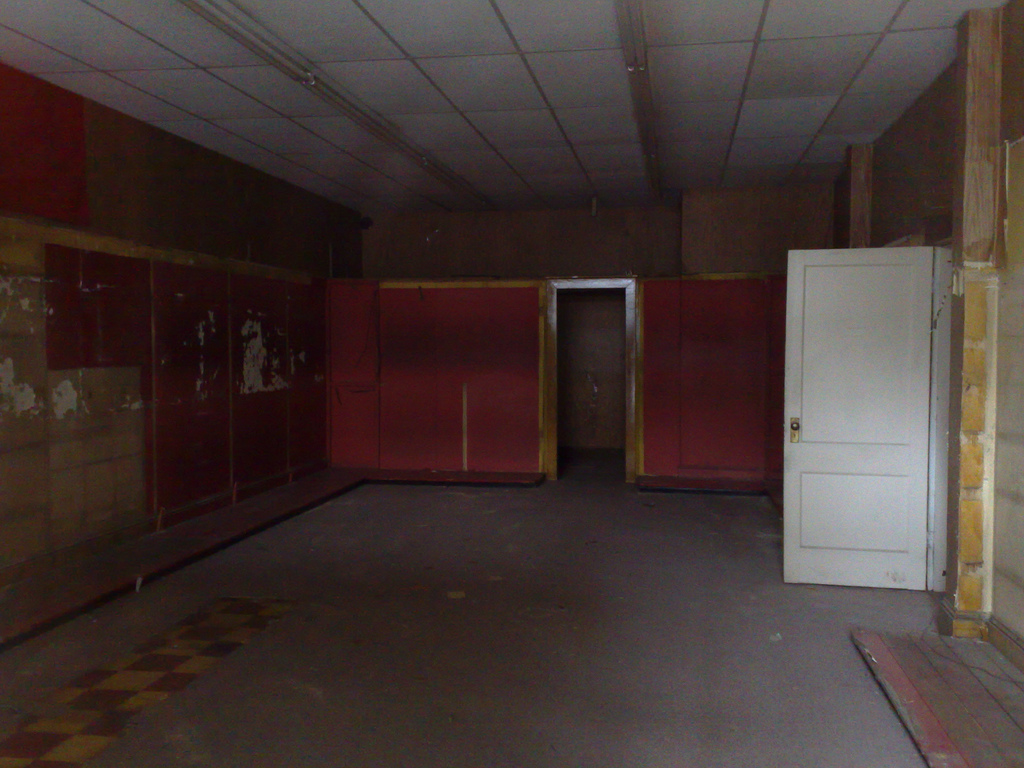
And here, after the start of some substantial-looking demolition, is what the inside looked like this morning:

The Old Hambly & Innis
🗓️

When I was a kid — it was probably grade 4 or grade 5 — the cooler kids used to tease you by asking “do you wake up with hair in your mouth?” It was a trap: if you answered “yes,” well, there were implications. And if you answered “no,” then they would respond with “Professional, eh.”

Of course the specific nature of the implications was completely lost on me. In the same way that the meaning of the insult “suck me off” lobbed at another kid was lost on me (I’m willing to bet that it was lost on most of the other kids as well). Actually, I think my Dad tried to explain it to me once, in a somewhat awkward discussion that may have involved additional awkward explanation of the meaning behind the name of the band Teenage Head.

All of which leads me to a discovery I made this morning.

I’ve always had issues with those sporty water bottles with the squirty nozzle at the top: I’ve never been able to get them to work and, at best I can get a trickle out of them.

When I headed off to the gym this morning Catherine handed me a metal water bottle, which was even worse because I couldn’t squeeze it, and thus couldn’t get anything to come out of it.

It turns out — and I have Catherine to thank for educating me on this — that effective use of sporty water bottles requires that you suck the water out, not to squeeze it out. Once I understood this my relationship to the bottle changed completely, and it hydrated my workout this morning quite effectively.

🗓️

Speaking of Q, I was finally able to watch Q on Bold, a one-hour weekly televised version of the radio program. It’s not really a TV show, per se, but rather a filmed radio show — in other words, more like Don Imus on MSNBC than This American Life on Showtime. There’s a Q YouTube channel too, where you can get a similar videotaped view inside the radio studio.

Generally I’m not an advocate for CBC-style synergy — the drive to “unite the platforms” that see news stories from Compass running the next morning on Island Morning. And I’m not entirely convinced that running a radio show like Q on television is a useful exercise that adds anything to the experience.

That said, it is interesting to watch partially naked radio in action. Even though I’m no stranger to the radio studio, for example, I was surprised to see just how scripted everything that Jian Ghomeshi utters into the microphone is, from intros and extros to questions — when Jian takes a breath and casually mentions “so, you were born in Utica, what was that like,” it’s not casual conversation, it’s a scripted prompt. I suppose it’s a testament to his skills that he’s able to make it sound like he’s making everything up off the top of his head.

What would be really interesting is if they had cameras rolling from before the radio show started until after it finished, and added cameras to the control room — that would really give us an archaeological dig through the radio-making process, and while it might expose even more of the artifice, it might also demystify the process enough to make more people consider taking it on as an amateur practise. (Example)

🗓️
CBC  •  Radio  •  Television

I chanced upon an interview with writer Dea Birkett on CBC Radio One’s Q on Monday talking about the Kids in Museums Manifesto. It’s a brilliant piece of work with a compelling back-story that should not only be adopted by all museums and galleries, but by any public or private facility that might engage with families.

My favourite item from the Manifesto is #19:

Remember there’s no typical family. Families can span generations, including toddlers, teenagers and grandparents. A visit should be enjoyable for the whole family together - not just the kids.

Even museums that do well otherwise often break down on this point, positioning “family activities” for a narrow age range, and structuring them so that it’s really more “adults watch or assist while kids do crafts” than it is “engaging activity for everyone.”

🗓️
Children  •  Customer Service  •  Design

If you’ve got a Mac and an Asterisk-based phone system, I highly recommend you check out Telephone, an open source OS X “softphone” with the following design philosophy:

I don’t know why they think you should like a mobile phone interface on your computer.

Which is, I assume, a shot over the bow of softphones like X-Lite. And, true to those words, here’s the simple UI:

Telephone for OS X Screen Shot

I’ve been trying Telephone out for a few days on long conference calls. Other than not being able to figure out “flash the switch hook” to be able to transfer calls (it’s a feature request), it’s performed flawlessly, and has enabled me to switch away from Skype to live the headset dream.

🗓️
Mac OS X  •  Telephony  •  Voice Over IP

One of my favourite new magazine finds is on site, which aims to “democratise and widen the discussion of the production of space.” It’s published in Alberta and I found Issue #19 on the newsstand at the Atlantic News in Halifax last summer.

At the back of that issue there’s a short piece by Joseph Heathcott, Associate Professor or Urban Studies at The New School, about an exercise he gives his new students. He writes, in part:

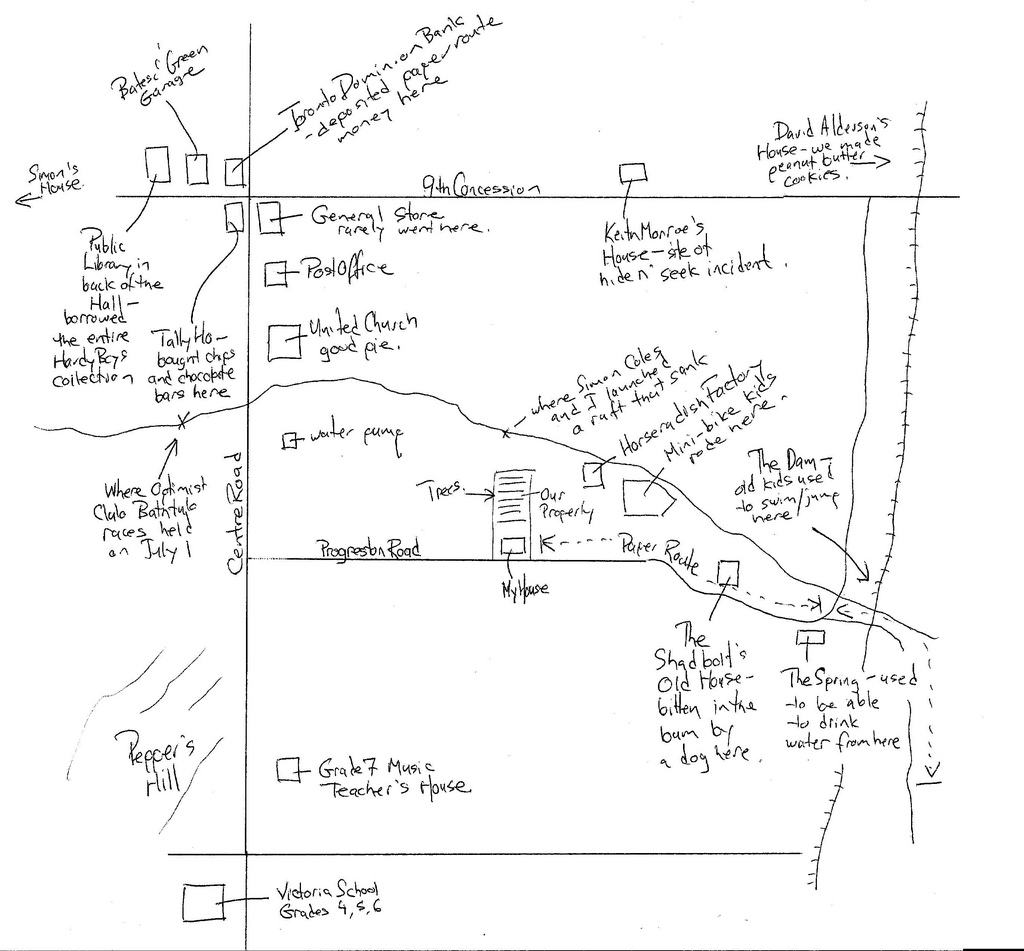
One of the first exercises that I have students undertake is to draw a cognitive map of their childhood neighbourhood with key landmarks — in under ten minutes. This exercise introduces the relationship between memory, place, and time.

I was intrigued enough by the exercise to do it myself. Here’s what I came up with in 10 minutes of my neighbourhood village of Carlisle, Ontario, where I lived from 1972 to 1985 (click for a larger version):

My Childhood Neighbourhood

I’d be interested to see what your sketch looks like — if you’re up for it, just scan (or take a picture or) your sketch and upload it to Flickr with tag mychildhoodneighbourhood and leave a comment here.

🗓️
Design  •  Ontario  •  Psychogeography

About This Blog

Photo of Peter RukavinaI am . I am a writer, letterpress printer, and a curious person.

To learn more about me, read my /now, look at my bio, listen to audio I’ve posted, read presentations and speeches I’ve written, see things I’ve favourited elsewhere, or get in touch (peter@rukavina.net is the quickest way).

I have been writing here since May 1999: you can explore the 25+ years of blog posts in the archive.

You can subscribe to an RSS feed of posts, an RSS feed of comments, an RSS feed of favourites elsewhere, or a podcast RSS feed that just contains audio posts. You can also receive a daily digests of posts by email. I also publish an OPML blogroll.

InstagramYouTubeVimeoORCIDOpenStreetMapInternet ArchivePEI.artDrupalGithub.