As part of my Social Consumption Project, I’ve had an electricity meter reader logging our household usage to a database since late September.

The week of October 5 our house was empty – I was in the west coast and Catherine and Oliver were in Ontario – and so this gave us a great chance to find out what the base electric load of our house is when there’s nobody living in it. Here’s what we found (number are kWh per day from October 5 to October 11, 2014):

Electricity Usage, in kWh, at 100 Prince Street in October, 2014

Other than lights, we took no steps to turn things off during our absence – poor planning – and so the bulk of the consumption that week were things like the refrigerator, the “instant-on” appliances, like our TV set, and our iMac computer, which we left on (and which was used a couple of times a day by our friend G. who was checking the house for us).

Maritime Electric’s charge for electricity is 12.78 cents per kWh, so our electricity was costing us between 64 cents and and 77 cents a day. So we weren’t going broke. But that’s that’s still $5.00 that we didn’t, in theory, need to spend that week.

By comparison, here’s our electricity usage for this week, when the house was fully occupied:

We used 117 kWh this week, which is 79 kWh more than an empty house, which you could say is our “discretionary” electricity – the stuff we do deliberately by turning something on.

Which made me curious: that 38 kWh our house used the week we were away, the electricity the house uses when we don’t deliberately turn something on, what’s using that?

And so I borrowed an electronic energy meter from the Confederation Centre Public Library (almost every public library on Prince Edward Island has one, so this is easy for anyone to do, and it’s free) and this weekend Oliver and I measured the electricity consumption of everything in the house that plugs in.  Here’s a chart showing the “stuff that’s always on that uses electricity”:

Appliance Load
Refrigerator 30 watts
Mouse Repeller 3 watts
Television 4 watts
Nintendo Wii 8 watts
Stereo 11 watts
Eastlink Router 9 watts
Apple Airport Extreme 7 watts
VOIP Telephone Box 5 watts
iMac Computer 94 watts
TOTAL 171 watts

There are some other things that aren’t counted in that total – the furnace coming on, a light that’s always on in the upstairs bathroom – but that total covers almost everything.

And so our “idle” household uses almost as much electricity as a 200 watt light bulb left on all the time.

And, indeed, 171 watts per hour is 0.171 kWh and 0.171 kWh for 24 hours is 4.1 kWh, which is within 1 kWh to what my electricity meter readings showed (the difference was likely those things we didn’t count, plus some lights that G. would have used).

There are some things we can do to lower this base load, some of which I’ve already done:

  • I’ve moved the television, stereo and Wii to a power bar that I can shut completely off when we’re not using them: that will save us 23 watts of load, or about half a kWh per day if we never turned them on.
  • We could have the iMac go to sleep (rather than just “idling” with the display off); this could save about 2.25 kWh per day if we never turned the iMac on.

Of course if nobody at all was going to be using the house, we could also turn off the Internet gear and the phone and we’d save even more.

The other step we’ve taken is to start to replace incandescent and compact florescent light bulbs with LED bulbs, starting in the living room. So far I’ve replace 221 watts of load with 59 watts but replacing the bulbs in the three lamps we use most often.

It may seem absurd to be taking these seemingly minor steps that will save us a few dollars a month on our electricity bill at most. But these small things mean a lot on a province-wide level.

There are about 40,000 households in Prince Edward Island. If each of those households has a computer on all the time that consumes about 100 watts of electricity, that’s 4 millions watts of electricity being used to power all those computers; that’s 4 megawatts, or about 2% of the Island’s electricity load (193 MW) as I type this sentence. That’s a lot of electricity, and it’s electricity that we weren’t using a generation or two ago. It’s also electricity that we could save a lot of if we put our computers to sleep (or turned them off) when we’re not using them.
🗓️

I just absolutely love this duet, shot cliff-side near Cannon Beach, Oregon and featuring couple-in-banjo-and-life Béla Fleck and Abigail Washburn. For more on the Washburn-Fleck union, watch this PBS NewsHour story.

🗓️
Béla Fleck  •  Abigail Washburn  •  Banjo

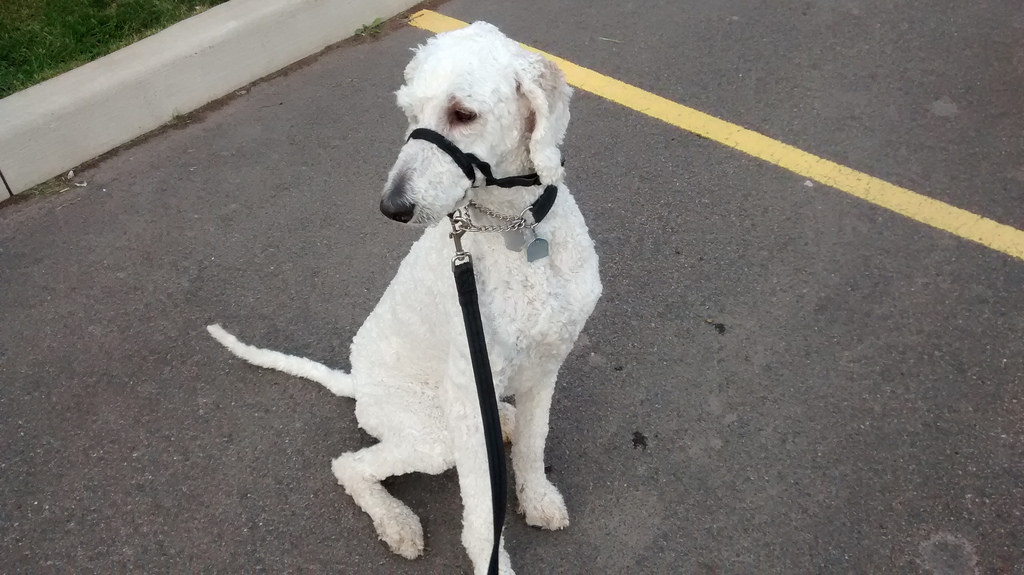
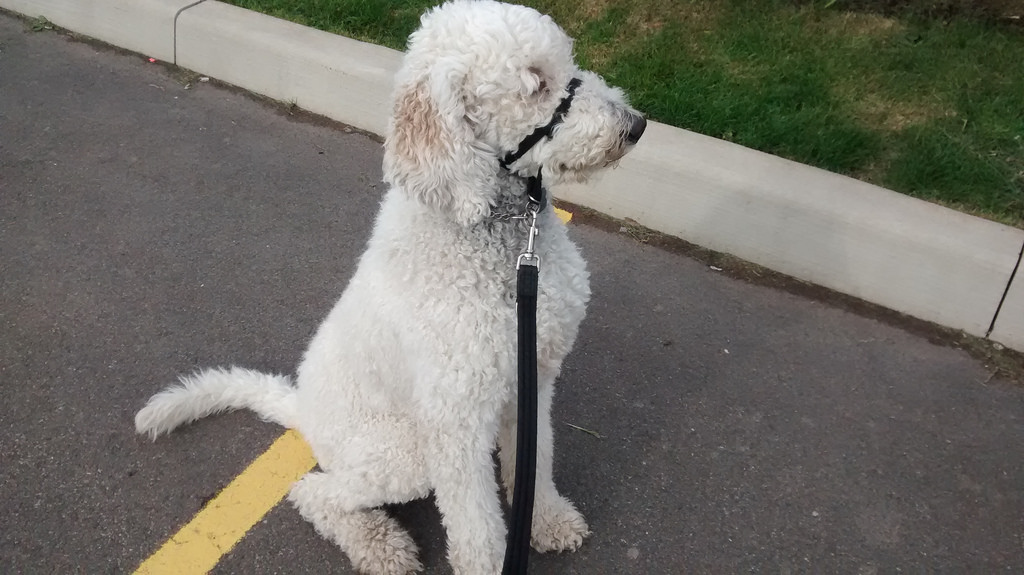
We generally keep Ethan’s hair clipped short: he’s a working dog, not an ornamental poodle, after all.

But we’ve been busy over the last month, and let his hair get a little on the long side, to the point where it was looking like he might have difficulty seeing through the shag soon.

So we made an appointment at Petsmart for this morning and dropped him off looking like this:

Ethan Gets a Hair Cut

When we picked him up four hours later, he look like this:

Ethan Gets a Hair Cut

It’s hard to believe that’s the same dog.

It will grow back soon.

🗓️

Two years ago next week I found myself trying to get to sleep in a Halifax hotel and so, as I often do, I listened to a podcast, the episode of Alec Baldwin’s Here’s the Thing where he interviewed Dr. Robert Lustig about the evils of sugar.

Toward the end of that interview Baldwin asked Lustig what public policy changes he recommended to lower sugar consumption; Lustig responded, in part (emphasis mine):

I would think very strongly about limiting access of sugar beverages to infants and children, like zero. There is no reason for it. And there’s something your listeners need to understand: there is not one biochemical reaction in your body, not one, that requires dietary fructose, not one that requires sugar. Dietary sugar is completely irrelevant to life. People say oh, you need sugar to live. Garbage.

(Here’s the audio of the clip).

For some reason, on that sleepless cold Halifax night in a strange hotel that simple statement hit me over the head like a hammer.

It seems silly to say, but it had never occurred to me that we don’t actually need sugar.

Sure, I knew that it was a good idea, for a host of reasons, to not have “too much” sugar – what kid who grew up in the carob-infused 1970s didn’t know that – but the notion that there wasn’t actually a need to have any sugar at all was something I’d never considered.

Over the years I’d had friends who would tell me “oh, I cut out sugar,” and I always heard that in the same spirit one might hear “oh, I cut out breathing”: it seemed like a foolhardy, impossible task.

But there, then, that night I decided to give it a try.

Partly as a personal challenge (it did indeed seem like a foolhardy, impossible task).

Partly as a way of figuring out how much sugar I actually was consuming.

And partly because, if Dr. Lustig was to be believed, I had a decent chance of improving my health if I did.

And so, when we got home to the Island a few days later, I just stopped.

It wasn’t a full-on puritanical “no sugar will ever touch these lips” kind of cold turkey, but it was as close as I could practically come while still allowing for the occasional piece of birthday cake.

And what did I find? I was eating a lot of sugar.

For example, a couple of times a week I’d have lunch at Tai Chi Gardens, a tea house around the corner from my office. In the summertime I’d always order a lemon iced tea with my lunch, reasoning that it was “handmade” by people I knew and therefore must be much better for me than if, say, I’d had a Coca-Cola at Subway.

But then I watched how much sugar goes into a lemon iced tea and I realized that sugar is sugar is sugar, and I started to order my lemon iced tea without sugar.

Among other things, I also stopped eating: ice cream, chocolate bars, dessert after lunch and supper, sugar in my coffee, sweets at bake sales, a cookie here or there, a handful of chocolate chips when they presented themselves; essentially I stopped eating all the “discretionary” sugar I’d been eating before, without obsessing about the hidden sugars in many prepared foods.

The effect was immediate and dramatic: I began to crave bread like never before. And when I say “crave” I mean “involuntarily bake bread at 10 o’clock at night because I really, really need to eat some bread.”

That lasted about a week.

And then… I lost my taste for sugar. Indeed the occasional lapse – a Mars bar at the movies, a piece of birthday cake at a family party – would not only no longer make me feel “better” as it used to but, in fact, would have the reverse effect, making me feel nervous and uncomfortable. It was a tremendous and convenient disincentive to sugar-eating.

And now two years have passed.

There’s no doubt that I confronted the amount of sugar in my diet, and came away surprised at how much I’d been consuming.

Health-wise, I have only a vague largely anecdotal feeling that my health has improved. Certainly I’ve lost some weight – about 20 pounds over two years. And I feel like my immune system is considerably improved (those winter colds that last days for others seem to pass through me in a few hours). But I’ve no idea whether I can chalk any of that up to sugar or not.

I still eat sugar, of course: it’s hard not to when it’s found in all manner of things including in salt (yes, one of the ingredients on our box of salt is “sugar,” albeit trace amounts). And I have a banana muffin most mornings for breakfast which I know contains more sugar than I can probably imagine (breakfast is a challenge for a non-egg-eating mostly-vegetarian). But I’d hazard a guess that I’ve been able to cut out about 95% the low-hanging obvious sugar in my diet.

Otherwise, I’ve been able to make some observations from this new vantage point.

The “sugar industrial complex” is everywhere and no more so than on television; by happy coincidence we cut off our cable television a few months before I cut off sugar, and with it I lost most exposure to Dairy Queen Peanut Buster Parfait commercials, Mr. Big chocolate bar commercials, Coca-Cola commercials, and the like. I’m certain that made early days easier.

There may be no nutritional need for dietary sugar, but that doesn’t mean there’s not a cultural need for it: there are holes in our day to day western life that we fill, generally, with sugary things. Coffee breaks. The time after supper. Birthday parties. Christmas parties. Hallowe’en. It’s not that these times are practically difficult to deal with – I’m not jonesing for sugar – but I do notice the holes nonetheless, and, in a strange way, I mourn the loss of my participation in them. The display case at my coffee shop is filled with intriguing-looking scratch-made desserts, and bypassing them and just ordering coffee leaves me feeling the same way that former smokers have described feeling when they go to bars after the quit… they miss having something to do with their hands, something to fill the time with. It’s weird.

It’s not powerful – more like background radiation – but it’s weird nonetheless.

All other things aside, perhaps the greatest lesson I take from this experiment-turned-lifestyle is that, when in the right frame of mind, I am capable of making substantial lifestyle changes. That’s a good thing to know, and makes we wonder what other things I could accomplish if I found the rationale and put my mind to it.

🗓️
Sugar  •  Health  •  Halifax  •  Alec Baldwin  •  Dr. Robert Lustig

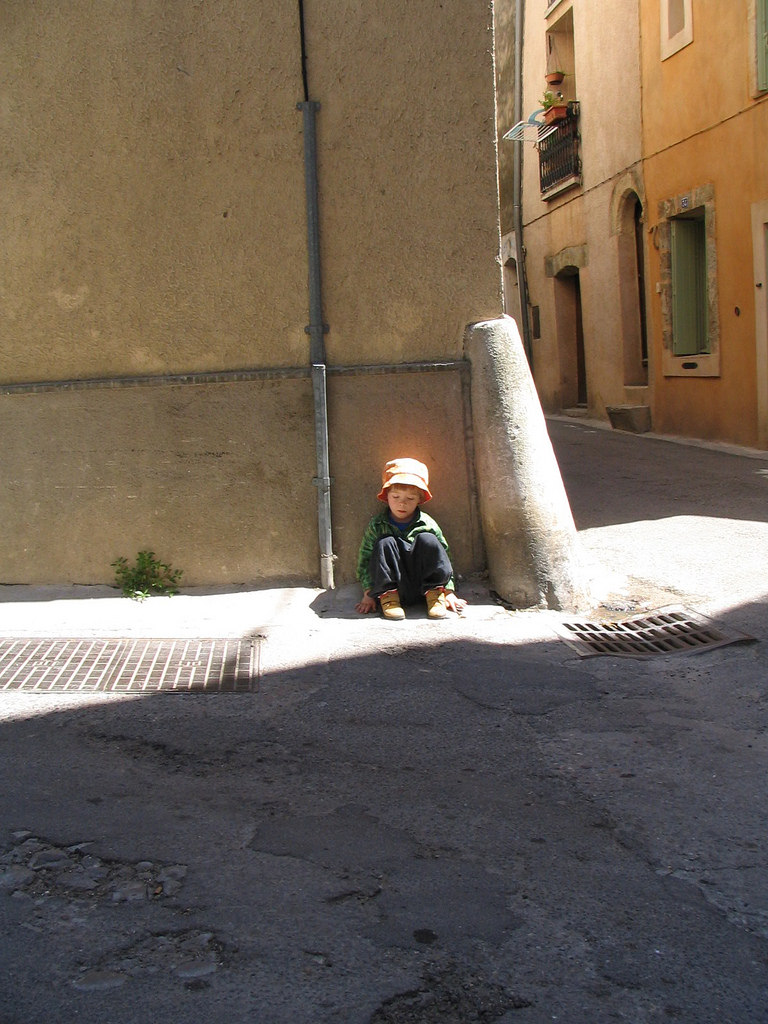
In the spring of 2005 we spent a month in the small village of Aniane in the south of France. The trip was the first test of my “I can work from anywhere” hypothesis, and the results of the experiment showed that this was just barely true: the house we rented was free of Internet, leaving me to scavenge for wifi in the surrounding towns, and the ergonomics of the attic I set aside to be my office were such that rope and pillows were required to strap me into a comfortable work position.

But, work logistics aside, it was one of the greatest trips we’ve taken as a family: Aniane was a tiny, perfect village with two boulangeries, a mid-week market and awe-inspiring stone architecture, surrounded by enough distractions to keep us pleasantly occupied for the month with fun family activities. Sometimes it was enough just to wander about the village, taking it all in.

Sunny in Aniane

The nearest major city, 30 minutes drive away, was Montpellier, and we would often go into the city to shop, or to wander, or to ride its city-centre carousel. A few minutes walk from the carousel was a park called L’Esplanade, and one of the features of L’Esplanade was that it offered pony rides for children.

Which is how we met Bembo.

Bembo was one of the stable of ponies, and was the one selected for Oliver to go on walkabout around the park. We paid our fee – a Euro, if I recall correctly – and were surprised to find that our marching orders were to simply set off, under Bembo’s guidance, through the park. In stumbly French I managed to determine that Bembo knew the way; there was nothing to worry about.

And Bembo did know the way: he dutifully, calmly, loped on his standard route, around and about and through, never diverging from his intended course. If we’d fashioned ourselves as pony thieves it never would have worked out, as Bembo’s determination to stay the course was unbreakable: he wouldn’t divert no matter how hard we might have pulled.

Everything went sideways, however, when we came to a section of the brick path that workers had just started to dig up: what was Bembo to do?

He couldn’t go forward, he couldn’t go backward, he wouldn’t go around.

So he stood there. Waiting.

It took all our strength and persuasive energies to convince Bembo that it was okay to divert 6 inches to the right to make his way around the disturbed section of the path, but we eventually managed it.

Once beyond, Bembo merrily continued on his way back to home base, where Oliver slipped off, and Bembo went back into the rotation.

My mind has returned to that afternoon with Bembo often in the years since: how many times must have Bembo walked that path for it to become so implanted in him that no other path was possible? How many times after Oliver’s ride did he continue to do so? What become of him? Could he still be there, 9 years later, still walking the same path?

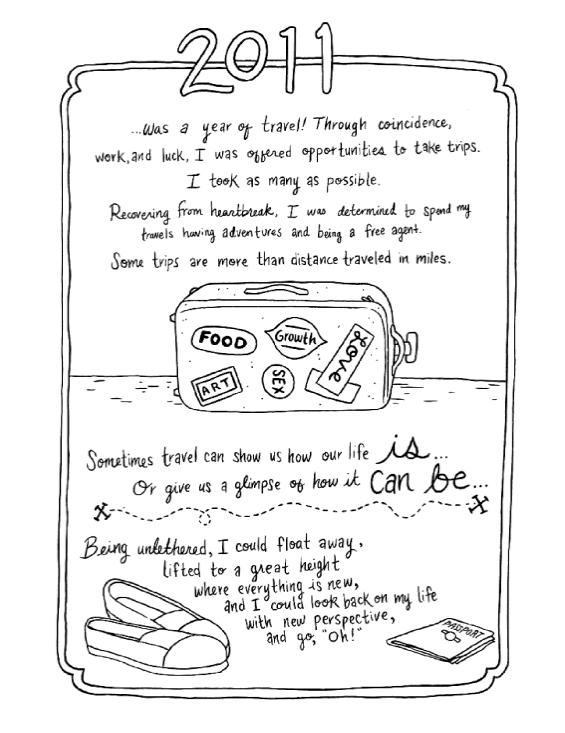
Oliver and I are reading the excellent Lucy Knisley book An Age of License, a “comics travel memoir” about her 2011 trip to Europe. The introductory page looks like this:

Licy Knusley, An Age of License, Introduction

She writes:

“Sometimes travel can show us how our life is… Or can give us a glimpse of how it can be. Being untethered, I could float away, lifted to a great height where everything is new, and I could look back on my life with new perspective and go, ‘Oh!’”

Our ride through L’Esplanade with Bembo afforded me some of that new perspective: we can worry ourselves into repetitive ruts in life, ruts worn so deep that we hardly even know that they are there, as they come to simply resemble everyday regular life, “the way things are.”

And on occasion we come to a break in the path, a pile of bricks set there by others, and we’re confronted, suddenly, with the need to find a way around.

We can use that opportunity to squeeze around the pile of bricks and continue on the path, or we can use the opportunity to realize that perhaps we have the ability to set off down a different path and avoid the bricks altogether.

🗓️
France  •  Musing  •  Oliver  •  Ponies

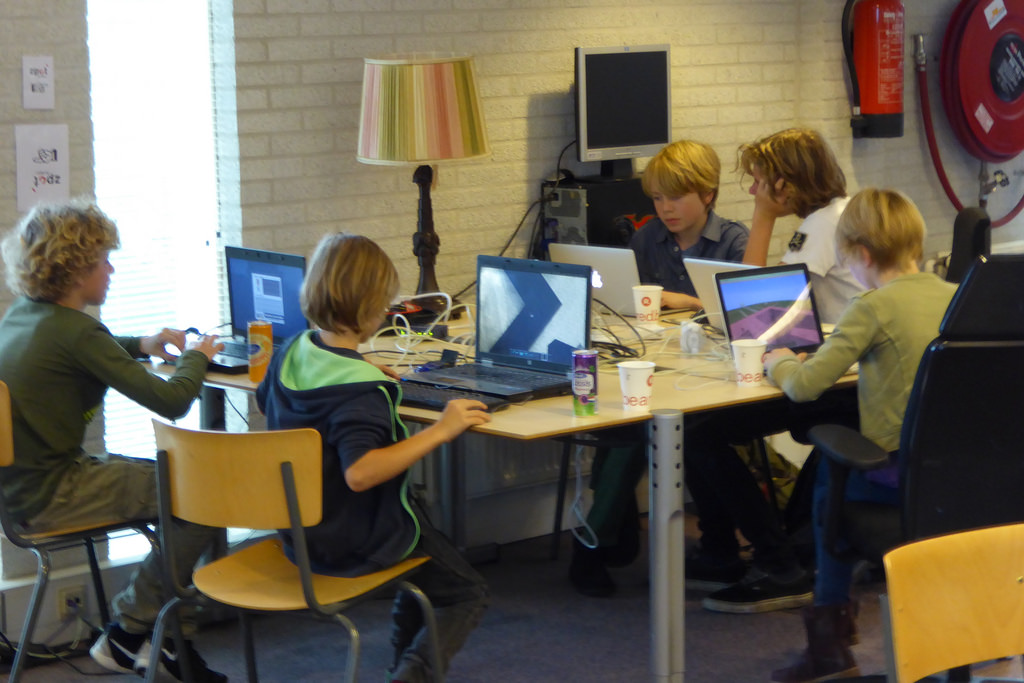
Back in July, in Enschede, Oliver and I gave a walk-through of Printcraft, the intriguing “make 3D models in Minecraft, then print them on a 3D printer” experiment, to a group at the Make Stuff that Matters unconference.

In the room that summer afternoon were Frank and Floris, father and son.

I am happy to report, via Ton, that Frank and Floris took the ball and ran, holding Meet2Minecraft this weekend in Utrecht and taking our little talk to the next level, with 40 kids gathering to craft in Minecraft and print in the real world.

I love it when ideas spread!

Minecraft / Printcraft

🗓️
Printcraft  •  Minecraft  •  Netherlands

Assembling instructions from here and here, this is how I installed Node-RED on my Raspberry Pi to support my electric meter reading experiments:

wget http://node-arm.herokuapp.com/node_latest_armhf.deb
sudo dpkg -i node_latest_armhf.deb
wget https://github.com/node-red/node-red/archive/0.9.1.zip
unzip 0.9.1.zip
mv node-red-0.9.1 node-red
cd node-red/
npm install --production

That last step takes a while – be patients and it should finish in 5 to 10 minutes, and it may look like nothing is happening.

Now install the serialport and Sqlite nodes for Node-RED:

npm install serialport
npm install node-red-node-sqlite

To disable login-by-serial-port, which appears to interfere with the ability of Node-RED to read serial devices, edit the /etc/inittab file and comment out the line:

T0:23:respawn:/sbin/getty -L ttyAMA0 115200 vt100

When this is complete, Node-RED should be installed. To have it start on Raspberry Pi bootup automatically:

wget https://gist.github.com/Belphemur/cf91100f81f2b37b3e94/download -O node-red-init.tar.gz
tar -xzvf node-red-init.tar.gz
sudo mv gistcf91100f81f2b37b3e94-f6cd047768778b48b25dd66c68fdcbb68ec15465/node-red /etc/init.d/node-red
sudo chmod +x /etc/init.d/node-red
sudo update-rc.d node-red defaults

To start Node-RED right now:

sudo service node-red start

You should now be able to see Node-RED from a browser at http://hostname-or-ip-address:1880/

Another useful step, cleaned from here, is to disable wireless drop-outs:

sudo nano /etc/modprobe.d/8192cu.conf

and paste in:

# Disable power saving 
options 8192cu rtw_power_mgnt=0 rtw_enusbss=1 rtw_ips_mode=1

This should make wifi much more stable.

🗓️

The first time I saw Stephen Fearing perform live was in the Market Hall in Peterborough, Ontario in the late 1980s as part of Mike Barker’s excellent Folk Under the Clock series (still going on all these years later!). I was transfixed by his songwriting, his wit, and his skills on the guitar. I saw him live again at the Winnipeg Folk Festival in 1989 – his first of many appearances there, and I’ve been a fan ever since.

But obviously not a very devoted or active fan, as 25 years have passed since 1989 and that’s a pretty long gap to not see someone you purport to be a fan of play live.

I resolved to rectify that when I noticed that he was scheduled to play The Trailside this past Friday, but fate intervened, as I was scheduled to be in Truro on Home & School business that night. What to do?

Fortunately, I realized that I would be driving right by Sackville, New Brunswick the next night, and he had a gig scheduled there that would fit into my schedule perfectly.

So I left Truro around 5:30 p.m. on Saturday night, drove through the stunning fall colours of the Cobequid Pass, and arrived in Sackville around 7:00 p.m.  After a quick Tofu Pulled Pork sandwich at Pickles (much better than it sounds like it will be), I arrived at the venue, George’s Roadhouse Kitchen in plenty of time to pick up a $20 ticket.

The venue is a odd one: right across from the VIA Rail station in Sackville, it’s closed most of the time, opening only for special events like this. It has a very “Jolly Hangman in the 1980s” feel to it – rough-hewn, a definite air of mold, a pleasant workaday bartender, an amiable doorman. Like the Trailside, but without the food, three times bigger, and more “people have probably gotten into fights here.” In other words, a pretty good venue for one of Canada’s preeminent singer-songwriters.

Fearing came on stage at 8:00 p.m. and played two sets, finishing up with an encore. We were all back out into the cool fall night by 11:00 p.m.

He did not disappoint: he played a selection of songs old and new. He has aged well, and his fingers are as nimble as ever, and his honey-golden voice as sweet. I’m so glad I took the detour at Aulac and spent 3 hours in his glow.

Stephen Fearing in Sackville

🗓️
Stephen Fearing  •  Sackville  •  Music  •  Travel

Node-RED is, like IFTTT and Yahoo! Pipes, a visual tool that lets you plug things together to create workflows. What sets Node-RED apart is that it’s specifically designed to enable workflows that reach into the physical “Internet of Things” world: data flowing in on a serial port, for example, or the state of GPIO pins.

It’s also something best illustrated by example, so here’s a walkthrough of how I created a display for the water meter in my office at The Guild in downtown Charlottetown.

To construct the water meter I used the following hardware:

  1. Grid Insight AMRUSB-1, a USB dongle that reads meters via radio and outputs messages that can be read on a serial port.
  2. Stock Raspberry Pi model B.
  3. PiTFT, a 2.8 inch touchscreen display.
  4. USB wifi dongle to connect to the Internet.

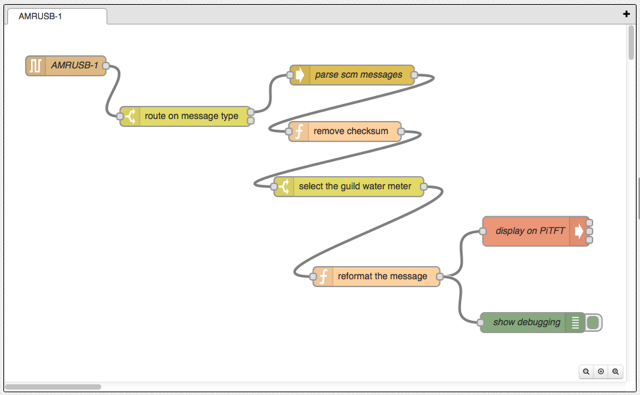
Here’s what the Node-RED workflow I created looks like when it’s done:

Node-RED Workflow

Each of the nodes in the workflow does something – reads data, processes data, outputs data, and so on – and they are wired together in a way that routes that data from node to node. Double-clicking on any node shows its details.

Read Data from the AMRUSB-1

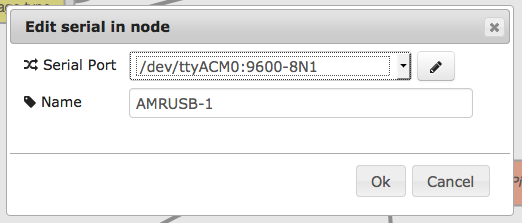
The first node reads data from the AMRUSB-1 on the /dev/ttyACM0 device, 9600 baud, 8 bits, no parity, 1 stop bit:

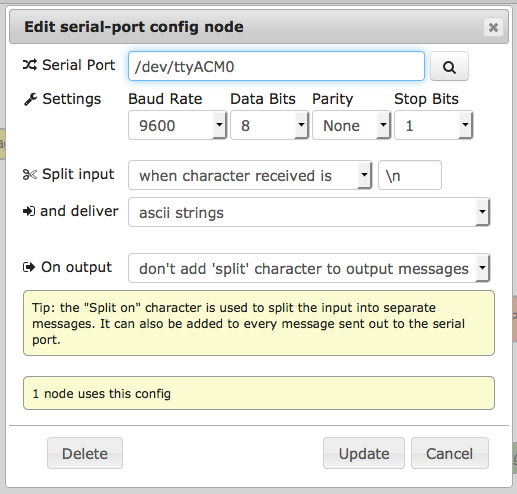
The details of the serial port setup look like this:

This is set up to send one Node-RED message for every line that’s received from the device (lines end with “\n”).

Route by Message Type

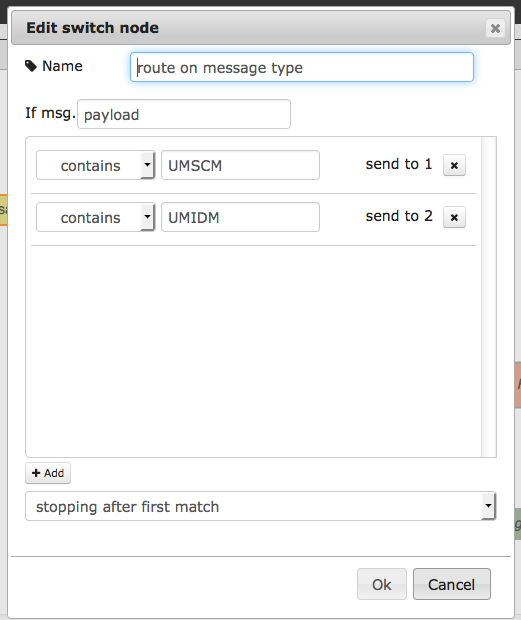
The AMRUSB-1 received two types of meter reading messages, SCM and IDM. We’re only interested in the SCM messages, so we use a “switch” node to split the workflow into two based on whether UMSCM or UMIDM is found in the message:

Route by Message Type

Parse the SCM Messages

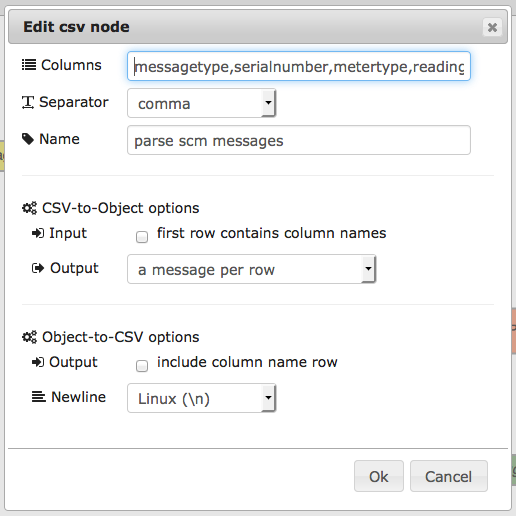
Each SCM message is a comma-separated set of values: the message type, the meter serial number, the meter type, and the meter reading; using a “csv” node, we split these into individual values:

Parse SCM

Remove the Checksum from the Reading

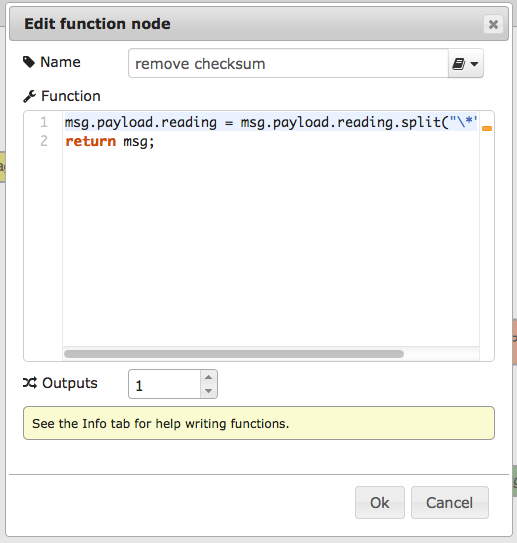
The final CSV value, “reading,” has a checksum value appended to it, beginning with an asterisk; we need to remove this, so we use a “function” node containing a simple line of JavaScript:

msg.payload.reading = msg.payload.reading.split("\*", 1)[0];
return msg;
msg.payload.reading = msg.payload.reading.split("\*", 1)[0];
return msg;

Remove Checksum

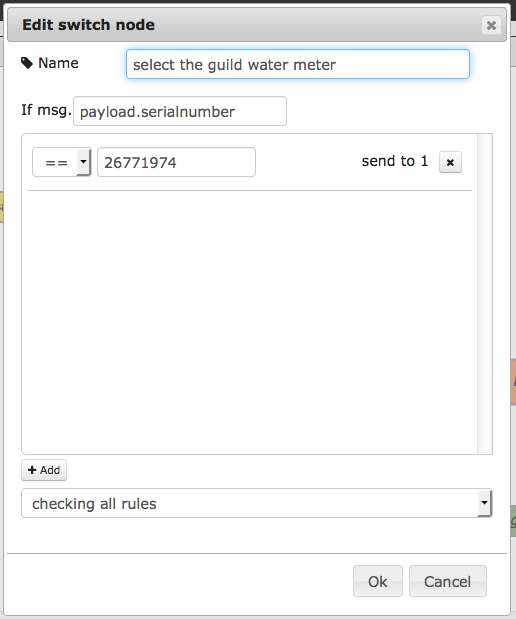
Select only The Guild Water Meter

Looking at the actual water meter in the basement of The Guild, I found it has a serial number of 26771974; because I only want data for that single meter (the AMRUSB-1 will read any meter in the area), I use a “switch” node to filter for that serial number only:

Reformat the Message for Display

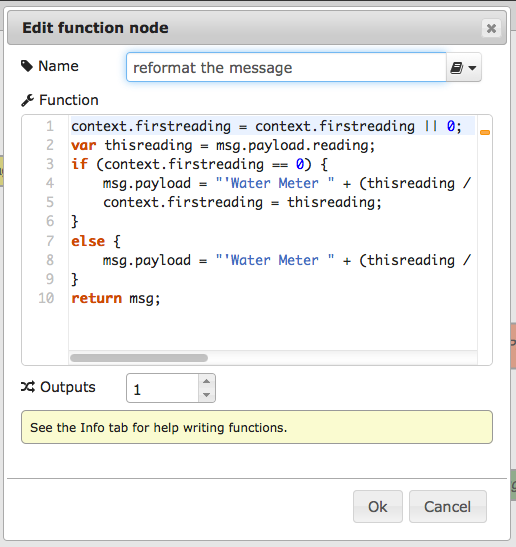
We want to display the message on an external display in the format Water Meter X m3 (Y m3 today) where X is the absolute value of the meter, and Y is the difference from the first reading taken. We use another “function” node to do this, using JavaScript to do the heavy lifting:

context.firstreading = context.firstreading || 0;    
var thisreading = msg.payload.reading;
if (context.firstreading == 0) {
    msg.payload = "'Water Meter " + (thisreading / 10) + " m3'";    
    context.firstreading = thisreading;
}
else {
    msg.payload = "'Water Meter " + (thisreading / 10) + 
      " m3 (" + ((thisreading - context.firstreading) / 10) + 
      " m3 today)'";    
}
return msg;

Reformat Message

Display the Message

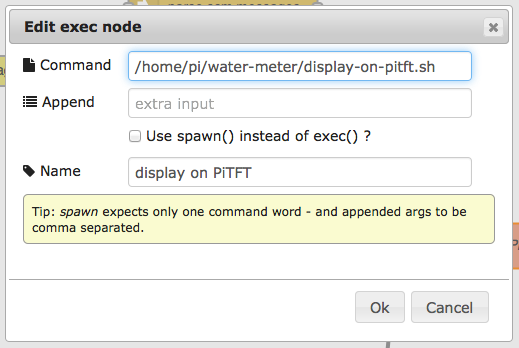
Now that we have the message, we want to display it on the PiTFT display connected to the Raspberry Pi. To do this we use an “exec” node to call a shell script on the Pi, display-on-pitft.sh, that displays the message using the fbtext utility to draw into the framebuffer:

Display Message

The shell script looks like this:

#!/bin/sh

pkill -9 -f fbtext
echo "$1" | /home/pi/fbtext/fbtext -d /dev/fb1 -i Inconsolata-38.bdf -

To start, I kill off any previously-running instances of fbtext; this means that processes don’t build up and keep running everything I update the display.

The $1 is the text of the message coming from Node-RED, fbtext is the executable (compiled from source obtained from here with guidance from here), /dev/fb1 is the PiTFT display framebuffer, Inconsolata-38.bdf is a bitmap font that I created from the Inconsolata OpenType using FontForge and the final dash says “read the text from the standard input rather than from the filename that I would otherwise specific here.”

Display Debugging

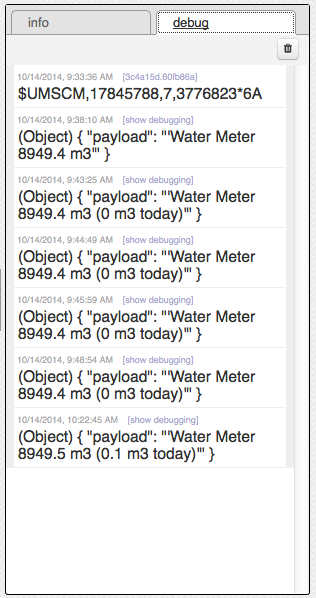
Messages can be routed to multiple nodes; to double-check what I’m sending to the display, I use a “debug” node to show the same message in the debug tab of Node-RED; it looks like this when the workflow is running:

Debug node

Up and Running

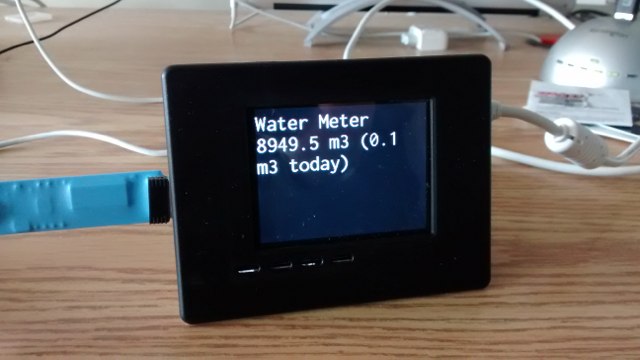
Once I deploy the workflow in Node-RED, it starts listening for AMRUSB-1 messages; when it receives one, the messages are parsed and reformatted and then end up on the display of the Raspberry Pi:

Raspberry Pi Showing Water Meter Reading

To Do

The “today” measurement isn’t really “today’s” usage, it’s the usage since the workflow started to run; I’d like this to be smarter.

I’d like Node-RED to auto-start when the Raspberry Pi boots; that way I won’t have to start the workflow running from my Mac via a browser as I do now.

And it would be nice to have the display be more information rich, with a larger typeface for the meter-reading and perhaps some graphical representation of the measure.

🗓️

On the list of things that can happen to someone like me, coming across an unexpected cache of paper maps – beautiful, richly colourful, paper maps on subjects ranging from the Northwest Passage to Polish geology to Ugandan agriculture – is right up there on the list of “greatest things ever.”

And that’s exactly what happened today: walking the halls of the fourth floor of the Taylor Family Digital Library here at the University of Calgary I spotted a door marked Spatial and Numeric Data Services.

How could you not walk through a door with such an intriguing title? It was like coming upon the Department of Dark Arts and Magical Incantations.

So in the door I did walk. Where I was warmly greeted by a friendly map librarian, who told me all about the services, spatial and numeric, that her section offers. I told her about maps at the University of PEI, and about Island Imagined. She told me about their aerial photographs collection and their GIS services.

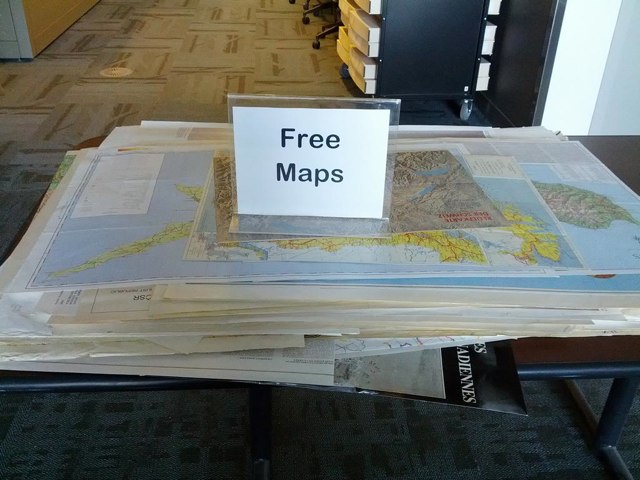
And then I spotted a table in the middle of the room marked FREE MAPS.

FREE MAPS table.

Were they really free maps?, I asked. Yes.

And so I spent an ecstatic 20 minutes browsing through maps of north and south and east and west. Satellite maps. Topographic maps. Index maps. Maps of Africa (a lot of maps of Africa). Maps of northern Canada. Maps of Iberia.

I couldn’t take them all, but I also couldn’t pass up the opportunity to take some of them with me, even if it did mean carrying around a cumbersome roll of Polskie mapy geologiczne for the rest of the week.

I curated a nice little selection, rolled them up, and asked the friendly librarian where I might purchase a tube to carry them home in. She generously pulled an old one out of their collection – don’t tell anyone I told you this, as no ill should befall her for this kindness – and I was on my way.

With the cumbersomeness of the tube quickly becoming apparent as I walked around the library for the rest of the afternoon, at the end of the day I made my way to the local Shoppers Drug Mart Canada Post Outlet and invested $15 in postage to mail the tube home.

Be thus warned: I will likely be prone to holding forth on the geography of the maize growing areas of greater Kampala in the weeks and months to come.

🗓️
Serendipity  •  Calgary  •  Poland  •  Maps  •  Kindness

About This Blog

Photo of Peter RukavinaI am . I am a writer, letterpress printer, and a curious person.

To learn more about me, read my /now, look at my bio, listen to audio I’ve posted, read presentations and speeches I’ve written, see things I’ve favourited elsewhere, or get in touch (peter@rukavina.net is the quickest way).

I have been writing here since May 1999: you can explore the 25+ years of blog posts in the archive.

You can subscribe to an RSS feed of posts, an RSS feed of comments, an RSS feed of favourites elsewhere, or a podcast RSS feed that just contains audio posts. You can also receive a daily digests of posts by email. I also publish an OPML blogroll.

Instagram • YouTube • Vimeo • ORCID • OpenStreetMap • Internet Archive • PEI.art • Drupal • Github.