So I’ve become slightly obsessed with with the world of flight planning and trans-oceanic air travel: it’s a new puzzle to solve, and it involves things flying over my house on the way to far-off lands. What’s not to love?

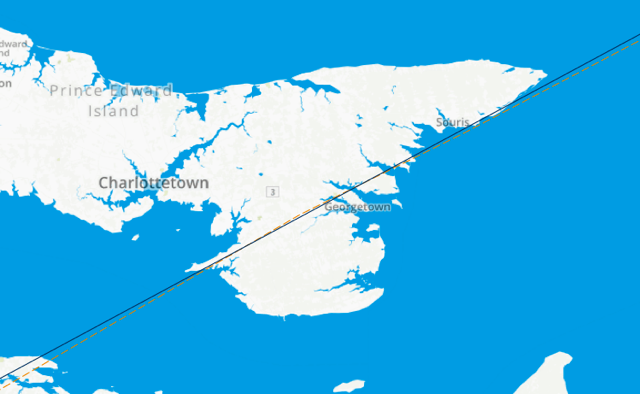
Last night around midnight, Aer Lingus Flight № 138 (code named EIN138), flying from Boston to Dublin, Ireland, flew over eastern PEI, making landfall near Point Prim, crossing south-eastern Kings County, continuing over Georgetown and Souris and heading off to sea. Here’s its track, from FlightAware.com:

EIN138 over PEI

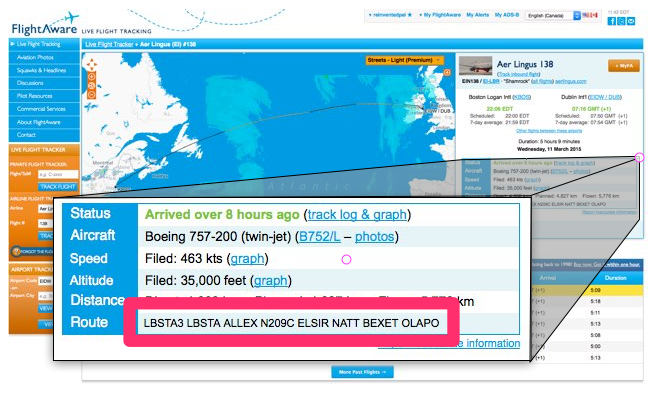
Looking up flight EIN138 in FlightAware provides a lot of interesting information about the flight, including a section labeled “Route” in a box on the right:

EIN138 Flight Plan

The route information is a series of “waypoints” – aeronautical bread crumbs, if you will – that EIN138 was to follow as it made its way from Boston to Dublin:

LBSTA3 LBSTA ALLEX N209C ELSIR NATT BEXET OLAPO

There is, oddly, no comprehensive database of these waypoints: there was a public resource called DAFIF, but it went dark in 2006, apparently amidst copyright concerns from Australia.

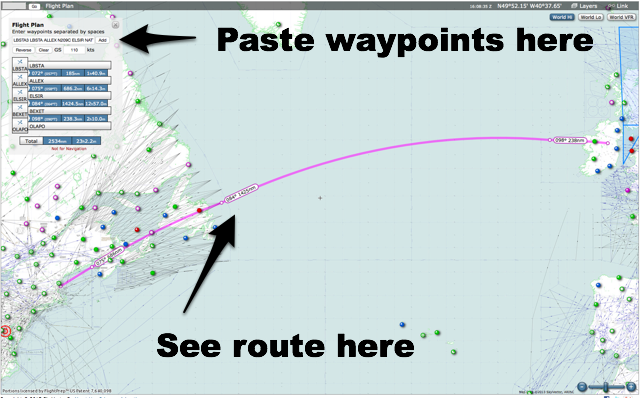
But there remain some web-based, if not open, data sources, that offer an incomplete way of looking up these waypoint codes, the most slick of which is Skyvector.com. You can simply paste the waypoints from FlightAware into Skyvector and it will, to the best of its ability, “connect the dots” (of the waypoints it knows about) and show you the flight plan on a map:

Skyvector.com in use

What’s most interesting, for my Prince Edward Island-focused purposes here, are two of those waypoints, ALLEX and ELSIR.

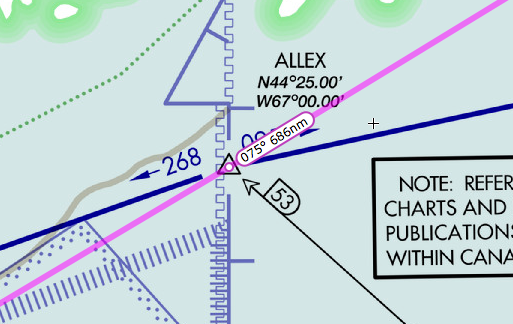
Zooming in a Skyvector.com, I can see the ALLEX is a waypoint at N44°25.00’, W67°.00.00’:

ALLEX

In decimal, that’s 44.416667, -67, which is a spot just inside Canadian airspace off Grand Manan, New Brunswick.

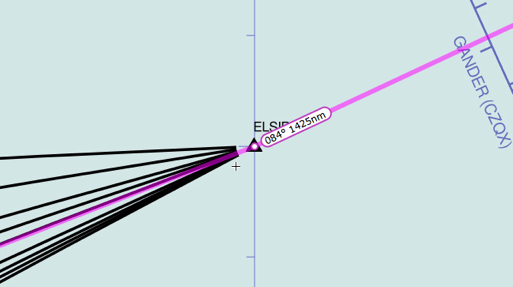
ELSIR, on the other hand, is at N49°30.09’, W52°0.17, or 49.5025, -52.004722 decimal, which is a spot in the North Atlantic off the east coast of Newfoundland:

ELSIR

ELSIR is an interesting waypoint because it’s one of the official “aeronautical doorways” to flying across the North Atlantic: all airplanes flying across the ocean fly along prescribed North Atlantic Tracks, which change daily: last night, our Aer Lingus flight started its trans-oceanic voyage by passing over ELSIR.

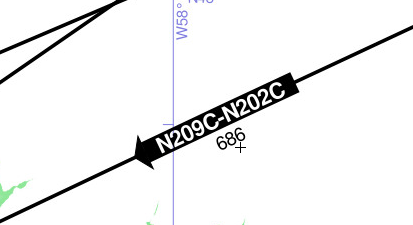
Running between ALLEX and ELSIR is a line that happens to be labeled N209C (which also appears in the flight plan in FlightAware):

N209C

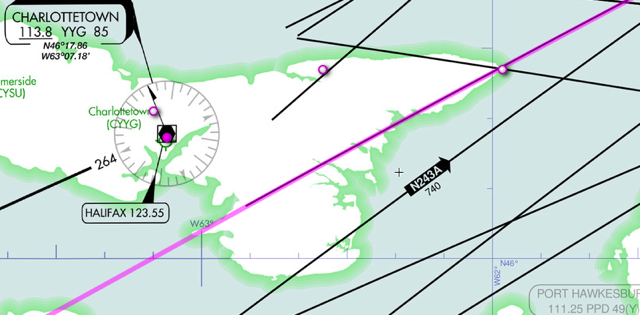
And N209C, because it connects ALLEX and ELSIR, runs directly over eastern Prince Edward Island:

N209C

All of which means, I’m assuming, that if you see ALLEX N209C ELSIR in a flight plan, it means that the plane in question will be flying over eastern Prince Edward Island.

Meanwhile, Aer Lingus Flight № 138 landed safely in Dublin at 7:16 a.m. this morning.

🗓️

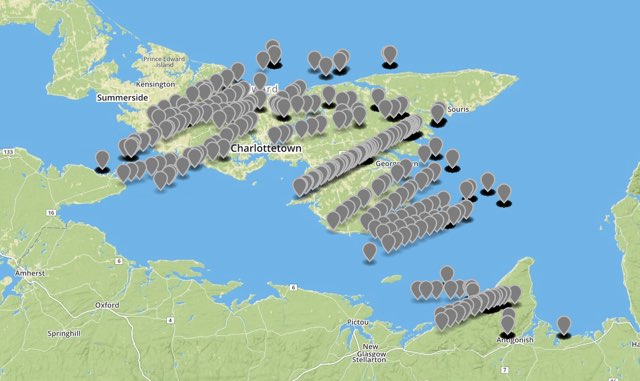
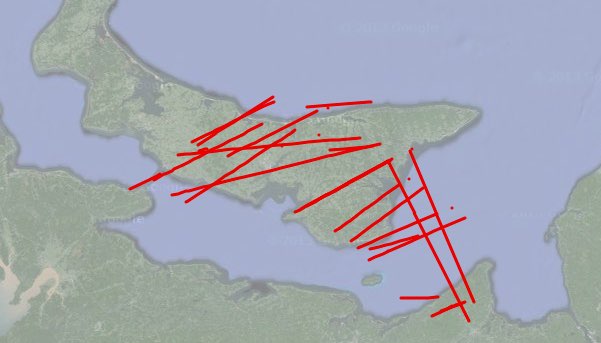
I’ve been detecting and archiving ADS-B position reports from airplanes flying over Prince Edward Island for the last 18 hours; here’s a map of what my little Raspberry Pi has picked up:

That’s a simple visualization of the positions recorded created using GeoJSON.io. To allow me to see individual planes’ tracks, I dumped the data points into a CSV file, edited it, and then ran it through GPS Visualizer:

Flights over PEI

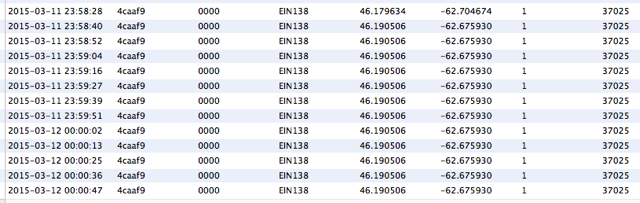
There were 1,095 position reports received from 37 distinct flights (here’s the raw data should you wish to experiment with it yourself):

  • AAL42
  • AAL50
  • AAL78
  • AAL80
  • AAL86
  • ACA848
  • ACA878
  • AWE722
  • AWE750
  • AZA610
  • AZA65F
  • BAW196
  • BAW81V
  • CJT621
  • DAL24
  • DAL72
  • DLH425
  • DLH431
  • DLH435
  • EIN104
  • EIN138
  • ETD150
  • FDX36
  • ICE630
  • KLM18
  • N800J
  • NAX7012
  • QTR764
  • QTR8102
  • SAS926
  • SWR52
  • THY18A
  • UAL114
  • UAL126
  • UAL58
  • VIR12E
  • WJA424

You can enter those flight numbers into Google, or into FlightAware, and see the flight details: when you do this you’ll notice that the vast majority of the flights were flying above 30,000 feet and were heading to or from Europe: none of the local flights from Charlottetown Airport were detected, likely because the ADS-B receiver I’m using is on the windowsill over my office downtown, and doesn’t have line-of-sight to local flight paths.

My next step, thus, is to put an antenna up on the roof.

🗓️

When I talk to people about wind energy generation on Prince Edward Island, they are often under the impression that the wind is a relatively small part of the energy mix on the Island.

And there’s no doubt that because of its variability sometimes there is no wind energy generation on the Island. Like when the wind isn’t blowing. And that’s one of the significant challenges of wind’s contribution to the Island’s energy future.

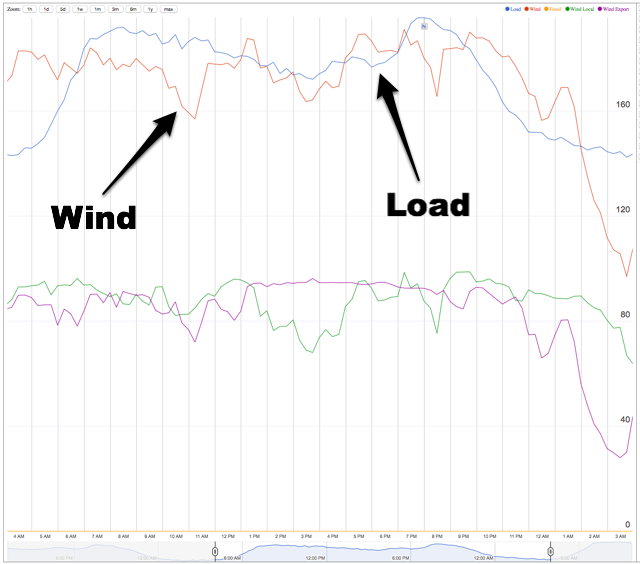
That all said, sometimes there are days, like yesterday, when the contribute of wind energy is near or above 100% of the provincial load for most of the day.

On this chart, showing 24 hours of load and generation starting at 3:00 a.m. on March 11 and ending on 3:00 a.m. on March 12, the orange line represents wind energy generation in megawatts and the blue line the province’s load in megawatts (the load being “how much electricity we’re all using together”). The wind topped the load several times during the day, including the four and a half hours from 9:30 p.m. to 2:00 a.m.

PEI Wind Energy vs. Load, March 11, 2015

🗓️
Prince Edward Island  •  Wind  •  Energy

If you’re interested in how it is that, without radar available to air traffic control, airplanes can fly over the Atlantic Ocean without flying into each other, this video from NATS about the Shanwick OCA is a fascinating one.

The video features a walkthrough of an Aer Lingus flight from Dublin to Boston, EIN137.  In a delightful coincidence, last night around midnight the return Boston-Dublin flight, EIN138, flew over Prince Edward Island at 37,000 feet:

EIN138 flies over PEI

🗓️
Video  •  NATS  •  OCA  •  Air Traffic Control  •  Airplanes

I’ve again taken the official Prince Edward Island School Calendar and updated a set of public calendar files to make it easier for parents and others to shunt the information around their digital devices. Here you go:

(Note for those of you who already had the 2013-2014 and/or 2014-2015 School Calendasr integrated into your digital devices: you don’t need to do anything, as those addresses haven’t changed from last year).

As a member of the School Calendar Committee for the PEI Home and School Federation I again asked to have the official calendar released as structured data by the Department of Education and Early Childhood Development itself, but as yet this (still) hasn’t happened.

🗓️

Longtime readers may recall that, starting three years ago, I’ve been running an AIS receiving station here in the Reinventorium in downtown Charlottetown, listening to the automated ships location broadcasts for Charlottetown Harbour and pushing the data to MarineTraffic.com.

It turns out that where ships broadcast AIS (Automatic Identification System), airplanes broadcast ADS-B (Automatic Dependent Surveillance – Broadcast) and, like AIS, these broadcasts are in the clear and can be received by any old radio capable of received on the ADS-B frequency.

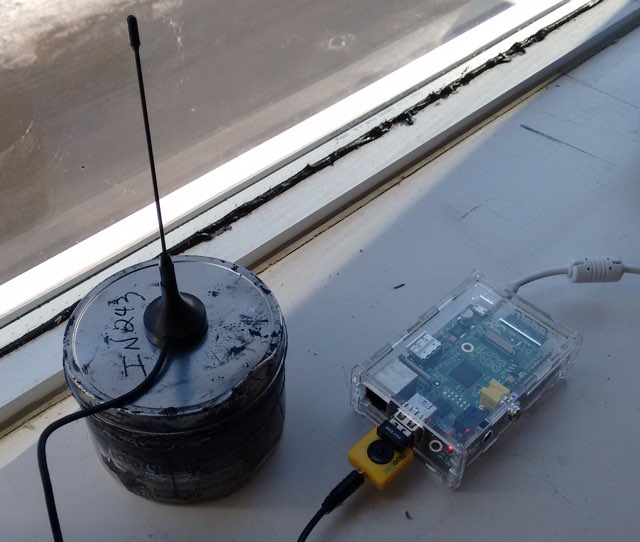
Like, for example, the NooElec NESDR Nano SDR & DVB-T USB Stick that I bought for $18 last fall to support my electricity meter reading project. It was manufactured as a European digital TV receiver, but, under the hood, it’s a software-defined radio capable of receiving radio from 25MHz to 1700MHz.

What’s more, just as MarineTraffic.com aggregates AIS reports, FlightAware.com aggregates ADS-B reports, and it has a Raspberry Pi distribution that makes sending data their way as easy as burning an SD card.

So, of course, I built one.

PiAware in the Reinventorium

You can follow along on my FlightAware status page, which lists flights detected in various formats.

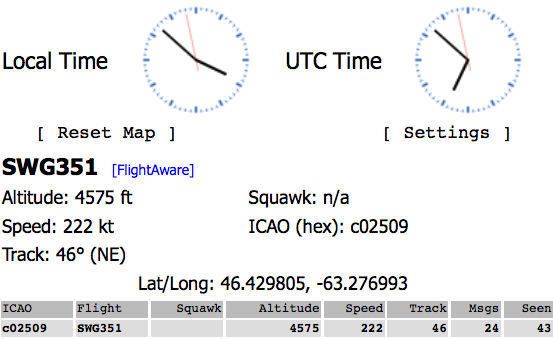
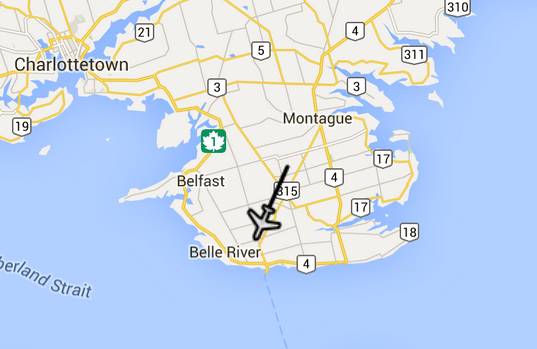
And sure enough, the system worked: here’s what Sunwing Flight 351 from Cuba to Charlottetown looked like on the local status page as it was coming in to land this afternoon just before 4:00 p.m.:

Sunwing 351

And here’s flight RRR4520 flying at 27,000 feet high above the Valleyfield Road:

It all seems like magic. But it’s just radio waves.

🗓️
ADS-B  •  Airlines  •  Airplanes  •  Radio  •  Raspberry Pi

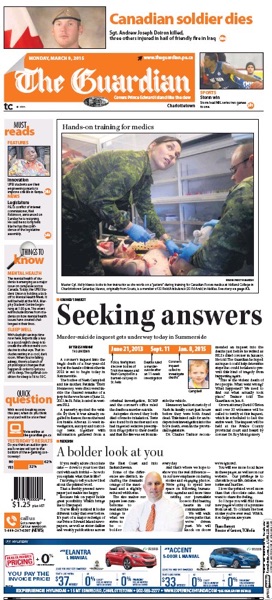
The Charlottetown Guardian unveiled its new design this morning, part of a redesign of all of parent company TC Media’s local newspapers called “Project Orange” internally. On the left is Saturday’s pre-redesign cover; on the right is this morning’s newly-orange front:

The Guardian Design, before Project Orange

It’s an interesting – and somewhat bizarre – move to paint all the company’s papers with the same orange brush (the exception is the Journal-Pioneer in Summerside which is turning blue instead of orange), especially given that one of The Guardian’s strengths locally has always been that, despite its rotating cast of parent companies, it’s always been strongly identified as a local paper, not an “outlet” of a corporate brand.

That this morning’s Guardian looks an awful lot like this morning’s Telegram in far-away St. John’s might make sense of some sort of corporate synergasm way, but I’m not sure why it’s required or even preferable when looked at from the ground. Doesn’t our community deserve a newspaper designed and built by Islanders for Islanders? What’s the upside for the reader in brand unification?

There’s also the issue of the web and the attention span: the redesign brings with it a collection of the short and snappy – the “quick questions” and the “things to know” and related factoid boxes – and an aversion to the beautiful grey expanse of type the defined The Guardian – and newspapers in general – for a good part of their lifetime. The aversion to grey isn’t new here, of course, and it’s not unique to TC Media: big photos and fact boxes have been a part of The Guardian’s recent incarnations, albeit to a less dramatic extent.

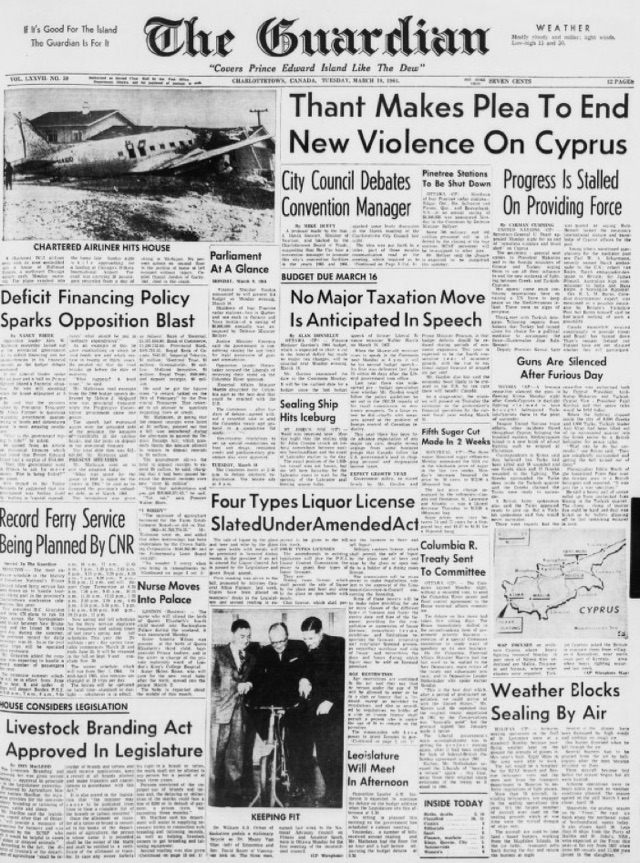
Philosophically I’m on a different page from where newspaper design is heading; I think the reaction to the web should be to go long and go deep and go grey and go big. In that I am, alas, perhaps alone. But man was 1964 ever a great year for newspaper design on Prince Edward Island:

1964 Guardian Front

🗓️
#FF5900  •  Orange  •  Newspapers  •  Design  •  The Guardian

In his book The Human Use of Human Beings, first published in 1950, author Norbert Weiner describes his coining of the term cybernetics:

Until recently, there was no existing word for this complex of ideas, and in order to embrace the whole field by a single term, I felt constrained to invent one. Hence “Cybernetics,” which I derived from the Greek word kubernetes, or “steersman,” the same Greek word from which we eventually derive our word “governor.”

He goes on to elaborate:

It is the purpose of Cybernetics to develop a language and techniques that will enable us indeed to attack the problem of control and communication in general, but also to find the proper repertory of ideas and techniques to classify their particular manifestations under certain concepts.

It was impossible not to think of cybernetics while watching Premier Wade MacLauchlan’s address to senior provincial public servants yesterday, The Premier as Public Servant Leader.

In his address, MacLauchlan clearly demonstrates that he is, at heart, a cyberneticist – a “steersman,” if you will – and that he views his role as Premier to manage a complex system of people, resources, and motivations to, as he references several times, “move the trend lines” of prosperity, demographics, revenue, and expenses.

The Premier’s construction of “ten lenses” through which policy will be regarded – collegial, people, prosperity, engagement, ethical, strategic, rural, frugality, entrepreneurial, small is big – surely equips his office, and his government, with a set of tuned “organs” that Weiner describes:

Much of this book concerns the limits of communication within and among individuals. Man is immersed in a world which he perceives through his sense organs. Information that he receives is co-ordinated through his brain and nervous system until, after the proper process of storage, collation, and selection, it emerges through effector organs, generally his muscles. These in turn act on the external world, and also react on the central nervous system through receptor organs such as the end organs of kinaesthesia; and the information received by the kinaesthetic organs is combined with his already accumulated store of information to influence future action.

This approach to Prince Edward Island as a cybernetically-governable system is echoed when MacLauchlan discusses his “strategic lens”:

The first role of the premier as a public servant leader is to identify strategic priorities and communicate them to the public service and the entire community. Without prosperity, we do not have a pretty future. Economic growth must be our top priority. With prosperity, our demographic trend lines will adjust, with the right strategic efforts and policies, to reflect the fact that we are retaining, repatriating and recruiting a younger, talented and entrepreneurial population.

These strategic priorities, prosperity and population, will be reflected across government. They are not a substitute for commitments to deliver services such as health, education, social assistance or environmental stewardship. However, if we cannot grow the economy and rejuvenate our population, our ability to deliver services in other areas will become increasingly stressed.

The premier’s leadership role, in addition to identifying strategic priorities, is to ask the right questions, repeatedly. I think of this as a Socratic form of leadership. Specifically, I will be heard to ask regularly, in response to proposed initiatives: Where’s the growth? How will we measure the return on investment? What does this do to change our demographic trend lines?

In saying this, MacLauchlan echoes Weiner’s description of the role of information in cybernetics:

Information is a name for the content of what is exchanged with the outer world as we adjust to it, and make our adjustment felt upon it. The process of receiving and of using information is the process of our adjusting to the contingencies of the outer environment, and of our living effectively within that environment. The needs and the complexity of modern life make greater demands on this process of information than ever before, and our press, our museums, our scientific laboratories, our universities, our libraries and textbooks, are obliged to meet the needs of this process or fail in their purpose. To live effectively is to live with adequate information. Thus, communication and control belong to the essence of man’s inner life, even as they belong to his life in society.

The Premier’s “What does this do to change our demographic trend lines?” is Weiner’s “the information received by the kinaesthetic organs is combined with his already accumulated store of information to influence future action.”

MacLauchlan is not alone in being a cyberneticist; newly-elected leader of the PC Party, Rob Lantz, is, both by inclination, chosen career as a digital worker, and demonstrated action as a member of Charlottetown City Council, a cyberneticist in his own right.

While his convention speech this weekend at the PC Party Leadership Convention was for a political audience, not a public service one, and therefore was less finely drawn than MacLauchlan’s address to the public service, Lantz demonstrated evidence of his own cybernetic approach to governance:

Lantz, like MacLauchlan, speaks of the twin pressures of demography and prosperity, and positions himself as a “problem solver”:

I don’t pretend to have all the answers, nobody does, but I’m a problem solver, I know how to listen, I know how to weigh the evidence, analyze the facts, and I know how to make decisions… It’s time for hard work, smart decisions, humility and listening. It’s time for building on our strengths and tackling our weaknesses.

That’s political rhetoric for a political audience, yes, but combined with the evidence of Lantz’s approach to government on city council, an approach that was generally regarded as open and collaborative, it suggests that he would be well-equipped to be a manager, a filter, an amplifier of the type of “messages” that Weiner writes about:

Messages are themselves a form of pattern and organization. Indeed, it is possible to treat sets of messages as having an entropy like sets of states of the external world. Just as entropy is a measure of disorganization, the information carried by a set of messages is a measure of organization. In fact, it is possible to interpret the information carried by a message as essentially the negative of its entropy, and the negative logarithm of its probability. That is, the more probable the message, the less information it gives. Clichés, for example, are less illuminating than great poems.

I had a spirited discussion yesterday with a good friend with a deep knowledge of Island politics; I suggested to her that Lantz and MacLauchlan were opposites: Lantz the digital tradesman, MacLauchlan the intellectual, Lantz the self-styled realist, MacLauchlan the self-styled optimist. She reminded me that Lantz and MacLauchlan are, in far more ways, cut from exactly the same cloth. What she meant was that they are both men, both well-off, both from “strong Island stock,” and so forth.

And of course she was right: they are more alike than they are different.

And perhaps in no way more so than their shared vision of Prince Edward Island as a system that can be managed and, what’s more, a system they are capable of managing.

While it might seem self-evident that anyone putting themselves forward to be premier would necessarily regard themselves in this light, there is less evidence to suggest that Prince Edward Island premiers-recent – Ghiz, Binns, Milligan, Callbeck – viewed themselves as tacticians to the extent that MacLauchlan and Lantz do, as tacticians able to – through collaboration, analysis, planning, and action – “move the trend lines” to such an extent that Prince Edward Island emerges from their tenure substantially changed.

This is not to suggest that our recent premiers have been do-nothings, simply that their approach has drawn from different approaches to leadership and governance, ones not so seemingly-rooted in notions of systems theory: there have been substantial rearrangements to specific parts of Island society over the last two decades, but they have been more “strategic” in nature than “systemic.”

The last time the Island was governed by a premier with this approach was from 1966 to 1978, the tenure of Alex B. Campbell, a man MacLauchlan has studied closely. Campbell’s Comprehensive Development Plan was nothing if not the product of a cyberneticist. As MacLauchlan relates in his book on Campbell:

With the signing of the Comprehensive Development Plan in March 1969, things changed for Campbell and his government – and for Prince Edward Islanders. In a February television address, Premier Campbell spoke with Islanders about the difference the CDP would make, telling them that this “may be our last chance to provide a future for this province.” He went on to say that PEI’s economic and financial condition was “precarious” and that stop-gap remedies and short-term policies “will no longer service the purpose.”

In other words, Campbell was suggesting that the Island’s future demanded planned, systematic change. You will find shadows of Campbell in both MacLauchlan and Lantz inasmuch as they both regard the Island, as Campbell did, as a system in need of substantial adjustment, and they both have confidence that this adjustment can be carried out through a careful process of adjusting systems, controls, and messages.

What is different this time around from the Campbell era is that while in the late 1960s Campbell saw a need to import systems expertise from off-Island, both Lantz and MacLauchlan see the resources they need to marshal in the people who are here already. This suggests that their comprehensive plans for the development of the Island, while they might share the same confidence in cybernetics as Campbell’s, will be enacted in a way that’s more homegrown and locally rooted.

I am myself a cyberneticist at heart, and so it should go without saying that I greet the renewed ascendance of the cybernetic mindset with considerable optimism, especially as it appears to cross party lines and so, one way or the other, is likely to underpin the next generation of PEI politics.

These are interesting times.

🗓️
Politics  •  University  •  Philiosophy

Back in 1992 I saw a film called Feed at the Festival of Festivals (now the Toronto International Film Festival), a film that IMDB succinctly describes like this:

This is a documentary about the 1992 New Hampshire primaries. It includes much footage of candidates as they meet people, and just before they go “on-air”.

It was a well-produced look into the moments just before the lights go on and candidates turned from regular everyday people like you and me into people who talk for a living professionally.

That’s a fascinating moment, one packed with nervous anticipation. Although I’ve never been a candidate for anything (at least not since I ran for grade 7 class president under the slogan “Vote Pete: He’s Neat!”), every time I speak in public requires going through that phase shift, from private to public. It’s like going through a wormhole.

And no matter how confident and prepared you are, focusing on that moment, as Feed did, provides some insight into the differences between private people and public people.

It’s a moment perhaps best encapsulated in popular culture by Bob and Doug McKenzie in their 1981 seminal recording of Great White North, a track that begins “This is where the DJ talks, don’t say anything… Ok, eh”

This weekend’s PC Party Leadership Convention provided another glimpse behind the curtain as the CBC Television web feed went to “air” seven minutes earlier than those at the anchor desk were aware of, something preserved in the video archive of the event. Host Bruce Rainnie is joined by guests Paul MacNeill and former premier Pat Binns and over those 7 minutes they have the kind of pre-broadcast chitchat that is at once mundane and deeply compelling. Here’s a transcript:

Paul MacNeill: …Pat?

Pat Binns: Yah, if you wouldn’t mind.

Paul: Do you wanna… have you seen it, Bruce?

Bruce Rainnie: I haven’t, no.

Bruce [to control]: Yah. Yah. Um hum.

Paul: Was it Pat Binns seven?

Pat: Yep.

Control [to Paul]: [indistinct]

Paul: Oh yah, kick it anywhere you want…

Paul: I hope that’s attached.

Paul: [indistinct]

Unknown: It was a good read today. [pause] It was a good read today.

Paul: Did you get that? Is the attachment there?

Pat: Uh, I don’t see the attachment. It’s probably here.

Paul: No, sometimes I have a problem with this. Just one sec.

Paul: Come on…

Bruce: Hey guys, um, CBC, Tracy’s printing out speeches, the three speeches, she’s gonna bring them over in paper form.

Paul: Oh is she, great.

Bruce: Five minutes, guys, five minutes. When we go live to the web.

Paul: That’s more notes than he used on last election night.

Bruce: Yah, these are just… yah. I’ve had a couple of nice conversations with all three. Just some personal stuff.

Bruce: Oh, oh.

Unknown: How are yah?

Bruce: Three minutes to the web, gentlemen.

Bruce: So we got, we got… [fade to silence]

Bruce: Guys, the plan here… [indistinct]

Bruce: Compton’s first, right?

At this point the lights go up, the theme music rolls, and the three become the public versions of themselves.

We are fortunate to have a CBC that is, at least for now, well-funded enough to be able to cover two political conventions in as many weeks (the Liberal Party held its convention the previous week and it received similar coverage).

It’s like it was sung by angels…

🗓️
Politics  •  CBC  •  News

Last night on Netflix I came upon a movie called Paul Williams: Still Alive and, more intrigued, I must say, by the typeface on the poster than by any strong memory of Paul Williams, I started to watch.

And then, all of a sudden, my childhood started to flood back.

Paul Williams, it turns out, was a part of almost every piece of pop culture during my childhood through the 1970s and 1980s, a pop culture that is perhaps best encapsulated in this 1978 episode of Hollywood Squares, one that featured Harvey Korman, Rose Marie, Loretta Lynn, Melissa Gilbert, George Gobel, Karen Lynn Gorney, John Amos, and Paul Lynde. And Paul Williams.

Through that collection of stars you get everything: the Dick Van Dyke Show, Good Times, Little House on the Prairie, Carol Burnett. Throw in a couple of Love Boat episodes and you’ve touched on all the TV we watched as kids.

Oh, and by the way, Paul Williams wrote the lyrics to the Love Boat theme.

And, of course, much of the American songbook over those decades, including Rainbow Connection, and Rainy Days and Mondays.

And, more recently, Touch, from the Daft Punk album Random Access Memories.

You see Paul Williams, as the film’s title suggests, is very much alive.

And in making a movie about him, Kessler has also made a movie about my childhood. And my adulthood. And about friendship and taking risks and rising again.

It’s a wonderful watch, and I highly recommend that you seek it out.

🗓️

About This Blog

Photo of Peter RukavinaI am . I am a writer, letterpress printer, and a curious person.

To learn more about me, read my /now, look at my bio, listen to audio I’ve posted, read presentations and speeches I’ve written, see things I’ve favourited elsewhere, or get in touch (peter@rukavina.net is the quickest way).

I have been writing here since May 1999: you can explore the 25+ years of blog posts in the archive.

You can subscribe to an RSS feed of posts, an RSS feed of comments, an RSS feed of favourites elsewhere, or a podcast RSS feed that just contains audio posts. You can also receive a daily digests of posts by email. I also publish an OPML blogroll.

Instagram • YouTube • Vimeo • ORCID • OpenStreetMap • Internet Archive • PEI.art • Drupal • Github.