
Three years ago next week Oliver started out at the Child Development Centre at Holland College. He began with a tentative day-or-two a week, gradually accelerating across the hall from daycare to kindergarten. He’s starting Grade One next week and so yesterday was his last day in the now-familiar halls:
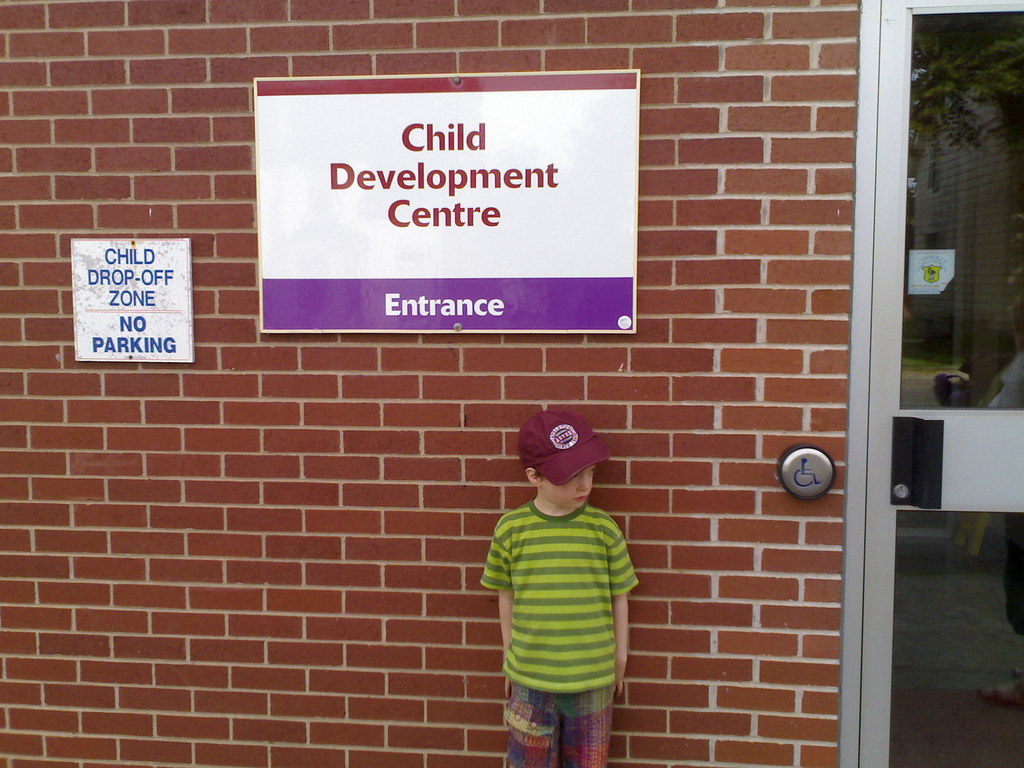
I can’t say enough good things about Kim and her staff at the Child Development Centre; they are a dedicated group of caring, insightful professionals (for the amount of good they do for the world they should be paid three times what they are). They took on Oliver and his delightful eccentricities with unflagging enthusiasm; our small family owes them a great debt for helping us help Oliver grow into the world.
If you are looking for a daycare or kindergarten in Charlottetown, I have absolutely no hesitation in recommending these folks; we’ll miss them all dearly.
Somehow “boutique hotel” and “Moncton” don’t seem a natural match. But over the weekend we spent a night at the brand new Hotel St. James (so brand new it doesn’t have a website yet), and I can attest to its full-on boutiqueness.
The hotel is located above (and takes its name from) the St. James Gate bar in downtown Moncton (a cousin, it seems, of the bar of the same name here in Charlottetown). It doesn’t seem to suffer from its bar-proximity noise-wise; there wasn’t a hint of raucous rock and roll when we lay our heads down to sleep around 11:00 p.m.
Our room was full of the the defining characteristics of a “boutique” hotel: hardwood floors, plasma widescreen television with all the channels; DVD/CD player; super-comfortable bed; low-noise air conditioning system with remote control. Perhaps the boutiquiest feature of the place is the double-wide see-through shower:
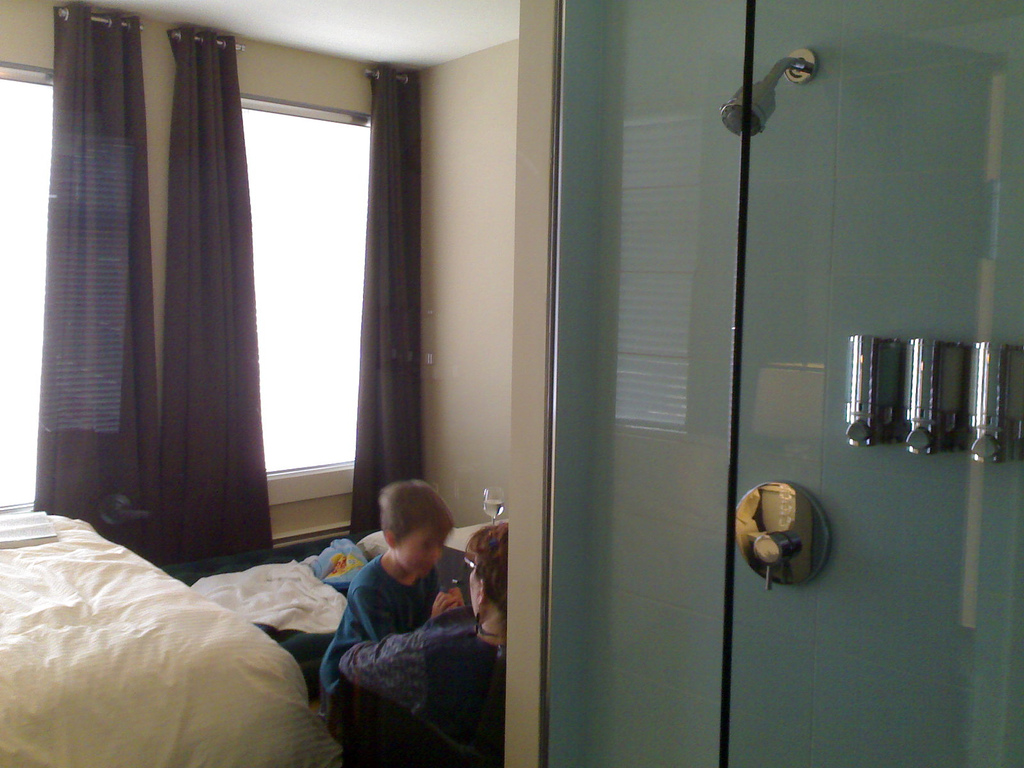
The shower’s back wall, in other words, looks right out onto the room, affording those in the room the full view of those performing their ablutions, and vice versa. Indeed all of the washroom is visible, meaning that those who treat the room as a “private space” may be somewhat uncomfortable (it did take some getting used to).
Rooms with a queen bed are $169/night; a king bed in a larger room is $179/night. They don’t have rooms with more than one bed, meaning that if you’re a three-person family you’ve got to improvise (Oliver slept on a blow-up mattress we bought from home). There are only 10 rooms in the hotel, meaning that you get all the personal service you need from the staff (who are very, very friendly and helpful).
Moncton is a city chocked-full of hotels, and especially in the off-season this means you can almost always get a room for under $100, even at the upscale Delta Beausejour. But what you’ll often end up with is a well-worn room with a polyester bedspread and cigarette burns on the carpet. In situations where you’re willing to splurge, the Hotel St. James is a very nice alternative; that it makes Moncton a pleasant place to visit is something of a minor miracle.
It’s been almost two weeks since I last updated you about my little community wireless experiment. Here are the latest stats:
- 4.4 GB of data transfered in total
- 47 unique users
- Identifiable users: Amanda, Ann, Carol, Kritin, Lola, Manuel, Margaret, Michelle, Mike and Tosh.
- Amanda has used the most bandwidth, transferring 1GB of data over the month.
- Thank-you email messages received: 1 (from Kenny; thanks!)
- Access point hit: Front of House, 30 users; Back of House, 3 users; Coles Building, 14 users.
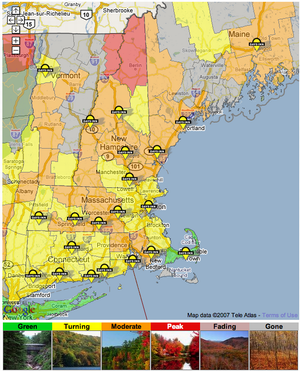
The project of the week has been the Interactive Foliage Map, the anchor of Yankee’s foliage website.
For the past three years this map has run as an old-school MapServer-based application. It worked well for the time, but in the age of slippy-slidy interactive maps, it was showing its age.
The challenge was to somehow leverage our existing foliage infrastructure (yes, we have foliage infrastructure) that is based on collecting foliage reports on a county-by-county basis across New England as the basis for generating a colour-coded map.
The week started with some experimenting with generating county polygons, an effort aided greatly by this helpful PHP script that converts census county boundary files into sets of Google-friendly vertices.
This was all very promising on a single-county basis. But when scaled up to a New England-wide level — 247 counties with about 300,000 vertices — it all went to hell. That’s a lot of heavy lifting for JavaScript to do; too much, in fact, as interacting with the map, even on a peppy laptop with a powerful processor, was a slow as molasses.
I thought about doing some work to come up with a simplified set of county polygons, but decided to look elsewhere before launching into that.
Fortunately at this point I came across this very helpful resource from the Commonwealth of Massachusetts, a bit of well-documented JavaScript that lets layers from a Web Map Service (WMS) be overlaid on Google Maps.
A quick re-compile of our MapServer install to turn it into a WMS server and I was in business. It took me a little while to grok WMS, but once I did, I had foliage on my map in about an hour.
The idea here, in essence, is that the WMS server becomes an additional “tile making engine” for the Google Map, generating graphic images of the same sort that Google itself generates for the map and satellite layers. Because the hard work is being done server-side, and is bolstered by Google’s pre-fetching algorithms (that fetch neighbouring map tiles before you need them), it all appears quite magical when it’s working.
Once the magic was in place, the map got wrapped in some of the JavaScript and AJAX goodness that drives the Best Western map on Yankee’s main site (the magic there is clustering the Best Western markers differently at each zoom level so that two hotels never overlap each other).
Moving forward, the ability to drop any WMS layer on a custom Google Map — just look at the variety of WMS layers from Natural Resources Canada, for example — opens up a lot of interesting doors for cool map mashups.
The Interactive Foliage Map is a beta testing right now, and is scheduled to go live next week; you’re welcome to take it for a ride.
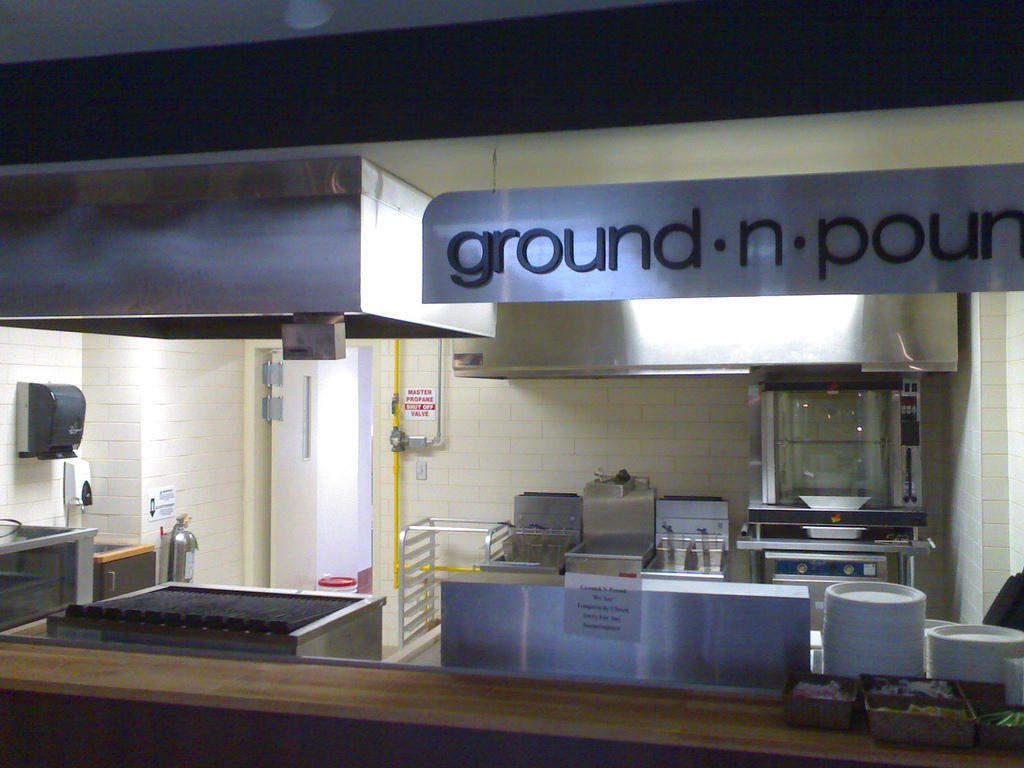
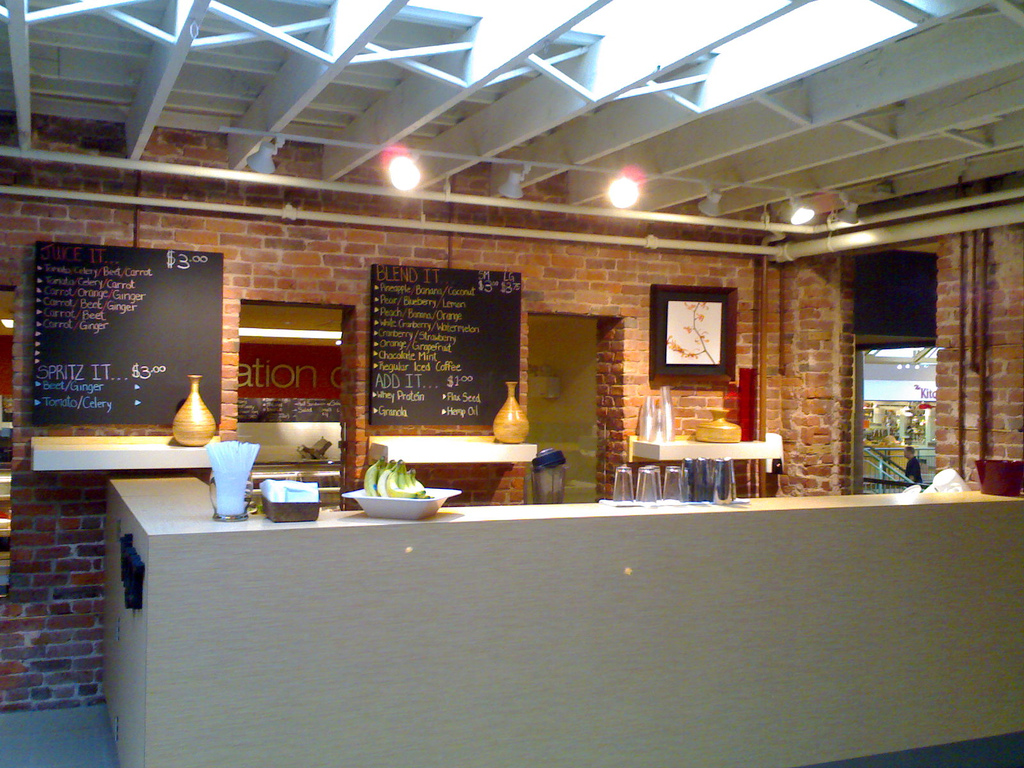
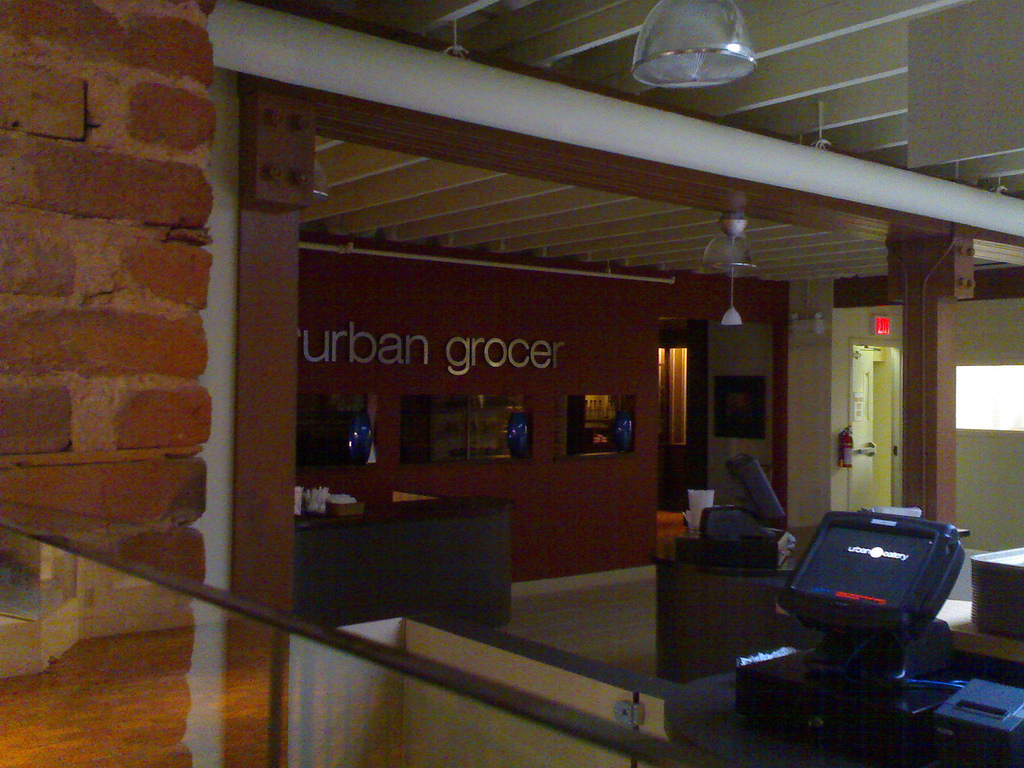
The second phase of Urban Eatery, which was supposed to open in June, finally opened, sort of, yesterday. Turns out that they were plagued with an opening day fume hood problem that meant they had to close early. So when Oliver and I showed up for supper at 7:00 p.m. we had to by satisfied with sandwiches. But when I stopped in for coffee this morning I was assured that today they will really be open.
Phase Two has four components: there’s a juice bar, an “around the world” station offering, well, food from around the world, the “ground-n-round” with meat-based fare, and the “urban grocer” which seems to be a sort of high-concept pocket-sized grocery store. Here are some spy photos:

I had lunch today at the Town and Country and instead of the usual I took my server’s recommendation and had the “Chicken Penang,” a new dish that’s not on the menu. It was fantastic — a nice combination of chicken and vegetables served over riced and spiced with a kick. Recommended.
This is, I think, our 14th summer on Prince Edward Island. And yet until last weekend we had never been to Cavendish Beach — the sort of “grand dame” of PEI beaches with the tourist set.
But, what with all the “day at the beach” frenzy swirling around us, we decided that Sunday would be a good day to try. Our resolve was enhanced when we discovered that access to the beach through “Cavendish Grove” — the rebadged fun-free Rainbow Valley — is free (it would have cost us almost $20 to go through the normal route).
The only thing you have to put up with to take this option is a 1 km hike to the beach. Fortunately it’s a nice hike through the woods. Always ready to walk a kilometer to save $20, we were sold.
It has been reported that “[e]ventually, Parks Canada intends to make Cavendish Grove the main entrance to this section of the national park, meaning a longer walk to Cavendish Beach.” So eventually the 1 km hike will become a fact of life for all. Might as well get used to it now.
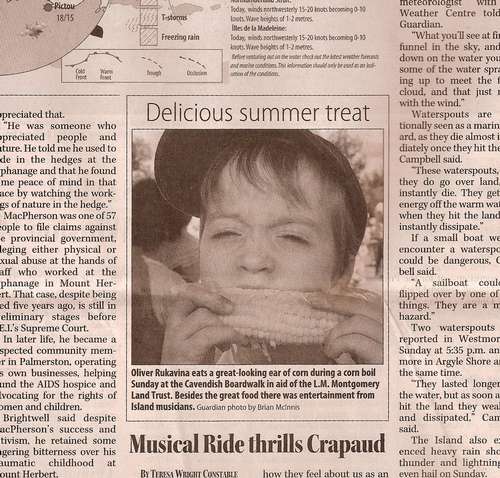
The L.M. Montgomery Land Trust is holding a fundraising event this Sunday at the Cavendish Boardwalk called The Great Big Cornboil. The event starts at 1:00 p.m. and there will be corn. Boiling. For sale. To eat. And live entertainment. And much family fun and merriment. Catherine and Oliver and I will be there shucking the corn. I’m sure Oliver will do a little dance. If you’re looking for a fun Sunday lunch alternative that will help the Land Trust’s work, please drop by.
About This Blog
 I am Peter Rukavina and this is my blog. I am a writer, letterpress printer, and a curious person.
To learn more about me, read my /now, look at my bio, listen to audio I’ve posted, read presentations and speeches I’ve written, or get in touch (peter@rukavina.net is the quickest way).
I have been writing here since May 1999: you can explore the 25+ years of blog posts in the archive.
You can subscribe to an RSS feed of posts, an RSS feed of comments, or a podcast RSS feed that just contains audio posts. You can also receive a daily digests of posts by email.