
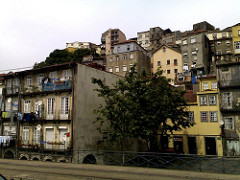
 On Sunday, after considerable recuperative sleep, we decided to venture into Porto, the large city to the south of us (and the country’s second-largest city; I called it “Portugal’s Summerside,” but that doesn’t really do it justice).
Access from Leça da Palmeira to Porto is dead simple: walk over the swing bridge and get on on the shiny new Metro at the Mercado stop for a direct train into the city. The Metro — more of a streetcar out here in the suburbs — uses the same cars they have in Montpellier, France that we rode last year; they’re Canadian Bombardier Flexity models that are the cat’s pajamas as regards cool “feels like your in the future” urban transportation.
Forty-five minutes later we emerged at the São Bento stop, in the hear of “old Porto.” Ten minutes down the hill we found the Douro River, one of the features that provided the rationale for traveling here. It is a sight to behold, and perhaps the grandest urban river I’ve yet to encounter. Much of its majesty derives from the steep banks that surround it: Porto rises dramatically from the banks, almost vertically in places. There are also the famous “six bridges” over the river that, like Halifax, let you mark your location in the city.
After a quick lunch at a riverside café (accompanied by buskers), we took advantage of the generous Sunday opening hours of Porto museums (3 p.m. to 7 p.m.) to walk the river and make a museum day.
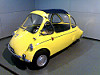 First stop was the Alfândega, home to the Museu dos Tranportes e Comunicações — the Transport and Communications Museum. This museum holds an impressive collection of 20th century automobiles, starting with a car built in 1903 and ending with a 2005 Toyota Prius. The building is as impressive as the cars; it’s a former customs house, and the floors are lined with rails used, in its former life, to roll cargo around.
 Next we headed west down the river to the Museu do Vinho do Porto, a subterranean space (also a former customs warehouse) with exhibits detailing the history of the port wine trade in the city. Most interesting to us was the exciting metal-enclosed washrooms and the generous kids area, with a giant rug-map of the city and a Rubic’s Cube-like puzzle of a Porto bridge scene.
At this point in the museum-going day, Oliver started to flag a little, becoming obsessed with taking pictures of obscure setups that he had difficulty communicating; we thought we were going to hit a wall, but a sudden breath of rain renewed our fire, and we continued down-river to the trolley museum.
Run by the local public transit authority, the Museu do Carro Eléctrico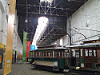 is a towering building (overseen by perhaps the nicest museum attendant I’ve ever met) filled with trolley cars from Porto’s history. While once the dominant vehicle for public transit, the trolley system has contracted to a San Francisco-like waterside line that appears to exist more for tourists than for practical use; the museum keeps the old trolleys, all in excellent shape, around for the next generation. Best of all, as kids (and fathers and mothers) are concerned, you’re allowed to jump right up inside most of the cars (all but the most ye olde ones). And the ticket to the museum (2 EUR a person) includes a ride back up the side of the river on the working trolley (which makes a lot of sense for a museum located at the end of a long line of museums, with its resulting role as an “end point” of a museum day).
Sunday being Mother’s Day, at least in North America, we couldn’t let the fun die just then, so we walked back the hill to the Metro, made our way back to Leça da Palmeira and, after some hungry aimless wandering, found a restaurant waiting for us.
The beauty of being overseas for Mother’s Day is that it’s not Mother’s Day for anyone else, so we had the place entirely to ourselves; it was as if Oliver and I had bought out all the tables and reserved the sole waiter to serve us personally. We started dinner with an entrée of fried mushrooms and coleslaw; we also received a complimentary dish of what we suspect was blood sausage — smoky, spicy, deep red — that Oliver quite enjoyed, chewing his way through two big pieces (we can’t get him to eat Chicken McNuggets, but he’ll happily eat spicy blood sausage; if he’s not careful he’ll be kicked out of childhood). For main dish, Oliver and I both had fried local whitefish served with a side of carrots, garlic cabbage and french fries; Catherine, who wasn’t quite sure what she was ordering, ended up with a large bowl of spicy rice topped with shrimp, shellfish and a large fried egg. It was all very good. For dessert Oliver and I split a chocolate mousse and Oliver and Catherine split a chocolate crepe (which explains why Oliver got a sudden burst of energy). Oh, and somewhere in there we polished off a bottle of Ferreira Esteva, which explains why I got a sudden burst of inability to walk straight.
By the time all was said and done, we got home at 10:30 p.m. and tumbled slowly to sleep. Oliver, bless his heart, decided to wake up at 6:00 a.m. the next morning…
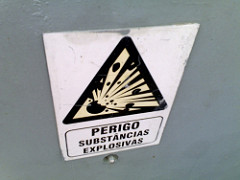 After getting settled in our house here in Leça, Oliver and I headed out to see what we could see. Walking over the swing bridge to Matosinhos, we noticed a bunch of military-looking ships docked right next door, with what appeared to be civilian tours going on. Never ones to shy from a good “crawling around a ship” opportunity, we diverted off the bridge and into the dockyard, acting as if we knew what was going on, and walked up onto a German frigate that looked inviting.
Oddly, we seemed to essentially have the run of the ship, and could walk freely about looking in all the nooks and crannies. Things were a little more formal on the Portuguese frigate moored right beside: there we had to go around with a tour (in Portuguese, of course) led by a fresh-faced sailor. But even there we had the run of the operations room, and apparent free access to a bunch of items marked “NATO Confidential.” Oliver was especially enamored of the shipboard helicopter, rolled out of its hanger to make a sort of children’s playground.
Further down the dock we found a U.S. ship moored beside a Canadian one — HMCS Athabaskan; unfortunately the Americans and Canadians were less hospitable, and didn’t invite the public in for a tour but instead had several imposing looking “you don’t even want to think about walking over here” guards on duty.
We took lots of photos of our tour.
Okay, here I am. It turns out that trying to vacation, and work, and attend to the postcard-sending needs of your 5-year old and recover from jet-lag do not pre-dispose one to blogging. Actually I have been pre-disposed, just without time. So here are a couple of catch-up posts to bring you up to today on our exciting euro-travels.
When I last wrote, we were in Dublin, about to head to Portugal. The next morning we caught a cab from our hotel (but for the slightly-too-tiny beads, I highly recommend Egans House for Dublin lodging) out to the airport; it was a quick trip, with no traffic, and we arrived exactly 2 hours before our flight, which is the Ryanair recommended arrival time.
Ryanair, despite its miniscule fares (129 EUR, all taxes in, for three people to fly from Dublin to Porto), was an excellent experience: the plane boarded quickly, left on time, arrived 30 minutes early and was staffed by pleasant flight attendants and a chatty flight deck.
The Porto Airport is stunning: huge open spaces, very quick passage through, very good signage. We were met by a helpful man, friend of the owner of the place we’re renting, who piled us and our luggage into his Volvo and drove us door to door.
We’re renting a house here in the community of Leça da Palmeira, itself a part of the city of Matosinhos, which is just north of the large city of Porto. Leça has a sort of triple identity: gritty industrial suburb, lovely beach-side town and workaday Portuguese community. The resulting mix makes it perfect for us, and the house is everything we could have dreamed of. Oliver is especially impressed with the fully equipped kids’ room, complete with “cave bed” and complement of excellent toys.
I’ve started to post photos of our travels. All were taken with my Nokia N70 camera-phone, which is proving to be an excellent “always on” device for taking decent photos with.
Arrived Dublin, Ireland this morning after an exciting array of air travel challenges.
When we showed up at Logan Airport in Boston yesterday around 4:00 p.m. we were told that “everything is backed up” and, because we arrived early, were put on a 5:00 p.m. flight that was delayed to 6:30 p.m. (rather than our original 6:30 p.m. flight that was expected to be delayed by a similar amount of time).
After various other delays, we finally took off around 7:00 p.m. and arrived in Philadelphia at 8:15 p.m., still in time for our 9:00 p.m. flight to Ireland. It turns out that Philadelphia Airport is approximately the size of a small city, and hiking from Terminal C to Terminal A is about 2 miles. Fortunately we flagged down a helpful golf-cart driver who took pity on us and gave us a ride.
We arrived at the gate at 8:45 p.m. to an announcement that there was a “maintenance problem” that was going to delay the flight until midnight. But to tide us over, U.S. Airways was springing for $10/person in food at the local food court. So we loaded up on food and drink and dug in for a wait. Then, miraculously, at 9:15 p.m., just as everyone was tucking into their food, the maintenance problem (a switch breaker, it turned out) was solved, and we started to board. A lot of large coffees got left in the lounge.
The flight over was uneventful — the usual arduous overseas flight in coach, no more no less. We’re now set up at the delightful Egans House, close to downtown Dublin. We got here with Gerard, a very helpful world-travelling cabbie. We are exhausted, but ready to conduct the fastest tour possible of Dublin before leaving for Portugal in the morning.</p?
One of my important works tasks today turned on whether midnight is part of “today” or part of “tomorrow.” As you might expect, my colleagues at The Old Farmer’s Almanac have many opinions on this issue, the predominate one apparently being that midnight is neither today nor tomorrow, but some amorphous nether region betwixt the days. Here’s what the 2006 edition says about midnight, in the “Astronomical Glossary” on page 75:
Midnight: Astronomical midnight is the time when the Sun is opposite its highest point in the sky (noon). Midnight is neither A.M. nor P.M., although 12-hour digital clocks typically display midnight as 12:00 A.M. On a 24-hour time cycle, 00:00, rather than 24:00, usually indicates midnight.
The issue at hand was that the tool we use for calculating sunrise and sunset times returns midnight as 24:00, but the tool we use for converting this to the user’s local time expects midnight as 00:00. In any case, problem resolved, and you can rest easy that sunrise and sunsets will emerge correctly when the sunset happens to coincide with midnight GMT.
Oliver likes to hug people. I’m not sure why. He doesn’t get it from me (I like a good hug as much as the next guy, but latent agoraphobia has always intruded). But Oliver hugs his friends when he leaves school (something that seems to have spread like wildfire through the student body). And he hugs Catherine and he hugs me at every opportunity. And if opportunity presents itself, he’ll hug just about anyone who looks huggable.
In recent weeks this has extended to members of the transportation system working class: a few weeks ago he hugged our bus driver after a good ride down from the Farmer’s Market; last night he hugged the flight attendant after our Air Canada flight from Charlottetown to Montreal. In both cases the look on the face of the hugged made it clear that regular hugging by customers is not a commonplace occurrence. But they both seemed pleasantly surprised at the offer once the initial shock had passed.
Talking in the car on the way up from Boston to Keene, New Hampshire where we’re staying, Catherine recalled that our first trip on Air Nova (the predecessor of Air Canada Jazz, the “regional” part of Air Canada) was to New York City back in the mid-1990s. On that flight they were conducting an experiment wherein they had an on-board oven that was used to bake fresh chocolate chip cookies. The cookies were amazing. And somehow not at all like the sesame snacks cum mealy twigs that are on offer now (okay, I know, enough with the sesame stick bashing; but it’s what I do).
As we’re only here for 3 days this time around, it turns out that the cost of renting a “Pontiac Sunfire or similar” is only $10/day different from renting a fully tricked-out Volvo XC70. So we drove up from Boston with heated leather seats glowing, moon-roof open, and Hertz NeverLost GPS system guiding our every move. Although I could never justify (or afford) such a car for the once a week market runs, it sure is a nice vehicle.
I’m here in Dublin, NH until Thursday; Friday morning I wake up in Dublin, Ireland.
Before taking off on vacation this evening, I went for my customary pre-trip hair cut. I was lucky: when I went in, Fergie was sitting in the barber chair by himself reading the paper and saw me right away; ten minutes later there were 5 men waiting to see him. Here’s what happened:
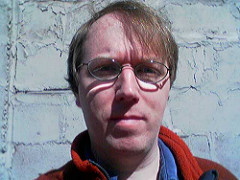
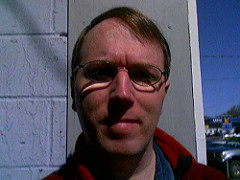
I get my hair cut about three times a year (I think: I can’t remember between times, so it must be about three times, as 100 days is about the length of my short term memory). There was a lot more grey hair on the floor this time than last time.
For other hair news from Charlottetown see this post on Rob’s website. Rob falls on the Ray’s side of the Ray/Fergie barber divide, a world I’ve never experienced.
Spotted at the corner of King and Prince in downtown Charlottetown last night around sunset:

In one of my earlier incarnations I worked developing new products for The Anne of Green Gables Store here in Prince Edward Island. In amongst all the jam and doilies and porcelain dolls, my favourite “new” product was Rogers’ Chocolates.
One of my most pleasant duties while in that roles was to visit Rogers’ store and plant in Victoria, British Columbia. To be effective at my duties, of course, required considerable comparison testing (read “orgy of chocolate consumption”). Thrown together with a stop for tea up the street at Murchie’s and I had a rollicking family-run business cavalcade of food and drink under my belt.
For me, the pinnacle of the Rogers’ line is their “Carmel Nut Dark Chocolate” bar — 2 oz and 250 calories of chocolate nutty goodness. Not something to have every day, but certainly something to indulge in on occasion. While the Anne store stopped selling the Rogers’ line a while back, Bruce MacNaugton’s to-be-named restaurant cum crafts shop on Queen St. in downtown Charlottetown is now selling them. I’ve just polished one off. I won’t need dinner.
About This Blog
 I am Peter Rukavina and this is my blog. I am a writer, letterpress printer, and a curious person.
To learn more about me, read my /now, look at my bio, listen to audio I’ve posted, read presentations and speeches I’ve written, see things I’ve favourited elsewhere, or get in touch (peter@rukavina.net is the quickest way).
I have been writing here since May 1999: you can explore the 25+ years of blog posts in the archive.
 You can subscribe to an RSS feed of posts, an RSS feed of comments, an RSS feed of favourites elsewhere, or a podcast RSS feed that just contains audio posts. You can also receive a daily digests of posts by email. I also publish an OPML blogroll.
Instagram • YouTube • Vimeo • ORCID • OpenStreetMap • Internet Archive • PEI.art • Drupal • Github.