I arrived at Halifax International Airport at 9:00 p.m. for an 11:00 p.m. flight. All the drive long from Charlottetown I was sure I would be terribly late.

I was the only person in the “line” at the checkout counter, the only person going through security (a wicket staffed by 6!) and the only person at the Maple Leaf Lounge counter. I was in and through and sitting here drinking tomato juice in 10 minutes. Obviously late-night Halifax departures are the way to go — much preferable to the barely controlled chaos of Trudeau Airport in Montreal, the other jumping off point for Islanders heading over the Atlantic.

Kudos to Air Canada, by the way, for the whole “web checkin” thing — it “just worked.”

🗓️
Airport  •  Halifax  •  Travel

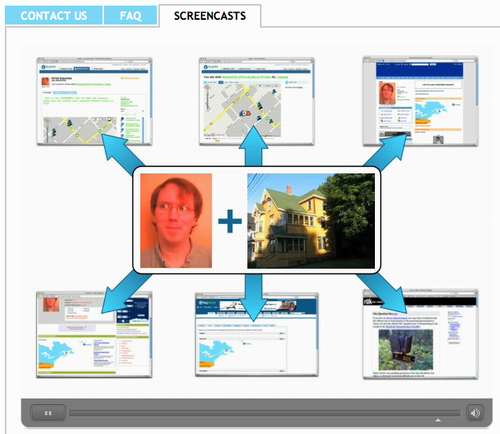
For the past couple of months I’ve been working with the folks over at Plazes in Berlin on a series of screencasts designed to help explain the service to new users.

It’s been an interesting journey: I’ve learned a lot about “screencasting” as an art, and have built up an good Screencasting Toolchain along the way. I’ve also stuck my fingers deeper into Plazes than ever before, and have worked with a really excellent team at Plazes bringing the screencasts from dream to implementation.

Plazes Screencast Snap

The screencasts went live just now, so our humble Reinvented Plaze is beaming out to untold millions. As is my goofy looking photo (a photo I took three years ago in our dining room that makes me look as though I’ve got a severe sunburn; but it has become “Brand Pete,” so what can I do?).

One of the interesting things about this job is that it came as a direct result of this declaration of war against shyness. Scroll down to the end of that post and you’ll read how I ended up at dinner in Copenhagen after reboot with Stefan and Felix — “the Plazes guys.” And so it began. Take that, shyness!

Another new Plazes feature went live at the same time: the ability to update your location by SMS text message. This feature takes Plazes mobile in a whole new way; you don’t need to have a particular mobile phone like you do with the Mobile Plazer — you can update your Plaze from anywhere with any mobile carrier with any phone.

Of course now I’ve got to update the screencasts to include a chapter on this new feature…

🗓️
Video  •  SMS  •  Reinvented  •  Plazes

I’m off to Italy tomorrow night for a two-week “working vacation.” I was corresponding with a new Plazes contact in Japan a month ago and mentioned this term and it made no sense to him; for me it means “relocating my regular everyday life to a new location for a couple of weeks, but continuing to do the same work I do, just eating different food, hanging out with different people and sleeping in a different bed.”

I’ve added my itinerary to the Rukapedia should you wish to play along from home (or if you’d like to have a Ligurian lunch, or you need to track me down to tell me that I left the tap running in the bathroom).

🗓️
Europe  •  Italy  •  Travel

Oddly enough for one like me with a career that’s all about patterns and systems, I’m notoriously bad at noticing patterns in my everyday life. Catherine still makes fun of the time, ten years ago, when I realized that sometimes the night sky was bright and sometimes it wasn’t (this despite having built a tool that demonstrates exactly why).

I am also notoriously bad at judging time — Johnny knows that if I say “I’ll be done in 10 minutes” I could emerge anywhere from 5 minutes to 2 hours later.

So if you asked me “what time do you usually arrive at the office,” any answer I’d come up with would be a crazy wild guess at best.

So I decided to find out.

I used the Plazes API to pull a list of my arrival times at the Reinvented Office on weekdays for the past four months. I then charted my “first arrival of the day” on a chart (using AppleWorks of all things) and here’s what I came up with:
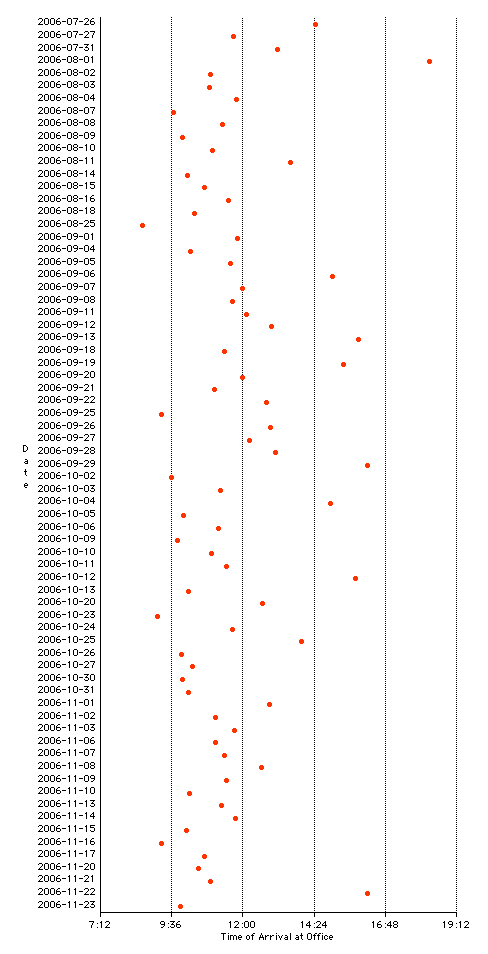
120 of Work Arrival Times

I am obviously completely unsuited for a traditional “9 to 5” job.

My work departure time is somewhat more consistent, mostly because there is usually a fixed point — 6:00 time for supper and Compass — to shoot for:
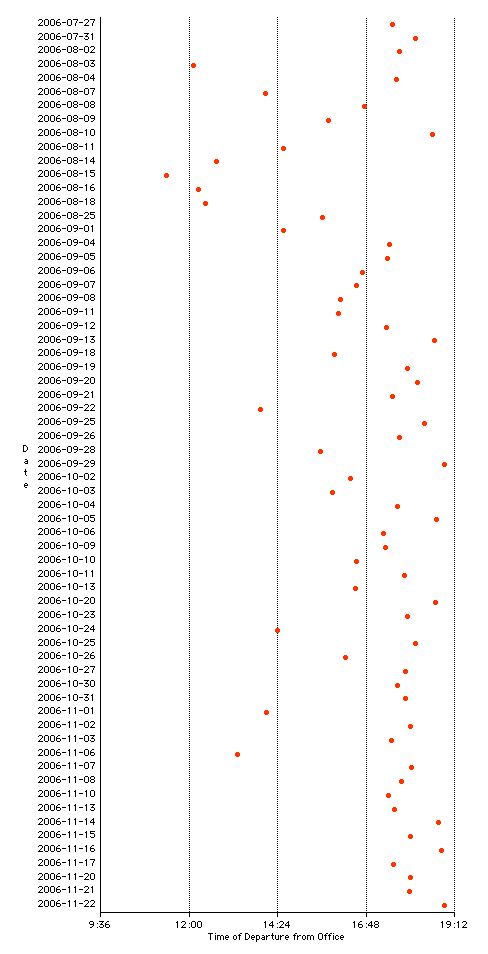
120 of Work Departure Times

The same graph a year or two ago, when I was much less successfully making it home for dinner on time, often working night four or five times a week, would have trended much later in the day.

Of course someone more versed in statistics, and with better tools at hand, could apply trend-lines to the data, and deduce something approximating an answer to the “usual arrival time” question. I’m content, for now, to leave it as a jumbly series of red dots.

🗓️
Design  •  Plazes

Morningside on John Allan Cameron. Man how I miss Peter Gzowski. And now John Allan. I only saw him live once: he was the best live performer of any sort of music I ever saw, a showman in the truest sense.

🗓️
CBC  •  Music  •  Radio

I’d never watched an episode of Gilmore Girls until Ian and Tessa told me that I should. And so I started, and it became a regular in our household, both in re-runs on W after Compass and the regular season on Global.

And the times they were good: the writing was quick and smart, the pop-culture references many, and the pace David Mamet-like.

And then came this season.

Sigh.

The plot has gone all muddy, the quirkiness has been excised, and the dialogue seems quick simply for the sake of being quick.

If I had to point to a single hinge around which things have gone all to hell, it’s the revivification of David Sutcliffe’s character as Lauren Graham’s love and Alexis Bledel’s father: his character was a “jealousy utility” play at best, and he’s simply not a textured or interesting enough actor to breath any life into the part. Everything else seems to have fallen apart as a result.

I haven’t de-DVRed the show yet, but it’s hanging by a thread.

🗓️

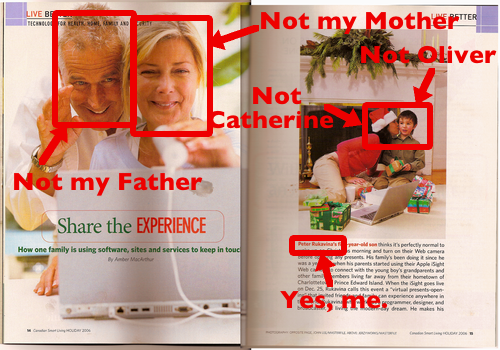
Back in the middle of the summer I got an email from Amber Macarthur. She was working on an article for Canadian Smart Living magazine, and wanted to interview me. Never one to shy from the glare of “small Canadian magazines that are given away for free inside newspapers”-style publicity, I agreed, and an email exchange ensued.

And then I forgot all about it.

Until I received an email from my high school biology teacher asking me if the cute kid on page 15 of the latest issue of the magazine was Oliver.

It isn’t.

Canadian Smart Living article

Neither is the Santa-hatted mother character Catherine. And the well-tanned parents using a de-branded computer aren’t mine either.

The images on both pages are from Masterfile, a stock photography agency.

So now you know.

Happily, the rest of the article is a fair representation of our lives: I do “maintain and nurture a global social network of clients and friends.” Or at least I like to pretend that I do.

🗓️
Family  •  Magazines  •  Technology

Far be if for me to cast aspersions on the presence of the headquarters of Veterans Affairs Canada here in Charlottetown: DVA employs a lot of people, at comparably excellent wages, and if nothing else those people keep a whole gaggle of downtown coffee shops in business year-round. And I’m sure they do good by veterans as well.

As such, I’ve resisted the urge to poke fun at DVA employees who wear their identification name tags all over town as they drink aforementioned coffee, eat lunch and so on (it’s always seemed so “look at me, I’m important, I’m a Fed!” — perhaps it’s simply “I’m too lazy to take off my name tag”).

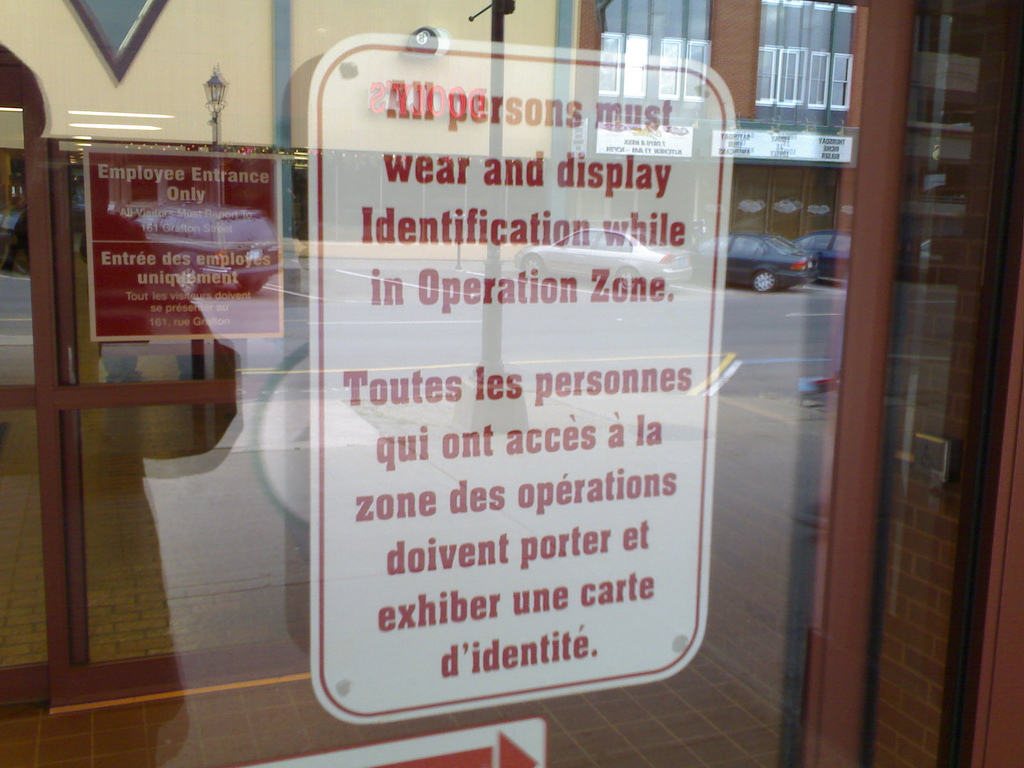
In any case, the fun-poking dam has burst with the posting of this sign on the back door of DVA headquarters on Kent Street:

Sign on the Window of the DVA Building in Charlottetown

Operation Zone?! I can understand “you must wear ID tag at all times.” But Operation Zone? Do they think they’re the CIA?

🗓️

Back in 2001 when I blogged about my first Usenet posting it had been 16 years since the great event. Now it’s 21. Oh, and I found and even earlier posting, reproduced below for posterity:

I have all but given up attempts to compose a BASIC terminal program for my SANYO computer (IBM-compatible) in GW-BASIC. Here is a brief version of the root of the program:
10 OPEN "COM1:300" AS #1
20 COM(1) ON
30 ON COM(1) GOSUB 1000
40 A$ = INKEY$
50 IF A$ <> "" THEN PRINT#1, A$;
60 GOTO 40
70 :
1000 IF EOF(1) THEN RETURN
1010 B$ = INPUT$(1,1)
1020 PRINT B$;
1030 GOTO 1000
Strangely, the program seems to be able to handle DATAPAC (the Canadian data communications network) quite fine, but gives repeated DEVICE I/O errors when used with anything else ? I can find no good reference to the possible cause of DEVICE I/O error in communications so I really can’t identify what needs to be changed. I am, of course, assuming the SANYO communications are handled, through BASIC, identically to IBM BASICA.

That was back in the days when we wrote our own terminal programs. Oh, DATAPAC, you were a teenage hacker’s playground of wonders.

🗓️

About This Blog

Photo of Peter RukavinaI am . I am a writer, letterpress printer, and a curious person.

To learn more about me, read my /now, look at my bio, listen to audio I’ve posted, read presentations and speeches I’ve written, see things I’ve favourited elsewhere, or get in touch (peter@rukavina.net is the quickest way).

I have been writing here since May 1999: you can explore the 25+ years of blog posts in the archive.

You can subscribe to an RSS feed of posts, an RSS feed of comments, an RSS feed of favourites elsewhere, or a podcast RSS feed that just contains audio posts. You can also receive a daily digests of posts by email. I also publish an OPML blogroll.

InstagramYouTubeVimeoORCIDOpenStreetMapInternet ArchivePEI.artDrupalGithub.