Back in 2001 I related my history of auto insurance, a path that led me, on Prince Edward Island, first to Gordon Full, a small office, staffed by two people, that was responsive and friendly beyond all belief.

Gordon Full eventually sold out to the still-local-but-not-as-small Hyndman and Company, and I’ve been happy to have Hyndman’s as my broker for the 22 years since.

Hyndman and Company was one of the Island’s oldest companies of any sort; many years ago I ask the Public Archives for information they might have in their records about the company’s telephone number, and the ever-helpful John Boylan replied:

The 1894 telephone directory lists FW Hyndman Insurance as being No. 67, 2 Rings. Customers had individual numbers ranging from one to three digits. Number one was the Rev. G.M. Campbell’s residence. The Falconwood Asylum was number fifteen. 

Although other phone lines were added to Hyndman Insurance, 67 remained the private office number for the business up to 1952. By 1952 customers had a mix of two, three and four digit telephone numbers. 

There’s a gap in our telephone directories from 1952 to 1959, but by ‘59 Hyndman Insurance was a four digit number, 6567. All numbers in the Charlottetown exchange appear to have been four digit ones by this year. By 1961 Hyndman Insurance was 894-6567. 

I was proud to be associated with a company with a long history, a local company that was just a few blocks or a quick phone call away.

Alas, if you dial that telephone number today, you get a message that it’s no longer in service. A metaphor for the company itself: Hyndman’s has changed a lot in recent years and I’ve become increasingly less satisfied with the service I’ve been getting: the agent I’m assigned to keeps changing, and getting in touch has become increasingly cat-and-mouse. Ten years ago my insurance company, Dominion of Canada, was swallowed up by the US-based Travelers Insurance, adding an additional layer of complexity when it came to yearly renewal. The straw that’s in the process of breaking the camel’s back is that Hyndman and Company was sold to Westland Insurance Group this year, “one of Canada’s largest independently owned insurance distribution businesses.”

So, now that any trace of dealing with a local company has been removed, any need to avoid shopping widely and broadly in the auto insurance marketplace has also been removed, and I’m open to any suggestions you might have: I’m shopping for price and for convenience. If I don’t ever need to talk to a person, that’s a bonus. Which is quite a journey from sitting down across from Gordon Full 30 years ago. But such is the modern world of commerce.
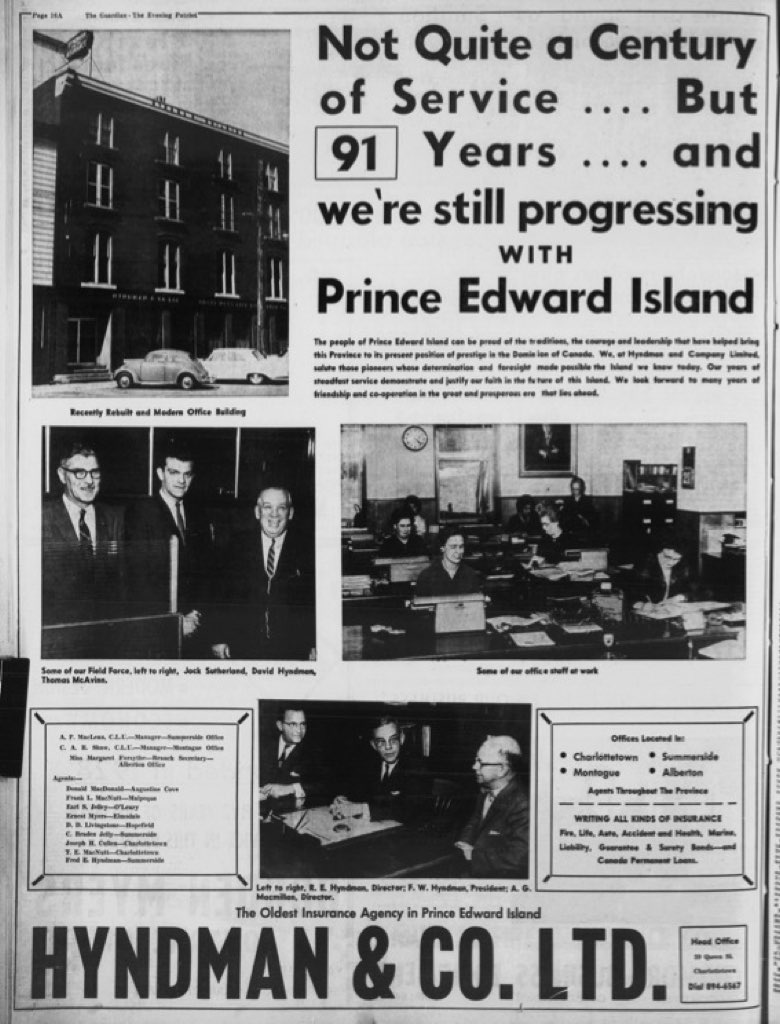
A Hyndman and Company ad in The Guardian from 1963

A Hyndman and Company ad in The Guardian from 1963

🗓️

I was sad to read yesterday of the death of Jim MacAulay. 

The public service contributions of the MacAulay family to are legion, and I crossed paths with each of the MacAulay brothers over the years.

Jim had a special place in my heart: as a lifelong educator he contributed enormously to public education on PEI, and I had the pleasure of sitting around the luncheon table with him at the PEI Retired Teachers Association; he was funny, curious, and willing to tell tales.

Among Jim’s many contributions to the province, his 1996 Eastern School District Facilities Review was one of the most significant: it’s a 433 page deeply detailed review of the school infrastructure in half of the Island that begins with a section “How Things Came to Be”:

In a study of this nature, a historical review provides useful perspective. Until the late 1950’s and early 1960’s education in Prince Edward Island was primarily provided by small, one-room, community schools. Frequently a farmer provided in a comer of one of his fields, sufficient space for the school building and its playground. Each of these structures and its administration was an entity unto itself. In many of our communities, this model served very well for the social, economic, technological and demographical climate of the day. Many very prominent citizens emerged from these institutions.

The report is at once a detailed review of school buildings (Parkdale Elementary: “Two new furnaces were installed in the last 3 years.”), and a capsule history of public education on PEI (“If one investigates school size over the past fifty years, many school sizes put forth as ideal. At one time people felt that very large schools were the answers. Before long problems which surfaced led to a change of thinking and understanding that schools could be too large to manage.”).

It is comprehensive, well written, and its publication served as an inflection point in how we think about school infrastructure, coming 30 years after the big push to school consolidation and construction that happened in the 1960s.

For anyone wants to understand “How Things Came to Be” from a 2023 perspective, it’s the place to start reading.

Jim MacAulay will be missed.

🗓️

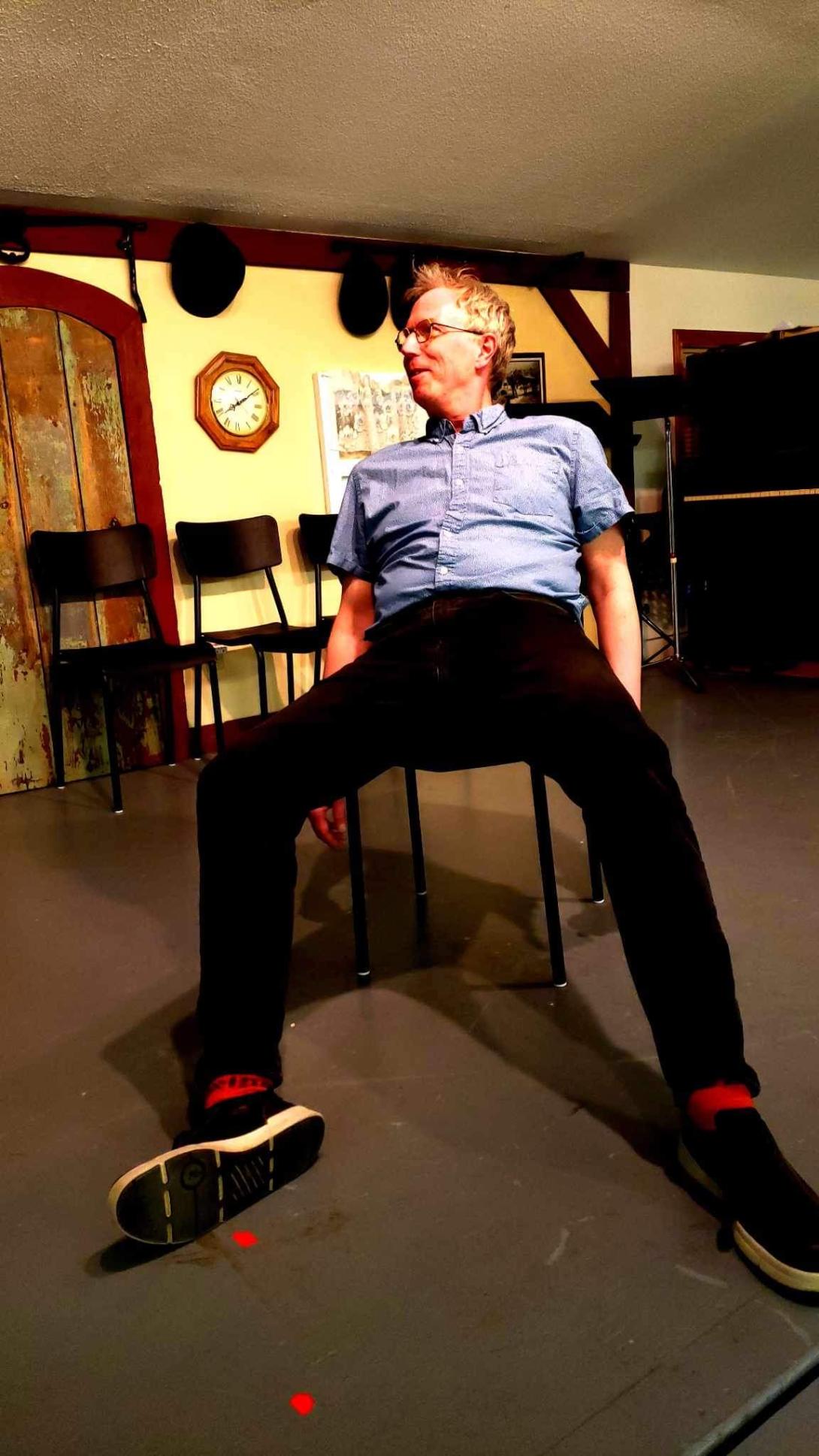
A photo of me, at improv class, taken by Laurie Murphy. My mother has taken to telling me that I seem preternaturally tall of late; until now, I’ve never seen it. 

🗓️

Every time I fear that Prince Edward Island has lost its mojo…

🗓️

Tamar Adler, in An Everlasting Meal: Cooking with Economy and Grace, on poached eggs:

I’ve heard of a lot of perfect ways to poach an egg, I’m sure they work. The problem with them is that to poach eggs is to understand egg cooking as you can’t when you cook them any other way.

A boiled egg stays secret until it’s cooked, and a frying egg sizzles in fat, too hot to touch. But poached eggs are cracked out of their shells and cooked directly in barely simmering liquid, which means you can literally feel them as they cook. The trouble with setting a timer, covering a pan, and walking away is that you end up bound to your trick, lost without a timer, stuck without a lid.

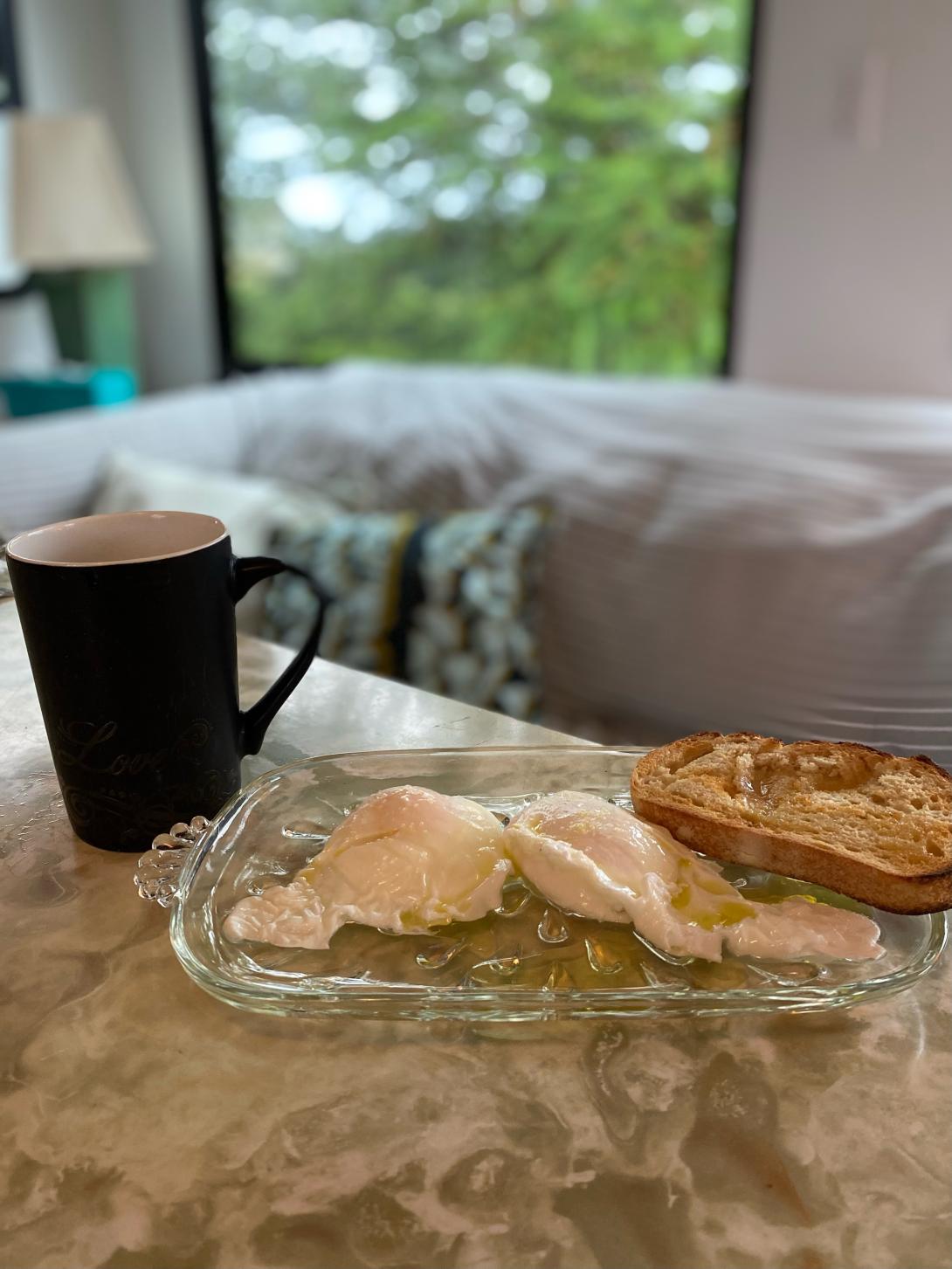
I followed her advice and made—though did not eat, given my eccentricities—poached eggs this morning for the first time.

(Photo by Lisa)

🗓️

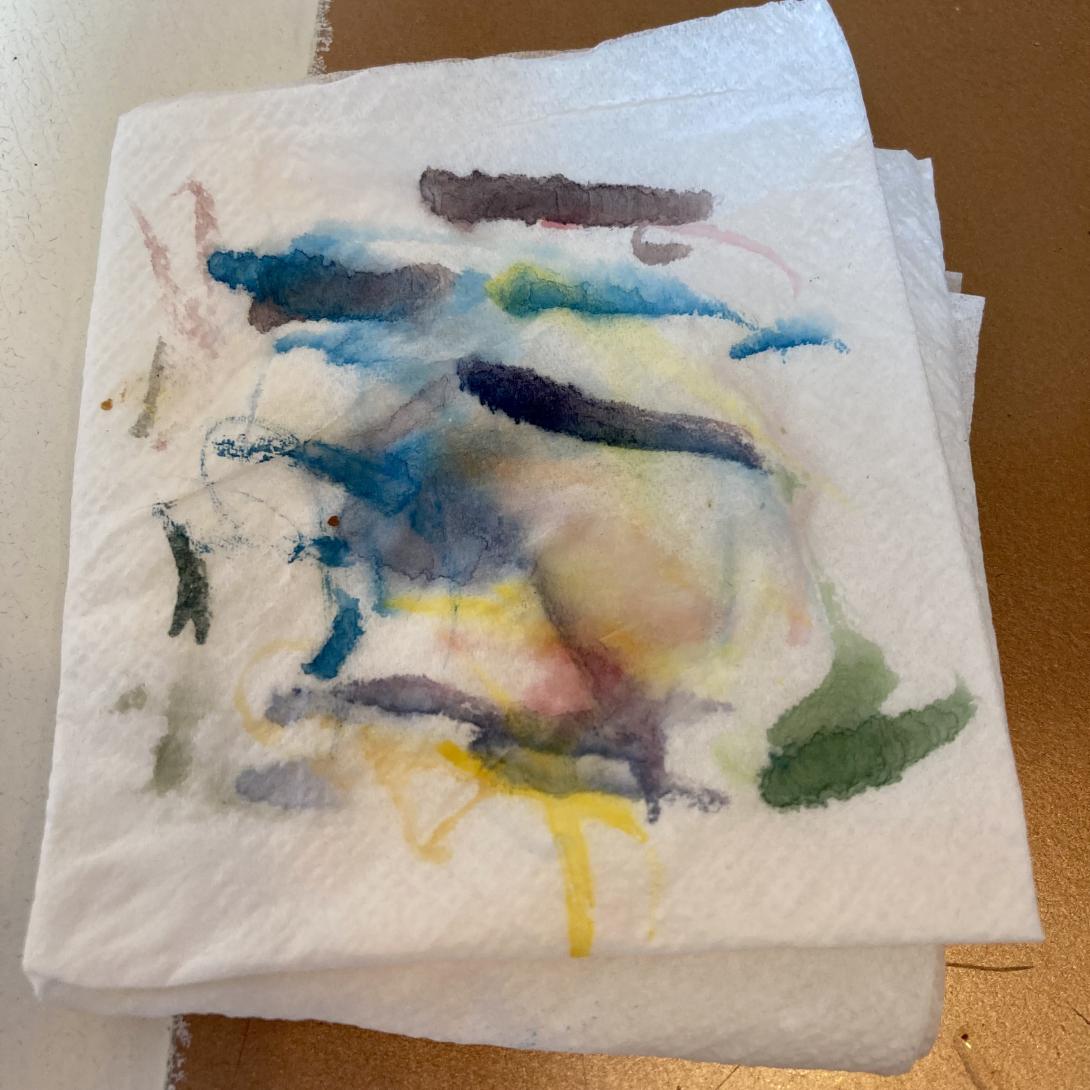
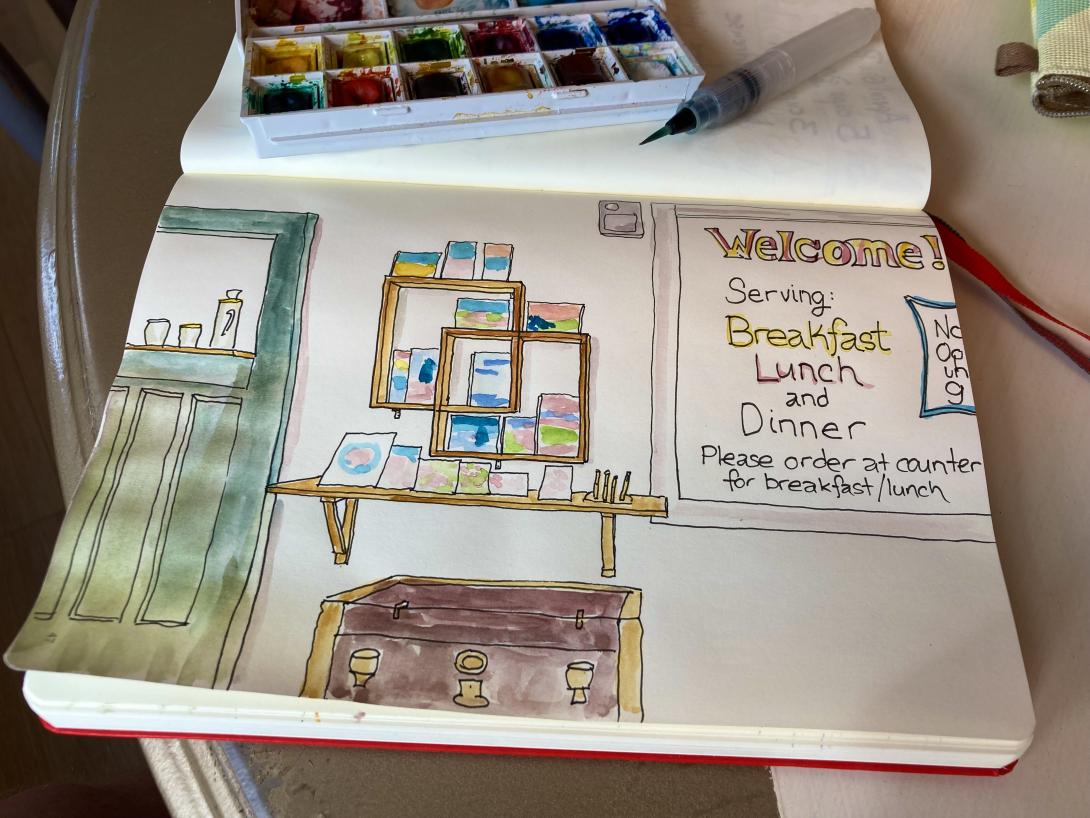
The paper towel used to blot my watercolour brush at the Black & White.

🗓️
🗓️
St. Peters Bay  •  Black & White  •  Coffee  •  Sketch

For someone who holds himself out to be in the imagination business, I have remarkably little skill in being able to imagine physical spaces not as they are.

Witness this photo of the end of our upstairs hallway: Lisa wallpapered it last week in a bold, black and white, geometric pattern:

Black and white patterned wallpaper on a back wall with a window.

When she proposed the idea I was queasy: unable to conceive of what it might look like, I had to rely on Lisa’s well-developed spatial conception engine.

I trusted her. The result is lovely. Truly lovely. In ways I could not have possibly imagined—something I write not hyperbolically, but literally: my mind simply could not picture this result.

And yet it makes my soul sing every time I climb the stairs.

I have been trapped inside this limitation for a long time. Which is to say that I have trapped myself inside it. I know enough about how my mind has been expanded by sketching, by setting type, by poking at the edges of the web browser canvas, to know that it’s possible to grow. And I know that to be a good partner, to not be at the effect of another’s design sensibility, it’s the edge I have to grow.

And so off I head, to enhance that part of my brain and that part of my spirit.

🗓️
Imagination  •  Creativity  •  Design

Matt Stone, quoted in Anatomy of a Breakthrough:

“What should happen between every beat you’ve written down is either the word therefore or but.” He sketches the structure using a more concrete example: “You come up with an idea, and it’s like this happens’ and then ‘this happens… .’ No, no, no. It should be, this happens, and therefore this happens, but this happens, therefore this happens. We’ll write it out to make sure we’re doing it.” Stone continues, “There are so many scripts we see from new writers, where it’s like ‘this happens, and then this happens, and then this happens…,’ and that’s when you’re, like, ‘What the fuck am I watching this for?’”

I stepped down from the Publications Committee of Island Studies Press this spring. Over the years I read dozens of manuscripts under consideration for publishing; by far and away the greatest sin committed regularly was exactly this “and then this happened, and then this happened, and then this happened.”

The book for which I’m happiest having played a small role in the greenlighting of was New London: The Island’s Lost Dream. Author John Cousins is a master storyteller, and the narrative arc is in his blood; perhaps unfairly, any manuscript that came after had John’s high water mark to be judged against. 

🗓️

I thought my finger was on the pulse of significant browser developments, but this one I missed completely: URL Scroll-To-Text Fragment.

Here’s the URL for a post on Lisa’s blog, for example:

https://lisachandler.is/pressure-summer/

Down in the text there is the sentence:

To cherish every memory.

It turns out that I can link directly to that sentence, and have it highlighted to boot, like this:

https://lisachandler.is/pressure-summer/#:~:text=To%20cherish%20every%20memory.

Pulling this apart—it’s all documented here—I add these to the URL:

  • #:~:text=
  • the text I want to highlight on that page, with special characters, like spaces, %-encoded.

There’s more in the documentation about linking to, and highlighting, a range of text, with a start and end string; for example:

https://ruk.ca/content/asking-questions#:~:text=And%20what,something%20sticks.

will link to and highlight the paragraph that starts with “And what” and ends with “something sticks.”

This is a browser feature I wish had existed from off the top—and that I wish I’d learned about earlier—as referencing sentences or paragraphs in my blog posts is something I do all the time.

There’s a browser extension that helps with making these links easier; right now it doesn’t appear to work for the latest Safari, but there’s a bookmarklet that does.

(Note that this isn’t a universally-supported feature, and Firefox specifically doesn’t support it).

🗓️
Browsers  •  Links

About This Blog

Photo of Peter RukavinaI am . I am a writer, letterpress printer, and a curious person.

To learn more about me, read my /now, look at my bio, listen to audio I’ve posted, read presentations and speeches I’ve written, see things I’ve favourited elsewhere, or get in touch (peter@rukavina.net is the quickest way).

I have been writing here since May 1999: you can explore the 25+ years of blog posts in the archive.

You can subscribe to an RSS feed of posts, an RSS feed of comments, an RSS feed of favourites elsewhere, or a podcast RSS feed that just contains audio posts. You can also receive a daily digests of posts by email. I also publish an OPML blogroll.

Instagram • YouTube • Vimeo • ORCID • OpenStreetMap • Internet Archive • PEI.art • Drupal • Github.