Oliver and I, at long last, timed a visit to Riverview Country Market so that we could enjoy a hot beverage on the front porch.

Oliver had the Riverview Fog, supplemented by a mysterious powder that turned it blue. I had a cappuccino. Both were good, and you couldn’t beat the view (or the weather).

,
🗓️

There are 30 people who subscribe to my blog by email (what, hold on, I can subscribe by email!? – sign up here). They all receive a daily digest, at 5:00 a.m. Atlantic Time, of the posts from the previous 24 hours.

Many of my subscribers are obviously early risers, as when I receive emailed comments from them they have “sent” times like 5:43 a.m. or 6:08 a.m. When do they sleep?

I set this up when I stopped pushing notifications of new posts to Facebook and Twitter. Because this.

I use MailChimp, which is free, to do all the heavy lifting: I just point MailChimp at my site’s RSS feed, and it does everything else (this is not a paid endorsement; I just like using MailChimp).

MailChimp provides me with statistics.

I’ve been doing this for 11 months.

Over that time the list of subscribers–MailChimp calls this “the audiance”–has almost doubled in size from 17 to 30:

MailChimp Audience Growth Chart

Over the last 45 days, 53.7% of subscribers have opened the daily email on average, and the average “click rate” (where someone clicks on at least one link in the daily email) is 8.9%. This fluctuates from day to day, but is fairly consistent:

MailChimp Open and Click Stats

That “open rate” is about twice the MailChimp average, but, then again, I’m not trying to sell anyone a blender.

About 60% of my subscribers read their email on a computer, and 40% on a mobile device.

Of the desktop email readers, half are using Gmail to read their mail.

Of the mobile email readers, a quarter are using iPhones, 7% are using Android phones, and 4% are using a BlackBerry.

Half of the subscribers are in the U.S.A., 46% are in Canada, and the rest are elsewhere.

If you want to enjoy all the benefits1 of a ruk.ca email subscription, sign up now!

1. There are no benefits. Other than receiving a daily email.

🗓️
Email  •  MailChimp  •  Statistics

GO Transit, which runs trains and buses in Southern Ontario, was the public transportation backbone of my childhood. It was born shortly after I was, in the mid-1960s, and its footprint and the footprints of my youth expanded in lock step.

I used to take the GO Bus from Murray’s Variety in Aldershot into Hamilton every Saturday morning when I was a teenager, to go to the YMCA.

When my family would go to the Canadian National Exhibition in Toronto, we’d take the GO Train and get off at the “Exhibition” stop.

Later, I commuted to work every day, as an 18 year old, from the Fairview station in Burlington to Union Station in Toronto and then took the subway up to the Royal Ontario Museum.

And, now that my parents have moved back to Burlington, I can take the UP Express from Pearson Airport to Union Station, transfer to the GO Train and walk 10 minutes from the same Fairview station to their house.

In other words, when I think about “commuting by public transit,” it’s GO Transit that’s the template in my mind.

Which is all to say: what’s up with the green!?

The colour that means “GO” to me is Pantone 354C, a colour described as “a meadow hue that perfectly matches that of Ontario’s highway signs”:

Pantone 354C

In 2013, GO recoloured itself in two-tone green, using Pantone 364C and Pantone 376C

Pantone 364CPantone 376C

While I’m never one to argue that brands should never change, what appears to have been missed in this switch is that the new colour scheme and the old colour scheme clash dreadfully.

Because the GO network includes hundreds of buses and trains and signs and stations, the switch is still in progress 4 years later (colours are updated in “ongoing refurbishing”).

This means that you regularly see clashing coaches like this on GO Train platforms:

All the GO Transit Colours on two train cars

Design needs to consider both the old, the new, and the delta, and this is clearly a case where the assumption was that we’d all just avert our eyes and live with the clash during the delta.

It’s a shame: with a little more savvy the delta could have been seamless.

🗓️
GO Transit  •  Design  •  Colour  •  Green

Oliver has had a copy of the Canadian edition of The Dangerous Book for Boys on his bookshelf for many years; long enough that I don’t recall how it got there.

On Tuesday night, needing something to occupy his mind at bedtime, he pulled the book of the shelf and transcribed the names of every author listed in a section called “Books Every Boy Should Read”:

Books Every Boy Should Read (detail)

On Wednesday morning, as I was helping him wake up, I scanned the list to see which authors were included and was annoyed to find that, in the several pages of books listed, only two of the recommended books were written by women: the Famous Five books by Enid Blyton and the Harry Potter books by J.K. Rowling.

Every other book was written by a man.

So The Dangerous Books for Boys is dangerous in ways that transcend “Making a Bow and Arrow” and “A Brief History of Artillery.”

I suppose I shouldn’t be surprised: the book, after all, has sexism baked right into the title.

But surely, even in the broken world of “only boys can be interested in fossils and orienteering,” there must be a sliver of realization that reading books by written by women is important and useful.

Apparently not.

What books should appear in the erratum?

🗓️
Books  •  Gender  •  Literature

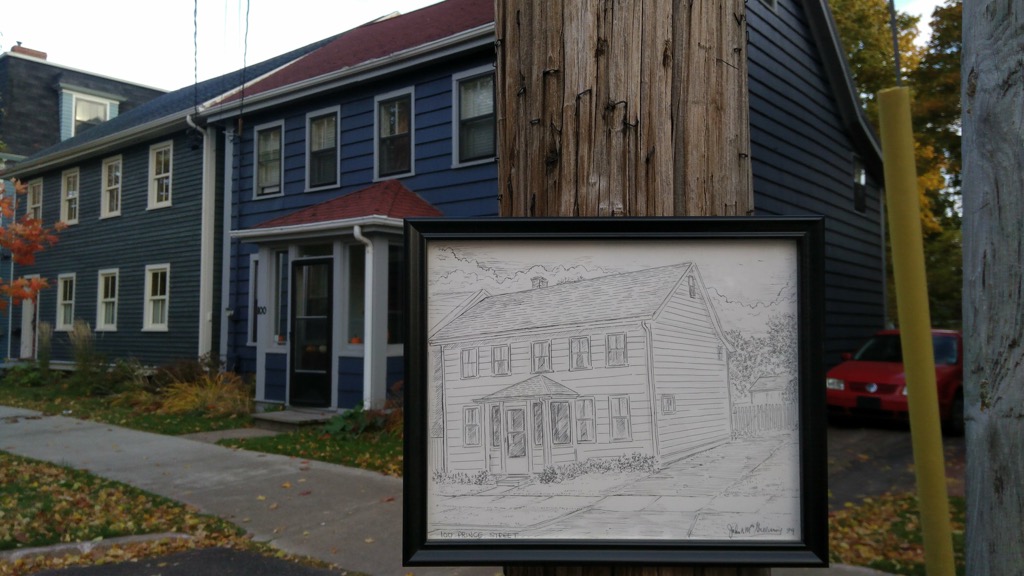
When we moved into our house on 100 Prince Street in the summer of 2000, the Reid family, from whom we’d purchased it, left a sketch for us on the mantle.

We didn’t know anything about the sketch or the artist until this fall: I noticed that it was signed by what looked to be “John MacGillivray,” and, on a visit to Brìgh Music & Tea a few weeks ago, I happened to ask personable co-owner Mary MacGillivray whether she might be any relation.

“That’s my Uncle Johnny!” exclaimed Mary.

John MacGillivray, it seems, is, among other things, a prolific sketcher of houses, ours among them.

Mystery solved.

Sketch of 100 Prince Street by John MacGillivray

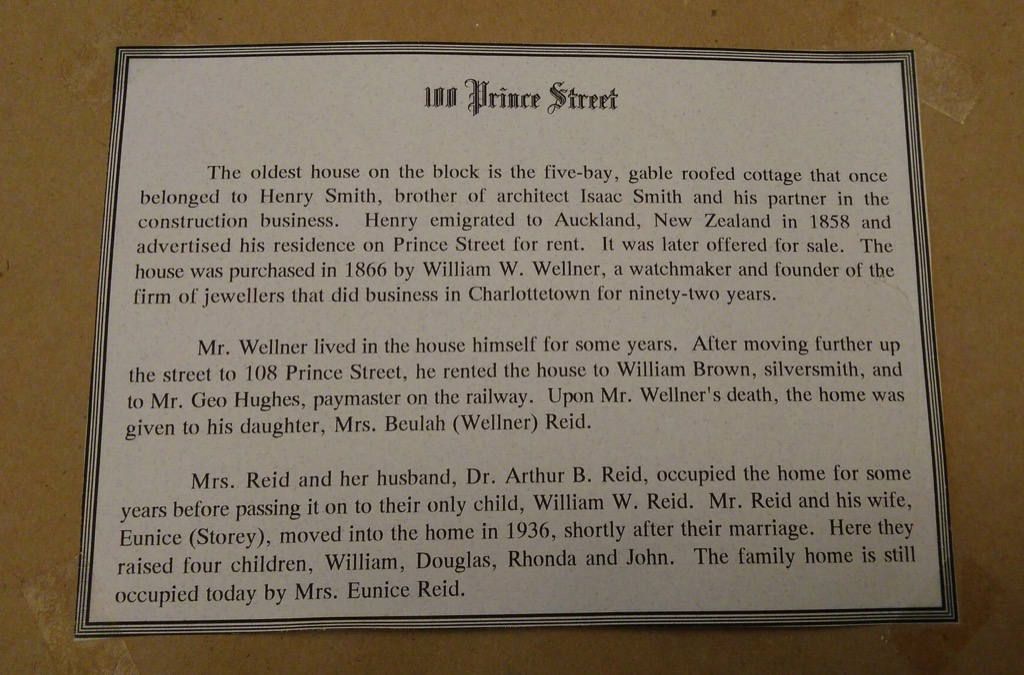
Here’s a thumbnail history of the house–minus us, of course, as it was written well before we moved in–that’s taped to the back of the frame:

Thumbnail history of 100 Prince Street.

🗓️
100 Prince Street  •  John MacGillivray  •  Art  •  Sketch  •  Brìgh Music & Tea

I’ve been a Firefox user forever but I only today learned what the “Use smooth scrolling” setting means:

Firefox Preference showing "Use smooth scrolling"

I’d always assumed this was a setting that somehow “smoothed” the scrolling up and down on a web page as I turned my mouse wheel or used the scroll bar; I thought that without this setting checked the scrolling would be “jankier.”

But today, on a lark, I tried switching it on and off and could see no difference in this regard.

Turns out that’s not what it has to do with.

Rather, here’s how Mozilla’s documentation describes it:

Use smooth scrolling: Smooth scrolling can be very useful if you read a lot of long pages. Normally, when you press Page Down, the view jumps directly down one page. With smooth scrolling, it slides down smoothly, so you can see how much it scrolls. This makes it easier to resume reading from where you were before.

Which is a pretty good explanation of what it does do.

And which prompted me to realize that my keyboard has a key labelled “PgDn” which I’d been ignoring for the last decade (despite, in an earlier era with a different keyboard and a different computer, using such a key all the time).

🗓️

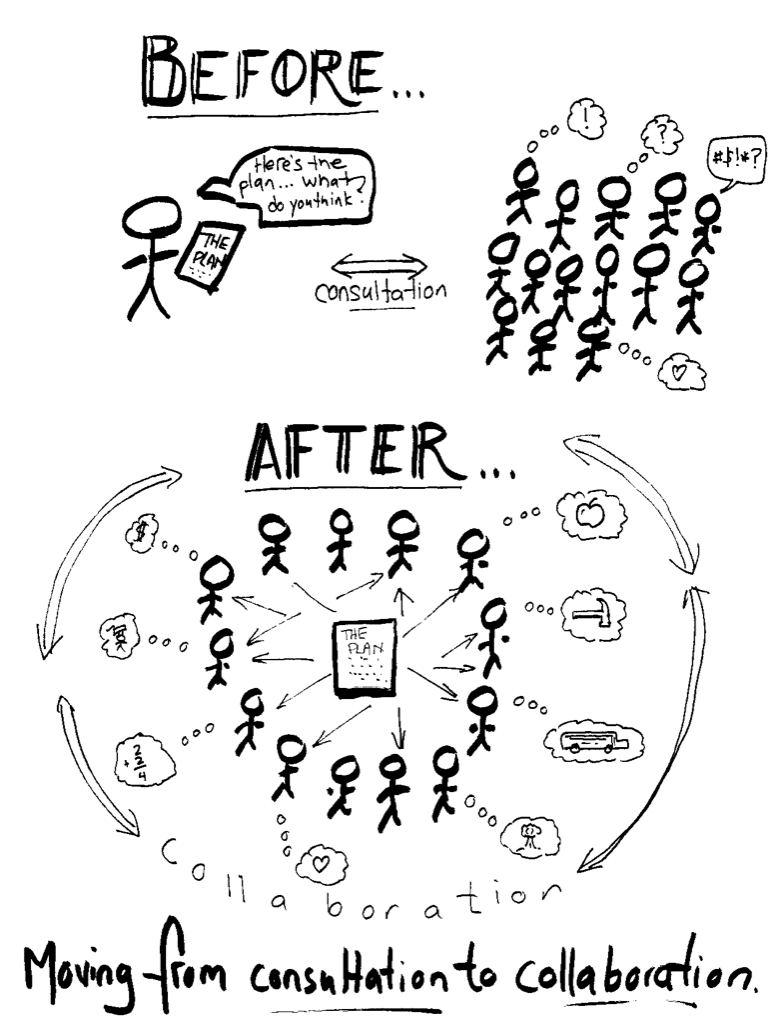
Procrastination–or “just in time planning,” as I prefer to think of it–led me to coming up with a visual to set the scene for last night’s PEI Home and School Federation semi-annual meeting in the late afternoon. What I needed was a way of conveying what we were hoping to achieve: a transition from “consultation” (where government comes up with plans and then asks people for feedback) to “collaboration” (where people are involved in the making of the plan from the very beginning).

I gave designing something a go on my computer, but found it hard to do the concepts justice by assembling bits of other people’s clip art, so I set the keyboard and mouse aside, pulled out a piece of paper and my sketching markers, and drew up something on the fly.

This is what resulted.

Infographic illustrating the differences between consultation and collaboration.
Creative Commons Attribution-NonCommercial 4.0 International

I showed this to Oliver on the way to the meeting, and he immediately understood (which is not surprising, given what he’s taught me about collaboration); this was a good sign.

I hope it worked.

🗓️

The first source of anxiety for Oliver, starting out this week, was that his regular afternoon educational assistant at high school was going to be off yesterday, and there was, as Oliver put it, some “iffiness” about who would be substituting for her.

Oliver doesn’t like “iffiness,” especially where personnel matters are concerned. This anxiety wasn’t all-consuming–”the situation got resolved,” Oliver told me–but it raised the alert level a little.

On Tuesday morning Catherine got hit with a sudden and unexpected bout of vertigo–”It’s like the worst hangover with out all the fun,” is how she put it on Instagram. Her home care nurse advised staying in bed all day.

Her sudden infirmity threw a spanner into the works of my plan to attend the semi-annual meeting of the PEI Home and School Federation on Tuesday night, as with Catherine in bed, and Oliver’s support worker leaving at 6:00 p.m., Oliver would be left without supper and support. We quickly cobbled together a plan that would have Oliver go out for supper with his support worker before 6:00 p.m., and then Oliver left under the watchful-but-infirm supervision of Catherine-on-bed-rest. Not the perfect solution, but a workable one. We thought.

Late on Tuesday afternoon, I found myself at Central Queens Elementary School helping to set up the sound system for the Home and School meeting (sounds systems are complicated and we found several ways to come close to blowing our eardrums out before we got it right). Once we were set, I checked my email and found a just-arrived message from Oliver:

I miss you, this is too much. Today is too much.

I immediately called Catherine at home, and found that the prospect of an evening off-the-rails was causing Oliver considerable anxiety. She suggested I come home. So I begged out of Home and School hosting duties, hopped in the car, and, 30 minutes later, I was at home with Oliver. By the time I arrived, he’d calmed down considerably, primarily because my impending arrival would help to normalize things.

As it was still daylight, and we both needed to get out of our heads, we piled back into the car, with Ethan the service dog, and headed to the dog park to get some exercise. The dog park was packed with frisky dogs, and Ethan got a week’s worth of exercise in 30 minutes.

When we finished up, I realized that there was still time to get to the Home and School meeting in time for the small group discussions about the future of school planning, and, as students were encouraged to participate, bringing Oliver seemed like a good idea.

We high-tailed it out to Hunter River, stopping to grab a grilled cheese sandwich on the way there, and arrived shortly after the small groups entered conclave.

We found a group to join, 8 people gathered together in a classroom in mid-discussion about greenhouses and real-world curriculum. I interrupted the proceedings to introduce us to the group. And then we joined in the discussion.

Oliver and I have a lot of chats about the difference between consultation and collaboration, and a lot of my ideas about this are informed by things that I’ve learned from him. And so there was a certain poetry to the notion that the fulcrum of the Home and School discussion was exactly that. Oliver was engaged in the discussion, and made several contributions. He was enjoying himself.

At various intervals through the hour that was set aside for the small group work, the moderator of the plenary that was to follow popped in to let us know how much time was left for us–”You have 20 minutes,” he said; then “Just 10 minutes left!” and so on.

One of the things that really, really triggers anxiety in Oliver is ticking countdowns: he finds it incredibly stressful to be hurried along and rushed, especially when he’s as engaged in an activity as he was in the discussion, and especially when he’s already had a stressful day. He was able to keep his anxiety contained while the discussions were going on, but as soon as they came to an end his anxiety boiled over, and he lapsed into a full-fledged meltdown.

This involved a lot of yelling, a lot of flailing of fists, and some toppling of chairs. To someone unused to witnessing this, I expect it would have been quite distressing.

It took Oliver about 10 minutes to calm down enough to the point where we could communicate, and about 10 more minutes to get to the point where we could safely, calmly leave the school.

We stopped on the way home to get something for Catherine to eat, and by the time we arrived home around 9:00 p.m., Oliver was relaxed and feeling a little better.

On the way two bed, an hour later, he’d had time to reflect on the day and on the evening, and was very intent on making it clear that he was “disappointed in his actions.” We had a long chat about what had happened, and how it wasn’t his fault, and about steps we could have taken along the way to mitigate the trigger (like asking the moderator, after the first pop-in, to stop the countdown and the rushing).

While the evening’s proceedings were stressful for Oliver, and stressful for me, having meltdowns isn’t unusual for Oliver. It’s not something that happens every day and, indeed, often weeks or months can go by without one. But it’s familiar territory for us.

What was novel for Oliver about last night is that this all played out on a very public stage; that’s why, I think, Oliver was more than usually disappointed–he’d broken down in front of a group with which, only minutes before, he’d been actively engaged.

What was novel for me about last night was that, over the following minutes and hours, I received about half a dozen text messages or emails from friends and acquaintances who were at the meeting, both checking in to see how we were and expressing some confusion about how or whether they could have helped.

So, in addition to everything else, this blog post is by way of answering that question, and providing some context to those people.

Here are some things to understand that might be helpful in future:

  1. When Oliver’s in the throes of a meltdown, and is lashing out and hitting and yelling and toppling chairs, this isn’t an expression of violence, it’s an expression of anxiety. It’s less “bar fight” and more “utterly overwhelmed.”
  2. When Oliver’s in the throes of a meltdown, he cannot hear. It took me a long time to figure this out, but Oliver’s good at describing it now: his senses shut down, and when I’m saying “everything’s okay Oliver, calm down,” he’s hearing “blah blah blah blah blah.” So, in the thick of it, there’s little point in doing anything other than working to keep him and others safe. It’s not the time for reasoning.
  3. It takes a while to fully recover. I know Oliver’s breathing and facial expressions well enough to know where he’s at in the meltdown rise and fall; after the room had cleared, and he was sitting down, he still couldn’t hear me. It took 10 minutes of calmly sitting together before we could have a conversation of any sort.
  4. Having a meltdown is exhausting for Oliver: it’s like running an emotional marathon in 10 minutes.
  5. When Oliver’s in the throes of a meltdown, I’m 100% concentrated on keeping him and others safe. Which means that, in a way that ironically parallels Oliver, I’m not focused on anything else, and I likely can’t see or hear you if you’re talking to me. I have very little memory of the height of last night’s meltdown, and couldn’t tell you how many other people were in the room or what they were doing.
  6. In general, I don’t need help. Introducing new people into the mix would only complicate things for me and for Oliver. If I happen to lose track of Ethan, grabbing his leash and keeping him out of harm’s way is a help. But, other than that, we’ll make our way through a process together, Oliver and me, and we’ll come out the other end of it.
  7. Reaching out to inquire about us after the fact is very helpful and supportive; having a meltdown is all-consuming for Oliver, but it’s also a parenting challenge, and simply being reminded that there are other people in the world, when we’re calming down, is a big help.

Oliver woke up this morning in a good mood, and, reflecting back on last night, he told me that “he enjoyed the creative part, just not the rushing part.” Thank you to the members of our group who welcomed him in and allowed him to participate as an equal in charting the course of how we plan public education; it meant a lot to him, and to me.

In the car ride home from Central Queens last night, I told Oliver that he didn’t have anything to be ashamed about: he wasn’t “bad” for having a meltdown, it’s just how his brain works sometimes.

“You tell me this every time this happens,” he told me, and a tone that conveyed resignation and appreciation both.

And it really is just the way his brain works. Some people are musical, some people don’t like spiders, some people have challenges reading, and some people freak out when they’re rushed. The best thing we can do is to learn from what’s happened, get better at mitigating the triggers and shepherding the process.

And helping our friends and family and community to understand that this is simply the way that things work for us. It’s our normal.

And so while Oliver might be disappointed or embarrassed about his actions on a public stage, perhaps there’s a silver lining that others, by virtue of that stage, get to understand a little more about Oliver and how he works.

🗓️
Oliver  •  Autism

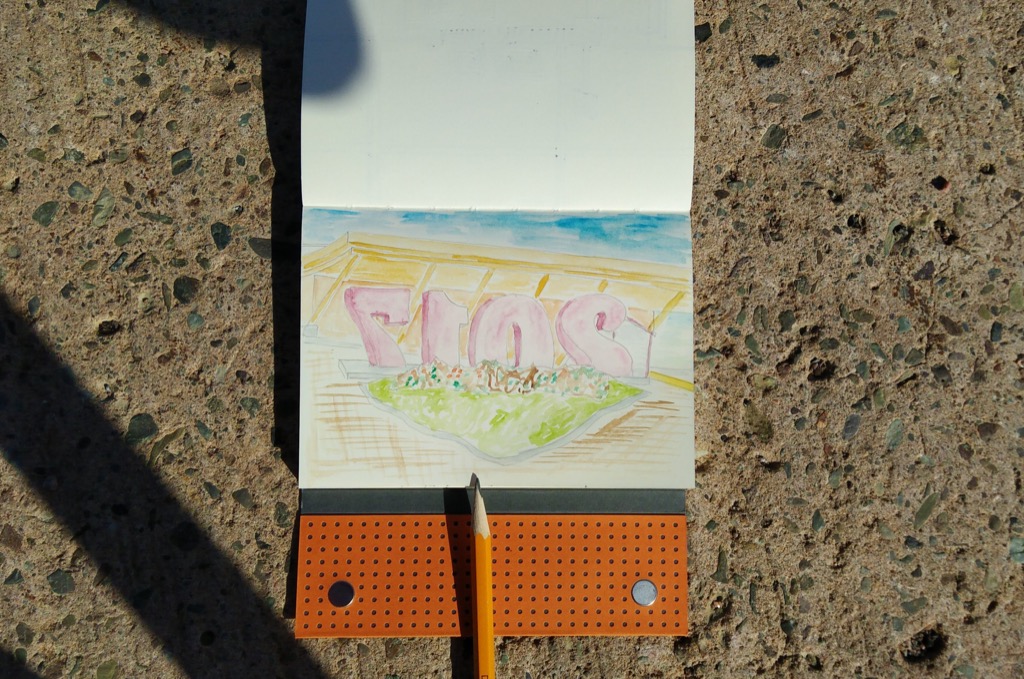
It was a bright sunshiny day today, and so, after lunch, instead of walking back up Queen Street to the Reinventorium, I walked down Queen Street to the Coast Guard wharf. Where I found a gaggle of cruise ship tourists taking selfies in front of the 2017 sculpture.

I set myself down behind them all, on an Adirondack chair chained to the wharf and facing the harbour, a chair I turned around to face the 2017 and the Milton Acorn Convention Centre, and sketched the 2017 from behind.

The sun and the sea and the wind conspired to do something interesting to the paper and paint, so the result was something significantly more traditionally watercoloury than I’ve been able to achieve previously.

2017 from behind

🗓️
2017  •  Charlottetown  •  Sketch

About This Blog

Photo of Peter RukavinaI am . I am a writer, letterpress printer, and a curious person.

To learn more about me, read my /now, look at my bio, listen to audio I’ve posted, read presentations and speeches I’ve written, see things I’ve favourited elsewhere, or get in touch (peter@rukavina.net is the quickest way).

I have been writing here since May 1999: you can explore the 25+ years of blog posts in the archive.

You can subscribe to an RSS feed of posts, an RSS feed of comments, an RSS feed of favourites elsewhere, or a podcast RSS feed that just contains audio posts. You can also receive a daily digests of posts by email. I also publish an OPML blogroll.

Instagram • YouTube • Vimeo • ORCID • OpenStreetMap • Internet Archive • PEI.art • Drupal • Github.