
About a year ago, when Amazon unleashed the ability for third-party developers to create skills for its Echo speaker devices, the first one I created was a skill that allowed you to ask questions about Prince Edward Island’s electricity load and generation.
But I never took the skill to certification (the review process by which Amazon certifies a skill and makes it available to everyone), and so while I continued to use it myself in “developer mode” on our Echo, nobody else could.
I decided to follow through on the last few bits of the skill development a couple of weeks ago, so that others could benefit. And at the end of last week I received a notification that the skill is now live for all Echo users in the U.S. and Canada.
This means that, if you own an Amazon Echo device, you can now ask it things like this:
- Alexa, ask PEI Power for a summary
- Alexa, ask PEI Power about the wind
- Alexa, ask PEI Power for the load
- Alexa, ask PEI Power for the peak load in 2014
- Alexa, ask PEI Power for the peak load in December 2017
- Alexa, ask PEI Power for the peak load yesterday.
Behind the scenes, this skill looks like this:
{
  "languageModel": {
    "intents": [
      {
        "name": "AMAZON.CancelIntent",
        "samples": []
      },
      {
        "name": "AMAZON.HelpIntent",
        "samples": []
      },
      {
        "name": "AMAZON.StopIntent",
        "samples": []
      },
      {
        "name": "GetLoad",
        "samples": [
          "the load"
        ],
        "slots": []
      },
      {
        "name": "GetPeak",
        "samples": [
          "the peak on {Date}",
          "peak on {Date}",
          "peak {Date}",
          "peak load on {Date}",
          "the peak load on {Date}",
          "highest load on {Date}",
          "maximum load on {Date}",
          "the maximum load on {Date}",
          "high load on {Date}",
          "the high load on {Date}",
          "the highest load on {Date}",
          "the peak load {Date}"
        ],
        "slots": [
          {
            "name": "Date",
            "type": "AMAZON.DATE"
          }
        ]
      },
      {
        "name": "GetSummary",
        "samples": [
          "a summary",
          "the report",
          "a report",
          "an update"
        ],
        "slots": []
      },
      {
        "name": "GetWind",
        "samples": [
          "the wind"
        ],
        "slots": []
      }
    ],
    "invocationName": "p. e. i. power"
  }
}
That’s a JSON representation of the skill on the Amazon end; when an Echo device sends a query, Amazon tries to figure out which “utterance” (like “an update” or “a report” or “the wind”) the user is looking for, sends a request to a PHP script on my server that queries the same load and generation data I scrape from the Province of PEI website for other purposes, and my server then returns a script for the Echo to read back to the user.
It’s fundamentally a pretty simple ecosystem to develop skills for; there are some fiddly bits on the initial setup my skill got kicked back to me several times for seemingly minor inconsistencies like “you called the skill p. e. i. power but your sample utterance used the phrase p.e.i. power,” but I managed to resolve those quickly.
If you have an Echo, please take this skill for a ride and let me know what you think.
It was 13°C today in Charlottetown, and that made for a foggy morning over the ice-filled harbour.
The last time I was on the grounds of an abandoned tuberculosis sanatorium was in 2011 when Catherine, Oliver and I found ourselves in the woods outside Berlin with a ragtag group of artists and DJs on a sunny Sunday afternoon.
But I’m getting ahead of myself.
I’ve been feeling a little lost of late, lost in a fog of care-giving in two directions, worried about what happens next for our small family, more quick to anger than I would like, and generally unable to place myself on a solid mental footing inside the constellation of my lot.
A few months ago I remembered seeing something in the media about mental health walk-in clinics, and I kept the idea of walking into one in my back pocket in the weeks since. I wasn’t entirely sure whether I was the target market for these clinics, but it seemed that I might be, for their description positions them squarely in the “if you’re having some challenges” territory.
I finally decided that today was the day.
Not because of a particular crisis or confluence of events (although the death of a friend from metastatic breast cancer has weighed heavily on me this week), but mostly because I rationed that, if you find yourself Googling “PEI mental health walk-in clinic hours” more than once a week, you should probably go to the mental health walk-in clinic.
As with all previous self-directed mental health interventions I’ve undertaken, I had to confront a lot of monkeys on my back to get me from my lunchtime perch near the waterfront up to the McGill Centre: Was I really allowed to go? What if it’s full? What if the counselor is someone I know? What if I fall apart? What if I don’t fall apart? Why don’t I wait until next week! Surely there are others who need this service more than me! My, there are an awful lot of puddles near the road. Yah, right, maybe next week.
Fear and inertia are powerful, and I finally realized that if the only reasons for not going were fear and inertia, I owed myself the favour of ignoring them and pressing on.
And so I headed off to the northern regions of Brighton, through a neighbourhood both familiar and unfamiliar, toward the Mona Wilson Building at the corner of North River and McGill, located on the grounds of what, at one time, was Charlottetown’s tuberculosis sanatorium.
The walk-in clinic today was from 1:00 p.m. to 5:00 p.m. I re-confirmed several times that the description could embrace my circumstances:
…offer immediate mental health support to help with anxiety, as well as life events causing stress and other mental health issues.
That seemed close enough.
I walked in the door, found my way to the reception desk, and was given a short form to fill out, a form that asked for my Health Card number, my name and address, and a brief description of why I was there.
I wrote “need to check in with someone on the state of my general mental health.”
There were a few people in front of me, so I bided my time in the waiting room for about 40 minutes, at which point a chap named Ian came to fetch me. He guided me up to the second floor, and into a room with a couch and chair.
And for the next hour, we had a chat.
What I ended up doing was the psychological equivalent of what’s called, in my trade, a core dump:
In computing, a core dump… consists of the recorded state of the working memory of a computer program at a specific time, generally when the program has crashed or otherwise terminated abnormally.
And that’s pretty well what I did: I described my circumstances, my challenges, what was going well and what wasn’t. What I dread and what I welcome. What I’ve done, and what I haven’t.
Ian chimed in with helpful insights from time to time, and his presence was vital to the exercise. But it was mostly about me structuring my consciousness in a protected space with a helpful interlocutor.
An hour later, I was still the same me, but the process of working through some things was undeniably helpful, and I left with a few references to other resources, a few new terms (“psycho-oncology,” “fullness of person”) and generally feeling like I’d done the right thing by going.
Late in 2017, the CBC ran a series on the radio about youth mental health on PEI and on one of the stories they posted to the web they chose a photo of a young person sitting, head-in-hands, alone, in front of a bank of lockers in a school. I took umbrage at that photo, for it telegraphed that mental health challenges are something self-evident and obvious, that unless you look sad and are hanging your head low, you must be doing okay.
I wasn’t in crisis today. Indeed it was, for most intents and purposes, a regular old day and I was my regular old self; I’d hazard a guess that, to look at me on my way to work you wouldn’t say “there’s a guy who could use a mental health walk-in clinic today.”
But I was. And it helped. And I’m thankful that it was there.
Walk-in mental health clinics are run every week in locations across PEI. They are free and confidential, and you don’t need an appointment.
For almost a decade, I’ve been engaging in various experiments related to monitoring and visualizing energy load and generation on Prince Edward Island.
And because of the scattershot, following-the-shiny-tin-foil nature of the way I’ve been working, various experiments have ended up on various servers with various URLs. It’s gotten confusing.
So today I created a page that, while not entirely bringing order to this universe, at least gathers links together.
Visit http://energy.reinvented.net/ and you’ll find links to everything I’ve got.
(I also used the opportunity to play with CSS Grid Layout for the first time).
Member of the Legislative Assembly for Morell-Mermaid, Sidney MacEwen, went where no member of the public had gone before: a meeting of the Health PEI board (CBC, The Guardian).
And he provided a compelling blow-by-blow account of the experience on Island Morning this morning.
I applaud Sidney’s efforts: he’s doing what opposition MLAs are supposed to do, shining light into some of the darker less-noticed corners of government (in this case, a corner with a $640 million budget).
Sidney’s efforts point to a larger issue: a growing schism between two views of the relationship between government and the citizenry.
The first is the “leave things to us” model, the predominant model of the MacLauchlan government and governments before it. In this model there is a professional public service, and a very clearly defined (and generally very limited) set of portals through which citizens can see and offer feedback on the policy-making process.
The second is the “we’re doing this together” model, and it’s a model informed strongly by the ongoing digital transformation. Under this model, government and the citizenry are involved in a joint, constant, ongoing, multi-faceted policy-making partnership that dramatically increases the surfaces over which the public service and the public collaborate. This model is messy, we’re not quite sure how it works yet, and it’s likely that many of the cherished institutions and approaches to governance will break when exposed to it.
On the floor of the Legislative Assembly, the Premier sits beyond the rail, where he is served chilled orange juice by pages, and citizens sit thirsty in the gallery, remaining silent.
On the Internet there’s no rail, and the Premier’s just like us.
How we rationalize that dichotomy is the project that Sidney MacEwen is ultimately engaged in.
It will be fascinating to see how we work this out.
I wrote in December about how PEI had reached a new peak electricity load on December 27, 2017; since that time the temperature has remained low, Islanders have continued to use a lot of electricity to heat, and so electricity usage has remained high. The peak on Saturday, January 6, 2018 was 279.71 MW, which was just shy of the December 27, 2017 record.
I pulled the peak load for each day in January from 2013 to 2018 and created a chart to allow for a visual comparison:
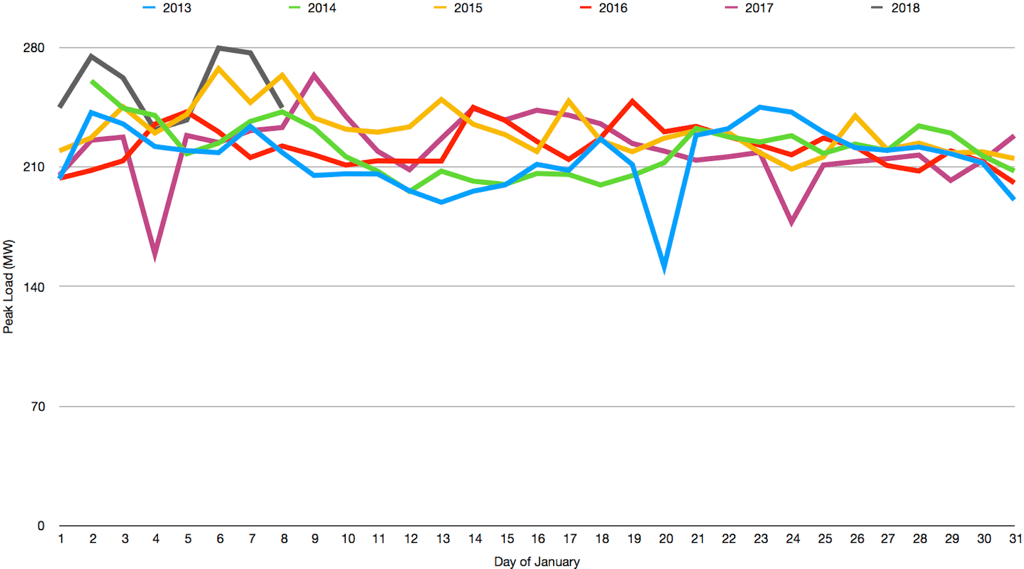
We’ve had 5 days in January 2018 so far that have seen the highest daily peak for that day of the year ever.
Here’s the raw data for the chart as a CSV if you want to create your own visualizations.
Oliver and I took our last run up to Sears tonight; it closes on Monday forever, so we didn’t quite make it to the end, but we were close enough. And given that we were pictured in The Guardian on opening day, we can truly say we were around for the entire 13 year run.
Sears in Charlottetown always seemed like an implausible proposition, and I can’t recall ever visiting the store when it seemed remotely busy. But we bought a lot of sheets and pillows and towels there over the years, a couple of appliances, three mattresses, several suitcases and a smattering of clothes.
For things like sheets and towels, I’ve no idea where else on Prince Edward Island one might buy such things now that Eatons and Sears are both gone. The Internet, I suppose?
The final weeks at Sears were a fascinating look at what’s left over when everyone’s bought everything: from the look of things tonight, it’s small men’s shirts, sheets for twin beds, Lagostina frying pans, and curiously compelling stationery.
It was the stationery that was my last purchase: we waited in line for 20 minutes for the privilege of buying half a dozen gold ink pens, a collection of beautiful, simple, colorful greeting cards and a pencil case.
Goodbye Sears: I never really loved you, but I’ve a feeling you will be missed.
I’ve long been a happy customer of La Sazón de Mexico at the Charlottetown Farmer’s Market.
So I was quite happy to learn that they’re making the jump from Saturdays-only to a full-fledged restaurant, a restaurant that’s conveniently located right beside the Reinventorium in the space recently vacated by Burrito Jax.
Our household came into an Instant Pot over the holidays.
In case you’ve missed the Canadian phenomenon that’s taking the world by storm, the Instant Pot is a new-fangled pressure cooker that, by virtue of its precise electronic heating and timing controls, can also sauté, act as a crock pot, cook rice, proof bread dough and make yogurt. It’s also an attempt to, in one fell swoop, get my generation over the “remember the time the pressure cooker exploded over at Reg and Joyce’s and blew a hole in the kitchen ceiling” stories that have heretofore kept us all a safe distance from any cooking implement with “pressure” in the name.
I’ve jumped in with both feet, and Catherine is following quickly after me: so far I’ve made apple sauce, aloo gobi, rice, and pressure-cooked pounds of chick peas.
And I’ve made yogurt. Twice.
We go through a lot of yogurt in our family, a couple of grocery store tubs a week on average, and yet the fermentational mysteries thereof are something I’d never given a second thought to. Until last week.
The Instant Pot’s success is often credited to social media–‘Cult-like worshippers’ turn Canadian-invented Instant Pot into a phenomenon, reported the CBC in November–and certainly you’ll find a plethora of recipes and advice online. The unseemly downside to all of this, however, is that the “sign up for my useful email newsletter of Instant Pot tips and advice” crowd has taken over much of the space, and so recipes, rather than being concise and easy to follow, become SEO-optimized thickets of keywords, with the recipe itself tacked awkwardly at the bottom.
It doesn’t have to be this way.
And so I present to you a simple postcard-sized “How to Make Instant Pot Yogurt” guide in comic form:
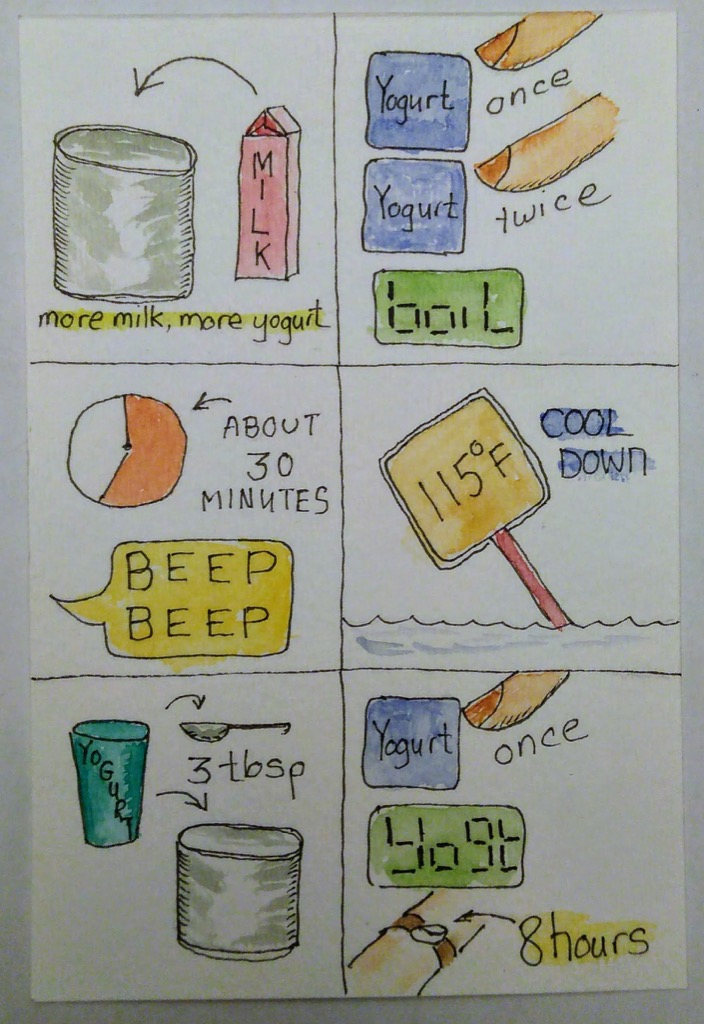
That really is all there is to it:
- Add some milk to the pot. Put the cover on.
- Press Yogurt twice; the display turns to boil.
- Wait a while, until you hear beeps. Remove the cover.
- Wait for the milk to cool to 115ºF.
- Add a few teaspoons of yogurt to start things rolling.
- Cover, and press Yogurt once; the display turns to Yogt,
- Wait 8 hours.
At the end of the process, you’ll have yogurt. Behold the awesome power of bacterial cultures!
In my experience a litre of milk yields a large mason jar of yogurt, which is enough to keep us going for 4 or 5 days. The only challenge to the recipe is that you need to start things rolling when there’s still 9 or 10 hours left in your waking day, so it’s best done as a morning activity with a suppertime finish.
Go forth and ferment!

I first met Dana Doyle almost 10 years ago at a Prince Street Home & School meeting; she was one of a new wave of parents breathing new life into the group, and she emerged as someone always ready to volunteer to pop the popcorn, or make the hotdogs, or to find sponsors for our silent auction at the yearly Spring Fling.
I remember one time, when Oliver was in grade 6, when Dana wasn’t available to pop the popcorn in advance of movie night, and so I stepped into the breach.
A few days before, she gave me a lesson in running the popcorn machine, how much popcorn to make, and how much time to set aside for the popping. She suggested that I come into the school mid-afternoon to get a jump on the popping, as it took a long time, advice that I quickly ignored; there’s no way it could take that long, I said to myself. Which is how I found myself popping furiously to fill my quota as the clock ticked ever-nearer to movie start time and I realized that Dana had been right.
This escapade gave me one small window into the number of hours that Dana poured into supporting the school community, hours mostly unseen by others.
Over the intervening years I came to know Dana as a friend and neighbour–she lived right on my route to and from Birchwood Intermediate School and I would often run into her on my way back from walking Oliver to school–and as a school crossing guard on Walthen Drive, a job she took seriously but with the kind of good humour and rapport with kids that made her daily charges grow very fond of her.
When Dana was nominated by the Home & School at Prince Street for the School Crossing Guard of the Year award last year, and my fellow directors selected her from the many nominations to receive the award (being a friend, I recused myself), I was overjoyed, as there was nobody that deserved the award more. It was an extra special joy to be asked to present it to her last June; it was a complete surprise to her, and I will never forget the look on her face as she walked into the Prince Street School gym to be greeted by the entire school community.
Dana continued to be involved with Home & School as her son Seth moved from Prince Street to Birchwood and on to Colonel Gray this year for high school; I was happy to see her at the first Colonel Gray Home & School meeting of the year last fall, and I looked forward to the chance to work with her again, now that our boys were both in high school.
Dana died unexpectedly last week, and her funeral was today; the large attendance from family, friends, neighbours, coworkers, and members of three school communities was a testament to the rich life Dana lived and the many connections she made.
She will be missed.
About This Blog
 I am Peter Rukavina and this is my blog. I am a writer, letterpress printer, and a curious person.
To learn more about me, read my /now, look at my bio, listen to audio I’ve posted, read presentations and speeches I’ve written, or get in touch (peter@rukavina.net is the quickest way).
I have been writing here since May 1999: you can explore the 25+ years of blog posts in the archive.
You can subscribe to an RSS feed of posts, an RSS feed of comments, or a podcast RSS feed that just contains audio posts. You can also receive a daily digests of posts by email.