For many years Donna Glass and her capable team have been running a kayak and paddleboard rental operation out of the riverside park in Morell; construction of a new bridge in Morell, with the resulting noise and chaos, has pushed them up the shore one watershed to a new base in Midgell.

Which turns out to be not such a bad thing: the Midgell River turns out to be just as nice a river to paddle on, and is perhaps even better for the new paddler, as it’s a little gentler and more compact (Kingfisher will still shuttle you up to the headwaters of the Morell River for their longstanding bridge-to-bridge paddle, which is a trip I recommend everyone do at least once).

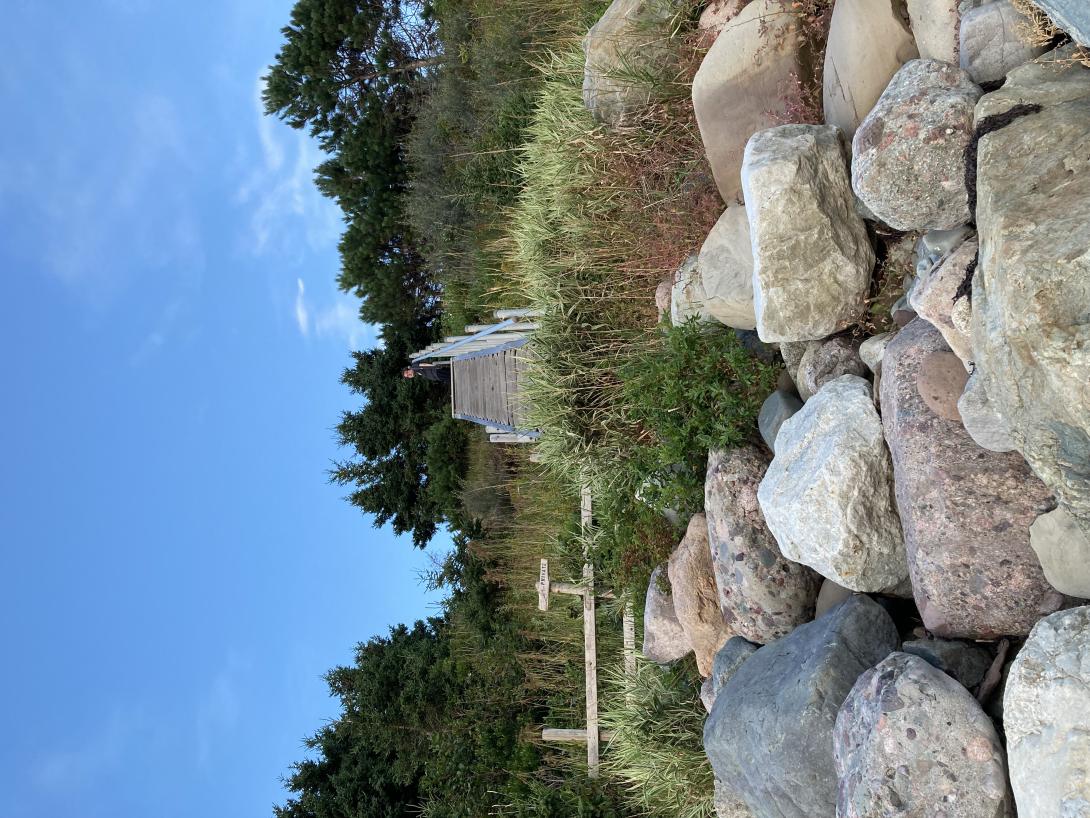
Kingfisher Outdoors base in Midgell.

From Kingfisher’s base at the bridge over the river, you can paddle upriver, which quickly takes you from the noise of the highway around the bend into pleasant silence, or you can paddle downriver, under the Confederation Trail bridge and into St. Peters Bay, where you’ll find what we are told is a pleasant beach.

Olivia and I went out to Midgell yesterday afternoon–a warm, sunny, windless day–for the Pride Paddle, an event Kingfisher holds annually, with all proceeds going to Pride PEI and Peers Alliance. We’d booked a double kayak, and as we pulled into the parking lot it arrived back from its previous trip, so we were right on time.

Olivia in the front of a double kayak, looking up the Midgell River.

We were paddling at low tide, so ran aground heading downriver; we levered ourselves out and went upriver instead. Unlike previous trips, where Olivia was more passenger than paddler, she figured out the mechanics of paddling and did as much of the work moving us forward as I did.

Midgell Bridge from the water.

We were out on the water for about 90 minutes. It was a gentle, relaxing way to spend time on the water; it’s something that anyone can do, and especially if you’ve never explored the Island’s river systems from a kayak, I highly recommend you take advantage of the opportunity, especially this year when we’re all sticking closer to home.

🗓️

From Be interested, be curious, hear what’s not said: how I learned to really listen to people by Annalisa Barbieri in The Guardian:

Listening, I discovered, wasn’t just about waiting for the other person to stop talking, or asking good questions, or even not interrupting. It was about really hearing what the other person was saying, and why they were saying it. Being interested, but also curious. Sometimes that means looking for what’s not said, what’s left out, which words are used to mask emotions that are hard to acknowledge. Likewise, good listening is about approaching what has been said as if you’ve never heard it before. Put simply, it’s about paying attention.

🗓️
Listening  •  Curiosity  •  The Guardian

For the first time in more than a year our monthly Pen Night met face to face. To allow us to socially distance, and to try out a hybrid format with far-aways coming in on Zoom, we gathered in the carriage house at Beaconsfield.

The hybrid experiment failed: the latency introduced by the wireless connection to the projector meant Zoom’s echo cancellation broke down completely. We’ll try again next time with a hard-wired connection to see if that improves things.

But the face to face was a rousing success, with a dozen of us gathering to immerse ourselves in fountain pen nerdiness.

Highlights included special guest star Art, a summer resident, who brought some lovely heavy pens with intriguing nibs, an Aurora 88 passed around by Stephen, a bookbinding gift from Chantal, and a good assortment of notebooks and letters circulated for inspection. There were also some very good refreshments: Tolkien-inspired cookies and rhubarb-strawberry crumble squares.

Being back in the room with my pen friends reminded me how important the monthly pen respite was during the summer of 2019 while Catherine was sick: just being able to get away for a few hours and not think about matters of life, cancer, and death was enormously helpful for my mental health.

We’ll meet again in August.

🗓️
🗓️
Olivia  •  Pride

I love this interview of Alicia Kennedy by Sarah Miller, which starts as a discussion about a pair of silver platform clogs, and migrates into an exploration of hyper-performant femininity and how “an interesting pair of shoes can throw the straight male mind into helpless orbit.”

🗓️

From the introduction to Finn V. Gratton’s Supporting Transgender Autistic Youth and Adults:

Finally, language related to “functioning levels” (e.g., “high-functioning” and “low-functioning”) will not be used, unless it is part of a quote or a study. The term “autism spectrum” will not be used because it generally refers to a one-dimensional line that extends from point A (those people perceived as furthest from allistic functioning) to point B (those perceived as most like allistic people). This verbal and mental construction posits a one-dimensional view of human experience and expression that places allistic experience and behavior as superior to autistic experience and behavior. Where differences in functioning matter, for example in the case of autistic individuals with low speech abilities trying to access services, I will note the distinguishing characteristics that affect the autistic person’s life.

🗓️

I hitched up my canoe to my bicycle using the Wicycle Trailer this afternoon to see how it handled on the road.

The canoe-bicycle connection is via a device Wicycle calls the “smart stick” and it turns out to be pretty smart: it mounts to the seat post of the bike and then ties up to the bow line of the canoe in a way that both keeps the canoe from flopping around and allows it to turn freely.

Out on the road, the weight of the canoe felt about the same as pulling a fully loaded trailer of groceries, albeit with more horizontal sway. It seems like a reasonable thing to expect to be able to cycle out to Andrews Pond for a first paddle. And home again.

I already have visions of getting a Brompton folding bicycle that I could carry in the canoe itself, allowing me full intermodality.

, , , ,
🗓️
Canoe  •  Bicycle  •  Wicycle

My Essex Country friends Laurie Brett and Art Rhyno came for a visit today, the first outlanders I’d laid eyes on months: they were en route from Ontario to Nova Scotia to see family, and, being lovers of Prince Edward Island, arranged their route to take them over here for a night.

As longtime readers will know, I’ve known Art since forever: we met in 1994 in St. John’s at the Access conference, and our paths have overlapped many times since.

Laurie is a former newspaper publisher, having run her family’s Essex Free Press for many years. And it was bearing a galley of type from the Free Press that Laurie arrived in Charlottetown, on a mission to see it given life in print via my Golding Jobber № 8.

Essex Free Press metal type

The galley had been passed down through the family publishers of the paper, and was originally set on a Linotype machine; despite having seen such machines in operation many times, this was my first time getting to handle their real work product: so much less fiddling than dealing with hand-set type!

Here’s the result:

A print of the Essex Free Press type

One of the fringe benefits of reanimating the story on paper is that it can now be OCRed, thus:

History of the Free Press

The first paper published in Essex Centre, was the Chronicle, first issue of four pages in May 1879, publisher, Robert Fair. In the fall of 1879 Mr. Fair sold out to John Milne, who continued to run it for several years, R. A. Hughes, S. E. Copus and John Curran, being at various times editors. On June 1th, 1880, the paper was changed to an eight page five column paper. Mr. Curran bought out Mr. Milne in July 1882 and continued as owner and editor until 1884 when he sold out to A. E. Lovelace. Meanwhile another paper “The Advance” was started in 1882, by John Stafford, and was carried on by him until 1885. At the beginning of 1885, George Laing and John Stafford bought the Chronicle from Mr. Lovelace and amalgamated the two papers, changing the name to “The Argus.” The paper was run under this name until December 1885 when it was purchased by a joint stock company, of which Dr. James Brien was chief stockholder. The name was then changed to the Liberal, the first manager being I. H. Brock, who was succeeded by J. G. Hands and finally the management passed, in August 1886, to J. M. Kennedy, from whom it was purchased in 1888, by J. E. Johnson, of Leamington, who sold it a year or so later to Henry and Frank Walters. The Walters ‘brothers, both of whom in later years, became well known lawyers in Detroit, carried on until 1892 and changed the name of the paper to the “Free Press”. They sold to Ed J. Lovelace, who, on June 1st, 1896, sold out to W. H. Auld and R. R. Brett. Mr. Auld passed away in January 1932 and Mr. Brett in October 1937, when the present proprietor took over. 

I’m so happy to have been able to do this. 

🗓️

Eavesdrop on musicians deconstructing music on the new Professional Musicians React show.

🗓️

From Lisa M. Shulman’s Before and After Loss:

The process of emotional healing and brain healing is enhanced by a balance of activities and experiences, some distracting and some challenging, some physical and some emotional, some social and some private.

Maybe this explains my move into sportiness.

🗓️

About This Blog

Photo of Peter RukavinaI am . I am a writer, letterpress printer, and a curious person.

To learn more about me, read my /now, look at my bio, listen to audio I’ve posted, read presentations and speeches I’ve written, see things I’ve favourited elsewhere, or get in touch (peter@rukavina.net is the quickest way).

I have been writing here since May 1999: you can explore the 25+ years of blog posts in the archive.

You can subscribe to an RSS feed of posts, an RSS feed of comments, an RSS feed of favourites elsewhere, or a podcast RSS feed that just contains audio posts. You can also receive a daily digests of posts by email. I also publish an OPML blogroll.

InstagramYouTubeVimeoORCIDOpenStreetMapInternet ArchivePEI.artDrupalGithub.