
In preparation for next month’s Wearable OPAC workshop, I’ve begun to lay some of the technical groundwork.
Last week I ordered up a Nokia N95-4 8GB, the latest incarnation of Nokia’s flagship device. It’s good for my purposes because it has wifi, has enough memory to run PAMP (PHP, Apache and MySQL), and it’s tiny and “wearable.” Oh, and you can also use it to call anyone, anywhere in the world, stream live video to the Internet, and locate yourself when lost in the Arctic with its built-in GPS (these features will be less vital for OPAC-creation purposes).
Today I got PAMP up and running: it’s actually rather easy to do, as there’s a canned install that’s pre-signed. You just have to click “OK” about a thousand times while it installs the various packages.
Lacking a good library-specific dataset for experimenting, I decided to use PEI Civic Address Data to take things for a ride. I initially ran into a problem with creating indexes, but found a workaround, and after waiting for about 30 minutes for the ASCII file to import, via Navicat, into the MySQL server running on my phone, I had a table containing 67,261 civic addresses ready to go.
Performance isn’t all that bad: with indexes on the street number, street name and community name I can find any civic address on PEI in less than a second. How much harder can cataloging data be?
I ran into a few hiccups along the way:
- The Bluetooth File Exchange on my MacBook, which is what I was using to move files back and forth to the N95, would time out from time to time, and then would refuse to re-establish a new connection until I rebooted the phone. That’s somewhat inconvenient.
- To work around that problem, I set up WebDAV in the Apache on the phone so that I could mount it as a remote drive from my MacBook. This mostly worked. And then it stopped working entirely. I have yet to figure out why.
- I have yet to completely figure out Devicescape, the third-party wifi manager I’m running to, in theory, make wifi management seamless. Sometimes it connects me to a wifi network on a separate LAN segment here in the office, which makes things really difficult. I can’t figure out how to make it stop doing this, other than disconnecting and hoping it connects to my local LAN the next time.
- A couple of times I got a “Got error 124 from storage engine” error message from the MySQL server on the phone. Not sure why.
That all said, I was able to whip up a small PHP application to run on the phone that accepts a civic address number, street name and/or community name and returns matching addresses. This is Good Sign for things to come.
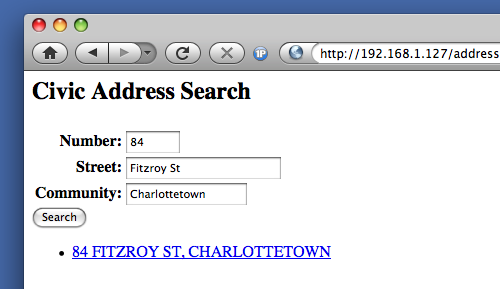
I’d like to smooth out the bumps in the development toolchain before the workshop so that we don’t have to keep rebooting the phone (nothing like waiting for a phone to reboot to dampen a scintillating workshop).
If you’ve ever had anything go wrong with an Air Canada journey — cancelled flight, weather delay, missed connection, lost luggage — then you know well the torture of endless lines at the counter, often followed by a “oh, we can’t help you here — you have to call the 1-800 number” or a “you need to go downstairs.”
The airline always appears to be operating on the edge, keeping just enough staff around for normal operations and getting completely flummoxed when things go off the rails.
So what’s their answer to a winter season’s worth of customer frustration?
Pay them $25 — in advance, on the chance that something will go wrong — and their new On My Way service will give you access to a “travel assistance service that will help get you on your way quickly, no matter what setback you encounter.”
This is almost comical enough to be joke.
I can only imagine that their next up-sell is going to be something like “Crash No More” …
Air Canada understands how terrifying it can be to hurtle through the air and 500 miles: the fear of unpleasant death is ever-present. That’s why we’re introducing Crash No More, a new flight crew upgrade service that will have you flying in peace.
Crash No More is now available at a low price when you book your next flight on Air Canada: for only $25 per flight segment, we’ll replace your regular pilot and first officer with seasoned veterans, many with actual combat flying experience. These are pilots who know the skies well, and are trained for any circumstance, thus helping you avoid the inconvenience of unplanned crashes or midair events.
I’ve got no problem with splitting off checked baggage, lounge access, meals and advance seat selection into optional services, but charging for what is an essential part of just being an airline is unconscionable.

The CBC is reporting [s]earch warrants for child porn too slow, say RCMP:
Const. Blair Ross, who works on child pornography cases on P.E.I., told CBC News Tuesday RCMP are short-staffed already, and getting a search warrant can take days or even weeks.
“As it stands here now in Atlantic Canada, the internet providers will not provide that unless we obtain judicial authorization, in other words, a warrant,” said Ross.
“So before we even begin to investigate we have that hurdle to jump over, which is time consuming.”
The RCMP should be ashamed of this stance: while privacy can never be absolute, it should be really hard to compromise our privacy. That’s why we have judges to mediate the process.
For the record, Eastlink has a Legal Information page with a link to their privacy policy, where they say, in part:
While our general policy is not to provide personal information to any party outside of EastLink without your consent, there are certain limited circumstances in which it is necessary to do so. When we provide personal information to third parties, we provide only that information that is required in the circumstances. In turn, information provided to third parties is used only for the purposes stipulated and is subject to strict terms of confidentiality.
They then go on to list those bodies that might qualify, and this includes “law enforcement agencies,” “investigative bodies and legal counsel,” and “emergency services.”
While kudos should go to Eastlink to resisting the RCMP’s request for warrantless access to private information, it’s foreboding to read their representative quoted as suggesting that they’re not 100% committed to this:
“We’re not necessarily opposed to seeing things move in that direction,” said Sibley.
“However, with the existing legislation that’s in place, and also privacy legislation that we have to operate under, we’ve chosen to continue to ask for a warrant.”
We’ve been experiencing flaky network access here at Reinvented HQ for the past few days, and today it seems worse than ever. As a result you might find access to the sites hosted here are slower than usual to load.
My little PresenceRouter Mac OS X application, designed to allow you to route your Plazes geopresence to web services like Twitter, Facebook and Fire Eagle, now allows you to route your Plazes geopresence to, well, Plazes.
If this seems like it has the potential to create infinite loops of presence routing you are right. But there is method to my madness: yesterday saw the unveiling of Plazes.net, a new developer-focused branch of Plazes that’s completely concentrated on developing the “geopresence engine” aspect of Plazes.
In other words, if you’re a regular everyday person looking to manage your geopresence, Plazes.com is still your destination. But if you’re a developer looking to bake geopresence support into your application, then you’ll find a new home at Plazes.net.
For the time being, the two branches of Plazes are separate: while you can import your historical Plazes.com geopresence stream into Plazes.net, presences you create in one will not exist in the other; there are two separate data streams.
So that’s why I’ve added “Plazes support” to PresenceRouter: you can now do any of the following:
- Use Plazes.net as you PresenceRouter data source, routing your Plazes.net presence information instead of your Plazes.com presence information.
- Route your Plazes.com presence to Plazes.net, allowing you to continue to use Plazes.com as your “mothership,” but echoing your presence stream to Plazes.net.
- Conversely, route your Plazes.net presence to Plazes.com.
So whereas before Plazes was only a source for PresenceRouter geopresence, it can now be a destination as well. Indeed you can even route your Plazes.com presence back to Plazes.com, to another account, if you can figure out a reason why that would be useful.
Grab PresenceRouter v2.7 if you want to try this out for yourself.
Remember the proposed 7-story office building for Fitzroy Street? Well the original design was rejected by Planning Board and the developer came back with an updated design that took it to 8 stories, but added a setback on the Queen Street side. Last week Planning Board rejected this design too.
So on the train trip up to Napanee for March school break Oliver and Catherine ended up overnight in a train car filled with sophisticated Ontario kids returning from their school break. And they all had handheld video games, which captivated Oliver. They didn’t actually share, but that seems to have only heightened his curiousity.
Upon their return home I conducted a full debriefing with Oliver, and, aided by Google Image Search, we were able to determine that the handhelds in use on the train were of the Ninetendo DS variety.
Now given that Oliver already has unfettered access to 100 Prince Street iMac, and his own $100 laptop, it seems a bit absurd to be debating the ethics of bringing a Nintendo into the house — the bridge over the Rubicon away from a peaceful electronics-free childhood was crossed long ago.
But we wrung our hands nonetheless. And ended reasoning that the “being a regular kid” upsides of the pro-Nintendo argument outweighed the “buying into a lifetime of brand-focused consumer entertainment” downsides (I realize that the same arguments can be made in favour of teen smoking).
And so on Saturday we got in our car, went out to Future Shop, and plonked down our (my) $139 for a brand new Cobalt Blue DS Lite. And with $20 off the first cartridge included in the price, we spent an agonizing 20 minutes poring over the selection before picking out Dora Saves the Mermaids (Dora at least has the “he’s learning Spanish!” sop for we theoretically brand-averse parents).
Reasoning that we might as well dive in completely, we stopped in at microplay on the way home and rented a couple of additional games so that we could get a better lay of the land.
And so, after 7 years of parenting, I was forced to confront the Entertainment Software Rating Board, the body that video game publishers outsource their “content ratings” to.
On the surface I should appreciate the help: one of Catherine’s provisos when agreeing to open our home to the Nintendo was a blanket “no war” policy on incoming video games, and sometimes it’s hard to tell from the game title or box alone.
The ESRB tells us, for example,that the DS title The Chronicles of Narnia: The Lion, the Witch and the Wardrobe, contains “Fantasy Violence,” which they describe as “Violent actions of a fantasy nature, involving human or non-human characters in situations easily distinguishable from real life.” Hmmmm. Does that mean Mr. Tumnus gets his still-beating heart ripped out by Maugrim, or that cartoon Aslan goes down to the White Witch on an animated Stone Table?
While I don’t necessarily begrudge the information the ESRB provides, as you scratch beneath the surface of their self-described “concise and impartial information,” you quickly realize that their rating system and “content descriptors” reflect a particular world-view and set of “inappropriate” behaviours.
So we can find out whether a given game has “Use of Drugs,” “Use of Alcohol,” “Use of Tobacco,” or even “Comic Mischief,” but there are no descriptors for “Strong Religious Themes” or “Imperialist World View” or “Extreme Anthropomorphism.”
Browsing through the Nintendo DS titles, it was hard to find any that weren’t Rated E for Everyone — it is, after all, a device that tilts at a younger demographic — and so ultimately the ESRB was of little help in finding out which games were any good.
So we guessed, ending up with MySims (Rated E, with the “Simulated Gambling” descriptor) and the video game version of Over the Hedge (“Mild Cartoon Violence”).
So far, even though it involves the most reading, and is somewhat hard to figure out, MySims has been getting the most gameplay. Dora and her Mermaids, which is simple to figure out, and requires no reading, is getting almost no play at all. And Over the Hedge seems to have a 3D environment that Oliver, at least so far, finds a little dizzying.
I’ve a feeling this is only going to get more challenging from here…
Another interesting statistic from the 2006 Canadian Census is Mode of transportation to work.
In Charlottetown 16% of workers walk or cycle to work; this is twice the rate of Vancouver and Toronto. The only capital cities of with a higher rate are Yellowknife (24%) and Iqaluit (32%).
| City | Workforce | Walk/Cycle | Percentage |
|---|---|---|---|
| Iqaluit | 3135 | 1010 | 32.22% |
| Yellowknife | 11040 | 2685 | 24.32% |
| Charlottetown | 14875 | 2380 | 16.00% |
| Whitehorse | 12600 | 1405 | 11.15% |
| Halifax | 186420 | 20670 | 11.09% |
| Quebec | 262120 | 26440 | 10.09% |
| Fredericton | 42770 | 3970 | 9.28% |
| Toronto | 1148935 | 101350 | 8.82% |
| Vancouver | 1003025 | 80000 | 7.98% |
| Winnipeg | 346790 | 25870 | 7.46% |
| Regina | 100695 | 7245 | 7.19% |
| St. John’s | 83580 | 5715 | 6.84% |
| Edmonton | 546070 | 34050 | 6.24% |
About This Blog
 I am Peter Rukavina and this is my blog. I am a writer, letterpress printer, and a curious person.
To learn more about me, read my /now, look at my bio, listen to audio I’ve posted, read presentations and speeches I’ve written, or get in touch (peter@rukavina.net is the quickest way).
I have been writing here since May 1999: you can explore the 25+ years of blog posts in the archive.
You can subscribe to an RSS feed of posts, an RSS feed of comments, or a podcast RSS feed that just contains audio posts. You can also receive a daily digests of posts by email.