I was eating dinner at the Town & Country Restaurant on Queen Street tonight (they’ll be in business 40 years this April; make sure you congratulate them next time you’re in). While I was sitting there eating my cheeseburger platter I realized Catherine and I had sat at exactly the same table the night before Oliver was born. We went home and watched a Kevin Costner/Paul Newman movie, spent a fitful night of contraction weirdness, and were at the QEH at 9:00 a.m.
This got me thinking about other significant restaurant meals in my life.
There was the time that Catherine, before “our time of dating,” took me to The Only Café in Peterborough only to act as a decoy lest her almost-old boyfriend show up. And then, several months later, our first of many Indian meals, at a restaurant in Waterloo. And a little after that when her parents came to visit for the first time and I ended up suggesting, completely by mistake, that we go and eat at the most expensive restaurant in town.
Much earlier, in the years before Catherine, there was the meal at The Parkhill Café where my girlfriend of the day took me and revealed that while I’d been away on the coast for two weeks she had started dating the man only known as “the folksinger.”
And several years after that there came the end of another erstwhile relationship, which suddenly imploded after a bizarre discussion about the merits of World War II.
I remember the time that Catherine and I took Oliver out to eat for the first time: he was about a month old, maybe even a little less, and we went out to the Lone Star, the now-defunct TexMex place in Charlottetown. He sat on the table in his car seat and just stared silently for the entire meal.
And the time in Phitsanulok, Thailand when the wait staff whisked Oliver off to the kitchen. He reappeared, magically, on the makeshift stage, in the arms of the young woman singing U.S. power ballads in a heavy accent. Oliver had the microphone in his hands, and was trying to sing along.
My brother Mike and I had our “first adult conversation” (in the sense that we were adults, not children) in Charlotte Ann’s, across from the Peterborough Examiner.
With my friend Stephen Good, nee Elliott, I used to go out to Kelsey’s Road House, on the Lansdowne Street strip in Peterborough, every week after our meetings at The Systems Group at Trent and talk about life for a while. Every week we earned another “decorative Coca-Cola glass.” I think I accumulated a half dozen. By the time they got to Charlottetown I was sick of them, and in a fit of insanity I tried to crush them between cutting boards, which succeeded mostly in impregnating the cutting boards with shards of glass.
My Dad and I used to go to the Beehive Restaurant, at Clappison’s Corners near Hamilton, every Friday after I was done at the YMCA. It was the best diner, ever. And the Coca-Cola there tasted better than anywhere before or since. It’s gone now, replaced by a Tim Horton’s and a Wendy’s.
When we were kids and visited my grandparents in Cochrane, Ontario, my Mom’s home town, Dad used to smuggle us out every day after dinner and take us to the Chinese restaurant downtown for french fries. It was a welcome antidote to the roast beef and potatoes.
I remember the time my grandmother came to the Island and we took her out to the lobster supper buffet in North Rustico and, mindful of the astronomical $20 price for the meal, proceeded to eat ever dessert in sight so as to ensure we got our money’s worth.
And the time that Oliver and I snuck over to Mcdonalds in Bangkok while Catherine was shopping for quality Thai crafts and Oliver ate his first french fry (delivered in 60 seconds or it was free).
And the meal that my brother Steve ordered for us in Seoul on my second day in the country. After ordering in passable (to me) Korean, he admitted that he’d had no idea what he ordered. We ended up with a hearty melange of broth, eggs and bits of squid.
My first big meal without my family was a trip to Hamilton’s Mr. D’s Restaurant with my YMCA friends Steve, Sam and Tom. It was a big deal, and we got dressed up. There was sorbet to “cleanse your palet, Sir.” And the total bill for the four of us came to over $100, which we thought was amazing.
I had a spate, about 6 years ago, where I wrote a monthly restaurant review column for The Buzz here in Charlottetown. It was, to be honest, mostly a failure. I realize now that this is because I like restaurants not for the food, or the decor, or the service. I like restaurants for what’s happened in them. And what will.

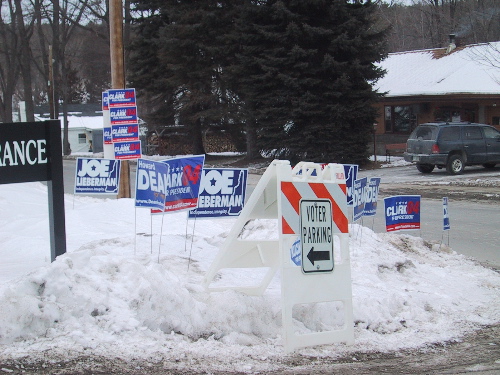
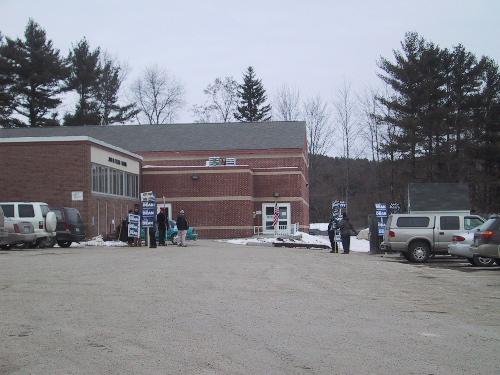
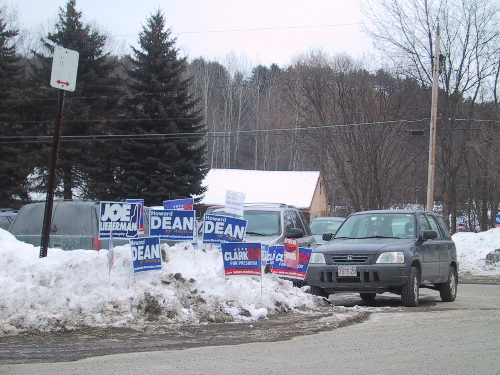
 Wesley Clark — he’s just “Wes” to you and me now that he’s a politician — appeared at a rally at Daniel Webster College in Nashua, New Hampshire this afternoon and I was there with bells on.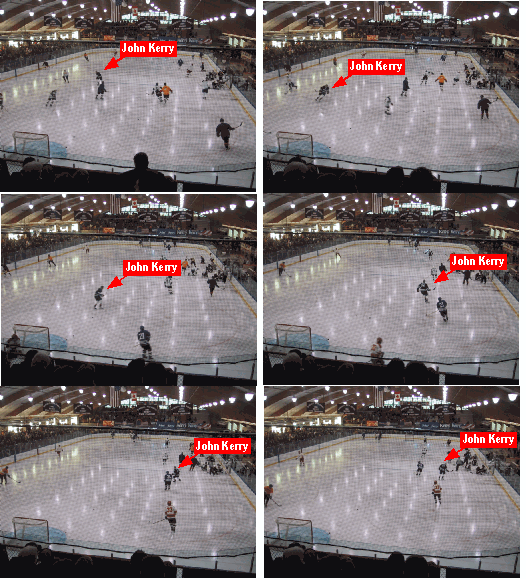
 I am
I am  You can subscribe to an