
The CBC’s Piya Chattopadhyay reported for The Current this morning from coastal India. It was among the most skilled reporting I’ve heard on the effects of the earthquake and tsunami, and showcased the advantages radio has as a story-telling medium over television and print. The audio of her segment should be available later in the day on The Current website.
Jan Egeland, the United Nations Under Secretary General for Humanitarian Affairs and Emergency Relief Coordinator, was on Charlie Rose tonight. He said that the situation in the Congo deserves the world’s attention, that it is the worst humanitarian disaster over the last 10 years, and that the “one disaster at a time” western focus on the tsunami damage will only make this worse.
UNICEF says:
In less than five years, an estimated 3.3 million people are thought to have been killed, the vast majority of them civilians.
I had no idea there was “a situation in the Congo.” Do I care about southeast Asia — and I do — because “there but for the grace of God go I,” whereas what’s happening in the Congo bears no relation to my life? Is it natural disaster vs. human disaster? I don’t know.
🗓️
India: Hole in the Wall, a documentary about an Indian experiment in making free public-access Internet computers available to children, aired last night on ZeD, CBC’s weird and wonderful TV/web amalgam. You can watch streaming video of the entire documentary from this PBS page. It’s quite compelling.
🗓️
Some evil person has been, presumably automatically, posting meaningless comments at random both here and on Steven’s website. The comments are full of links and act presumably to drive up the destination sites’ Google juice by causing, in effect, a link from this site to appear to exist.
[indent]For me it feels like someone peeing in my backyard.
[indent]By way of trying to mitigate this flow, I’ve added a new “feature” to the comment submission form, a section called “Are you human?” which forces comment-makers to type in the characters of a captcha to be able to post. The intended effect is to make automated comment-posting impossible, or at least difficult enough to not be worth the effort. This may or may not work; in the meantime, I apologize for the additional effort required, and hope that commenters see the upside in having their comments not peed upon by unseen others.
[indent]For me it feels like someone peeing in my backyard.
[indent]By way of trying to mitigate this flow, I’ve added a new “feature” to the comment submission form, a section called “Are you human?” which forces comment-makers to type in the characters of a captcha to be able to post. The intended effect is to make automated comment-posting impossible, or at least difficult enough to not be worth the effort. This may or may not work; in the meantime, I apologize for the additional effort required, and hope that commenters see the upside in having their comments not peed upon by unseen others.
🗓️
A couple of updates to the site today:
- I’ve brought back the “search this site” widget, using regular old non-monetized Google searching. You could always do a “site: ruk.ca” Google search to achieve the same thing — this just makes it a little easier.
- I’ve pared down the blogroll, removing dead blogs and added in some new ones.
- I’ve updated the Live From the Formosa Tea House XML feed — just a couple of RSS tweaks — so that it now works properly with the new “download enclosures automatically” feature of NetNewsWire beta.
🗓️
Here’s how the Reinvented website appears, in part, when translated into Spanish and then back to English:
Reinventan to a very small company of the technology. We have taste of her that way. We worked very hardly to construct strong relations with our clients: we are not salesman, we are an additional system of the fellow workers technology-that know to read and to write that they have the advantage of being able to take the opinion from the eye of a bird of which our clients are doing. So that to be able to help them to use technology to do it better. We are friends with our clients: we above invited them for the supper, we watched the series of the world with her, entered the ceremonies of graduation of its cabritos, topetón she in the street and end for above that leaves for the coffee. This is not a technique of the sales: it is how we have taste to live. We have taste to have diversion, to create the matter cleaned up, and to work with elegant people.
🗓️
When I was a teenager, my high school band went on an “Open House Canada” exchange with a high school band in Fort McMurray, Alberta. One of the events scheduled for our visit to Alberta was a special high school dance.
At that dance I had the unfortunate, unprovoked opportunity of being thrown up against a set of lockers by a raging drunken Albertan student against a pulsing backdrop of Duran Duran, Toto and Culture Club.
I wasn’t hurt, but the shock and shame of being the weakling aggressee, combined with the ignominy of having my only dance of the night being with the the elderly french horn playing math teacher cum chaperon, left me with ill feelings about anything remotely related to alcohol. A feeling that remains, at least somewhere in the background, to this day.
I didn’t take a drink myself for the first time for another eight years. I still get nervous in crowded bars and parties.
Which explains, at least in part, why New Years Levees are such a delight for me: it’s drinking, but with rules.
Enter, hand calling card, shake hands, have a drink and a sandwich or a brownie, have a chat, on to the next stop, repeat. For an alcophobe, and a shy one at that, the structure of the levee is paradise: you get to drink, you get to socialize, but the fact that the aides-de-camp are standing ready eliminates the possibility of anything but polite discourse.
This year, like last year, I was accompanied by G, J, and P. This year I also had the pleasure of exposing Catherine, my parents, and Johnny and Jodi to the leveeosphere. I think we all had a good time.
Random notes about our journey this year:
- Andrew Sprague was nowhere to be seen. Rumour was that he was at home with the flu. Best wishes for a speedy recovery, Andrew.
- The Premier’s levee had the best food: everything from bacon-wrapped scallops to chocolate chip brownies. And, odd for a public event, very, very good tea.
- HMCS Queen Charlotte, which was a new stop for us this year, is really quite beautiful inside, a fact not belied by its somewhat austere exterior. They seem quite insistent on maintaining the conceit that the building is a ship: the washrooms are labeled “heads.”
- The Bishop was looking resplendent in his fuschia robes. There was general concensus among the family that his levee should be awarded “best overall.”
- If you show up 30 minutes early for the Premier’s levee, you don’t have to wait in line for two hours. You still have to wait in line, just not for two hours.
- The Masons might be opening themselves up to public view, but if they want to be fully embraced, they’re going to have to do something about the creepy chamber hall: it’s power-packed with really, really disturbing vibes. They did serve very tasty punch, however.
- The band at the Queen Charlotte Armories is absolutely crackerjack. And if you ever get the opportunity, you should check out the Regimental Museum in the back.
- Reminder to J for next year: wear better shoes.
We’ll be back next year. In the meantime, if I look a little skittish when you hand me a Tom Collins, you’ll know why. If I look really bad, just shake my hand and wish me a Happy New Year and I’ll snap out of it.
🗓️
Delirium is:
A state in which the thoughts, expressions, and actions are wild, irregular, and incoherent; mental aberration; a roving or wandering of the mind, — usually dependent on a fever or some other disease, and so distinguished from mania, or madness.
And I got it:
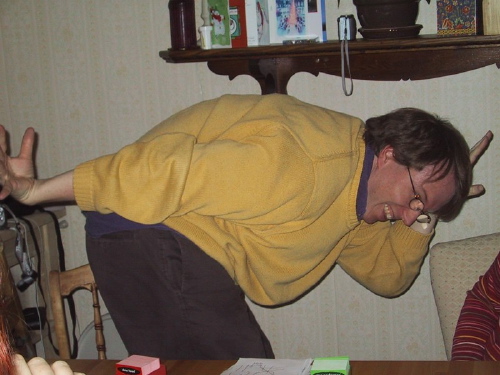
The game was Cranium. The charade target was “catnip.”
🗓️
Here’s a draft schedule for the New Year’s levees in the Charlottetown area on January 1, 2005. In each case, I contacted the organization sponsoring the levee directly, so the information should, barring typographical errors or last minute changes, be accurate. The definitive source, of course, remains tomorrow’s Guardian.
Interestingly, just like Lamont Sweet, University of PEI President Wade MacLauchlan answers his own phone.
Missing from the list are the Diocese of Charlottetown and the Queen Charlotte Armories; I couldn’t track down information for them.
| THE LEVEE OF… | HELD AT… | STARTS | ENDS |
|---|---|---|---|
| Lieutenant Governor | Government House | 10:00 a.m. | 11:30 a.m. |
| City of Charlottetown | Charlottetown City Hall | 10:30 a.m. | 1:00 p.m. |
| University of PEI | Charlottetown Hotel | 11:00 a.m. | 12:30 p.m. |
| Haviland Club | 2 Haviland Street | Noon | 1:00 p.m. |
| Town of Stratford | Stratford Town Centre | Noon | 1:30 p.m. |
| Town of Cornwall | Cornwall Town Hall | 1:30 p.m. | 3:00 p.m. |
| Royal Canadian Legion | 99 Pownal Street | 2:00 p.m. | 3:00 p.m. |
| Saint John’s Lodge No. 1 | 204 Hillsboro Street | 2:00 p.m. | 3:00 p.m. |
| Premier Pat Binns | Confederation Centre of the Arts | 3:00 p.m. | 5:00 p.m. |
| Charlottetown Curling Club | 241 Euston Street | 4:00 p.m. | 6:00 p.m. |
🗓️
After having rejected double-entry bookkeeping for almost 39 years, I have, just today, completely embraced it as a wonderful invention. Anything, in this chaotic world, that brings order and logic is welcome today.
🗓️
About This Blog
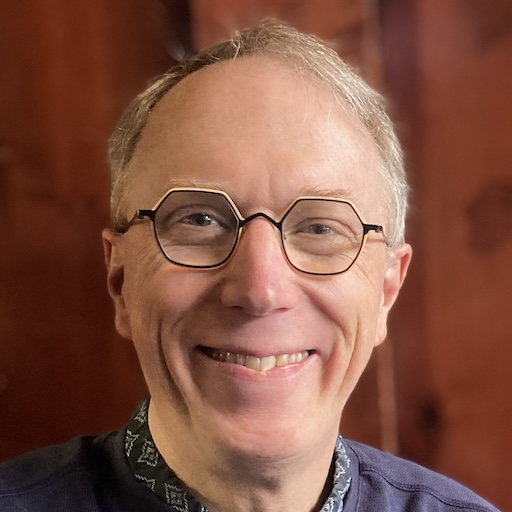 I am Peter Rukavina and this is my blog. I am a writer, letterpress printer, and a curious person.
To learn more about me, read my /now, look at my bio, listen to audio I’ve posted, read presentations and speeches I’ve written, see things I’ve favourited elsewhere, or get in touch (peter@rukavina.net is the quickest way).
I have been writing here since May 1999: you can explore the 25+ years of blog posts in the archive.
 You can subscribe to an RSS feed of posts, an RSS feed of comments, an RSS feed of favourites elsewhere, or a podcast RSS feed that just contains audio posts. You can also receive a daily digests of posts by email. I also publish an OPML blogroll.
Instagram • YouTube • Vimeo • ORCID • OpenStreetMap • Internet Archive • PEI.art • Drupal • Github.