
From the project website:
Asterisk PHP allows you to control the dial-plan and write applications for Asterisk in PHP. This is faster and more flexible than phpAGI.
Doc Searls’ talk at reboot focused on the language we use to frame the network. When we use the network, are we users? the audience? participants? subscribers?
I thought of Doc’s talk this morning when I read this FAQ on changes to the Canadian Copyright Act. Question number seven is:
Is there a risk that protection of technological measures (TMs) will adversely affect users?
The answer to this FAQ doesn’t bear repeating, as it is essentially content-free.
The important thing to note, for me, is that we the people are referenced as “users” in this question. I thought the government was ours, looking out for our interests and that, at the very least, we should be addresses as citizens, not “users.”
I’ve got my City Councillor, Kim Devine breathing down my back (hey, isn’t it supposed to be the other way around?) about locations for bike racks in downtown Charlottetown. Apparently the city works department has four brand new single “circle and post” racks waiting for new homes, and Kim needs suggestions for places. Any ideas?
I did a tour of downtown Charlottetown tonight, most of the area south of Euston St. to the water, looking for open Wifi that I could document. The result is a big jump in the number of Plazes in Charlottetown.
There’s Wifi almost everywhere downtown — you seldom have to walk more than a block to find an open access point. The greatest concentration of Wifi is, as you might expect, around 84 Fitzroy Street. There’s also a heady flow up at the corner of Gerald and Upper Prince.
In my tour, I found 93 access points. Of these, 60 were “open” (i.e. not using WEP to secure access) and 33 were “closed.” Common names: default (19), linksys (13), and NETGEAR (4). Four access points (including my own) identified themselves as wificharlottetown.org.
Whenever I could both get access to the net, and find a place to park the car for a minute, I added a new geolocation to Plazes. So now there are 24 public Wifi Plazes in Charlottetown.
I have never really been a fan of licorice. I did like those spaghetti-like strands I used to buy at the tuck shop at the YMCA as a kid. But I’m neither a fan of the Twizzlers interpretation (bland, tasteless, like eating wax) nor the “health food” variety (“milled from rich Corinthian licorice trees in the Amazon rain forest — includes real bark taste!”).
This all changed when I bought a small round yellow tin of Cachou Lajaunie at a highway rest stop in France. These are tiny almost microscopic pieces of highly charged licorice: just one in the mouth is enough to send you swooning with delight for licorice.
In Copenhagen last week I found Läkerol-brand “Strong Licorice” to be an excellent substitute. These are larger than the Cachou Lajaunie — about the size of a penny — but have a similar intense licorice flavour.
I’ve already polished off the tin of Cachou Lajaunie and I’m a good way through the Läkerol. I’m going to have to work fast to find a new North American licorice brand to feed my newfound licorice addiction.
Back in the mid-1990s, when Dave Moses and I started Okeedokee, the conversation that got us rolling was about how to map the sort of “who’s your father” relationships that permeate almost all conversation on Prince Edward Island.
Via Dragos comes a pointer to Introduction to social network methods, described as an “on-line textbook introduces many of the basics of formal approaches to the analysis of social networks.”
This study of what I like to call “sideways genealogy” fascinates me, and text is a terrific introduction to understanding methods for analyzing and representing social relationships.
For a long time the “house style” here on the blog has been to indent the second and following paragraphs by 2 ems. Daniel Burka once criticized this as being a “relic of print.” And it is.
Yesterday, as part of my wiki hacking, I thought to myself “it’s time to get with the program, leave print behind, and do with a more Daniel-approved ‘white space between paragraphs, no indent’ style.” So I did. The result is on the left in the image below:
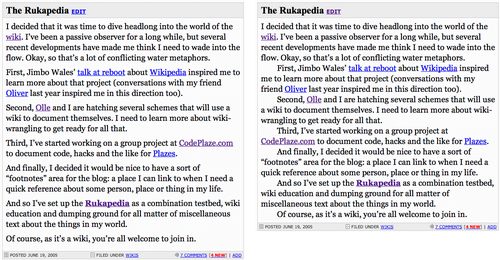
I tried living with this style for almost 24 hours. But I couldn’t take it. Every time I opened my blog in a browser I recoiled in horror at the ugliness.
So this morning I have reintroduced this relic of print (witness right side of the image above). I’ll just have to live with Daniel’s contempt.
I decided that it was time to dive headlong into the world of the wiki. I’ve been a passive observer for a long while, but several recent developments have made me think I need to wade into the flow. Okay, so that’s a lot of conflicting water metaphors.
First, Jimbo Wales’ talk at reboot about Wikipedia inspired me to learn more about that project (conversations with my friend Oliver last year inspired me in this direction too).
Second, Olle and I are hatching several schemes that will use a wiki to document themselves. I need to learn more about wiki-wrangling to get ready for all that.
Third, I’ve started working on a group project at CodePlaze.com to document code, hacks and the like for Plazes.
And finally, I decided it would be nice to have a sort of “footnotes” area for the blog: a place I can link to when I need a quick reference about some person, place or thing in my life.
And so I’ve set up the Rukapedia as a combination testbed, wiki education and dumping ground for all matter of miscellaneous text about the things in my world.
Of course, as it’s a wiki, you’re all welcome to join in.
On the second day of reboot 7.0, I left my laptop at the hotel and took notes in my Moleskin notebook instead.
After being turned on to Flickr by Ben (yes, I know I should have paid attention earlier; it was just the whole “my photos on someone else’s server” thing that hung me up), and then seeing Olle’s demo of photo annotations, it dawned on me that I could scan my notes, upload to Flickr and annotate them with web links and additional explanatory text.
This Flickr set is the result. Click on any of the images, then “mouse over” the black annotation boxes to see the notes, and click on any hyperlinks you see in the notes to jump onwards.
I’m not sure that this is a sustainable habit: the scanning, cropping, uploading and annotating took a lot longer than simple transcription would have taken. But I do like having the original document visible, squiggles and all, for reference.
On this rainy late afternoon Saturday, I found myself sitting in the Formosa Tea House reading Almost French (subtitled “Love and a new life in Paris”), and this passage made me lust (yes, lust) for a cup of hot chocolate:
At Frédéric’s insistence we order hot chocolate — the speciality of the maison, he promises. It arrives in two steaming white jugs and you can tell just from the smell that this is an intense brew made with cream and couverture chocolate. We fill our cups. The liquid pours slowly like an oil slick of dark molten mousse.
The closest I have ever come to reaching this height of chocolate ecstasy was at Le Relais de la Tour in Capdenac le Haut; here is the evidence:
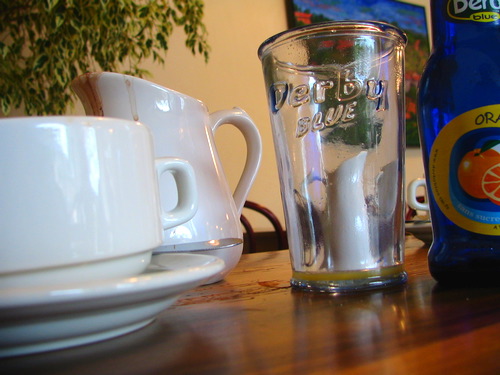
How did I choose to sate my lust today? Well, Timothy’s was closed, it was too rainy to head to Mavor’s, so I had to settle for Tim Hortons. Yes, I realize I am an idiot. I wanted a molten oil slick of pleasure and instead I got a soupy paper cup of tepid Quik. What was I thinking?
Couverture, just in case you were wondering, is “a term used for cocoa butter rich chocolates of the highest quality.” (thanks to Wikipedia for that).
This brings another episode of my Europhilia to a close. Sorry for the interruption.
About This Blog
 I am Peter Rukavina and this is my blog. I am a writer, letterpress printer, and a curious person.
To learn more about me, read my /now, look at my bio, listen to audio I’ve posted, read presentations and speeches I’ve written, or get in touch (peter@rukavina.net is the quickest way).
I have been writing here since May 1999: you can explore the 25+ years of blog posts in the archive.
You can subscribe to an RSS feed of posts, an RSS feed of comments, or a podcast RSS feed that just contains audio posts. You can also receive a daily digests of posts by email.