Yes, thank you iPhone, I do want to delete this memory of a bedraggled version of myself, with horrible hair, and rumbled shirt, from the hard summer of 2016.


Yes, thank you iPhone, I do want to delete this memory of a bedraggled version of myself, with horrible hair, and rumbled shirt, from the hard summer of 2016.
The people who are interested in talking about my challenging workout this morning: my coach; M. and S., who did the workout beside me; Lisa (because we tell each other about our workouts).
The people who are not interested: everyone else.
Like hearing how awesome the Gate of Heaven tour at the Duomo in Siena is, there are things that fall apart in the telling, experiences that are meant to be experienced, and not retold.
So consider this, kind reader, a note to myself.
This morning’s workout at Kinetic was described like this:
“MYMC 22.3 (FITNESS)”
15 ROUNDS FOR TIME
2 Jumping Chest to Bar
3 Thrusters (95/65)
6 Burpees
(Score is Time)
To translate this into human language:
Because everyone is different, we all adapt the workout to our real (or perceived) capabilities. In this case, I did a more aspirational than real ”chest to bar,” I did my thrusters with a 55 lb. barbell, and I did “up-downs” instead of burpees (up-downs are a more sedate, measured version, with less unrestrained flopping).
But this is not what I’m here to write about.
I’m here to write about a brief moment, in the middle of an up-down (oddly, the most taxing of the three movements for me), where I realized that the only way to finish 15 rounds was going to be to treat each and every movement as an accomplishment unto itself. I wasn’t going to get to the end by focusing on what I’d done, or how much was to come; all I could do is one up-down. Or one thruster. Or one chest to bar.
One.
And only then would I even begin to conceive of my next move.
In doing so, I found an unusual sense of “presence,” for lack of a better word.
This morning, unrelated, but also rather related, I read this in Against Optimization:
Another way to look at this is that you cannot optimize for resilience. Resilience requires a kind of elasticity, an ability to stretch and reach but then to return, to spring back into a former shape—or perhaps to shapeshift into something new if the circumstances require it. Resilience is stretchy where optimization is brittle; resilience invites change where optimization demands continuity. But whether we’re talking about our public infrastructure or our workplaces, our streets or our lives, it’s change we need to be ready for. Whatever is ahead for us, it’s not more of the same.
It seems like this sense of presence I describe, of being in the moment and reacting to conditions as they are in the moment, might be this “stretchy resilience.”
“Optimizing” my workout, which is how I started out this morning, was hearing my coach’s “you need to do one round every minute and ten seconds to finish with a good time” and then throwing myself into the (overwhelming, impossible, exhausting) workout all at once.
And it was exhausting: by five tick-marks on the whiteboard I was near-spent. I could no longer finish with an optimized attitude.
And so.
One.
Movement.
Just one.
And, only then, the next.
I finished.
I did the 15 rounds in 17 minutes and 30 seconds.
I am proud.
And I also feel like I’ve learned a much-more-broadly-applicable life lesson.
Thank you to everyone who ordered Offcut notebooks: they sold out in three days.
Here’s a stack of envelopes ready for posting to Charlottetown, Stratford, Halifax, Toronto, Calgary, and The Netherlands.
They were a delight to produce, and I’m proud to have them fly away.

Part of our monthlong trip to Europe this spring was a five day printmaking residency at Two Cents Press in the small Tuscan village of Serrazzano.
We stayed in an apartment above the printshop, and, with the help of Two Cents’ proprietor Franco Marinai, threw ourselves into producing an edition of our This Box is for Good series, something I’ll write more about soon.
Left on the cutting room floor when we were done were pieces of beautiful Magnani Pescia paper. I couldn’t bring myself to leave them there. So, in the waning hours of our residency, I turned them into an edition of 10 small notebooks, printing the cover with offcut on the Two Cents letterpress shop using a font of wood type. Magnani Pescia paper is otherworldly: it’s made of 100% cotton, and while it’s recognizably paper, it feels and folds unlike any paper I’ve ever encountered. I love it.
Magnani paper was produced at mills in the village of Pescia, not far from Lucca, from 1404 until 2014, when circumstances, including a landslide on the road into the village, led to its untimely end. Franco purchased this paper many years ago, from original stock, and so in addition to being otherworldly, it’s also a relic of a 610 year old paper-making tradition.
Today I finished hand sewing the notebooks, and I’ve posted them in the Queen Square Press shop for sale (update: sold out!), pricing them at $14.04 because, well, of course.
As I wrote in the product description there, “they are ’perfectly imperfect,’ an improvised rush job to rescue some lovely paper.” While I love the boxes we produced in Serrazzano, I love these notebooks too; I’ve a soft spot for projects the come together in a flurry at the last minute.

Seven years ago my friend Judy pointed me to Robin Sloan’s Mr. Penumbra’s 24 Hour Bookstore: “I just read a book that made me think of you, in a bunch of ways,” she wrote.
Judy was right. I bought the book, and the next, and became, in so doing, a card-carrying Robin Sloan fan.
His newest book, Moonbound, was just released, and my copy arrived at The Bookmark as scheduled.

Here’s a photo I took on this day, five years ago, May 31, 2019, at Dharma Sushi in Halifax. We’d just rendezvoused with Olle and Luisa, freshly arrived from Sweden, in advance of the Crafting {:} a Life unconference.

Five years is recently enough that it seems just like yesterday.
Five years is long enough that it seems like a lifetime ago.
I recognize myself in that photo: “hey, that’s me, but with different glasses.”
I don’t recognize myself at all in that photo: “oh, that’s the actor who played me in earlier seasons of the show.”
Dick York, Dick Sargent. Did anyone notice?
I’m feeling nostalgic because it’s 25 years ago today that I made my first blog post.
By happenstance, my friend Paul wandered into the coffee shop just now, and we had an interesting chat about life and death and legacy.
As a result of the conversation, I realize that, “hold on, no,” I’m more interested in what comes next than what happened to this point.
My friend Pedro wrote this in his thesis, The Way We See:
John O’Donohue defines two different time realities: surface time–where everything runs at high speed, and where our senses and perception will capture a fraction of what happens.
And the second form of time, which he calls the deep below surface time, where stillness happens and where things move slower–”if you take time not as calendar product but as actually the parent or mother of presence, then you see that, in the world of spirit, time behaves differently.”
I told Paul about how my father kept a journal every day for 53 years; for 29 of those years it was one big Word file. Here’s Dad’s “post” from May 31, 1999, the day I started blogging:
What if I fed 29 years of Dad’s words—supper at Breezy Corners, getting gas for the lawn mower, running baudtests—into a large language model and created a Lou Reed-style chatbot: what would chatting to that Dad look like?
I suspect it would be nothing like chatting to alive-Dad at all: none of his wit, imagination, contrarianism. None of the stuff, in other words, I’d really want.
“Did you love me?”
Like Dad’s journal, I realize this blog is, has been, mostly, about “surface time.” It’s been slices of my life: nerdy noticing, travelogues, documenting projects.
Not only, but mostly.
“I was here.”
Underneath all that, unseen, is the “mother of presence” time.
Like:
I wrote above that Paul and I “had an interesting chat about life and death and legacy.” I can imagine words like that as a bullet point in Dad’s journal. “I was here.”
But what’s missing from that is how it felt to sit here with Paul, to invite him to take a seat, have him settle in, to talk about something more and deeper than sowhatareyouuptothesedays. How it feels to have known Paul for as long as I have, the trust I have in him. How good it felt for him to say that, since Catherine’s been gone, I’ve grown in ways that he can see. How I appreciate his depth and creativity, his wisdom.
How did Dad feel on May 31, 1999? What did he and Brian talk about on the road to Breezy Corners? How did Dave feel when Dad sprained his side loading the boat? Why was he still working after he got home at 9:30 p.m.?
When I wrote about the 20th anniversary of this blog, or the 10th anniversary, my focus was analytical and nostalgic.
“I was here then, and then, and then, and then.”
I recognize the me who focused that way: there is comfort in remembering supper at Breezy Corners, and recollection of the workaday events of surface time can be a warm bath of the known and predictable.
What I resolve, though, on this day, 25 years in, is to spend more time dwelling in the places ”where stillness happens and where things move slower.”
Three years ago, about six months before I met Lisa, I read the book Needing to Know for Sure: A CBT-Based Guide to Overcoming Compulsive Checking and Reassurance Seeking, and took a photo of this passage, which I found helpful at the time:
Living Well Although Bad Things Happen and We All Die
It is possible to know that none of us gets to avoid eventual death, and that most of us suffer losses, mishaps, and mistakes, some severe-—and to still live with joy and meaning. We can know things, not deny them, and yet not become preoccupied with them. We want lasting health, lasting pleasure, lasting security, but the world is constantly changing and dynamic. Wasting time on preparing for unknown future catastrophes carries the illusion of being responsible and somehow more ready to endure what lies ahead.
I didn’t know it at the time, but that notion served as a pathway for me; it is, in a way, the central point around which most discussions, both inside my head and out, focus.
It’s a notion, too, that has served me well in building a life together with Lisa: she is an excellent partner in pursuit both of living well, and finding the places where stillness happens; indeed it’s the tensions between those points on the compass that make our life together interesting.
Because I know that, regardless of my intentions, the pull to nostalgia will forever be part of me, here’s a note to my future self: on this 25th blogaversary you are having a good day. The sun is shining. You had an excellent breakfast. You woke up with the woman you love. You are having lunch with your brother. You are living well. There is a taste of the stillness you seek. You are here.
Found poetry at the corner of Great George and Kent in Charlottetown.

Brooklyn Bridge is the first track on Anaïs Mitchell’s self-titled 2022 album.
I’ve listened to the song a dozen times today, since it algorithmically showed up in Spotify’s Discover Weekly, sandwiched between In Your Circle (by Aaron Percy and judah mayowa) and Indiana (by Adrianne Lenker).
Somehow, on this day, it scratches what’s itching me. The lyrics aren’t profound — the heart is the phrase “everything I want,” which is sung 36 times — but it builds and dips and hangs together and, well, it’s just delicious.
Be sure to listen to this live recorded version, and this performance at Les Etoiles Paris from late 2022, which is perhaps my favourite.
Speaking of people named Anaïs and Paris (you had to see that coming), I am reminded of the time, I was confounded by (and then redeemed from) the task of setting a line from an Anaïs Nin’s diary:
In Paris, when entering a room, everyone pays attention, seeks to make you feel welcome, to enter into conversation, is curious, responsive. Here it seems everyone is pretending not to see, hear, or look too intently.
What a lovely line that is, that.
Anaïs Nin, like Anais Mitchell, was a polymath.
Mitchell, for example, developed the Broadway show Hadestown, about which she wrote a book.
Nin was a “diarist, essayist, novelist, and writer of short stories and erotica,” but what is often left out of her biography is that she was a letterpress printer. From The Intimate Books of Anaïs Nin – Diarist as Letterpress Printer, by Emily Larned:
What is less known about Nin is that she was a habitual self-publisher. Throughout her life, she would continuously, obsessively republish a text once it had fallen out of print, creating many different books from one text. The poet and printer Alan Loney distinguishes between the words “text” and “book.” Although the terms are often used interchangeably in English, an author’s text (her words) is mutable of form. This slippery, shape-shifting text is contrasted with the particular material specificities of a physical book. It is these nontextual qualities—the paper, the type, the margins, the size and shape—Loney explains, that he found so compelling. Today when a contemporary reader finds a book by Nin, it is often a slim, inexpensive paperback printed on cheap paper, with a glossy, ill-designed cover strewn with garish colors and art deco type. How different this reading experience is from hovering over the dark, hushed, carefully made letterpress editions produced by Nin’s own hands.
From Nin’s own words, in The Diary of Anaïs Nin, Vol. 3: 1939-1944:
The relationship to handcraft is a beautiful one. You are related bodily to a solid block of metal letters, to the weight of the trays, to the adroitness of spacing, to the tempo and temper of the machine. You acquire some of the weight and solidity of the metal, the strength and power of the machine. Each triumph is a conquest by the body, fingers, muscles. You live with your hands, in acts of physical deftness.
You pit your faculties against concrete problems. The victories are concrete, definable, touchable. A page of perfect printing. You can touch the page you wrote. We exult in what we master and discover. Instead of using one’s energy in a void, against frustrations, in anger against publishers, I use it on the press, type, paper, a source of energy. Solving problems, technical, mechanical problems. Which can be solved.
Oh my that’s it, exactly it.
Anaïs Mitchell was, as you might imagine, named after Anaïs Nin; from SPIN:
Because she is my namesake, I read all the diaries and even the erotica when I was quite young. I just wanted to find out what she was about, and I had very little actual life experience with which to understand what she was writing about. I adore Anaïs Nin’s writing. I find it so delicate and brave and when I think about how extraordinary it was, her commitment to her art and to the life experience she was determined to go out and get (including her many affairs), it’s quite overwhelming. She was so wildly powerful and also so vulnerable.
From the bridge of Brooklyn Bridge:
I wanna be someone
Wanna be one in a million
I wanna be the one you want
I wanna be one of a kind
I wanna be once in a lifetime
Wanna be the one you ride beside
That’s it too.
After putting out the patio furniture yesterday, this morning was our first opportunity to eat breakfast outside on the deck. It was chilly, and the gathering storm clouds suggested rain, so we moved inside for quiet reading time, but it was delightful nonetheless.
The new Salman Rushdie book was, by some miracle, available at the public library, despite only having been published a month ago.

This conversation between Mike Birbiglia and Judd Apatow is fascinating: I leaned a lot about the creative process, how movies get produced (and what a producer does). and about how much effort creating a compelling movie takes.
”Every script needs a friend,” is a line I will remember.
As is this passage from Apatow about the incurious (which recalls this post from last year):
You know, because we know so many people, they’re so funny and they’re so neurotic, and then you’ll leave them after two hours and realize they never asked me a question, right, and you were just servicing them in some way the entire time right, which I don’t mind cuz some of those people, they’re magic, they’re broken, but they’re magic, and it’s fun, and it’s worth it, but there are times where you go ‘that’s just so interesting that they don’t have any curiosity.’”
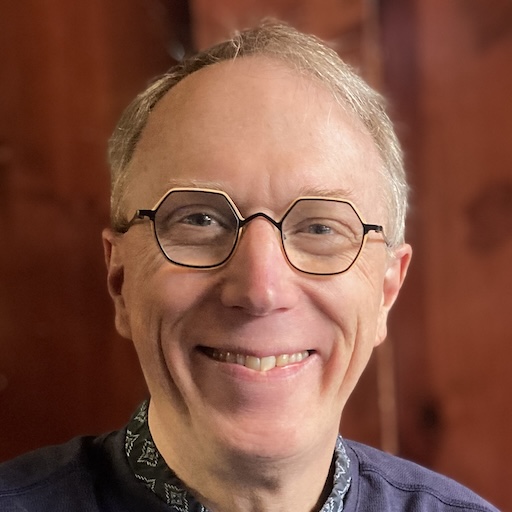 I am Peter Rukavina and this is my blog. I am a writer, letterpress printer, and a curious person.
To learn more about me, read my /now, look at my bio, listen to audio I’ve posted, read presentations and speeches I’ve written, see things I’ve favourited elsewhere, or get in touch (peter@rukavina.net is the quickest way).
I have been writing here since May 1999: you can explore the 25+ years of blog posts in the archive.
 You can subscribe to an RSS feed of posts, an RSS feed of comments, an RSS feed of favourites elsewhere, or a podcast RSS feed that just contains audio posts. You can also receive a daily digests of posts by email. I also publish an OPML blogroll.
Instagram • YouTube • Vimeo • ORCID • OpenStreetMap • Internet Archive • PEI.art • Drupal • Github.