Thanks to the efforts of Canadiana.org, the Journal of the House of Assembly of Prince Edward Island from 1852 has been digitized and is freely available online. The Free Education Act was passed that year, and the Journal records the discussion leading up to Royal Assent on Saturday, April 3 (thanks to the Public Archives for filling in that detail), including the report, on February 18, of the Special Committee:

Your Committee appointed, last Session, to enquire into the expediency of establishing a system of Free Education throughout the Island, have to report — that they find the present system of Education, although liberally supported by Legislative grants in aid of the salaries of Teachers, does not stimulate the inhabitants to that increased solicitude, and consequent efforts to educate their children, a measure which is of such vital importance to the well-being of every country, and particularly so to the inhabitants of this Colony.

Your Committee find, that during a series of years, different modes have been adopted to encourage good and efficient Teachers to locate themselves in the several Districts, but they are of opinion that unless School Masters’ salaries are wholly paid by the Government, and a system of Free Education established, many settlements will not be able to reap the benefits of Education for the rising generation, under the present system; for they find that in the year 1844 there were 126 Public Seminaries imparting instruction to 5,040 pupils, while, in 1850, there were only 130 Schools, including Primary and Infant Schools, and 4,547 pupils; showing a decrease of pupils, while during that period, the increase of children, under 16 years of age, was about 7,000; although the Legislative allowance had been increased from the year 1843 to 1850, from £1,349 18s. to £2,068 7s. 1-1/2d.; but as the present law allows two-thirds of the Districts to assess the remainder for the support of the Teacher, in addition to the public grant, litigation in many instances, has been the result; and in many cases parties have paid the assessment and kept their children at home, and frequently many are summoned to the Small Debt Court for the amount assessed, — Your Committee likewise find, that on an average, there ought to be from 8,000 to 10,000 children attending School, yet it is lamentable to reflect, that not more than half that number are receiving regular instruction.

In view of the foregoing data, your Committee would, therefore, recommend that a Bill be passed, providing means to establish Schools on the free system throughout the Island, and that a tax of one half-penny per acre, be imposed on all Lands in addition to the present Land Assessment, and eight-pence each on the pasture Lots in Georgetown Royalty; and 2s. each on Pasture Lots in Charlottetown and Royalty; and that a rateable tax be assessed on all property in Charlottetown, and Common, and Georgetown„ as Well as on all Shops, Dwelling Houses’, &c., throughout the Island, where there is not a certain number of acres of Land attached thereto, and the remainder to be taken out of the General Revenue of the Island; that one Visitor be appointed to superintend the Schools, who shall not have any other occupation; and that one Member be added to the Board of Education from Prince and King’s Counties; and that an extra allowance be given to Masters of the higher class, for every Pupil whom the School Visitor will certify has been taught, not exceeding Ten Shillings per Scholar, until his salary amounts to £60 per annum; and encouragement be given to Female Teachers for such Districts as would prefer them.

Your Committee have examined 50 Petitions in favour of the free system, bearing upwards of 1,700 signatures; two conditional, signed by 139 individuals; and three against the scheme with 200 signatures — all presented to the House in the present Session; and, although some of those in favour, differ in the detail, yet all approve of the Free system. With reference to the few against it, the parties seem to be under an impression, that a tax of Twenty or Thirty Shillings per 100 acres, would be levied to meet the expense; and should that be the case, they would prefer the present system; but your Committee are satisfied that when they are made aware that it is not contemplated to tax the land to a higher amount than Four Shillings and Two-pence per hundred acres, in addition to the present land tax, scarcely an individual will be found to oppose the principle.

You have to parse the thicknesses of the ye olde language to make sense of this, but the essence is clear: if families have to pay for education, fewer children will go to school.
🗓️

From Ian Robertson’s Reform, Literacy, and the Lease: The Prince Edward Island Free Education Act of 1852, which discusses the context of the coming of free public education to the Island (emphasis mine):

“The Free Education Act of 1852 addressed the financial issue directly, for teachers were to be paid in full by the colonial treasury. This provision meant an end to reliance on two other potential sources of revenue: local assessment and tuition fees. Teachers paid under the act were specifically forbidden to demand the latter, and the former was only to be used for the erection and maintenance of school buildings, which were the responsibility of the local trustees (who were chosen by the resident householders of the district). The changes meant that after 1852 poor districts and poor children would be much less likely to be disadvantaged. In two years the number of students enrolled doubled.”

In the years since we have forgotten how revolutionary an idea that free public education is and, perhaps as a result, that which falls under the banner of “free” has been allowed to gradually creep backwards: parents are now called upon to pay for everything from field trips to basic school infrastructure. The 160th anniversary of the passage of the act will, I think, provide an excellent opportunity to discuss education on Prince Edward Island and how it is paid for.

🗓️

Despite the helpful efforts of CBC’s Island Morning, the local Newcap stations, Facebook and this here blog, the important part of my Golding Jobber Letterpress that, it seems, fell off the truck in transit from Tryon to Charlottetown, is, it seems, not to be found.

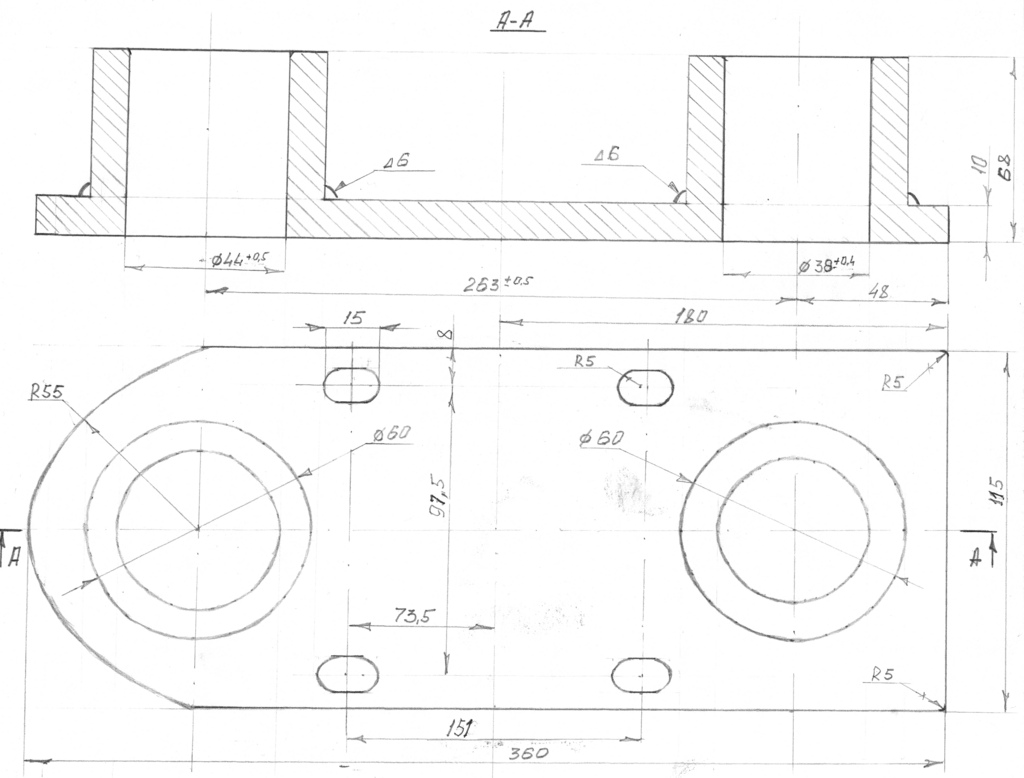
So, onward we go. Fortunately my Cousin Sergey, in Charlottetown for three months to learn English, happens to be a trained metallurgist, fabricator, and jack-of-all-trades. He valiantly jumped into the breach, preparing, without benefit of proper tools or facilities, the measurements required to have a replacement part fabricated:

Diagram for Replacement Part, Golding Jobber No. 8

In Canada the saying goes “measure twice, cut once.” In Ukraine, Sergey tells me, the saying is “measure seven times, cut once.” And so we’ve made several visits to the Golding Jobber’s new home in the basement of The Guild, equipped with rulers and calipers, to measure and compute and re-measure.

To help double-check our approach, I contacted the ever-helpful John Falstrom in Connecticut, the nexus of the Golding press universe, to see if he knew of someone else with a Golding Jobber No. 8. It turns out that John knows of only one other, owned by Gota Tryckkammaren in Sweden; I’ve dropped her a line with hopes that she might do some measurements of the part we’re looking to replace.

On Wednesday night Sergey and I drove up to Kensington Metal Products to discuss the fabrication itself; they made a couple of helpful suggestions, and are ready to go as soon as I give the word.

So, in theory, I should be printing before Christmas.

🗓️

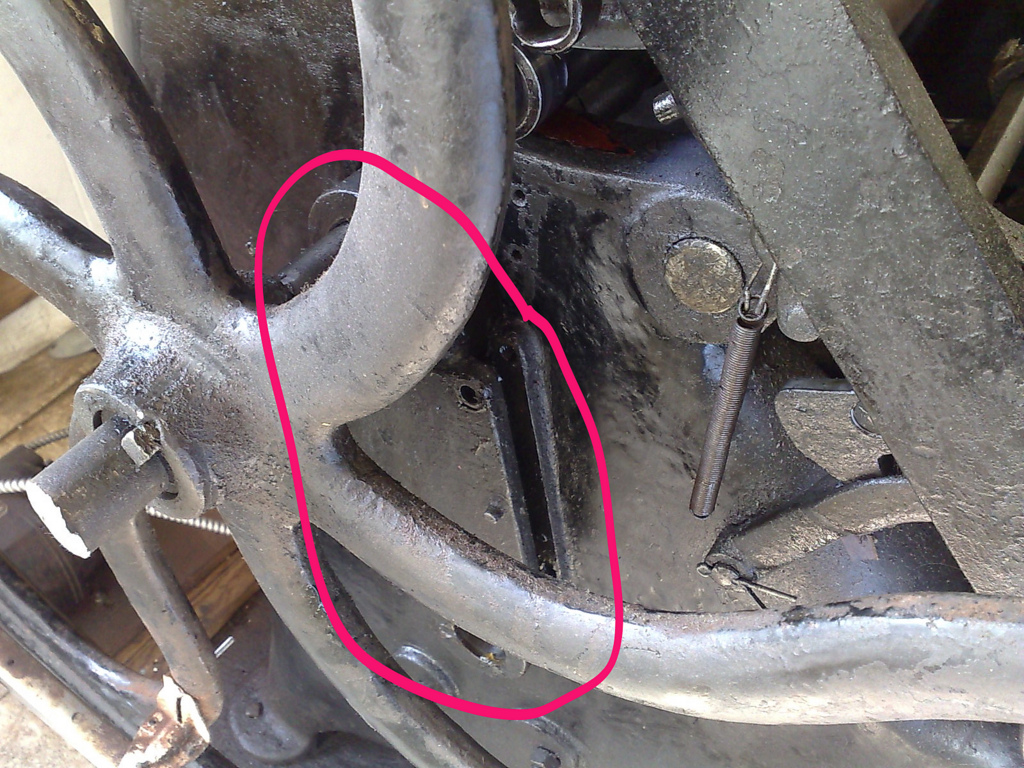
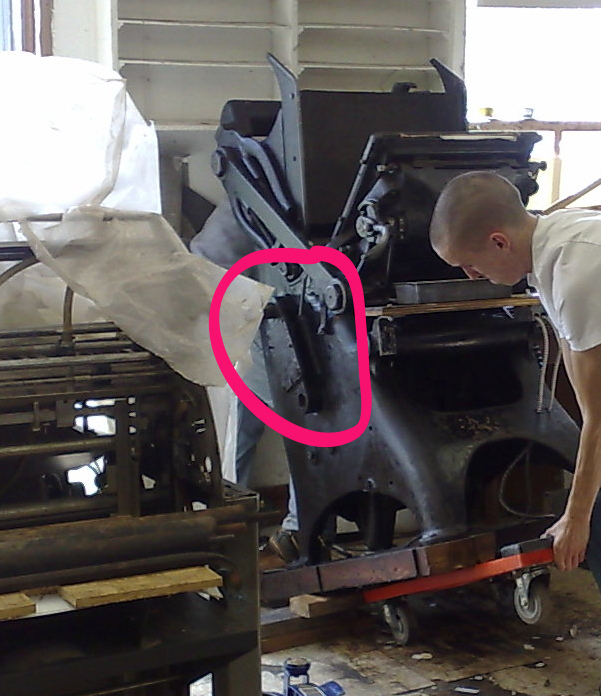
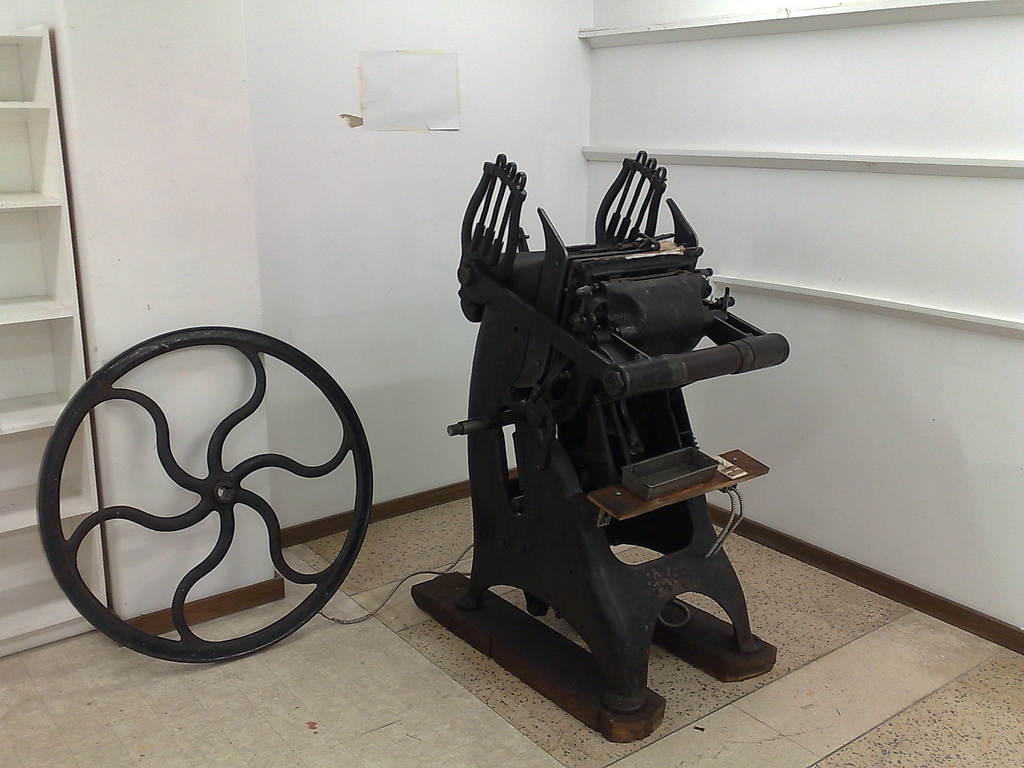
It seems that an important part of my Golding Jobber letterpress is missing. As it was on the press when we started moving it, it’s likely, because it wasn’t firmly bolted on, that it went missing somewhere between Tryon and Charlottetown, rattling off the press and perhaps onto the side of the road.

It’s a flat piece of iron, about 18 inches long, with 4-6 bolt holes and two larger holes.

On the off chance that you found it, and have been holding on to it in anticipation of someone looking for it, here’s a couple of pictures showing the part. If you’ve found it, please let me know!

Missing Letterpress Part

Missing Letterpress Part

🗓️

I didn’t notice until a couple of days ago that the counter that’s bolted to the top of my new letterpress is, in fact, a Potato Acreage Calculator made in Fort Kent, Maine by the Morin’s company.

111220113628

🗓️

On Saturday night I arrived at The Guild with a full kit: toolbox, varsol, paper towels, rags, and a giant sledge hammer (purchased from Rogers Hardware on the day they closed for good many years ago). On the other side of the basement there was a gaggle of well-dress patrons of the arts sipping wine and admiring paintings during the intermission of The Attic, The Pearls and Three Fine Girls, something seemingly at odds with my plans for sledge hammering, but I was assured, on assuming my tenancy, that the building is soundproof enough for this not to be an issue.

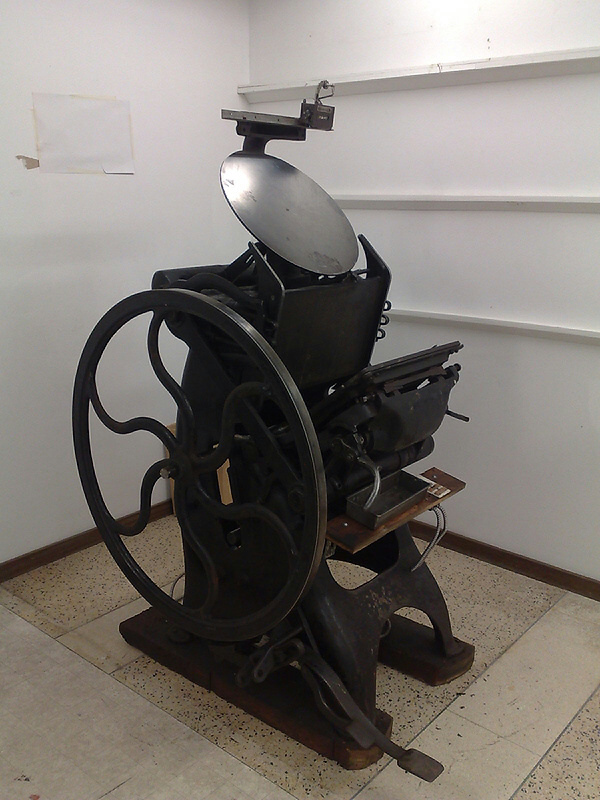
After an hour of heaving and shoving and sledging, I ended up with the press reassembled:

gravity-scaled-1

I reattached the flywheel and the ink disk and its supporting arm as well as the foot-pedal brake (I have to talk to Ian Scott about making me up some sort of leather add-on for the brake to prevent metal-on-metal braking).

There’s an issue I need to figure out with the flywheel and its axel: things aren’t running as freely as they should and I think it’s because the axel needs to be moved further to the right; to do this properly, however, I need a way of shifting the position of the small gear on the press’s righthand side further onto the axel. I’m sure there’s a way of doing this, but my digital mind is at its limits; fortunately Cousin Sergey is a metalurgist and jack-of-all-trades and I’m hoping he can help.

Not too far from the point where I’ll be able to start printing…

🗓️

Remember how I told you that my letterpress has found a home in the basement of The Guild? Well Catherine reminded me this morning that soon after arriving in Prince Edward Island back in the early 1990s she was on the board of the PEI Council of the Arts when the building now known as The Guild was being acquired from the Royal Bank.

Catherine and Ron Arvidson (see his sundial on the side of Charlottetown City Hall) were on the committee that was responsible for laying out the selfsame basement.

So, in other words, Catherine has my back to the extent that she preemptively arranges for suitable space to become avaialble to me 15 years in advance.

Thank you.

🗓️

You may recall that when we last spoke my Golding Jobber letterpress had made it from Tryon to Clyde River — half way along its journey to town. It’s taken me almost a month to get it the rest of the way.

First, I needed to find a space. After a tour of what seemed like every light industrial space south of Allen Street, I finally made arrangements to share a space in the basement of The Guild and so with the space identified the next challenge was to get the press from Clyde River to town.

Fortunately my friend Tom Cullen at Purity Dairy heard my call for help and pointed me toward Austin McQuaid on Allen Street. Everyone thinks of McQuaid’s as a place to store things, but they’re in the moving business too, and Tom has used them over the years when he too has had heavy things to move around.

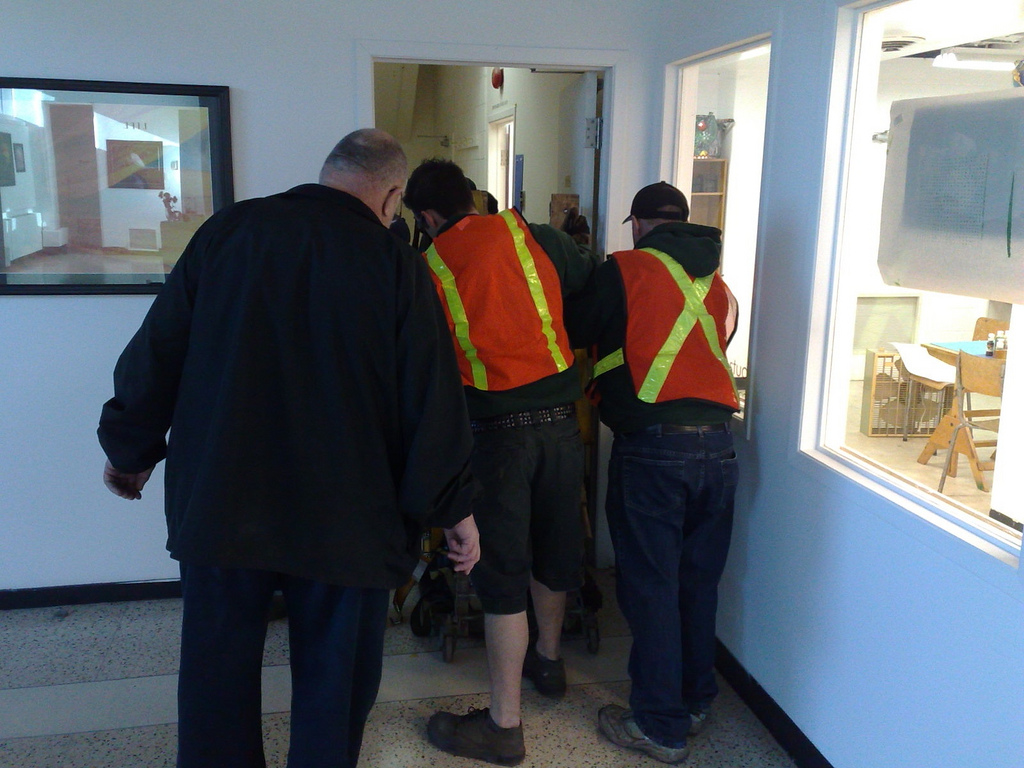
I gave Austin a call last week and he and his son met me at The Guild to see if it was something they could handle; I showed him a photo of the press, and he came up with a plan and asked that I arrange to have Griffin’s Towing in Clyde River move the press into his warehouse on Allen Street so they could prepare for the move into The Guild.

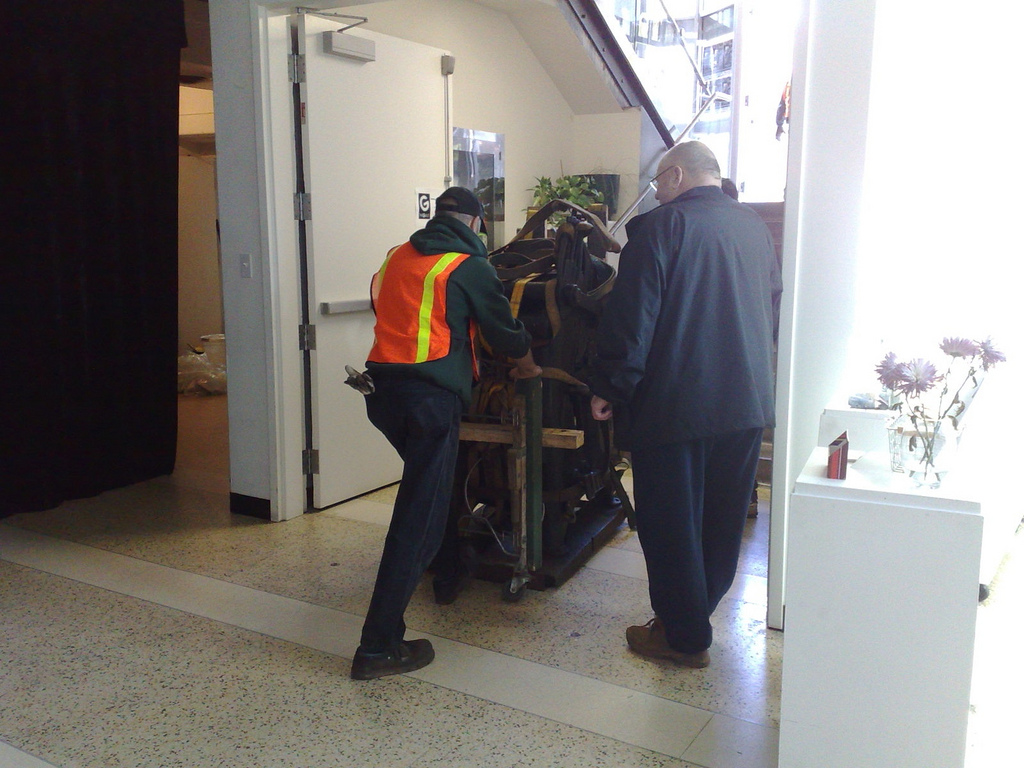
The press arrived at McQuaid’s yesterday afternoon and this morning at 8:30 a.m. I had an email from Kay in Austin’s office telling me they’d be at The Guild at 9:00 a.m. I made sure that the doors would be open and then headed down to guide them where to set it down.

111020113611

111020113612

By the time I arrived at The Guild 15 minutes later they had the press out of their trailer, in the front door and down the front stairs; just as I arrived their forklift was driving out of the front door of the building. Ten minutes later they had the press on a piano sledge and five minutes after that it was set down into place.

111020113617

Austin brought a full team to the move and they were all the most good-natured, professional guys you’d ever meet: I can’t imagine a better moving team. If you got something heavy to move on PEI, I wholeheartedly recommend them.

111020113615

At every step of this two-month process each new person to encounter the press adds a couple of hundred pounds to their guess of how much it weights: Bill Campbell, the previous owner, guessed it was about 800 pounds; the next mover thought it was more like 1,000 pounds and Austin was pretty sure it was more than that (one of his men estimated 1,725 with a twinkle in his eye).

🗓️

On my way out the door this morning Catherine handed me a business card from our electric meter reader; he’d knocked on the door of our house yesterday looking for information about the Blueline Power Cost Monitor that’s strapped to our meter and wanted me to give him a call.

We spoke on the phone for 5 minutes this morning and any fears I might have had — “look, you can’t just go strapping unauthorized equipment to your electric meter” — were immediately assuaged: he just wanted to know where I got the monitor, what kind of information it gave me, and how much it cost me. He was just curious, in other words.

It’s nice to have an electric company with employees like this.

🗓️

The Social Graph is Neither, an essay by Maciej Ceglowski on the Pinboard Blog lays out eloquently many of the thoughts about current Internet trends that I’ve intuitively felt for a long time but have never been able to express; the essay deserves to be read in its entirety, but in you want to skip ahead to the punchline, for me it is this:

Social networks exist to sell you crap. The icky feeling you get when your friend starts to talk to you about Amway, or when you spot someone passing out business cards at a birthday party, is the entire driving force behind a site like Facebook.

Because their collection methods are kind of primitive, these sites have to coax you into doing as much of your social interaction as possible while logged in, so they can see it. It’s as if an ad agency built a nationwide chain of pubs and night clubs in the hopes that people would spend all their time there, rigging the place with microphones and cameras to keep abreast of the latest trends (and staffing it, of course, with that Mormon bartender).

There much more in the essay, including a cogent argument for, as the title says, “the social graph is neither.” Go read it.

🗓️
Social Graph  •  Internet  •  Weblogs  •  Pinboard

About This Blog

Photo of Peter RukavinaI am . I am a writer, letterpress printer, and a curious person.

To learn more about me, read my /now, look at my bio, listen to audio I’ve posted, read presentations and speeches I’ve written, see things I’ve favourited elsewhere, or get in touch (peter@rukavina.net is the quickest way).

I have been writing here since May 1999: you can explore the 25+ years of blog posts in the archive.

You can subscribe to an RSS feed of posts, an RSS feed of comments, an RSS feed of favourites elsewhere, or a podcast RSS feed that just contains audio posts. You can also receive a daily digests of posts by email. I also publish an OPML blogroll.

Instagram • YouTube • Vimeo • ORCID • OpenStreetMap • Internet Archive • PEI.art • Drupal • Github.