You know how Radiolab has Radiolab Live and This American Life has The American Life Live?

Well, I don’t have David Sedaris nor Neil deGrasse Tyson in my Rolodex, but all the same it occurs to me that it would be interesting to marshall the forces that keep this here ruk.ca in the air to produce a ruk.ca live. There would be 3D printing and artisanal coffee and letterpress demonstrations and Finnish anarchists and live-action role playing. And no face painting.  It’s not like I don’t have a theatre at the ready mere steps from the centre of my digital life.

Hmmmm.

🗓️

Nørd Camp (“Geek Camp” in Danish) is a project of the Roskilde Festival in Denmark. In poorly-translated-from-Danish it describes itself as a summer camp where:

Every day is a new day filled with new challenges, tasks and not the least knowledge of the real Big Nerd spirit. Participants are involved in building projects, shaping them and test whether they work in the end. This will bring participants through many different things - everything from chemical reactions to build soapbox cars and final competition.

In short, it looks like the greatest camp on earth.

🗓️

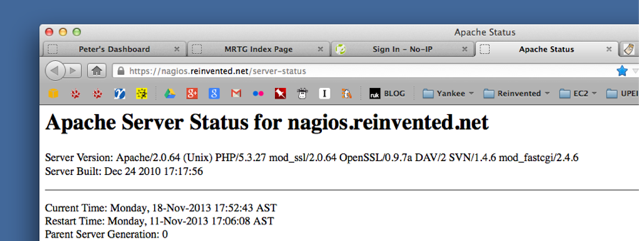
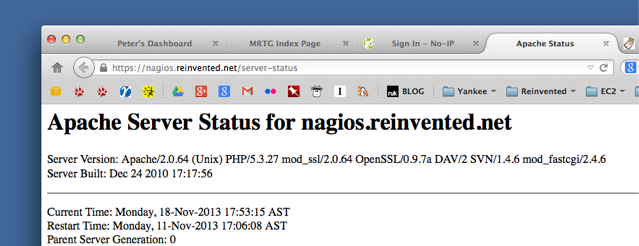
I updated my Firefox Nightly and, blamo, this ye olde UI:

became this sexy new UI:

It’s called Australis and you can read more here and watch a video introduction here.

🗓️
Firefox  •  Design

Oliver in New Coat, LoopingSo the new Target store opening here in Charlottetown last week, taking the place of the old Zellers (which, in turn, took the place of the old Towers and the old IGA).

Target, for we here on the fringes of North American geography, has always held a certain magical allure: when we’d visit a Target on trips to the United States everything would seem so bright and roomy and exotic compared to the grungy old Zellers here in Charlottetown.

“Oh look, it’s a Michael Graves egg spatula!”

And there’s no doubting that a purpose-built Target, architecturally, is an impressive building. It’s still a discount store, yes, but a discount store with white space.

Here in Charlottetown, alas, there was little white space to be had, as the new Target had to be shoehorned into the old Zellers née Towers.

And so no matter how much money they spent repaving the parking lot and putting up the colourful red bollards and extinguishing the clock and the pretzel place and the engraving kiosk from the main entrance hall of the Charlottetown Mall, Target, in the end, is still a Zellers-in-Target-clothing.

The space will never be able to fully shake its history, even if the Zellers cafeteria is now a Starbucks and we “customers” are now “guests.” It still feels like they took the IGA and the Towers and mushed them together. The ceilings are too low, the entrance is in the wrong place. The aisles are too narrow.

That said, we did find an awfully nice winter jacket for Oliver at Target on Saturday, a snazzy Champion-brand model in green. It was 40% off. It’s a men’s small, and fits very well.

On the way in to the store we saw the line at the checkouts was 50-people deep and so I thought twice about the ROI on getting in line, but then I saw that there was a cash register in the TV department and I asked the cashier (“team member?” “service concierge?” “betterment consultant?”) if I could pay there and they cheerfully agreed so we were in and out in 5 minutes.

🗓️
Target  •  Retail  •  Charlottetown

From Challenges to learning and schooling in the digital networked world of the 21st century

Beyond making 21st century competencies a part of education, understanding how ICT might shift our educational structures from industrial era schools to new types of 21st century formal educational models is important. Societies can no longer afford a labour-intensive model of education that uses expensive human resources inefficiently. This is not a temporary financial dislocation due to an economic downturn, but a permanent sea change that has already happened in every other service sector of our economy. Many of the innovative pedagogical practices supported by technology of the SITES study (e.g., Kozma, 2003) are based on personal heroism, educators who make sacrifices in every other part of their lives in order to help their students. These are wonderful stories, but such a model for educational improvement is un-scalable to typical teachers. Scaling up involves adapting an innovation successful in a local setting to effective usage in a wide range of contexts (Dede, 2006). Scalable designs for educational transformation must avoid what Wiske and Perkins (2005) term the ‘replica trap’: the erroneous strategy of trying to repeat everywhere what worked locally.

Wise words. Conventional wisdom among the digerati tends toward thinking that technology-in-education is a sort of revealed religious truth that, once everyone “gets it” will naturally spread like wildfire. This is naive.

🗓️
Education  •  Technology  •  Design

I’ve been experimenting with ownCloud on my Raspberry Pi as an alternative to Google (for contact and calendar sync) and Dropbox (for file sync). Because of the contrained resources of the Raspberry Pi this setup doesn’t exactly fly like a rocket, but it works, so far, and I’m happy to have my sync repository on my desk as opposed to in a murky bunker in place unknown.

I installed the stock Raspbian image and then followed the steps in this helpful guide to get Nginx, PHP and ownCloud running on the Pi. It worked without issue; the only thing I diverged from is that I installed ownCloud six instead of the version 5 mentioned there.

Part of the helpful guide involves creating a self-signed SSL certificate to allow traffic to and from the Pi to be encrypted. Setting up OS X Calendar sync with this certificate in place didn’t present a problem: I simply agreed to trust the certificate. Same thing in my iPad.

On Firefox OS, however, there’s no such option, and when I tried to add my ownCloud calendar as a Caldav account I got an unhelpful generic error message. Looking at the output of adb logcat as this failed I saw the cause was, indeed, SSL related:

The certificate is not trusted because it is self-signed.

Fortunately there’s another helpful guide that walked me through the process of adding a new root certificate to my Firefox OS device. A few notes on that process:

  1. I didn’t have the Mozilla NSS certutil binary on my Mac, and there didn’t seem to be a non-complicated way of compiling and installing it, so I did all the certificate-mangling work on an EC2 host where it was pre-installed.
  2. In the text where it says “<CAName>”, you simply make up a name for your personal “certificate authority,” like “Reinvented” or “PeteCo”.
  3. The references to “<CAFile>” are to the cert.pem file you generated on your Raspberry Pi.

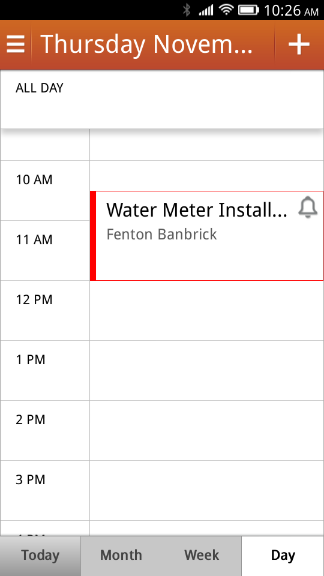
Otherwise, the process went exactly as advertised, and once I restarted the Firefox OS device (and this was a necessary step), I was able to add my ownCloud Caldav server to the Calendar app without issue, and after a brief pause for sync my calendar showed up:

My ownCloud calendar on my Firefox OS device Calendar app


🗓️
SSL  •  Raspberry Pi  •  ownCloud  •  Firefox OS

I was cleaning out an old long-forgotten S3 bucket this morning and came across the video of the demo session from PlazeCamp, the developer hackday we held at Plazes back in January of 2008. An interesting pan-European crowd showed up to hack on the then-new Plazes API, and in this demo session we all showed off our day’s work.

Hard to believe that was 5 years ago.  The Wii Plazes that I demonstrated (complete with a public unveiling of my quickly-changed-thereafter password) is still online, although, without a Plazes API to send anything to, it doesn’t do much.

🗓️
PlazeCamp  •  Plazes

Through one of those rabbit holes that the web is so good at conjuring I came across the heart-wrenchingly-good tract The Playwork Primer (PDF) this morning.

When I was young I wanted to be a teacher, and so I started down the path to becoming educated as a teacher Trent University. Our final assignment was to write an essay expressing our “philsophy of education.” I never handed it in (I never started it). Which is why I’m not a teacher.

In The Playwork Primer, however, I find what amounts to the best description of my philsophy of education that I’ve yet to come across:

We aim to provide a play environment in which children will laugh and cry; where they can explore and experiment; where they can create and destroy; where they can achieve; where they can feel excited and elated; where they may sometimes be bored and frustrated, and may sometimes hurt themselves; where they can get help, support, and encouragement from others when they require it; where they can grow to be independent and self-reliant; where they can learn—in the widest possible sense—about themselves, about others, and about the world.

Those words are from Stuart Lester, Senior Lecturer in Play and Playwork (!) at University of Gloucestershire in England.

If you’re interested education and play and children’s lives, I encourage you to grab a copy of The Playwork Primer: it’s an inspiring guide. It’s hard not to love a piece of writing with subheadings like “Cloak of invisibility,” “Cardboard boxes,” and “Commodification of play” (and that’s only the Cs). One of my favourite sections is “Secret spaces”:

This is a phrase used by Elizabeth Goodenough to describe the hideaways that children need to create or discover and to have safely within their control. Without these private places where their inner playful lives can be exercised, children have little opportunity for many different types of play.

Morgan Leichter-Saxby asks, in her work on forts and dens, without the opportunity to experience privacy how on earth can children discover a sense of their private selves and personal worlds? She writes:

To be by oneself, in a place that feels safe and unadulterated, to have time and space to dive into the depths of the playing that is an intrinsic drive within you, to step at once aside from and yet deeper into the world as you experience it, that is when and where the richness of the play that is possible ripens to fruition.

The notion that there’s someone whose professional practice includes “work on forts and dens” is amazing to me.

🗓️
Play  •  Children  •  Education  •  Adventure Playgrounds

🗓️
Video  •  Junk  •  Innovation  •  Film  •  Design

One year ago today I started archiving the energy load and generation data that the Province of PEI makes available at 15 minute intervals on its website. I’ve collected 34,471 data points (if you like you can grab the entire archive as a CSV file for your own analysis).

I’ve been using this data, over the course of the year, to help build my own “peripheral awareness” of the Island’s electricity situation, using tools like this visualization of load vs. generation and this simple gauge showing how much of our load is being met by the wind.

I’ve had conversations with staff at Maritime Electric and the PEI Energy Corporation to try to better understand these numbers, and one of the things that I’ve learned is that “peak load” is an important number when talking electricity: utilities like Maritime Electric are contractually obligated to be able to meet the peak load – the maximum amount of electricity we might all collectively call for at any given time – and they have to build generation capacity or have a reliable import source to meet that obligation.

Over the last 365 days the Island’s peak load came on January 23, 2013 at 245.07 megawatts (MW). We had 75 days where the daily peak load was more than 200 MW and the lowest daily peak was 140 MW on May 26, 2013. This late-January peak represents trend away from the traditional “Christmas lights peak” in December and, I am told, comes as a result of an increasing shift toward electric-source heating.

Here’s what that daily peak load for the last 12 months looks like on a graph:
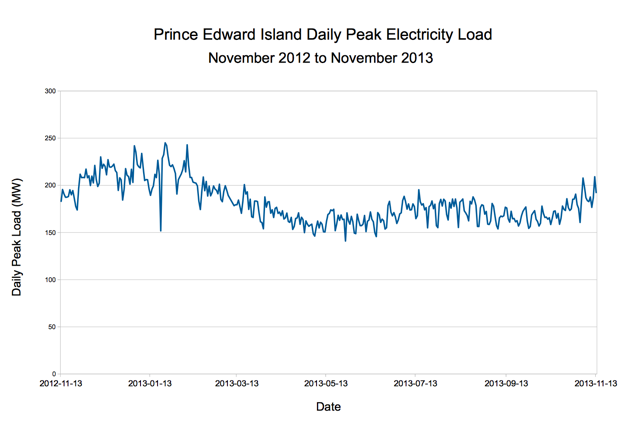
PEI Daily Peak Electricity Load, November 2012 to November 2013

These are important numbers for Islanders to know and understand because it’s the peak, more may any other factors, that drives the cost (and complexity) of meeting our electricity needs.

The report of the PEI Energy Commission is an excellent resource in this regard.

From that report, for example, I learned that the yearly peak in 1977 was 95 MW – meaning that our peak in this year was 2.5x higher than our peak 36 years ago.

And that the capacity of the electric cables to the mainland is 200 MW. Which means that when the load goes over 200 MW – as it did on 20% of days over the last year – we need to make up the difference from local generation, either fossil-fuelled or wind-generated.

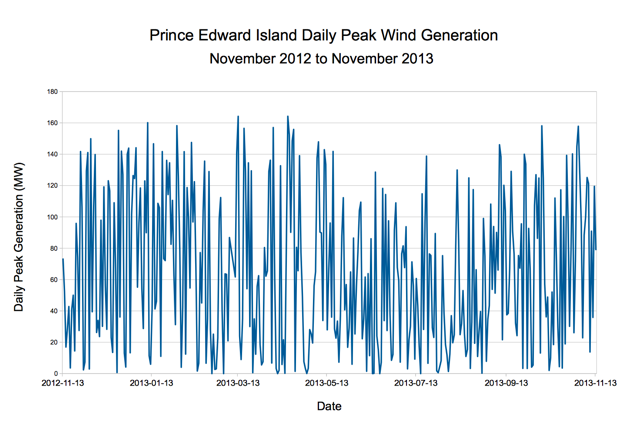
The wind, of course, wasn’t a factor in our energy mix back in 1977 and now it’s a significant one. But, as the graph below, showing the daily peak wind generation over the last year, shows, the wind is variable:
PEI Daily Peak Wind Generation, November 2012 to November 2013

There have been some fantastic days for wind generation – 12 days, for example, where the daily peak was more than 150 MW – but also some bad days for the wind: on 59 days the daily peak was 10 MW or less.

That said, there were 1,546 intervals of fifteen minutes or less over the course of the year where wind generation exceeded load, making PEI, temporarily, an energy exporter. Granted, most of these intervals were in the middle of the night; but on October 8, 2013, for example, we were generating 56 MW more than we were using at 3:00 a.m.

It is de rigueur in energy and “personal analytics” fields these days to believe that the mere fact of monitoring behaviour affects behaviour: if you keep track of how many steps you’re walking every day, you’ll be more inclined to walk more steps every day.

I feel like that’s supported by my own electricity-using behaviour: I seems like I’ve become a more responsible electricity consumer since I started paying attention to PEI’s energy mix – like I’m turning off lights more often, unplugging things that don’t need to be plugged in.

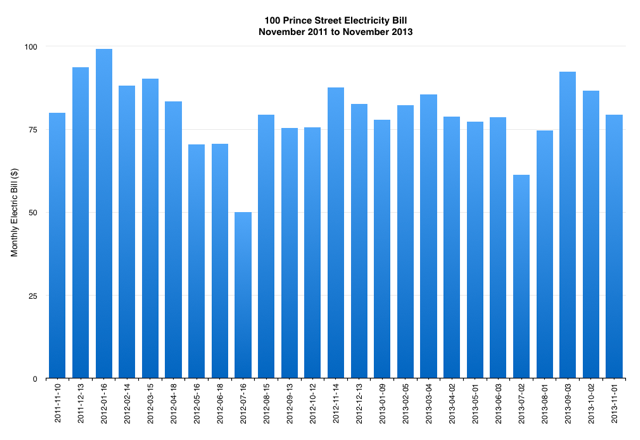
So far, though, the evidence doesn’t really bear this out: here’s a chart showing our monthly electric bill at 100 Prince Street for two years, one in which I wasn’t paying attention to electricity and one in which I was:
100 Prince Street Electricity Bill, 2012 to 2013

Our total yearly bill for November 2011 to November 2012 was less than a dollar different than the bill for the following year (although, to my credit, the rate per kilowatt hour did incease, on our March 2013 bill, from 12.05 cents to 12.41, so it’s not quite an apples-to-apples comparison).

I’ll keep watching, and keep turning things off: knowing that my vigilance hasn’t really made a dent, at least for a while, will make me ever-more-vigilant.

🗓️

About This Blog

Photo of Peter RukavinaI am . I am a writer, letterpress printer, and a curious person.

To learn more about me, read my /now, look at my bio, listen to audio I’ve posted, read presentations and speeches I’ve written, see things I’ve favourited elsewhere, or get in touch (peter@rukavina.net is the quickest way).

I have been writing here since May 1999: you can explore the 25+ years of blog posts in the archive.

You can subscribe to an RSS feed of posts, an RSS feed of comments, an RSS feed of favourites elsewhere, or a podcast RSS feed that just contains audio posts. You can also receive a daily digests of posts by email. I also publish an OPML blogroll.

InstagramYouTubeVimeoORCIDOpenStreetMapInternet ArchivePEI.artDrupalGithub.