I’ve been using the Brave web browser on my desktop and on my Android phone for many months now. Especially on the phone, it can’t be beat for speed and lack of annoying “you’ve now seen 10/10 articles this month” intermediation.

While Brave’s a snappy and well-designed browser, its killer feature is Brave Payments, a Bitcoin-driven way for users to put money into a kitty, and for publishers to get compensated from the collective kitty based on aggregate usage of their site by Brave users.

I’ve thrown money into the kitty (by sending Bitcoin through Brave’s Preferences > Payments screen), but until today I never saw the publisher side of the coin.

That’s because Brave’s description of how the system works appears to suggest that you need to pass a threshold of $100 USD in payments before they’ll set you up:

These funds grow as new micropayments are added. When contributions for a publisher exceed $100.00 USD, an email is sent to both the webmaster of the site and the registered domain owner from your WHOIS information. The email explains how to verify the ownership of your website with Brave Software.

I figured it was unlikely that I’d reached $100 in payments, or, indeed, that I ever would, so I left this thought aside.

But today I noticed that right under that paragraph is a link to Get Verified Now, and when I followed that link I was able to establish ownership of ruk.ca (through adding a DNS TXT record) and, presto, I found $4.99 waiting for me:

Screen shot of Brave confirmation page showing publisher approval.

Not enough to quit my day job, I admit, but I’ll soon have $4.99 in hand, as I followed on, entered my Bitcoin address, and filled out an IRS W-9 form (easy to do online; just needed my name, address and SSN). My funds are due to be transferred from Brave at month’s end.

I’m fascinated by the system that Brave has built, and will be watching it closely.
🗓️
Brave  •  Bitcoin

Stelios Georgiades writes, in Tracing autism’s trajectories could help explain its diversity:

Much of this uncertainty stems from how we study autism. We tend to group children together based on features they share at a given point in time, and then assume that children within a particular group will share a similar developmental path. But children develop at different rates, and their individual developmental paths are rarely linear.

If you are a student of Glendenningism, this notion is one that can be applied to anyone: especially in public school we make broad, and often inaccurate, assumptions about people based on their age, their diagnoses, their behaviour, and their past experiences.

Life and learning and development are seldom linear, yet so many of the systems we’ve built assume they are.

🗓️
Autism  •  Learning

Longtime friend-of-the-blog Valerie Bang-Jensen has a new book out this season, Sharing Books, Talking Science: Exploring Scientific Concepts with Children’s Literature.

With her co-author Mark Lubkowitz, she draws connections between literature and science, leading to the delightful conclusion that “every book has the potential to be a science book.”

From the introduction:

“I marvel at folks who can take something complex and present it as if it were common sense. I stand back and study how they break it down and present it in a manner that leaves me thinking, How come I didn’t think of this? That is exactly how I felt by the time I reached the end of the first chapter in this book. And on the last page I would have given Valerie and Mark a standing ovation had I been in their audience. This work is smart yet they make it so very accessible.”

This sensibility has a lot in common with what Robin Sloan termed the “culture of clear explanation,” and it’s a laudable thing to nurture, for if we collectively lack anything in this topsy-turvy world, it is the ability see patterns, to identify and understand systems (or to admit that we cannot understand them), and to make connections between seemingly disconnected things.

In my final year of high school I took a course called “science communications,” which was, in essence, a course about the techniques of clear explanation. For one of our assignments–the topic escapes me now–I drew a short comic strip rather than handing in the expected essay. When the marked assignments were returned, I received a poor mark with the notation that the medium I’d chosen was “not appropriate to the subject matter.” Being a cheeky lad, I used the next assignment, where we were to conduct a “demonstration” of something, to demonstrate against my poor mark, and attempted to make the case for why, in fact, a comic strip was completely appropriate to the subject matter.

Mark and Valerie’s book is, in essence, a vindication of that thesis.

You can purchase Sharing Books, Talking Science in the USA directly from the publisher; in Canada you can purchase it from Amazon.ca or from your local bookseller (ISBN 978-0-325-08774-0). You should also encourage your local teacher resource library to purchase a copy.

Oh, and you can listen to them talking about the book here (thank you to Oliver for tracking that down).

🗓️

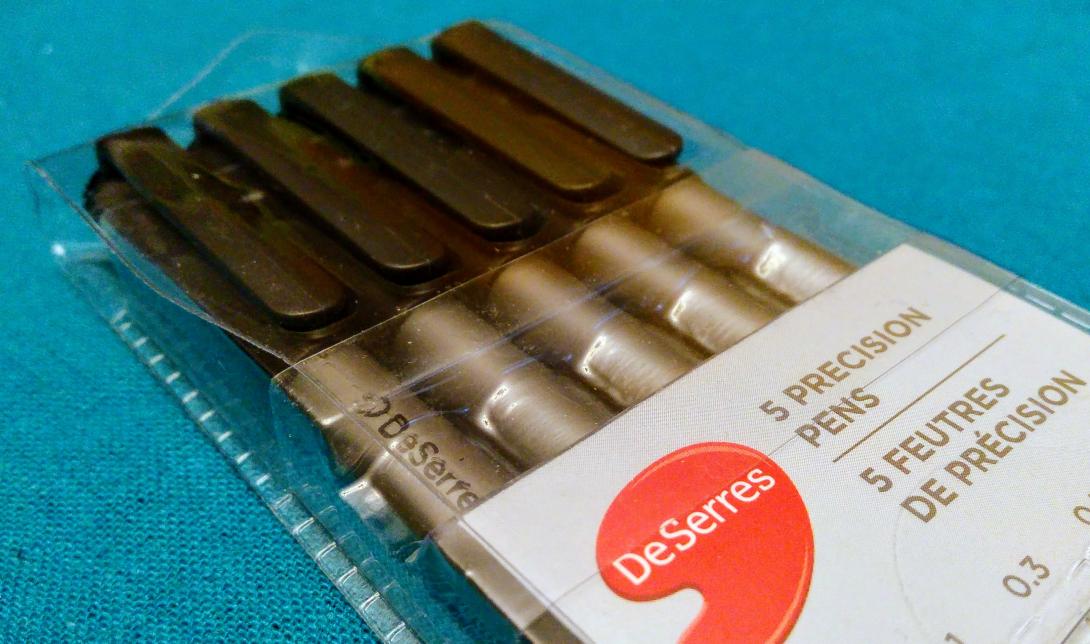
Purchased last week in Halifax at DeSerres on Barrington Street. The five pens are a nice range of thicknesses, from 0.05 mm to brush. They come in a handy carrying case. Recommended.

🗓️

From A Smoother International Relocation:

If you’re wondering — shipping a 20 foot container across the Pacific (enough space for a minimalist family’s worldly possessions) takes ~6 weeks and costs ~$4k.

I would happily purchase a book that summarized the logistics of everyday life in this fashion.

🗓️
Travel  •  Shipping

On Dan Misener’s Work in Progress podcast last week there was a reference to Sketchbook Skool.

Intrigued, I looked it up, and, somewhat against type, plonked down $29 for the How to Draw Without Talent course.

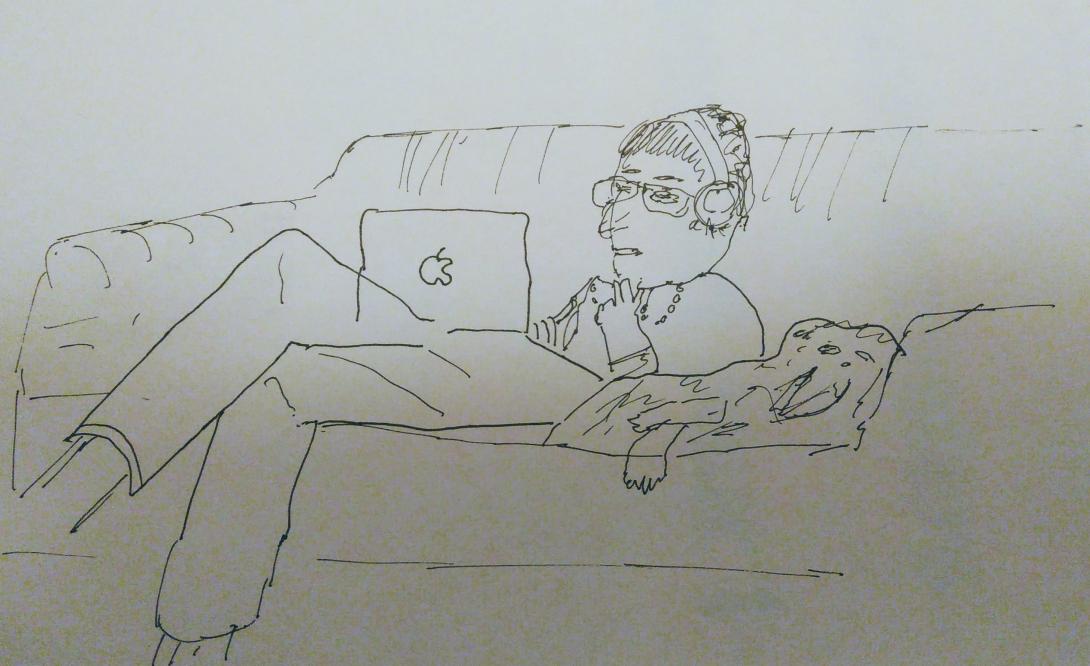
I’m halfway through the course now, and the drawing below is the first one I’ve produced that comes anywhere near looking like its subject. This is all rather remarkable to me, as I truly have considered myself to have no talent for drawing, especially with a third dimension.

The course—a series of very short videos punctuated by exercises—seems almost laughably primitive on first blush. But it gets to the heart of the matter rather ingeniously: to draw something you have to see it.

Which is to say that I need to turn off the “oh, that’s Oliver” part of my brain and turn on the “that line finishes just over top of that circle” part.

It turns out that drawing things that look like the things you’re drawing has an awful lot to do simply with getting angles and proportions right. And it turns out that’s a learnable skill.

I had no idea.

🗓️
Oliver  •  Drawing  •  Sketching  •  Ethan  •  Dan Misener  •  Sketchbook Skool

Google provides a way of browsing through and, optionally, deleting all or selected “OK Google” voice requests that you’ve made: it’s called My Activity > Voice & Audio, and while it’s useful, there’s no mechanism provided for downloading the voice snippets in bulk.

Which is just the kind of thing I’d like to do, for archival purposes, before deleting anything.

From the looks of it, nobody’s come up with an easy way to automate this, so I’ve developed a not-very-easy way of doing so.

Here’s what you need to do (using Firefox; if you’re using another browser you’ll have to use a different tool for the final downloading step):

First, login to the My Activity > Voice & Audio page for the account you want to archive requests for.

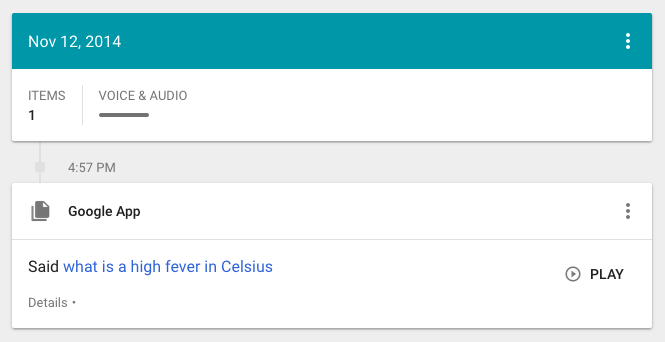
Second–and this is one of the not-very-easy parts–keep scrolling and scrolling (and scrolling) down until you see the very first of your “OK Google” requests. The page lazy-loads new requests as you scroll, so this can take a while. It took me about 10 minutes to get down to November 2014, where my first request to Google was “what is a high fever in Celsius”:

Screen shot from Google showing my first OK Google request in November 2014

Next, save the web page as an HTML file called voice-history.html. It will be a large file, but that’s okay.

Buried inside this HTML file are the Google URLs for the individual voice files, on lines like this:

<!----><audio-player ng-if="::!detailsItem" audio-url="/history/audio/play/1490302747998829"><button class="history-audio-button md-button md-ink-ripple" type="button" ng-transclude="" ng-click="controller.togglePlay()" aria-label="Play">

Extract all of these from the command line and into a text file:

grep "audio-url" voice-history.html  > audiourls.txt

Then use your favourite text editor to do some searching-and-replacing so that you end up with a plain list of URLs that looks like this:

https://myactivity.google.com/history/audio/play/1490367941523848
https://myactivity.google.com/history/audio/play/1490359331224911
https://myactivity.google.com/history/audio/play/1490302747998829
https://myactivity.google.com/history/audio/play/1490278534174703

Save this as a text file for later reference.

Next, open Firefox, and install the DownThemAll! add-on.

Making sure you’re logged in to the same Google account as you grabbed your voice history for, select Tools > DownThemAll! Tools > Manager. From within the new Manager window that opens, right-click and select Advanced > Import from File from the context menu. Select the list of URLs that you saved above.

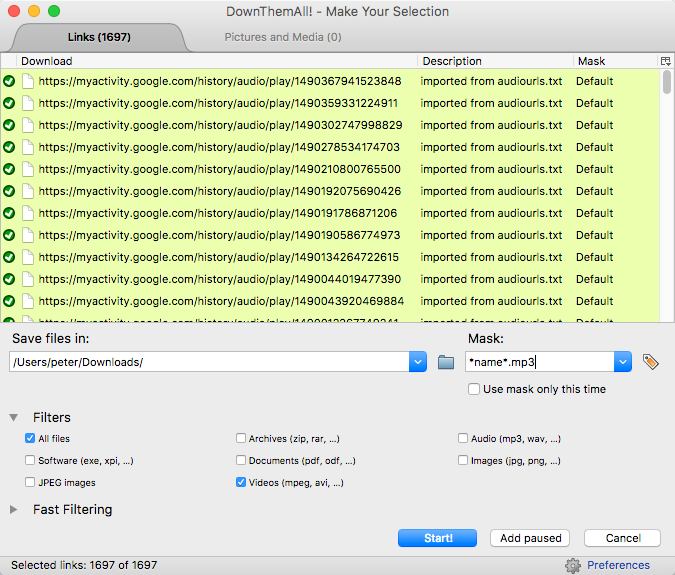
Once the list of URLs has loaded into the Manager, open the Filters section, and check “All files” to select all of the files for download. To ensure that the files end up with a .mp3 extension, edit the Mask field and change the contents to *name*.mp3. The result will look something like this:

Screen shot of DownThemAll! add-on showing MP3 files for download

Finally, click “Start” and then wait as Firefox downloads each voice snippets as an MP3 file; the add-on is very quick, and in my case the 1,697 snippets downloaded in a couple of minutes.

🗓️
Google  •  OK Google  •  MP3

At the Discovery Centre this week, we spent a lot of time experimenting with motors, gears and connectors.

Kind of by accident, I made this machine that translates the “circular motion” of a rotating gear into “back and forth” motion of a rod.

I’ve watched this video I shot over and over and over and it still looks like magic to me. But I’m pretty sure it’s the physical basis upon which my Golding Jobber № 8 letterpress works, so I feel like I should understand more about what’s going on. Physicists?

🗓️

From a profile in The New Yorker of Mo Willems:

Mounted on a wall at the back of the workspace was a Calder-like sculpture of a metal circle hovering beneath a metal bracket, and looped onto a metal triangle with a rope. Willems said that it was one of his “magnet doodles.” He took up metalwork after Cher suggested that he needed a non-remunerative hobby; soon he had made a grill for the back yard, a window guard for his daughter’s room in the shape of a large metal snake, and a car-size red metal elephant that lives at the Eric Carle Museum of Picture Book Art, in Amherst. Willems’s magnet doodle recalled the magic of science shows from childhood, but I’d never seen anything quite like it. “I used to feel that when I turned the lights out it collapsed,” he said.

From an interview in The Creative Independent with Michael Stipe:

Was it always important for you to have a creative outlet that was not connected to music making? Something outside the world of R.E.M. that was just for you?

Music was always like a beautiful fog around me. I’m very susceptible to music. Anyone who has been out to dinner with me, been out in public with me, will tell you how distracting music can be for me. It blocks out all other input. In a way, the band blocked out all this input for me for a long time. It made it very hard for me to be able to focus on other things, like reading books.

I was doing all these other things, I was learning all these other skills, either through the band or in conjunction with the work that I was doing with the band. At a certain point, I found myself surrounded by amazing and unemployed film people who wanted to do things. So Jim McCay and I put together a production company and started working with people like Jem Cohen and James Herbert. Through River Phoenix I met all of these other amazing people and eventually we started Single Cell Pictures and started working on films.

I love the phrase “non-remunerative hobby,” for it describes so much of what I spend my time on. I can’t imagine what it would be like to do only one thing, all the time, every day.

🗓️
Hobbies  •  Mo Willems  •  Michael Stipe

Like I did last year, I’ve assembled a list of the things we really enjoyed about this week’s March Break trip to Halifax:

  • The best meal of the trip was undoubtedly at EDNA. This place fires on all cylinders: transcendent staff, comfortable room, good music, absolutely fantastic food (the best gnocchi I’ve ever had, hands down). I’m only sorry we waited so long to search it out.
  • There’s been a shift in the coffee scene for the first time in a long time: Weird Harbour is now my go-to, replacing the venerable Two If By Sea. Overseen by the serene Dan Weir, the place evokes the good old days of ROW142 here in Charlottetown. Runner up is Narrow Espresso in the South End; the coffee’s not quite as good, but the space is fun and the folks are friendly.
  • Yu Yo was our favourite find of the trip: we went twice, and had good tea and great service both times. And bought more stationery than is healthy.
  • We really, really enjoyed the new Discovery Centre.
  • Fruition, in the Seaport Market, satisfied our need for a vegan eatery after a few days of non-vegan indulgence. It doesn’t get more “why on earth would you need a bun for a veggie burger?” vegan than this; the food was tasty, though, and we’ll be back.
  • Ethan’s favourite new thing was the Ardmore Park Service Dog Area; he loved it.
  • We stayed at the Hampton Inn Downtown, on Brunswick Street. It’s not the cheapest place to stay, but you can’t beat it for being central, with both the South End and the North End an easy walk, and Quinpool Road and beyond a straight shot up Cogswell. The rooms are clean, the beds comfortable, and the breakfast plentiful and hot.
  • Last year it was Oliver’s computer that needed fixing; this year it was mine. The Apple Store rose to the challenge again, and swapped a new battery into my 2011 MacBook Air with only a couple of hours wait (this is, by far and away, the longest any computer has ever lasted me; and it’s still going strong).

Meanwhile, Halifax appears to be continuing to eat itself: the downtown remains in a constant state of construction, with cranes and barriers around every corner. I’ve no idea who the market is for all the new office space and condos that are going up; are these new people, or just a rearrangement of people already there? The net effect of this, at least for the moment, is that Barrington Street, which was the vital heart of the city when I first visited in the 1980s, remains a veritable wasteland, and it’s not clear what the end game is. I suspect little will be settled if we return in a year’s time.

🗓️
Halifax  •  Restaurants  •  Coffee

About This Blog

Photo of Peter RukavinaI am . I am a writer, letterpress printer, and a curious person.

To learn more about me, read my /now, look at my bio, listen to audio I’ve posted, read presentations and speeches I’ve written, see things I’ve favourited elsewhere, or get in touch (peter@rukavina.net is the quickest way).

I have been writing here since May 1999: you can explore the 25+ years of blog posts in the archive.

You can subscribe to an RSS feed of posts, an RSS feed of comments, an RSS feed of favourites elsewhere, or a podcast RSS feed that just contains audio posts. You can also receive a daily digests of posts by email. I also publish an OPML blogroll.

Instagram • YouTube • Vimeo • ORCID • OpenStreetMap • Internet Archive • PEI.art • Drupal • Github.