Thirteen years ago on this day I wrote about Nagasaki:

The threat of nuclear destruction is still here today (nuclear powers would have you think it’s from terrorists; my money is on the nuclear countries themselves, through accident or intent), it’s just faded into the background.

Oliver is almost four years old now. He doesn’t know about Hiroshima or Nagasaki or the Holocaust or the Bataan Death March or any of the innumerable other inhumanities we have committed on each other. I am stymied when I think of how to begin to tell him. “Sorry, Oliver, humankind isn’t as great as I led you to believe originally…”

And now not so much in the background.

🗓️

I resurrect a series that had been in stasis for a year.

  1. Piatto, the pizza place on Queen Street, in the Kays Building, makes an awfully good cappuccino. They go on a little too much about it on the menu (“creating microfoam to top the coffee”), but ignore that. They hand-pull on a Pavoni, and they appear to be really good at it.
  2. The Garden Café on Kent, at 88 Kent Street, across from the Charlottetown Firehall where Interlude used to be, has an eclectic lunch menu. I had the spinach panini for lunch, accompanied by Greek and potato salads and a cup of tea. It was very good, and the service was warminhly friendly.
  3. The Bookmark, the local Charlottetown bookstore that keeps on keeping on, has proved an unexpected fount of knowledge on all things pen and ink. I’ve always known they carry art supplies; I never knew they knew so much about them.
🗓️

Oliver, to me, last night on our walk home from an Island Fringe show:

“I just realized that Košice and Bratislava are both in Slovakia.”

🗓️
Slovakia  •  Travel

From Olle, a pointer to Hygge, “a short text game about the ups and downs of moving to another country, daylight, school, kids, coffee, lifting weights, learning new languages, working from home, and travelling the world.”

I’m midway in; here’s my favourite part so far, a description of the 13 year old, who’s on the autism spectrum:

She’s weird, but she’s basically not much weirder than any thirteen year old girl. She’s going through the same changes. She just gets excited about things in different ways than everyone else.

Yes.

🗓️

I was coming out of Sobeys last night after shopping for the weekly groceries when I noticed some interesting weather to the north: huge clouds lighting up every 15 seconds or so with flashes of lightning.

I pull out my phone and pushed the “take a rapid succession of shots” button, and turned the result into an animated GIF.

Here’s a looping animation of one of the flashes:

🗓️
Audio file

Oliver made this piece of audio art by overlaying multiple TED Talks and then manipulating the audio in GarageBand on his Mac. I love this.

🗓️
Oliver  •  Podcast  •  TED Talks  •  Mashup  •  Audio Art

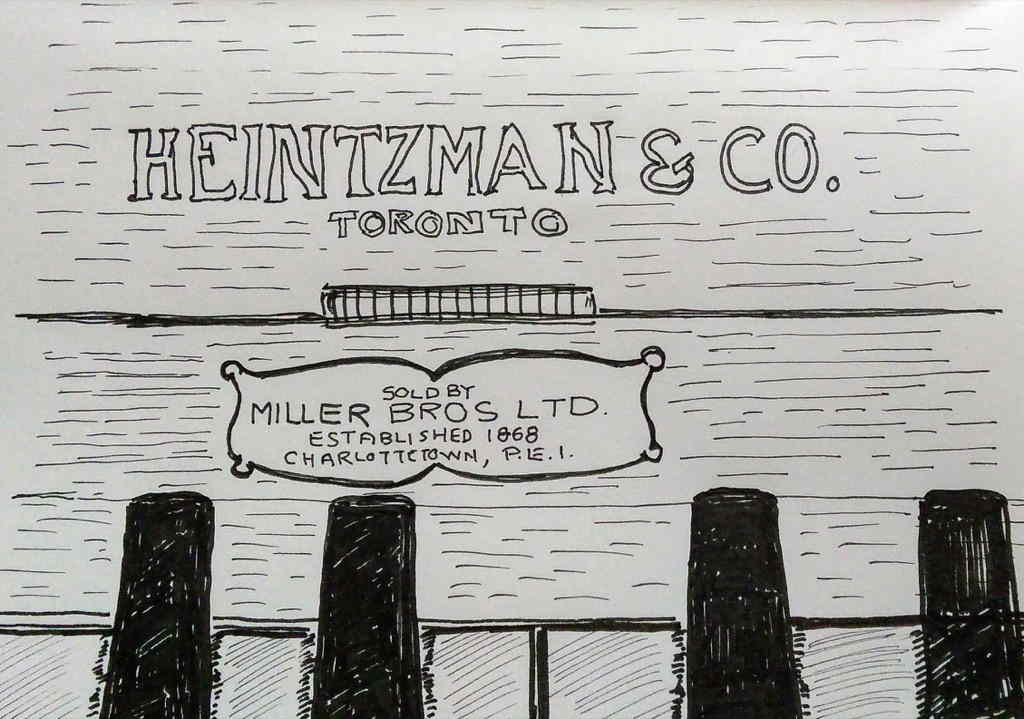
At the performance of Perk Up, pianist! today at the Haviland Club, Oliver and I sat beside the Heintzman piano in the back of the room (a piano only partially-working, and thus not the piano used for the performance). I took the opportunity to sketch the “Sold by Miller Bros Ltd.” label on the front:

Sketch of detail of Heintzman piano from Haviland Club, sold by Miller Bros

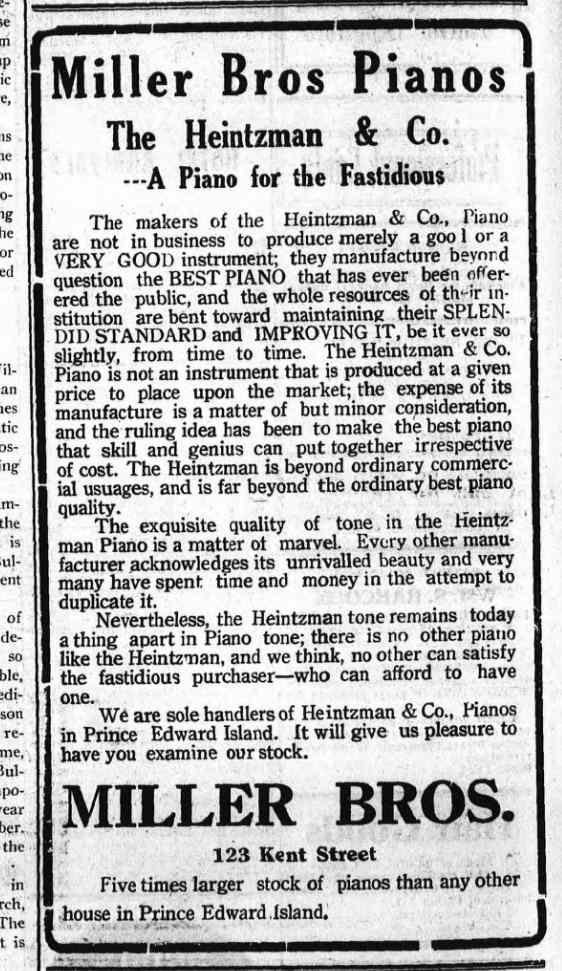
Miller Bros Ltd. was a Charlottetown institution for decades; you’ll find more than 2,000 references to the company in The Guardian over the years, like this one, from 1915 that mentions their Heintzman business:

Miller Bros Ltd. ad from The Guardian, November 10, 1915

🗓️
Pianos  •  Charlottetown  •  History

The summer programming in the theatre here at The Guild–a theatre located mere inches of drywall away from where I work away each day–includes Anne & Gilbert, Seussical Jr. and Dreamworks Madagascar A Musical Adventure Jr. running in repertory.

Because the managers of The Guild are frugal, the air conditioning in the building is only turned on when there are to be theatre patrons in the building for a show; otherwise we are left to sweat in squalor.

Today’s morning performance was Seussical Jr. at 11:00 a.m., and, sure enough, my temperature logger here in the Reinventorium shows the temperature starting to drop from an overnight high of 25ºC starting at 9:30 a.m., hitting a low of 20ºC almost right on the button for the 11:00 a.m. show start. Once the show was over, and the crowd dispersed, at 12:30 p.m. the temperature started to go up, and as I type this at 3:30 p.m., it’s up to 26ºC, which is only 1ºC cooler than the outside temperature.

Chart showing the temperature in my office from 9:30 a.m. to 3:30 p.m. today

The humidity followed a similar progression, taking a dip from 50% down to 44% starting at 9:30 a.m. and then gradually creeping back up (presumably, in part, because of the number of breathing patrons in the theatre), and then, with the air conditioning off at 12:30 p.m., taking a jump up to 52%. As I type it’s hovering around 50%.

Chart showing the humidity in my office from 9:30 a.m. to 3:30 p.m. today

Here’s a Humidex chart, originally from Environment Canada, that I pulled from the Canadian Centre for Occupational Health and Safety; it shows the “degree of comfort” for various combinations of temperature and humidity:

Humidex Chart

So at showtime, with a temperature of 20ºC and a humidity of 45%, the Humidex was 22, or “no discomfort.” I can attest to this: it was a very pleasant work environment.

Here at 4:00 p.m., though, with a temperature of 26ºC and humidity of 50%, the Humidex is 20, or “some discomfort.”

Now I’m not exactly exerting myself physically as I tap away at the keys here, so, even if we moved into the “great discomfort” range, I would likely be in little risk of heat stroke (even if I would feel as if in the rain forest).

The interesting aspect to all of this, however, is how I’ve developed a Pavlovian response to the presence of musical theatre in my midst.

No matter the degree of joy that the singing children bring to themselves and to the audience, you might think that you can only listen to “I like to move it, move it” so many times before you wish ill of those behind the 4th wall, but this is significantly mitigated by the improved working conditions that “I like to move it, move it” brings with it via its air conditioned comfort.

To the point where I now look forward to the stirring courses of Anne, King Julien and The Cat in the Hat.

Such is life here abreast the theatre.

🗓️
The Guild  •  Sensors  •  Temperature  •  Humidity

I was feeling kinda down after lunch today, not particularly enthused about a trip right back to the office; not a mid-life crisis, just a dip in the shields.

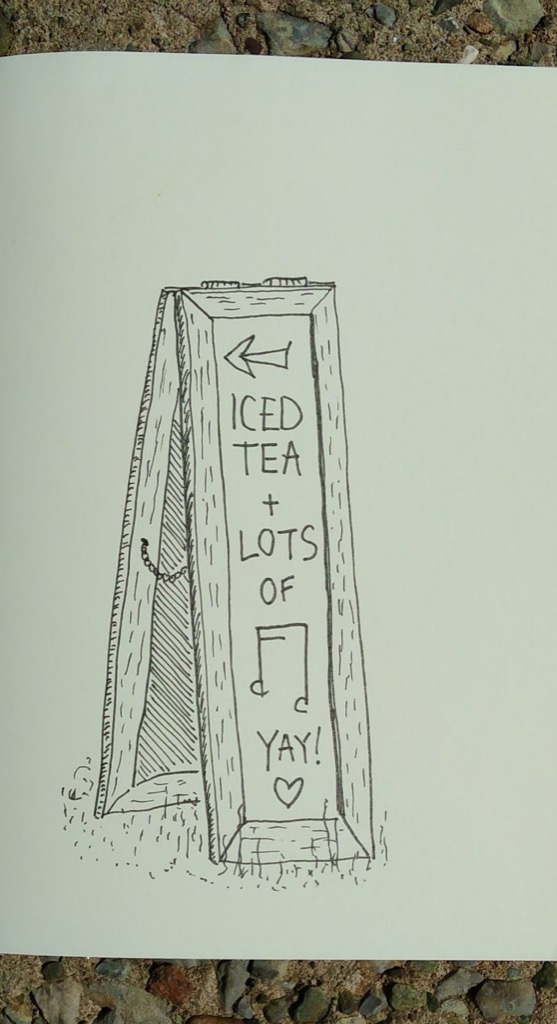
I decided to swing round Brìgh Music & Tea instead of heading straight back to work, and was greeted by this new sandwich board out front:

Brigh Music and Tea Sandwich Board

They had me at “Yay!” and I stepped into the banjo-filled air-conditioned oasis, had myself a cool berry tea and one of Katlin’s sea-salt and caramel chocolates and a little bit of a chat (children, cellos, Go Tell Aunt Rhody, and whether a “free banjo with every 5 cups of tea” would be economically sustainable). And then I emerged into the sun, made a quick sketch of that which brung me in, and I’m back at the office with shields at full strength.

🗓️
Brìgh Music & Tea  •  Charlottetown  •  Tea  •  Music  •  Chocolate

Coyotes are again in the news here in Prince Edward Island, with the CBC reporting ‘I could have lost my daughter’: Pack of coyotes stalks girl in P.E.I.

The 2001 report of the Environmental Advisory Council, Coyote Management in Prince Edward Island, is a helpful document for putting coyotes in context.

Coyotes are not native to the province; they arrived on the ice in the early 1980s:

Originally an animal of the Western Great Plains, the coyote began extending its range following European settlement of that region during the late 19th century. The extirpation or reduction of timber wolves coupled with land settlement and clearing apparently facilitated its range expansion. Coyotes arrived in New Brunswick in the 1960s, Nova Scotia in the 1970s, Prince Edward Island in 1983, Newfoundland in 1987 and the Magdalen Islands in 2001 and occur in all jurisdictions in Canada, the United States and much of Central America. They are capable of lengthy treks across ice and have been observed and photographed on ice flows far from land in the Northumberland Strait and in the Gulf of St. Lawrence. The first coyote recovered in Prince Edward Island was snared near Souris in November 1983, although previous sightings of coyotes had been reported.

Following their arrival, the coyote population increased rapidly, particularly during the late 1980s and early 1990s, almost doubling annually, a pattern similar to that observed in other jurisdictions. They dispersed to all available habitat and by 1998 the population showed signs of reaching peak numbers according to harvest records collected by the Fish and Wildlife Division. Similarly, coyote populations in New Brunswick and Nova Scotia reportedly showed signs of leveling off approximately 15 years after the first specimens were recovered. Coyotes currently occupy habitat throughout the Island.

As with attempts to eradicate cats in (the other) Prince Edward Islands, attempts by humans to eradicate coyotes elsewhere have proved costly and unsatisfying:

There is no practical way of preventing the natural increase in coyotes. History has shown that poisoning, trapping, shooting from snowmobiles and aircraft, hunting with hounds, and bounty incentives, have consistently failed to reduce their numbers. Nova Scotia’s experience with a $50 bounty during the 1980s emphasizes the futility of coyote control. In spite of the bounty, the coyote population continued to expand at the same rate in Nova Scotia as it had in New Brunswick where there had been no bounty, practically doubling every year. The total cost of bounties paid for coyotes went from $2,250 to $22,100 in four years before Nova Scotia eliminated its bounty.

Since most coyotes are not problem animals, it makes sense to direct efforts at controlling those coyotes that prey on livestock or, even better, preventing the problems from occurring in the first place. A program aimed at reducing the whole coyote population might actually increase livestock predation by stimulating females to have larger litters. This, in turn, would increase the demand for food by these animals during spring and summer, at a time when livestock are most vulnerable (Sabean, 1989).

In other words, coyotes are here to stay, and there’s not much we can do other than learn to share the Island with them; the recommendations of the Environmental Advisory Council echoed this, emphasizing, in its 12 recommendations, adaptations and monitoring over eradication.

That report, by the way, is a model of clarity: it provides context, solid research, and well-worded recommendations. All such efforts should turn to it as a template for how to conduct their work.

My favourite part of the report, by the way, is the summary of the telephone calls that came in to the “Nuisance Wildlife Hotline Response” that were coyote-related, a list that includes:

  • Date: 07/25
  • Nature: Around dwelling
  • Description: Neighbour’s cats are disappearing
  • Location: York
  • Action Requested: What can we do?

In addition to its diagnostic utility, this report could also be optioned as the basis for the next hit Netflix miniseries.

🗓️

About This Blog

Photo of Peter RukavinaI am . I am a writer, letterpress printer, and a curious person.

To learn more about me, read my /now, look at my bio, listen to audio I’ve posted, read presentations and speeches I’ve written, see things I’ve favourited elsewhere, or get in touch (peter@rukavina.net is the quickest way).

I have been writing here since May 1999: you can explore the 25+ years of blog posts in the archive.

You can subscribe to an RSS feed of posts, an RSS feed of comments, an RSS feed of favourites elsewhere, or a podcast RSS feed that just contains audio posts. You can also receive a daily digests of posts by email. I also publish an OPML blogroll.

Instagram • YouTube • Vimeo • ORCID • OpenStreetMap • Internet Archive • PEI.art • Drupal • Github.