
Today was International Museum Day. I hope you knew that, because if you did you would have taken the day off and gone to the museum. And it would have been free, and you would have had a good time.
This morning Oliver and Catherine headed out early to the Museu da Quinta de Santiago, just 5 minutes from our house here in Leça da Palmeira. This being International Museum Day, the museum was unveiling its new audio guide, and Catherine and Oliver had the privilege of being the first users.
After lunch, we headed over the draw bridge to the Metro, and headed south to the Casa da Música station, located next to the Casa da Música, a building that deserves its own visit:
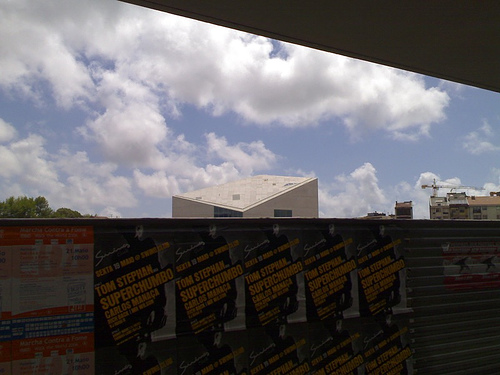
Once there we hopped on the 201 bus and headed towards the ocean, getting off about a mile later near the Fundação de Serralves, our destination.
Fundação de Serralves is a veritable museum-, art-, and park-lovers paradise: the sprawling verdant grounds house the Museu Serralves (a museum of contemporary art designed by Alvaro Siza — see my post about visiting the tea house he designed), Parque Serralves (home to a rose garden, scented garden, working farm and innumerable other delights), and Casa Serralves (an historic home, and extension of the museum).
Like the Casa de Chá Boa-Nova, Siza’s museum building feels like part of the landscape; this is not “big dick architecture,” but something rather more heartfelt and organic (although still monumental and awe-inspiring). In many ways Siza could be considered a sort of antithesis to Frank Gehry.
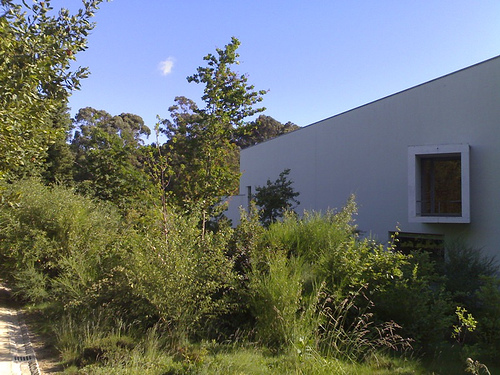
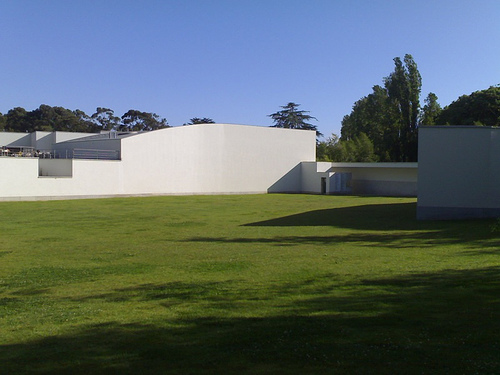
Having forgotten to eat lunch and thus being somewhat catatonic (see 2005), we began our visit with a trip to the fourth-floor cafeteria (although because of the nature of the building, the effect is more “second floor” than fourth) and had a tasty meal of pasta, sandwich and drinks.
Next we conducted a whirlwind tour of the contemporary art; nothing hit me over the head with a rake, but it was all interesting, and Oliver was especially impressed by a room full of paintings all of which incorporated the letter ‘T’ somehow.
After the museum, we headed down the entire length of the property towards what was promised as a “working farm.” In turn this took us past a rose garden, through a towering forest, past a tea house hidden in the woods, through a huge garden of scented plants and finally to an intriguing collection of stone farm buildings surrounded by an organic vegetable garden in full bloom. In one of the buildings we found some very, very long-horned cattle, some rabbits, a horse, some ducks, a turkey and a pheasant. It was all very bucolic. And thus a rather unusual part of a contemporary art museum.
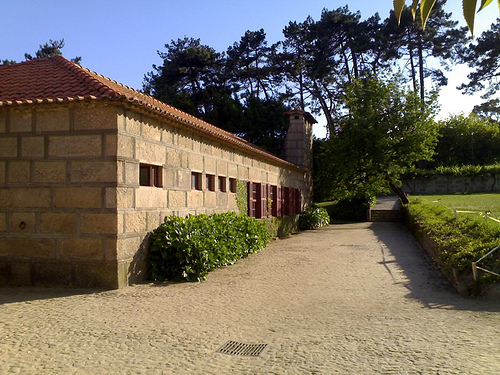
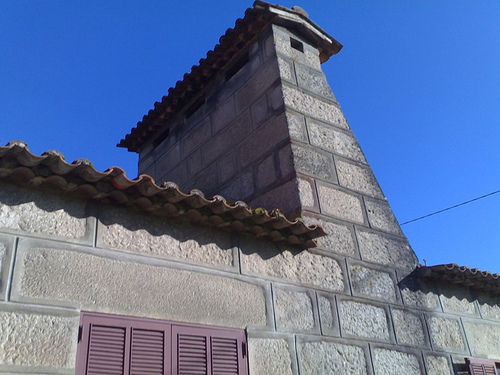
The 7:00 p.m. closing time drawing nearer, we dashed up the spine of the park, through the rose garden, and made it to the front entrance just as things were winding down for the day.
We thought we would have plenty of time to spare, but as it turns out we’ll have to plan another visit to be able to see it all — we skipped half the grounds, and the entire Casa Serralves. I can’t think of a better way to have celebrated International Museum Day, though.
Catherine decided to take advantage of the early opening date for the Da Vinci Code movie here in Portugal (it opened here today, one day in advance of the U.S. and Canada), so she headed off to the multiplex at Norteshopping via bus and metro while Oliver and I hopped on the handy 502 bus that took us right back to the Mercado metro station, passing through the north end of Porto, by the ocean, and through Matosinhos on the way.
Oliver and I enjoyed a dinner of leftover pasta, codfish cakes and potatoes, read Pinocchio in Portuguese, and had some chocolate cake before dinner.
Who knows what we’ll do tomorrow.
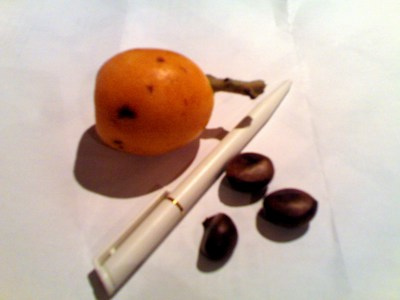
Okay, here are two tasks for the smart ones in the readership to help me with.
First, I came across a well-designed OS X application that made manipulating Flickr photos and tags and descriptions much easier. It was heavy on the clean typography and was well-designed. Might have actually been a web app. Might have had a name like “Meebox” or something like that. Any ideas?
Second, we have purchased a type of fruit here in Portugal that is new to us. About the size of an apricot with an apple-like exterior and a consistency and taste somewhere between peach and pear. Two largish pits at the core. Orange or “ruddy” colour. Our local grocer can’t tell us what the name in English is.
Catherine takes photos too. Be prepared for many windows and doors and interesting buildings (as opposed to the “no dogs allowed” sign photos that you’ll see in my Flickr).
What’s the main problem with an invisible restaurant? It’s hard to find the door. Thus our problem finding our way into the Casa de Chá Boa-Nova — the Boa Nova Tea House, a restaurant of some reknown here in Leça da Palmeira designed in the mid-1960s by Portuguese architect Alvaro Siza. Siza’s design, it says here:
…is about ‘building the landscape’ of this marginal zone on the Atlantic - through a careful analysis of the weather and tides, existing plant life and rock formations, and the relationship to the avenue and city behind.
In other words, the place blends in in a deeply serious fashion. So we found ourselves coming around the back by mistake, and having to ramble over some serious boulders to get to the front door.
It was worth it. Catherine said it was like eating at Frank Lloyd Wright’s house — and it was:
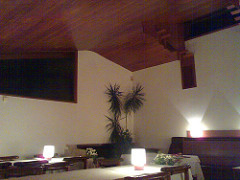
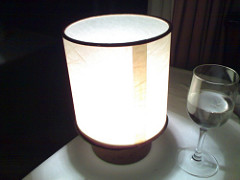
As I’d managed to fumble my way through making a reservation over the phone, a table was waiting for us. But for a large German tour group spread out over half the restaurant, we almost had the place to ourselves.
Our head waiter was Balthazar — we know his name because Oliver asked him — and the service was a perfect in that “slightly officious but with knowing winks to let you know that everyone’s in on it” kind of way. I continue to be amazed at how taking Oliver to a chi chi place for dinner — in a way that we would never imagine doing at home — seems like second nature over here; he was well cared for.
We started with appetizers of seafood soup (me) and avocado and seafood (Catherine and Oliver). Main course was “sea perch” for Catherine (she said “like perch, but bigger”) and grilled hake for me, with Oliver sharing all ‘round. On the side was creamed spinach and boiled potatoes. Service was interesting: food was rolled to the side of the table on individual large platters and then served in two identical “settings,” each on a clean plate. It was very civilized and makes me think everyone should do it that way.
For dessert I had a chocolate mousse (I am a creature of habit) and Oliver and Catherine shared a banana split (when I say “shared” I mean “Catherine got one bite”). I finished off with a cup of strong black tea (it being casa de chá after all).

I can tell I’m getting euro-acclimated: the 1/2 bottle of wine for dinner is making me less loopy. At least I think it is.
After what ended up being an excellent dinner in a stunning sea-side location, we headed off on a brisk 30 minute walk home along the beach, which was a great way to end the night.
Every time I’ve set up my GSM mobile phone with a new SIM card (see What is a SIM card?) previously, it’s involved a somewhat complex process. For Croatia and France I ordered before traveling from Telestial and the complication was mostly in the time and expense (about $60 to get started each time). For the U.S. (T-Mobile) and Switzerland (United Mobile) I bought SIM cards once in-country, and there was, in both cases, lots of paperwork and showing of ID, and it took about 30 minutes. It took about the same amount of complication to get a Rogers SIM in Canada.
Last night I walked into the FNAC outlet at Norteshopping, picked up an Optimus SIM card package from the rack, paid 9,90 EUR at the checkout and walked out. It took about 2 minutes. This morning, Catherine walked up to the local post office and did something similar, for the same cost, and ended up with an UZO SIM card.
For both of us the process of getting our mobile phones working was: insert SIM card and turn on phone.
Both the Optimus and UZO packages had the phone number and PIN for the SIM card included in the pack. We didn’t have to dial up anyone to register or activate service; it just worked.
So we’re now both toting Internet-surfing, call-making mobile powerhouses (I’m carrying my Nokia N70 and Catherine’s got my old T610). Of course we’ll mostly just end up calling each other to see if we need anything from the bakery on our way home (although if you dial up Reinvented and “press 1 for Peter,” you’ll ring through automagically to Portugal too; I’m just waiting for my first telemarketing call).
What with all the vigorous museum going the day before, yesterday we took things slowly. That Oliver woke up at 6:00 a.m. forced Catherine and I into an extended bout of tag-team sleeping and child-rearing that let us both emerge, by noon, with our wits somewhat about us. We took the afternoon “off” and rambled about the house, had a tasty lunch of cheese sandwiches, and by 5:00 p.m. we were ready to climb back onto the horse of adventure.
While we like the museums and ye olde architecture and the old world ambience as much as the next couple, Catherine and I have a secret love of overseas retail as well; Europe might not have invented the shopping mall (well, I think they actually did, back in the middle ages) they’ve certainly refined it to high art. And we’re suckers for that. So Monday became “a day at the mall.”
Although I’m becoming better at figuring out how Portuguese works, I still found it somewhat difficult to figure out how to actually get to the mall by public transit. Either nobody every goes there that way (malls are, after all, a car-centric invention), or the directions were hidden away in Google behind a keyword I could never find, but when we headed out to the Metro, I was only about 25% confident that we weren’t going to have to jump across several freeways to get there.
As it turns out, it’s really, really easy to get to Norteshopping (“the mall”) by Metro: you just get off at the Sete Bicas station (only 15 minutes from Mercado near our house), and walk one block left out of the station and one block left from there; the mall is on your right (I had help from a policeman along the way, but it’s really very obvious).
Norteshopping didn’t disappoint. Here are some of the highlights:
- A food court to end all food courts; I had a bowl of hearty soup, a salad of green beans, lettuce and mushrooms, a fresh roll, and a glass of fresh-squeezed juice all for 5 EUR; Catherine and Oliver had what she called “the best Chinese food I’ve had since I was in Vancouver last year.”
- A “check in your children” centre: parents can enjoy the delights of the mall while their children are, for 2,50 EUR/hour, cared for by trained (English-speaking) staff in a centre that includes 10 “theme areas” running the gamut from “dance and movement” to “new technology.” Think “the IKEA ball room, but with intention.”
- Stores the likes of which you’ve never seen; for example: at least a dozen stores devoted entirely to children and mothers: maternity wear, strollers, car seats, furniture, shoes, toys.
- A giant working steam engine. For no seeming purpose whatsoever other than to illustrate the principles of steam engines. Oh, and the steam feeds an espresso bar.
- An art gallery. In the middle of the parking garage. You have to see it to believe it.
- A multi-plex with shows that run to 3:00 a.m. every day (!)
The whole mall itself is open until midnight every night. We came close to just moving in.
But 9:30 p.m., after experiencing all of the above and doing our grocery shopping to boot, we headed back home. Twenty minutes later we were ensconced in our little stone house back in the last century.
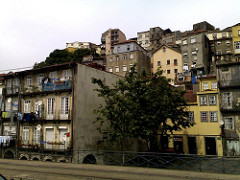 On Sunday, after considerable recuperative sleep, we decided to venture into Porto, the large city to the south of us (and the country’s second-largest city; I called it “Portugal’s Summerside,” but that doesn’t really do it justice).
Access from Leça da Palmeira to Porto is dead simple: walk over the swing bridge and get on on the shiny new Metro at the Mercado stop for a direct train into the city. The Metro — more of a streetcar out here in the suburbs — uses the same cars they have in Montpellier, France that we rode last year; they’re Canadian Bombardier Flexity models that are the cat’s pajamas as regards cool “feels like your in the future” urban transportation.
Forty-five minutes later we emerged at the São Bento stop, in the hear of “old Porto.” Ten minutes down the hill we found the Douro River, one of the features that provided the rationale for traveling here. It is a sight to behold, and perhaps the grandest urban river I’ve yet to encounter. Much of its majesty derives from the steep banks that surround it: Porto rises dramatically from the banks, almost vertically in places. There are also the famous “six bridges” over the river that, like Halifax, let you mark your location in the city.
After a quick lunch at a riverside café (accompanied by buskers), we took advantage of the generous Sunday opening hours of Porto museums (3 p.m. to 7 p.m.) to walk the river and make a museum day.
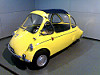 First stop was the Alfândega, home to the Museu dos Tranportes e Comunicações — the Transport and Communications Museum. This museum holds an impressive collection of 20th century automobiles, starting with a car built in 1903 and ending with a 2005 Toyota Prius. The building is as impressive as the cars; it’s a former customs house, and the floors are lined with rails used, in its former life, to roll cargo around.
 Next we headed west down the river to the Museu do Vinho do Porto, a subterranean space (also a former customs warehouse) with exhibits detailing the history of the port wine trade in the city. Most interesting to us was the exciting metal-enclosed washrooms and the generous kids area, with a giant rug-map of the city and a Rubic’s Cube-like puzzle of a Porto bridge scene.
At this point in the museum-going day, Oliver started to flag a little, becoming obsessed with taking pictures of obscure setups that he had difficulty communicating; we thought we were going to hit a wall, but a sudden breath of rain renewed our fire, and we continued down-river to the trolley museum.
Run by the local public transit authority, the Museu do Carro Eléctrico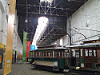 is a towering building (overseen by perhaps the nicest museum attendant I’ve ever met) filled with trolley cars from Porto’s history. While once the dominant vehicle for public transit, the trolley system has contracted to a San Francisco-like waterside line that appears to exist more for tourists than for practical use; the museum keeps the old trolleys, all in excellent shape, around for the next generation. Best of all, as kids (and fathers and mothers) are concerned, you’re allowed to jump right up inside most of the cars (all but the most ye olde ones). And the ticket to the museum (2 EUR a person) includes a ride back up the side of the river on the working trolley (which makes a lot of sense for a museum located at the end of a long line of museums, with its resulting role as an “end point” of a museum day).
Sunday being Mother’s Day, at least in North America, we couldn’t let the fun die just then, so we walked back the hill to the Metro, made our way back to Leça da Palmeira and, after some hungry aimless wandering, found a restaurant waiting for us.
The beauty of being overseas for Mother’s Day is that it’s not Mother’s Day for anyone else, so we had the place entirely to ourselves; it was as if Oliver and I had bought out all the tables and reserved the sole waiter to serve us personally. We started dinner with an entrée of fried mushrooms and coleslaw; we also received a complimentary dish of what we suspect was blood sausage — smoky, spicy, deep red — that Oliver quite enjoyed, chewing his way through two big pieces (we can’t get him to eat Chicken McNuggets, but he’ll happily eat spicy blood sausage; if he’s not careful he’ll be kicked out of childhood). For main dish, Oliver and I both had fried local whitefish served with a side of carrots, garlic cabbage and french fries; Catherine, who wasn’t quite sure what she was ordering, ended up with a large bowl of spicy rice topped with shrimp, shellfish and a large fried egg. It was all very good. For dessert Oliver and I split a chocolate mousse and Oliver and Catherine split a chocolate crepe (which explains why Oliver got a sudden burst of energy). Oh, and somewhere in there we polished off a bottle of Ferreira Esteva, which explains why I got a sudden burst of inability to walk straight.
By the time all was said and done, we got home at 10:30 p.m. and tumbled slowly to sleep. Oliver, bless his heart, decided to wake up at 6:00 a.m. the next morning…
 After getting settled in our house here in Leça, Oliver and I headed out to see what we could see. Walking over the swing bridge to Matosinhos, we noticed a bunch of military-looking ships docked right next door, with what appeared to be civilian tours going on. Never ones to shy from a good “crawling around a ship” opportunity, we diverted off the bridge and into the dockyard, acting as if we knew what was going on, and walked up onto a German frigate that looked inviting.
Oddly, we seemed to essentially have the run of the ship, and could walk freely about looking in all the nooks and crannies. Things were a little more formal on the Portuguese frigate moored right beside: there we had to go around with a tour (in Portuguese, of course) led by a fresh-faced sailor. But even there we had the run of the operations room, and apparent free access to a bunch of items marked “NATO Confidential.” Oliver was especially enamored of the shipboard helicopter, rolled out of its hanger to make a sort of children’s playground.
Further down the dock we found a U.S. ship moored beside a Canadian one — HMCS Athabaskan; unfortunately the Americans and Canadians were less hospitable, and didn’t invite the public in for a tour but instead had several imposing looking “you don’t even want to think about walking over here” guards on duty.
We took lots of photos of our tour.
Okay, here I am. It turns out that trying to vacation, and work, and attend to the postcard-sending needs of your 5-year old and recover from jet-lag do not pre-dispose one to blogging. Actually I have been pre-disposed, just without time. So here are a couple of catch-up posts to bring you up to today on our exciting euro-travels.
When I last wrote, we were in Dublin, about to head to Portugal. The next morning we caught a cab from our hotel (but for the slightly-too-tiny beads, I highly recommend Egans House for Dublin lodging) out to the airport; it was a quick trip, with no traffic, and we arrived exactly 2 hours before our flight, which is the Ryanair recommended arrival time.
Ryanair, despite its miniscule fares (129 EUR, all taxes in, for three people to fly from Dublin to Porto), was an excellent experience: the plane boarded quickly, left on time, arrived 30 minutes early and was staffed by pleasant flight attendants and a chatty flight deck.
The Porto Airport is stunning: huge open spaces, very quick passage through, very good signage. We were met by a helpful man, friend of the owner of the place we’re renting, who piled us and our luggage into his Volvo and drove us door to door.
We’re renting a house here in the community of Leça da Palmeira, itself a part of the city of Matosinhos, which is just north of the large city of Porto. Leça has a sort of triple identity: gritty industrial suburb, lovely beach-side town and workaday Portuguese community. The resulting mix makes it perfect for us, and the house is everything we could have dreamed of. Oliver is especially impressed with the fully equipped kids’ room, complete with “cave bed” and complement of excellent toys.
About This Blog
 I am Peter Rukavina and this is my blog. I am a writer, letterpress printer, and a curious person.
To learn more about me, read my /now, look at my bio, listen to audio I’ve posted, read presentations and speeches I’ve written, or get in touch (peter@rukavina.net is the quickest way).
I have been writing here since May 1999: you can explore the 25+ years of blog posts in the archive.
You can subscribe to an RSS feed of posts, an RSS feed of comments, or a podcast RSS feed that just contains audio posts. You can also receive a daily digests of posts by email.