
Back last year at the tail end of my trip to Copenhagen for reboot, Nikolaj Nyholm and I took a walk in a park and he related to me his new involvement with a bunch of brilliant image processing minds. That “involvement” eventually became a living, breathing project, termed Polar Rose.
The company’s task is to develop applications that will “give meaning to digital photos and allow these to be indexable just like text documents on the web are today.” In its simplest form this means “automatically figuring out who’s in photos.”
After a long development ramp-up, Polar Rose launched a private beta of the current version of their web-based system today, and after a bit of ego-surfing to web to locate photos of myself, this is what it looks like:
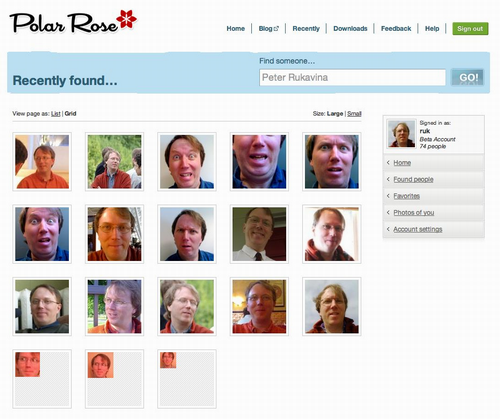
In its current incarnation the Polar Rose beta is built around a Firefox plug-in that, as you browse the web, sticks a clickable icon on top of any image where it can pick out a person’s face. At your option you can click on the image and provide the name of the person it has identified. This data gets sent to the Polar Rose server where it joins their index of “who’s in photos.”
Ultimately — although not yet in its public form — their technology will be able to automatically identify people in photos using the clues it has obtained from previous human-submitted identifications.
Obviously this has some significant implications for privacy. For some people it’s problematic to have anonymous photos of themselves on the web, let along ones that can be Googled. In this blog post from last December Nikolaj attempts to address some of these concerns. This is certainly an ongoing issue, and one they’ll have to be ever-vigilant about addressing as they move forward.
As with other self-inflicted wounds against my personal privacy (see Plazes et al), I think it’s important to dive headlong into experiments like Polar Rose precisely because of the privacy implications of the technology. I don’t want Wal-Mart to be able to auto-tag me as I roll in the front door, but you gotta imagine that it’s coming soon. To say nothing of CSE and their ilk.
At the very least I want to have some personal familiarity with the technology terrain before this happens so that I can understand what evil can be wrought against me; otherwise I’m just a naive sitting duck.
All that said, the technology that underlies Polar Rose, when it’s working full tilt, is one of those things that will appear tantamount to magic (it’s already pretty magical that it can figure what’s a face and what isn’t). In other words, it’s pretty cool.
It’s been almost two weeks since I released PresenceRouter into the wild. While it’s been interesting for me to deploy an actual working desktop application for the first time, more interesting has been to see how, in a small way, an application can stitch together disparate services, services that might even otherwise be seen as competitors, into a cooperative eco-system.
While the application has Plazes at its heart, here’s an example (and here’s another) where I’ve been providing PresenceRouter support inside Jaiku (that has a way of commenting on presence streams that Plazes doesn’t).
I knew that there was support to offer because I have a Google Alert set up for keyword “PresenceRouter” that pointed the way.
Since I’ve been sending my presence information to Twitter, I’ve started to actually use Twitter again, and I’ve been using its “direct message” feature to communicate there about things that, in a sense, “happened” on Plazes.
And, even though I have my suspicions that it might all be a house of cards built of University of Phoenix advertising, I even find that, now that my presence trickles through there too, I’m visiting Facebook more often.
All of which is causing me to be more vigilant about my Plazes presence, and a more active user of Plazes itself.
After two weeks, the lines between Jaiku and Plazes and Twitter and Facebook are starting to blur and I’ve begun to conceptualize them as neighbourhoods of the same town, or tools in the same toolbox with different strengths, rather than distinct destinations unto themselves.
Last week my friend Fred Louder gave me an issue The New Quarterly in which some of his poems ran. In the same issue there was an essay by David Helwig about his life in the theatre scene in Peterborough, Ontario in the 1950s.
Having wandered on the fringes of the theatre scene of Peterborough in the late 1980s, I was struck by how much of what David wrote about echoed my own experiences 30 years later. Peterborough it seems, especially the ragamuffin world of small theatre, never changes.
Something born out for me again after reading about plans for a new theatre space in the city. A space that references The Union, a earlier incarnation of much the same thing that I was present at the conception and birth of (including one particularly drawn-out session in which the name of the space was chosen; in the end it came down to “Kitchen Sink” vs. “The Union”).
Just to neatly tie this thread together, it seems that David Helwid is, in addition, the father of Maggie Helwig, a friend of many Peterborough friends, including my friend Stephen Good. Who, if memory serves, was a member of the cast of at least a few productions mounted at the aforementioned Union.
I have now passed the David Helwig essay on to my friend Ann, resident of Peterborough in the 1970s, to confirm or deny that the scene of that era blew the same way.
Summertime television being what it is (which is mostly variations on The Bachelor), and having watched all the reruns of Food Jammers and No Reservations, I swapped out the digital channels on the cable box for a summer of The Movie Network. This affords us access not only to various and sundry movies, but also access to various HBO and Showtime series. No commercials (except for the annoying interstitials for The Movie Network itself). And some not-too-bad television for hot summer nights.
On the series side, I have decided that I am pro-John from Cincinnati (which seems to be a series that you either love or hate), neutral on Durham County (so far there’s too much “bashing in heads with large rocks” for my taste, but we’re only one episode in), and completely over the moon for the television version of This American Life (all other things being equal, I would marry Ira Glass in a heartbeat).
On the movie side, last night I stayed up late to watch Shut Up & Sing, a movie about the Dixie Chicks travails over recent years. It was a well-produced documentary that turned me into a Dixie Chicks fan. It also made me afraid to enter vast swaths of the USA.
A few nights back we watched This Film Is Not Yet Rated, a documentary about the MPAA and the film rating system in the USA. I left with a similar distaste in my mouth about America’s thin-skinned xenophobia. The film is also well-produced, with an interesting through-line centred around a private detective hired to out the identities of the secret panel of “concerned parents” that does all the rating. The heart of the movie, however, is an extended discussion of the implications of Maria Bello’s pubic hair.
I recommend both films.
I am spending the afternoon making my way through the wonderful tutorials that NASA has available to explain their SPICE system. Here’s my favourite slide so far, which serves to explain the meaning of the technical term “kernel” within the SPICE world:

From Fabrica, a link to Die Electric, a delightful exhibition of alternatives devices for plugging into electric sockets, including OFF, The Light Switch Hook:

OFF, the light switch hook, provides a hanging function when in the OFF position. It is a fully functional light switch. It was designed to persuade people to use less energy.
Permit me to offer this one observation on the meeting of The Right Honourable Stephen Harper and Honourable Robert Ghiz yesterday: our Premier wears a suit much, much better than our Prime Minister …




This is neither a political observation nor a personal attack, simply an observation of fashion sense. Fashion is, depending on your point of view, either everything or nothing. (Images are stills from last night’s Compass).
Anyone who knows how I actually work knows that I am a completely iterative learner. Which is to say that when faced with a new challenge in unfamiliar territory I simply dive in, see what works and what doesn’t, adjust, and repeat. Ad infinitum. Until I get where I’m going.
This is how I code astronomy applications in Perl, and it’s also how I find a vegetarian restaurant in Lisbon. If you’re along for the ride on an iteration that works it seems like magic; if I drag you along for the 25 iterations that came first it seems like I am insane.
I used to think that everyone worked this way, but apparently some people prefer to take the “get completely educated about the domain, then implement” route. Which is probably more efficient, but is much less fun and cuts out the opportunity for collateral learning.
In any case, this morning I watched Oliver engage in a classic case-study of iterative learning.
Oliver cannot type. Well, he can type, but as he cannot yet write words, his typing is limited to entering his Mac OS X password, and his first name. Because of this, he’s generally limited to visiting websites for which he has pre-established bookmarks (Treehouse, CBC, Croatian State Television, etc.) or websites that are linked to therefrom.
And let’s face it, no matter how much fun that Nana’s Helper game is to play, eventually everyone needs variety in their life.
I witnessed Oliver’s solution to seeking variety, given his inability to type new URLs or search for new content, this morning.
He’s figured out that if you drag a URL from your Firefox toolbar into the Firefox Google search, and then (and this is the important part) click on the “Images” tab in Google, you’ll see something like this collection of images. In other words, a visual list of related links. The rest is easy.
All of which explains how Oliver ended up at the Civil Rights Treasure Hunt website this morning without typing a single letter.
This solution, one that I could have never possibly imagined and thus would never have thought to teach him, was brilliant in a way that brought tears to my eyes. And it served to reconfirm my deeply-held belief that, at least for some sorts of kid learners, the best thing to do is to just get out of the way.
Remember good old Marine Atlantic? They used to run the ferry service from PEI to the mainland, and they still run the ferries to Newfoundland.
As Oliver and I are plotting travel plans for later in the month, I visited their website looking for information on possible sail-to-Newfoundland options. Being new at this, the first thing I wanted to know is exactly where they sail to.
While I can easily, find a page about their Gravol sales policy it took me 15 minutes of searching to find a bad map of their terminals in Newfoundland. Sigh.
Moo. Because of blog posts like this. Meanwhile, Oliver’s stickers have been dispatched. Shhh, don’t tell him.

About This Blog
 I am Peter Rukavina and this is my blog. I am a writer, letterpress printer, and a curious person.
To learn more about me, read my /now, look at my bio, listen to audio I’ve posted, read presentations and speeches I’ve written, or get in touch (peter@rukavina.net is the quickest way).
I have been writing here since May 1999: you can explore the 25+ years of blog posts in the archive.
You can subscribe to an RSS feed of posts, an RSS feed of comments, or a podcast RSS feed that just contains audio posts. You can also receive a daily digests of posts by email.