
I’ve just released an updated version of PresenceRouter that uses an updated method for grabbing current plaze and status from Plazes.com, and so actually works. Grab yours from the PresenceRouter download page (or just auto-update if you’ve got an older version).
I’ve been spending my time of late completely immersed in the sun and the moon, preparing a new feature for Almanac.com that will be released shortly. I don’t know where I’ve been all my life, but man is this every crazy stuff: once you understand something about the mechanics of all these rotating bodies lots of simple everyday things — from time zones to astrology — make a lot more sense.
My work has been greatly aided by The Old Farmer’s Almanac house astronomer, and when I professed a new-found appreciate for the sky last week she encouraged me to go look up yesterday morning before sunrise to see the full moon and lunar eclipse. So I did:
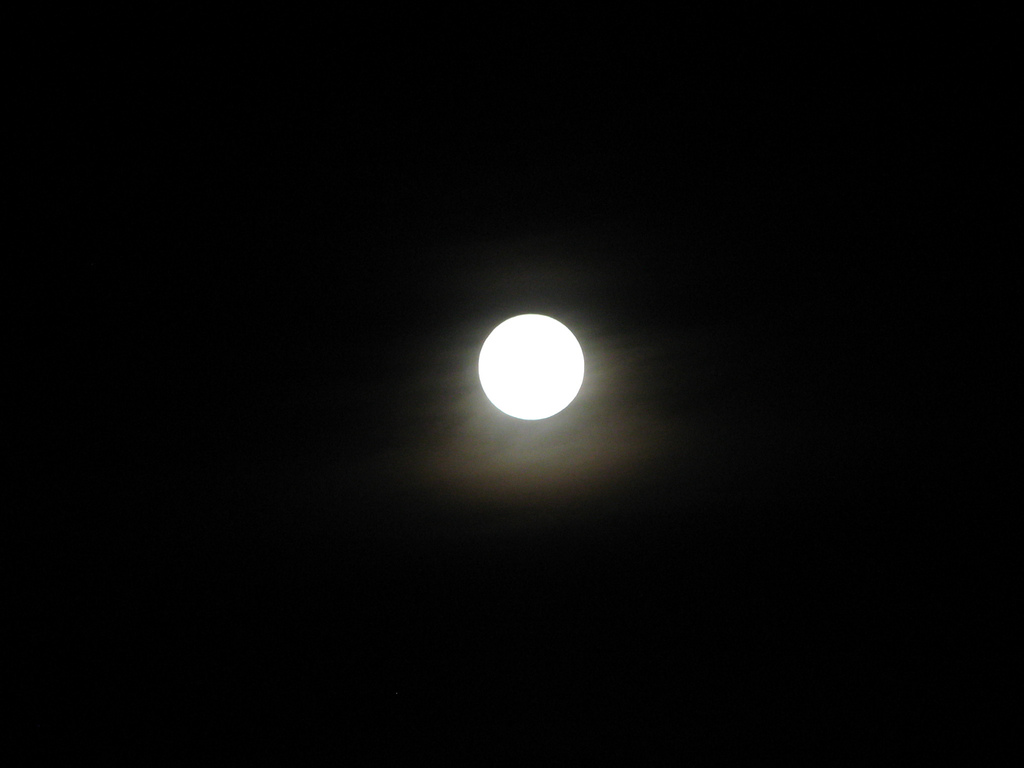
The eclipse happened as the moon was setting in our hemisphere and as the moon was setting at 6:28 a.m. and the sun was rising at 6:27 a.m. the east coast wasn’t afforded prime viewing for the eclipse; indeed just as things were starting to get interesting in the sky, the moon set into the clouds:
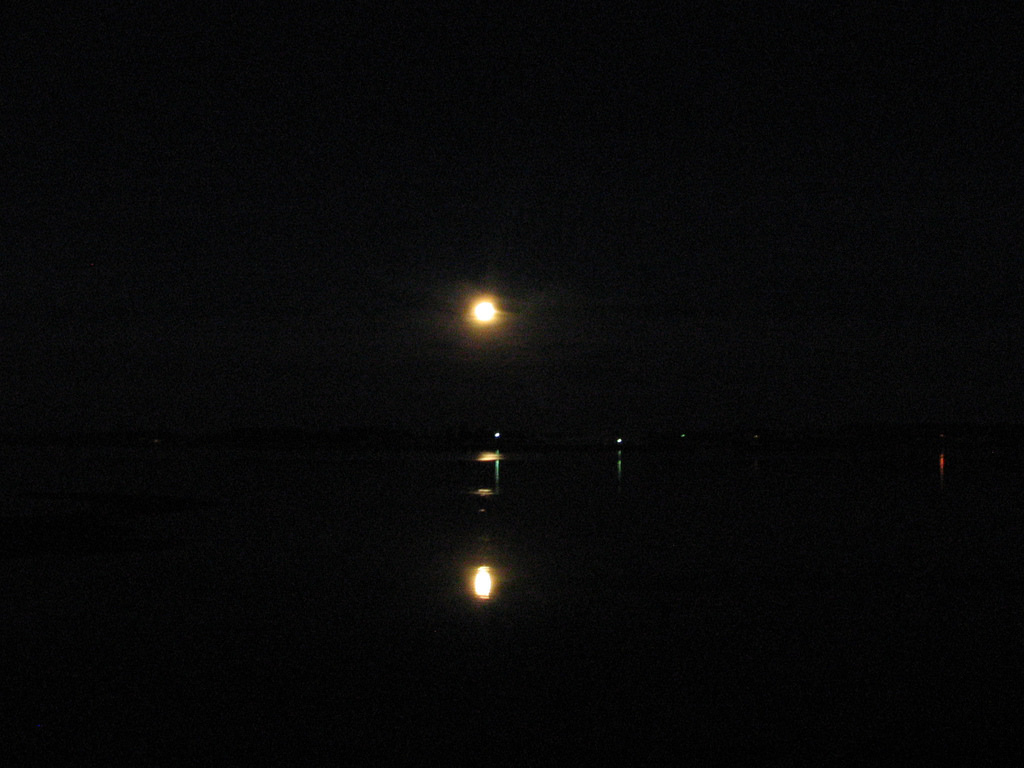
I actually woke up, unaided, at 4:29 a.m. in anticipation of all this. I headed downstairs and opened the door and looked out and saw a beautiful full moon above the St. Paul’s Church office. Faced with the prospect of waking Catherine up if I went back upstairs and got dressed, I threw on my helmet, grabbed my bike, and headed out into the dark morning still in my pajamas, camera in hand.
It was a perfect morning for riding around the deserted streets of downtown Charlottetown in your pajamas. I headed down Richmond Street to Charlottetown Harbour, spent some time walking up and down the boardwalk (which was annoyingly completely lit up by bright lamps despite the hour), and the rode around to Victoria Park hoping for greater darkness (it was lit up too, alas).
By 6:00 a.m. the moon had disappeared into the clouds and I turned back towards home. And therein realized that while it’s perfectly natural to be riding around on your bike in your pajamas at 4:30 a.m., it’s a little weird to be doing so at 6:00 a.m. as the citizenry are emerging from their houses and headed for Tim Hortons.
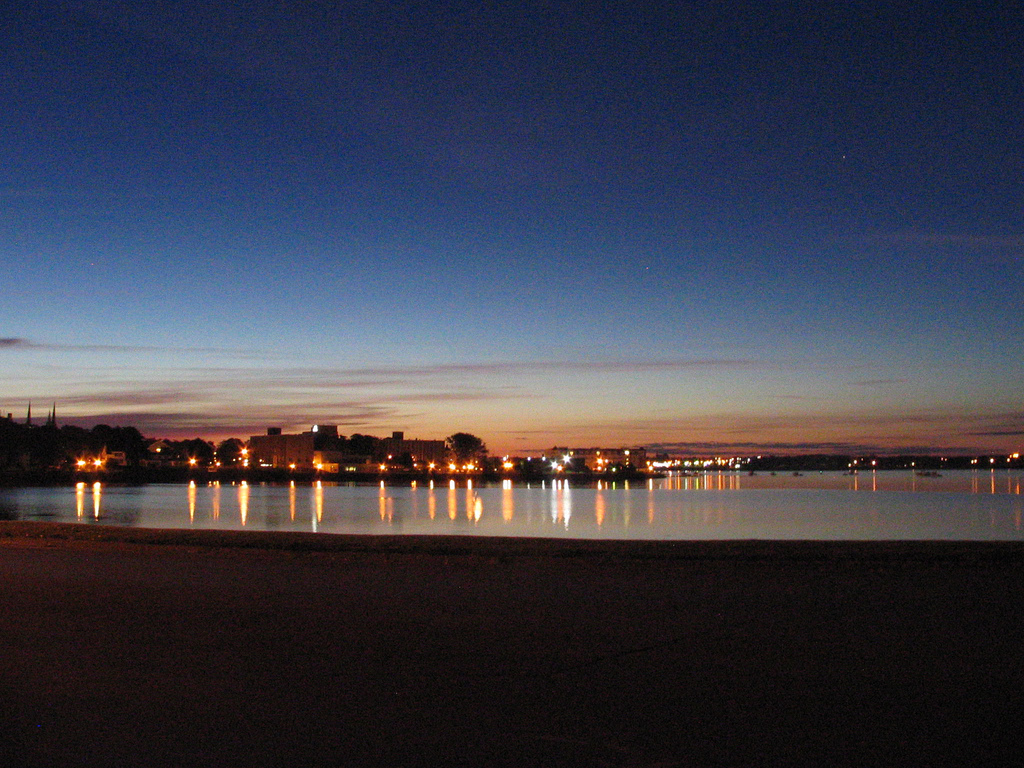
I made it home unscathed, and fell immediately back to sleep for another three hours. Now I’m thinking that it would be awfully cool to be able to see the night sky sometime soon unfettered by the lights of the city. Can telescope purchase be too far behind?
My friends at Plazes have made some changes to the unsupported, not-yet-released Plazes API that have had the unfortunate side-effect of breaking PresenceRouter. This is understandable, and shows what a folly it was to rely on a pre-release API to build the app. I’ve confidence that the functionality offered by the nascent API will return in some form sooner or later, and I’ll update PresenceRouter to match at that time. It was fun while it lasted ;-)
Update on August 29: just released a new version, v1.01, that should work properly going forward. Grab yours from the PresenceRouter download page.
My father has prepared an updated description of the NWRI Sediment Archive, a resource that holds the results of many years of his field research.
The trusty Reinvented mail server is being hit with an uncommonly heavy torrent of spam today, and Spamassassin is churning away trying to make sense of it all, taxing the server’s resources. As a result, email is taking longer than usual to get through. If you need to get in touch with us here at HQ in a hurry, please phone.
Oliver and I had more fun at the Confederation Centre Art Gallery on Sunday morning than I’ve ever had in an art gallery before, and here’s why:
The installation, from Instant Coffee, a self-described “service oriented artist collective,” has a suitcase of 45s, a record player, and a crazy bunch of knitting to sit on while listening. Rush. Shaun Cassidy. Ozark Mountain Daredevils. Bing Crosby.
It was Oliver’s first experience of ye olde vinyl, and it made me realize how much I miss the physicality that listening to music used to involve.
Entry to the Art Gallery is free. It’s open 7 days a week. It’s probably less than 10 minutes away from where you’re reading this (if you have any sense). I highly recommend a visit. I’ve half a mind to organize a dance party.
Sunday morning. Out on the town violating all my deeply held beliefs doing some Sunday shopping: looking for a 2-1/8” plastic thingy to fit into the 2-1/8” hole Catherine drilled in the desk at home to route the cables for the home iMac. Home Depot. Staples. Canadian Tire. No luck.
Catherine professes great hunger, and suggests an emergency trip to Wendy’s. Concerned about my family’s health, I make an emergency diversion out of town, away from Wendy’s and 15 minutes later we’re in one of the Rusticos pulling in to dayboat, the self-important two year old restaurant that, among other things, was the subject of an episode of the television program Opening Soon.
I’d resisted dayboat from the very beginning: the owners came across on TV as highfalutin New Yorkers eager to pull primitive Islanders into their century; trusted restaurant aficionados reported meek service and lackluster food. And I wasn’t sure, given all that, that I was willing to risk $100 on what might turn out to be a mediocre, or at least pompous experience.
I was bought off by the promise of a lobster lunch. Somewhat at odds with the high-class halo of the place, dayboat advertises $13.95 “Lobster Lunches” on a big sign out front. We were hungry, Wendy’s was nipping at our heels, and I had to take quick evasive action. Here’s how it went:
- Service was alternatively excellent and absent. When it was good, it was attentive and helpful. When it was absent, well, we felt abandoned. It took 15 minutes to pay.
- Flies, dead and alive. Okay if you’re on the wharf; when you’re paying $7 for a salad I would like there to be no flies.
- There weren’t actually any “Lobster Lunches” on for $13.95. One assumes, perhaps naively, that a “Lobster Lunch” means you get to eat a lobster; there were products-of-lobster on the menu — sandwiches, salads, pasta, etc. — but not any actual lobsters. And they were out of chowder.
- My “Lobster Club” was excellent: everything you would ever want in a clubhouse sandwich served on very nice break, with lots of lobster. I would order it again.
- Catherine’s “Lobster Napoleon” salad, she reported, needed more punch.
- Oliver’s green salad was a green salad.
- The view is spectacular, and the space has been completely enlivened from its dark old days as Café St. Jean. They may be highfalutin, but the owners know how to design a restaurant.
- The washrooms are shockingly small and poorly arranged; they are a glaring hole in an otherwise well thought-out space.
- The video cameras in the ceiling — the Opening Soon episode pointed them out as a way for the owners to monitor the place from afar — are creepy.
In the end, we walked away well-fed and not overly disappointed. But certainly not with the impression that there’s anything all that special about dayboat; it doesn’t live up to its transcendent billing.
For dessert, by the way, we drove up Route 6 to The Dunes. The Dunes is transcendent, but its transcendence is completely without self-importance. The service was excellent, the setting out-of-this-world, and the dessert was very, very good.
Travel writer Edward Hasbrouck announced today on his blog that the next edition of his book The Practical Nomad: How to Travel Around the World is now available for pre-ordering for delivery in early October. I’m a proud owner of the last edition, and I highly recommend the book, both for those who want to travel around the world, and for those who seek a deeper understanding of how the world works. Edward is a good writer, and his take on travel departs for the usual in very important ways.
There’s no doubt that tourism is important to the Prince Edward Island economy. Indeed without the dollars that tourism brings to PEI many of my friends would be out of work, either because they rely on tourists to buy their services or their products, or because they live off the secondary markets that tourism generates, from advertising to road construction. Indeed, when PEI purchases advertising in the pages of Yankee, that revenue gets used, in part, to pay my salary.
But there’s another side to tourism, the part where we invite 1.6 million people to share our home with us. Dollars aside, who these people are, where they come from, how they think, and what they do when they’re here has a profound effect on the way we live, the extent to which we contort ourselves to accommodate them, and the vision we have of what Prince Edward Island is.
While it seems vaguely eugenics-like to talk about demographically “programming” the nature of these visitors — shouldn’t everyone be welcome on our Island? — in fact the Island’s marketing efforts are very finely targeted. Here, for example, are the media targets for 2007, right out of the Tourism PEI Marketing Launch 2007:
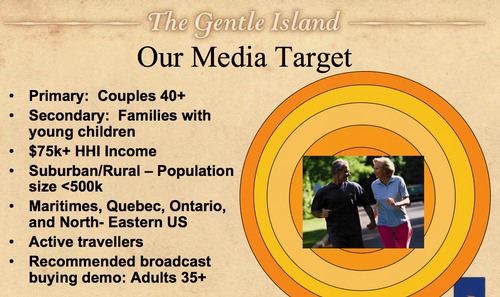
This demographic targeting then informs the places that tourism marketing dollars are spent:

Now of course marketing and advertising are inexact sciences, with results that are hard to gauge. But they must have some effect. And, indeed, if you walked down the streets of Charlottetown this week, you were quite likely to bump into 40+ couples who looked a lot like the target demo of Toronto Life, Reader’s Digest and Cottage Life.
Now I don’t want to make sweeping generalizations (although that’s what marketing is all about, isn’t it?), but if I was planning a great party, and wanted to invite a million cool people to it, I don’t think the first place I’d turn would be Reader’s Digest subscribers.
Such folks may be affluent active travelers ready and eager for a bit of Gentle Island rejuvenation, but, as a group, they’re not particularly the kind of folks I want skulking around my neighbourhood all summer long.
That’s completely a matter of my taste, of course: what I define as “cool,” who I find interesting, and what I find annoying.
But imagine how our summer visitors might be different if our marketing dollars went, instead, to a mix that looked something like this:

I’m not necessarily proposing this mix as a new demographic (if indeed you can pull a common thread out of that montage). But I do think it’s important to recognize that where we spend our marketing dollars has a direct impact on the kind of place we live. If we market to boring old farts, we’ll get infrastructure that meets the needs of boring old farts. If we market to revitalizing feminists, we’ll get infrastructure that meets the needs of revitalizing feminists.
These are not academic questions: the kind of visitors we attract determines the kinds of restaurants we have to eat in, the kind of art in the art galleries and the kind of music in the theatres. If we have visitors who drive we need more roads; if we have visitors who cycle we need more trails. Do we need more stores selling scented candles, or more stores selling guitar picks? Pad Thai or bigger burgers? Campfires or fireworks? Nickelback or Dylan or Lightfoot or the Bolshoi? Better beaches, or better lawn bowling facilities? More potatoes or cleaner rivers?
And because we can’t help but have our workaday lives overlap with the lives of our visitors, the politics, persuasions, and passions of our visitors influence who we are, what we think, and how we feel about ourselves.
I’m not suggesting that we throw out the old Homemakers readers and replace them with anti-globalization hitchhikers and radical feminists (but you gotta admit that it would be more fun to run into a reader of Bitch Magazine in the line at Tim Hortons that it would be to bump into Yet Another Cottage Life Reader).
I’m simply suggesting that it would be nice to have some opportunity to consider the effects that our marketing efforts are having on the kind of place PEI will grow into: creepy and Orwellian or not, our marketing dollars and the way we spend them give us an unparalleled opportunity to determine who visits us.
We’re doing it already — discriminating economically by using dollars and lodging nights as the metrics we use to judge our success. Is it possible to change our thinking so that we factor more nebulous, but ultimately profoundly more important, qualities into our spending decisions?
At my core I am a logistics man: I am fascinated with the movements and interactions of data and people and the world. It’s why I love maps hacking and plumbing geopresence. It’s why I’ve been happily coming to terms with the sun and the moon and the stars for the past two weeks as I develop a new custom publishing engine. It’s one of the reasons I love the traveling part of travel and the mechanics of the transport that makes it happen.
And it’s why, when Charlottetown got a public transit system back in the fall of 2005, I decided to lend a pro bono hand and created a map to make it easier to navigate. Although the transit company took an interest in my efforts (going as far as to plaster the thebus.ca URL all over their promotional materials), it was and has continued to be a skunkworks effort happily free from bureaucracy or responsibility.
Which is to say that, setting aside the “public transit is good for the world” part of my rationale, my map dabbling was fired by an interest in getting my hands dirty with intersections and stops and schedules and map APIs.
As the transit system evolved, I continued to evolve the map, in part spurred on by the increasing elegance of the four interconnected transit routes that covered the city like a huge figure 8, meeting downtown, at the Atlantic Superstore and at the Charlottetown Mall.
In May of this year that elegant system was thrown out, replaced with what, frankly, was an incomprehensible rabbit warren of a schedule. “Routes” were replaced by “Services” and “Loops.” The figure 8 was jettisoned. Buses that used to leave “every hour on the hour” now left at seemingly random times. And the brand new 6-page full colour schedule was, in short, simply impossible for any sane person to understand.
While I’m certain there was an internal logic to the completely renovated system, and that it no doubt addressed many specific “John needs to get from X to Y at 8:32 a.m.” concerns from riders, taken as a whole the system sank from elegance and simplicity into a chaos.
Setting aside the practical ramifications of the move — like the fact that my friend Dan simply gave up on the system altogether after being one of its more dedicated advocates — I was simply aghast on a purely artistic level.
And so while I may have been able to sit down for a week and try to figure out how to translate the new schedule into something that I could represent on a map, I too simply gave up.
At least for a while.
It’s taken me three months to forgive the logistics assault on the universe: tonight I sat down and started to breath some life back into the Charlottetown Interactive Transit Map.
I’m starting slowly: so far only one of the “routes” (or is it a “loop” or a “service” — not sure), the “University Avenue Express,” is represented. It’s the least confusing run, and easiest to rekindle on the map (it’s actually quite convenient if you live downtown and want to go to the movies, as it now runs until 10:00 p.m.).
While I was at it, I made some upgrades to the way the map itself operates.
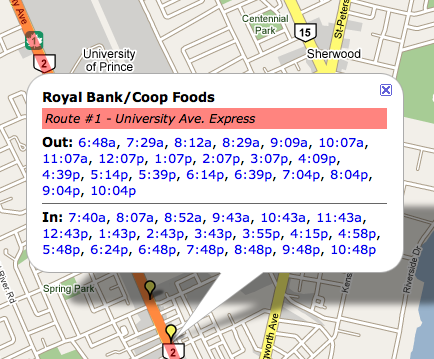
As before, you can click on any “stop marker” to get a pop-up information window about the times that the bus stops there:
But now every time in the pop-up window is a clickable link to the stops on that “run”:
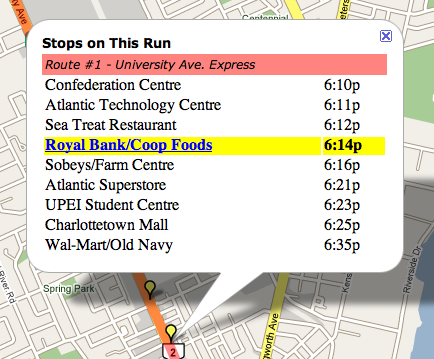
This solves one of the limitations of the previous code, which was that although it was easy to see when the bus was leaving your stop, it was almost impossible to figure out when it was going to arrive at your destination. Now it’s easy.
In the days and weeks to come I’ll see if I can’t make sense of the remaining routes / loops / services and translate the rest of the system into this new home (of course I could also suffer another bout of being aghast and just throw my arms up in the air again too).
Please take a look. Comments welcome.
About This Blog
 I am Peter Rukavina and this is my blog. I am a writer, letterpress printer, and a curious person.
To learn more about me, read my /now, look at my bio, listen to audio I’ve posted, read presentations and speeches I’ve written, or get in touch (peter@rukavina.net is the quickest way).
I have been writing here since May 1999: you can explore the 25+ years of blog posts in the archive.
You can subscribe to an RSS feed of posts, an RSS feed of comments, or a podcast RSS feed that just contains audio posts. You can also receive a daily digests of posts by email.