
Let me briefly sing the praises of the combination of NetNewsWire, my longtime RSS newsreader for the Mac, and NewsGator Mobile for the iPhone, a web-based application to which NetNewsWire automagically syncs.
When “syncing” got added to NetNewsWire (after its acquisition by NewsGator) I was perplexed by why such a feature would be useful. I tried it out for a while to sync up the RSS feeds on my laptop and my desktop, but at the time it seemed slow and prone to problems, and when I integrated my life onto a single MacBook even that utility went out the door.
Things have improved. A lot.
The syncing from the NetNewsWire end is seamless and very fast — your feed list, and what you’ve read and not read is auto-synced to the NewsGator servers every time you refresh your feeds and when you exit the application. And so the next time you visit NewsGator Mobile for the iPhone, you can essentially pick up where you last left off. And the syncing works both ways, so if you read a few things on the iPhone, the next time you load NetNewsWire they appear as “read” there automatically too.
By far and away the killer feature of this combination, however, is the ability to “clip” feed items in the mobile client (you just click “Clip” when scanning the feed). Anything clipped this way automatically shows up in the “Clipping” folder in NetNewsWire:
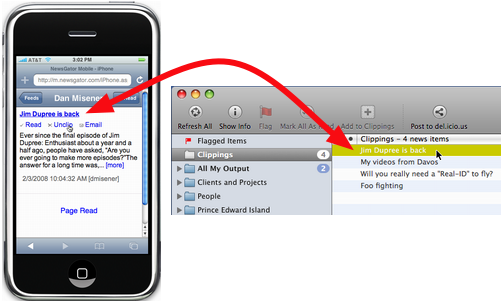
This means that I can open NewsGator on my iPod Touch every morning over coffee, scan my new items — something the iPod UI is very tuned for — and “clip” anything that demands a closer read. Then, once I get to the office I simply fire up NetNewsWire and read the items that I’ve clipped, something my big screen and full-sized browser is much better suited for.
And one final cool feature of all of this: anything that I clip, on either NewsGator Mobile or NetNewsWire, ends up automatically on my clipping RSS feed, which you can subscribe to yourself and share in the joys of my peculiar interests.
For some reason I thought that it would be better to take the bus to the Charlottetown Farmer’s Market this morning than to drive — what with the ice all over the roads and the driving rain. I’m not sure why this seemed like a good idea, especially given that taking the bus means walking along Belvedere Avenue to the Market with a sketchy sidewalk:

Amazingly enough we didn’t get completely drenched, as most drivers were watchful enough to slow down and avoid the puddles. There were some clods that came awfully close to dousing us, though; frightening to realize that some people really aren’t paying any attention at all to their driving environment.
By 12:00 noon the sun was out and the day was very pleasant.
As we know, Maritime Electric has been in the centre of the news this week here in Prince Edward Island. Something that caused me, when walking by on my way up to drop Oliver off at school, to take another look at their headquarters building at the corner of Kent and Prince in downtown Charlottetown:

If you look carefully at that photo you’ll notice that although there are electrical wires running through this intersection none of them actually run into Maritime Electric itself, suggesting that, despite their widespread advocacy for “electricity,”, they don’t actually use it themselves.
To say that this is hypocritical is an understatement, and places the credibility of the company in some dispute. In any case, the situation certainly demands further investigation, especially as, without electricity, it’s unclear how they power their lights, computers and other devices (I personally suspect they have some sort of secret technology that uses converts air into light, but that’s just me).
Our friends Dale Sorensen and Sandy Nicholson live in an area of Prince Edward Island that was hard-hit by the ice storm this week, and thus have been, in theory, “without power” all week. Except that Dale and Sandy live “off the grid” so they’ve been as “powerful” as they regularly are. I asked Sandy to write a little bit about this; she replied:
Living off the grid can have its challenges at times, but when the provincial power system fails it makes me wonder if there isn’t a better way. Today is a bright sunny day and we have been getting free, clean energy pouring into our batteries all day from our solar panels. If only all those who are without power on PEI could have access to that same energy. I would love to see more discussion about options for people to have energy independence.
Although I don’t think that our system is necessarily the answer for everyone on PEI, we have been very happy with it. I certainly don’t have all of the answers, but I do think that it is a good time to start talking about having a different delivery system for our power.
Our solar power system contains the following components:
- 8 - BP Solar BP85 - 85 Watt Laser Grooved Solar Modules (generates electricity when exposed to sunlight)
- 8 - Surrette 6 volt, 460 Amp Hour Deep Cycle Batteries, with Hydrocaps (store electricity and provide energy)
- Trace PS2524 - 2500 Watt Sine Wave Inverter, 24 volt (converts DC (battery) power into AC (utility) power)
- Trace C40 - 40 Amp Load Controller (protects the batteries from being overcharged)
- Trace DC175 - 175 Amp Disconnect Box (over current and short circuit protection between the inverter and batteries)
- Kohler 8.5RMY - 8500 Watt Propane Generator Set (provides back-up or supplementary power)
Our power system was designed by Kevin Jeffrey, Avalon House, RR1 Belfast, PEI.
Sandy and Dale have a page on their website with more details about their house.
Reinvented Inc. came to life on May 21, 1999. Our corporate year-end is January 31, which means that today is the start of our 10th year in business.
Later this month I’m scheduled to head over to Sackville to join Shauna McCabe’s Architectures for Creativity — a “protracted symposium” at Mount Allison University — to talk about “Plazes and contemporary psychogeographies.”
I suppose it would behoove me to learn what “contemporary psychogeographies” actually means before I go…
Coming from the day-to-day world I come from, where we regularly lapse into buzzword-laced talk of XML-RPC and AJAX and “scrum forums” and “optimized user experiences,” it’s dangerous for me to point an accusing finger at the lingual arcana of other disciplines. But I do note, for the record, that I find Shauna’s world particularly laced with its own vocabulary (when’s the last time you had a casual conversation about “modernity and monumentality”).
That all said, as I scratch below this confusing surface I find intriguing overlap between the technical curiosities that underlie my interest in location and presence and what appears to be a different expression of the same curiosities from the academic side of the fence. If my “presence stream” is your “contemporary psychogeography,” then perhaps we have something to discuss?
Stay tuned for reports from the field; before you know it I’ll be blogging about “formal and more ephemeral architectures” here.
 The power has been out in vast swaths of PEI this week because of an ice storm. We have been fine here in Charlottetown for the most part — our power has been out for no more than 5 hours in total — but in the central and western parts of the Island they have been dark and cold all week, and there are still 8,400 homes without power.
Maritime Electric, that provides electricity to the bulk of PEI, is obviously the focus of much of the attention here, and the public face of the company is Kim Griffin. She is doing a brilliant job, and anyone in the business of crisis management should take a page out of her book: she is honest, well-spoken, good at managing expectations, and, it would appear, able to exist without sleep.
Of course it’s the crews out in the field, both from Maritime Electric and from regional power companies lending a hand, who are bearing the brunt of the back-breaking work. But by being the straight-shooting spokesperson for the company Kim Griffin is doing them all proud. Please, give her a raise.
Remember my friend Mike from Peterborough and his film about his student loan?
Well on Sunday night Catherine and I were looking for something to watch on television — there is less and less these days — and flipping through the channels I happened, by accident, to catch Mike’s latest film, The Making of Lost in Canada playing on CTV.
It’s a great film; not only is it very, very funny, but Mike captures a sense of “Eastern Ontario DIY culture” better than anything I’ve ever seen or read.
A love song for Lisbon, and my mother from the Saturday travel section of The Globe and Mail. Doyle is my favourite Globe writer.
As I feared would happen, we’re now starting to see the results of so-called common assessments of Prince Edward Island grade 3 students used to advocate:
No matter what your position might be on the tests and whether or not the school-by-school results should have been released, surely we can all agree that it’s not proper to extrapolate anything profound from how kids respond to a multiple choice test about Bobby’s Big Toe.
There may indeed be problems with our schools, but these test results aren’t a useful measure of what those problems are: they are a flawed statistical snapshot of a very thin slice of what’s “important” about education. To use them to make policy and resource decisions runs the risk of ignoring where and what the real educational challenges are.
About This Blog
 I am Peter Rukavina and this is my blog. I am a writer, letterpress printer, and a curious person.
To learn more about me, read my /now, look at my bio, listen to audio I’ve posted, read presentations and speeches I’ve written, or get in touch (peter@rukavina.net is the quickest way).
I have been writing here since May 1999: you can explore the 25+ years of blog posts in the archive.
You can subscribe to an RSS feed of posts, an RSS feed of comments, or a podcast RSS feed that just contains audio posts. You can also receive a daily digests of posts by email.