
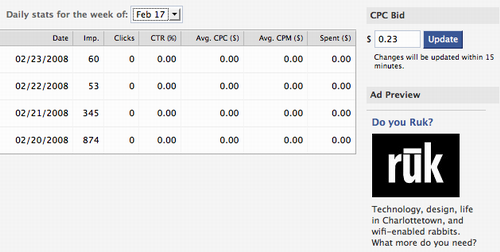
Remember my Facebook ad campaign for ruk.ca? Well I ran it for over four days last week. The ad received a total of 1,332 impressions (to the “liberal and moderate people between 18 and 60 years old in Charlottetown, PE” audience). How much traffic did it generate? None.
Remember four years ago when I did some experiments with my local library’s online catalog? While I’ve returned to the project, and have released some updated code that leverages the fact that Dynix, the engine behind the catalog, can output XML for almost everything it does. The result is a PHP class: class.dynix.php.
You can try this out for yourself, if you’re a PEI Provincial Library card holder, by visiting this example page wherein you can enter your public library card number and password and retrieve a nicely formatted list of the items you have checked out and on hold. Here’s what it looks like in action:
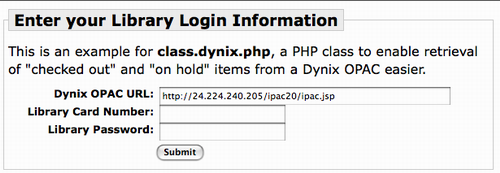
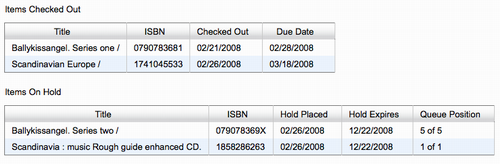
Note that although I don’t record your library card number and password, they are sent insecurely, and as such are liable to interception by evil doers. Of course this is also true when you use the OPAC directly, albeit with one fewer point of possible evil.
In theory this should work for any Dynix system that has a website: the default URL in the example above is for Prince Edward Island, but if you can find the equivalent URL for your system, just enter it (it might end in ipac.jsp like ours does?).
For maximum fun, go and grab the PHP source code and set yourself up locally: all you need is a standard PHP5 install — there are no other dependencies.
Remember our morning traffic light bird? Well there’s been no sign of it for the past several months. But, today, a sign of spring:

Oliver noted some additional signs of spring today as well: no ice and snow on the sidewalks, and the forecast calls for rain (although preceded by snow).
Something’s afoot at Casa Mia: while I was having coffee this morning there were important-looking meetings being conducted with architects, and drawings of “Casa Mia 2.0” were in evidence. I inquired as to whether I’d still be able to get coffee post-renovation, and was assured that I would. Perhaps we can lose the glassware now?
The Punkt Festival is:
…a music festival in the city of Kristiansand in the south of Norway. The festival concept is centered around a stage/studio hybrid called the Alpha Room. This room is an extension of how the curators of the festival, Jan Bang and Erik Honoré, have worked with a range of Nordic and international improvisational artists over the last years; with live sampling and live electronics, and as record producers and remixers.
The Wagner Reloaded Concert from the 2006 edition of the festival, featured a piece by J. Peter Schwalm and Brian Eno.
If you tried to get Plazes + Jott to work, and it didn’t (you got a blank screen when you went to configure the Jott link), please try again: Jott changed the capitalization on one of their API parameters, which broke my client. It’s fixed now.
The mashed up bank is an interesting post, from a real live UK banker, that asks the question “[is it possible] to do without a bank at all and still have a relatively normal life?” (I found the post thanks to a link from Johnnie Moore).
One of the things the post mentions is something called “prepaid debit cards,” something I’ve never encountered. So I asked for some pointers and received today a helpful pointer to Guide to Prepaid cards.
Do such things exist in Canada?
 Starting back in November I found myself with a serious bout of heartburn. I suspect I had some sort of persistent stomach bug, as almost anything, even the most benign foods, could set it off. As such it was hard to avoid by changing my diet, and I became, for the first time in my life, a serious Rolaids consumer.
My problems continued in through January, and when there appeared to be no end in sight I started to look around for alternatives to antacids like Rolaids for relief.
At some point I found a very clearly-worded website, there reference to which now eludes me, that suggested that if heartburn is caused by “excess stomach acid,” one way of combatting it is to eat or drink things that are alkaline.
Of course this seems like common sense — what are antacids other than a chemical way of neutralizing stomach acid. And of course it’s something that, faced with a nightly onslaught of Nexium, Rolaids and Tums commercials on television, I never had cause to consider.
And it worked. Almost immediately.
My stomach problems have largely cleared up, perhaps for reasons completely unrelated to my modified treatment regime, but for the month or so that they persisted, my “crazy pineapple trick” worked wonders. I haven’t popped a Rolaids all year long.
But, for me, this is less a story about pineapple and heartburn but about my revelation that it might be useful to stop taking health advice from the 30-second spots between NCIS and The Unit.
Tums photo from Todd Ehlers - license. Pineapple photo from giniger - license.
One small tweak to my experiments with Plazes and NetworkX results in much, much clearer and useful network diagrams (and ones that render in seconds rather than hours): I removed from the graph any node (i.e. any Plazes friend) who has no friends of their own. This means that if I say “you’re my friend,” but you don’t reciprocate, and you don’t have any friends of your own, you don’t show up on the graph. This has the pleasant effect of leaving in place only more “active” Plazes users, who have friends of their own. By separating the wheat from the chaff, so to speak, the true nature of the network is much easier to see. I’ve also modified the graph so that the size of a user’s node is proportional to the number of friends they have. Here’s the graph that results for me:
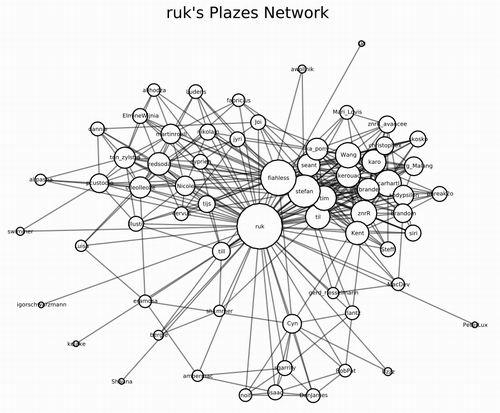
This graphic is actually more than the sum of its parts (rather than an unintelligible rat’s nest of connections): you can clearly see my reboot network (top left), my Plazes crew (top right) and my tiny local network (along the bottom).
You can grab the updated Python code yourself if you want to take this for a ride.
About This Blog
 I am Peter Rukavina and this is my blog. I am a writer, letterpress printer, and a curious person.
To learn more about me, read my /now, look at my bio, listen to audio I’ve posted, read presentations and speeches I’ve written, or get in touch (peter@rukavina.net is the quickest way).
I have been writing here since May 1999: you can explore the 25+ years of blog posts in the archive.
You can subscribe to an RSS feed of posts, an RSS feed of comments, or a podcast RSS feed that just contains audio posts. You can also receive a daily digests of posts by email.