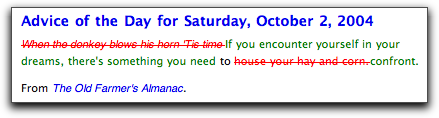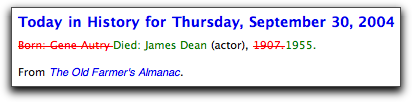
I’m not sure whether I’ll use RRDtool myself, but its website is worth a look: it’s an excellent example of thorough documentation for an application, full of examples, well-written prose and code. Bravo.

🗓️

Zbigniew Brzezinski was on Charlie Rose tonight. I know little of his past or his present, but boy is he a good interview: every word well choosen, a very quick mind, listens to questions. I would welcome the opportunity to hear him speak someday.

🗓️

A great New Yorker article about Al Gore in this week’s issue, written by David Remnick. My favourite part (emphasis mine):

Politics was a horrible career choice for him. He should have been a college professor or a scientist or an engineer. He would have been happier. He finds dealing with other people draining. And so he has trouble keeping up his relations with people. The classical difference between an introvert and an extrovert is that if you send an introvert into a reception or an event with a hundred other people he will emerge with less energy than he had going in; an extrovert will come out of that event energized, with more energy than he had going in. Gore needs a rest after an event; Clinton would leave invigorated, because dealing with people came naturally to him.

By coincidence, I was talking to a psychologist this morning and, on a tangent, we talked about whether I’m an introvert or an extrovert.

What I told her was this: I was a relatively comfortable introvert as a child (other people were less comfortable: I had teachers try and help me “reach out” to other kids), and I am still fundamentally that way. But somewhere along the ride I discovered the joys of other people, and I’ve taught myself social skills — small talk, conversational ebb and flow, and so on — to allow me to live in that world. I’ve had a lot of help with this, from my parents, from folks at the YMCA, from my experiences in community radio, working in the newspaper composing room.

And of course it would be hard to imagine being an introvert and living on Prince Edward Island: the PEI operating system doesn’t support introversion very well.

Speaking of psychologists: I’m not in therapy now, but I’ve had some experience with it (after a particularly bad breakup about 18 years ago sought out a counsellor for a summer). Psychotherapy has something of a stigma attached to it, although probably less nowadays than 20 years ago. It gets made fun of for Woody Allen and Bob Newhart reasons, there’s a protestant “vanity is evil” ethic at work, and there’s a common fear of, misunderstanding of, and paranoia about dealing with mental health (ironic given that most people wouldn’t think twice about going to a doctor for the flu or a cold).

My personal skittishness about therapy was mostly about not feeling as though “things could be bad enough for me” to need help. This was only amplified when, sitting in the waiting room, I would hear the clients with the appointments before me crying and wailing and throwing things and generally, I thought, in “real need of help.” Hard to make “feeling bad after a breakup” feel worthy of attention in that environment.

But I stuck with it, and I did find it helpful. The immediate break-up induced concerns — nobody loves me, etc. — were quickly extinguished, and we went on to talk about loftier issues. Therapy, at least of the sort in which I was engaged, places a lot of stock in the notion that simply talking about things to a disinterested, listeningful person will be of help in and of itself. And it was.

I didn’t come out of the experience with a checklist of “things I need to do to make my life better.” But I did come to understand more about the way that I think, what drives my choices, and what I deserved from a “deep and committed loving relationship” (therapist’s phrase, not mine; it’s stuck with me to this day, though).

Perhaps more than anything else, becoming comfortable with the notion that my mental well-being is important was a victory (and something that I should return to more often).

If you have an inkling that therapy might be useful to you, I encourage you to seek it out. The worst that can happen is that you’re out an hour’s wages for a therapist.

🗓️

I stumbled across this Vegetarian/Vegan Receptions FAQ today. Useful if you want to marry without the meat.

I’ve had my own dalliances with vegetarianism (apparently this is now written veg*an, to include vegetarians and vegans both), none of which has every really truly approached a complete absence of meat or other animal-products.

My friend Simon came to visit us on PEI about a decade ago and we conducted a “cheeseburger tour of Prince County.” Much meat was consumed. Simon went home and kicked meat entirely and became an animal rights lawyer.

I mostly don’t eat meat because I don’t like meat, not for any overriding ethical or moral issues with meat or the meat industry (not that I don’t have those issues, they’re just not enough to trump meat-eating when it’s convenient). And of course I’ve been living with a scion of a cattle farming family for 13 years, so to reject meat entirely would be to reject too much family heritage.

As a result, I find myself equally repulsed and compelled by Anthony Bourdain’s adventures eating the heads of baby squirrels et al.

Speaking of baby squirrels, let me make a brief comment on marriage.

This New Yorker article is the most well-worded summary of the debate about marriage that is simmering in America right now. The article concludes:

The mistake is to consider the change in meaning [of marriage] particularly drastic. After all, undoing customary expectations for how a husband and wife behave toward each other has been one of the goals of the women’s movement since its inception. Rather than an abrupt departure, same-sex marriage is the culmination of a larger and ultimately more consequential change in the nature of marital relations between men and women.
Which is one of the reasons that the opposition to it is so fierce. It has come to symbolize what is, historically speaking, radical about contemporary marriage: the decline of the patriarchal legal structure and the rise of the goal of self-fulfillment. Gay marriage is unsettling, to many, not because it departs from modern meanings of matrimony but because it embodies them.

Catherine and I are, in a way that’s occasionally defiant and generally otherwise benign, not married. We have lived under the same roof for almost 13 years. We have spawned a son. We love each other. We can interchange pillows comfortably and even sometimes toothbrushes (although the toothbrush thing may be asymmetric). Catherine has a complex explanation for why we’re not married, which is based on a more shaded understanding of gender studies than I have; my reasoning has been more focused on why we would marry, not why we wouldn’t. I’ve never found a compelling reason to do so, and faced with a partner who’s decidedly against the idea, we have arrived at a situation which has so far worked quite well.

In light of the article in The New Yorker, I read that it is we who are the dangerous ones: we’ve simply decided not to join the club (as opposed to trying to change the club’s rules). By demonstrating that this is possible, works well, and doesn’t cause us to go to hell, I would argue that we’re a greater threat to the traditional view of marriage than two men or two women who want to do essentially as their parents did.

When it comes time to go to the barricades to stand up for the rights of gays and lesbians who want to live in loose hurdy-gurdy partnerships without social or civil sanction, I’m ready to go.

That said, although I’m perhaps not fully qualified to speak on the issue — I’m not a member of the club to which membership is sought, after all — I think those who would stand in the way of two people — any two people — who want to join each other in holy matrimony because it offers them some spiritual or civic comfort should just get out of the way. Love is good and grand and worthy of our nurture and support no matter what wrapping lovers wish to put around themselves.

🗓️

Here’s what’s new and hot on the Blogroll:

  • Dave Hyndman is back blogging after a summer off.
  • Lisa Howard has started a new blog. You’re remember her from the fat cow affair.
  • I’ve started to read Adam Curry again now that he’s blogging about audioblogging, especially iPodder, which is really neat. I think Adam is the archetypical user in Dave Winer’s UserLand.
  • Mary Hodder blogs about Napsterization.

🗓️

Warning: LAX, the new NBC show produced by Heather Locklear, is perhaps the worst television show ever made.

🗓️

Oliver went off to pre-school this morning for the first time. At the Holland College Child Development Center. By lucky happenstance, the daughter of our friend Lowell (Oliver’s middlenamesake) is taking Early Childhood Education at Holland College, and so will be in and around Oliver and his peers a lot this year.

Catherine reports that Oliver ran all the way to school this morning, and didn’t bat an eye when she left. I take this simply as a determined effort on his part to rebel against my own anti-schooling feelings. No doubt he will start wearing a tie soon, and will insist on eating porterhouse steaks for dinner.

Beyond the usual “our little boy is growing up” sorrows (and their equal and opposite “our little boy is growing up!” excitements) this event has inspired, it’s personally daunting for me for an additional reason: my own first memories are of going to nursery school. I don’t remember nursery school clearly, but I certainly have strong impressions of the room and the routine and the people. It’s when my memory of life begins.

During the early years of Oliver’s life it was possible to console myself about my defects as a parent with the knowledge that his memory, at least his conscious memory, wasn’t compiling yet. If his experience mirrors my own, though, the “record” button has now been pressed. There are no do-overs left. And my performance as a parent will now officially become part of the record that will later be recalled over thanksgiving dinners when Oliver is 22 and wondering why he ended up the way he did.

Even as I type this, I can picture the grins of glee on my own parents faces as they read this. Turnabout is fair play.

🗓️
🗓️

Happiness is being able to fully embrace your dorkitude, and just run with it. Witness this, pictured here:

Quiz Show

With real buzzers, no less.

🗓️

Recalling that the Internet is sometimes called the world wide web makes the concept of spidering make somewhat more sense.

Search engines like Google, Feedster and Altavista — basically any web application that needs to grab a snapshot of the entire Internet so that it can be searched, indexed or otherwise sliced and diced — generally develop this snapshot using automated web browsing computer programs that start at one web page, collect all the links on that page and visit each of them in turn, collect all the links on those pages, and so on and so on and so on.

This process, because it is conceptually like “walking throught the web” is called spidering or crawling.

🗓️

About This Blog

Photo of Peter RukavinaI am . I am a writer, letterpress printer, and a curious person.

To learn more about me, read my /now, look at my bio, listen to audio I’ve posted, read presentations and speeches I’ve written, see things I’ve favourited elsewhere, or get in touch (peter@rukavina.net is the quickest way).

I have been writing here since May 1999: you can explore the 25+ years of blog posts in the archive.

You can subscribe to an RSS feed of posts, an RSS feed of comments, an RSS feed of favourites elsewhere, or a podcast RSS feed that just contains audio posts. You can also receive a daily digests of posts by email. I also publish an OPML blogroll.

InstagramYouTubeVimeoORCIDOpenStreetMapInternet ArchivePEI.artDrupalGithub.