
The Olympian reports on the fate of Harold Stephens’ old schooner Third Sea: Fabled boat’s journey ends as derelict in Budd Inlet.
It’s a big day here in Charlottetown: public transit has arrived (routes and schedules). And only 156 years after Upper Canada got theirs!
As our family’s car use has decreased almost down to nothing, with the remaining rationale being trips to Canadian Tire and the grocery store, that we can actually travel around Charlottetown on buses for the first time is a Big Deal.
The actual hardware implementing the system is a bizarre fleet of modern “ye olde” buses dressed up to look like trolley cars. You thought people made fun of us over the goofy Anne thing, just wait until they get a load of these.

Yet one doesn’t want to look a gift-bus in the mouth, so I’ll grit my teeth, don my waistcoat, and mount the trolleys just as if we had infrastructure not to be ashamed of.
The schedule presents something more of a challenge. Rumours were that the buses would run every half hour; indeed I had a city councillor in my office earlier in the week suggesting that missing one, and having to wait 30 minutes for the next one, might be a deal breaker. As it turns out, he didn’t know the half of it: the buses every two hours. While that might be fine for people who would set off to make a day of going to the mall, I can’t see how a schedule like that meshes with anyone’s real life.
Last night, for example, I needed to go out to Wal-mart. I thought perhaps I would wait until this morning and take the bus out rather than driving my car. So I looked at the schedule: if I caught the 10:00 a.m. bus at the Confederation Centre, I would be at Wal-mart at 10:30 a.m. I could get out, do my shopping, and catch the 11:15 a.m. bus back downtown, arriving at 11:50 a.m. Figure in time to walk to the bus, and it’s taken me two hours to do an errand which last night, once I decided to drive, took me 20 minutes.
But that’s not the worst of it: if I missed the 10:00 a.m. bus, I’d have to wait until the next one arrived, two hours later, at 12 Noon.
This morning Catherine walked out to the Superstore. She thought she might take the bus back downtown instead of a taxi. But she would have had to spend two hours waiting for the next bus to do that. She took the taxi.
Transit isn’t something you can do halfway. Buses that run every two hours aren’t simply “half as good” as buses that run every hour, or “25% as good as buses that run every 30 minutes.” Buses that run every two hours are “appointment” buses, not “transit” buses, and if I can’t think “I should take the bus instead of driving” and have a reasonable chance of catching a bus in the next 15-30 minutes, there might as well be no buses at all.
That all said, I’m willing to suspend my disbelief until I’ve had a chance to actually experience Charlottetown Transit first hand; I’m not unwilling to adjust my life to bend to the collective schedule, at least somewhat, so maybe this will work out. I just hope the City mothers and fathers have the patience to stick it out, and the tenacity to realize that before this is singing along we might need more rather than less.
🗓️
The Zaurus arrived today, and thanks to help from Steven (who has a giant LCD monitor with built-in espresso maker and CF card reader), I’m wirelessly online from my couch at home. Details to follow. Cool.
🗓️
I’ve switched to using Adium as my instant messaging Swiss Army Knife of choice. But I couldn’t figure out how to close the tabs that appear in the “each chat in its own tab” Adium window. Turns out the close feature is very elegant, but perhaps too subtle: hover over the icon in the tab and it morphs into a close button:
🗓️
Upstart Stratford (Prince Edward Island) taxi company Taxi Taxi has added a Toyota Prius to their fleet. You can order it up by phoning (902) 393-9966.
🗓️
 The Complete New Yorker DVD was released last week. As an avid reader of The New Yorker, I’ve been anticipating its release all summer long; my copy arrived a few days ago, and I’ve been itching to crack it open but haven’t found a spare moment amongst all foliage, elections and BASH hacking.
In the meantime something interesting has happened: if you do a Google search for New Yorker DVD you’ll find one of my earlier blog posts is the first result. It’s higher than the magazine’s own page about the DVD, and higher than Amazon.com’s product page:

Back at reboot all the talk was about “the long tail” and I’d no idea what it meant; over lunch, Dan and Steven helpfully explained that it’s about the long drawn out part of the “power curve.” Steven’s example was that the total revenue to Amazon.com from selling one or two copies of obscure books millions of times over exceeds the revenue from selling millions of copies of Danielle Steel books (and the like).
Presumably this also pertains to marketing: Johnny said that everything he knows about the New Yorker DVD he’s learned about from weblogs, not from the “formal” publicity campaign. I wonder if they’ll sell more copies because of thousands of little mentions by passionate bloggers than from their full-page magazine ads.
🗓️
The code described here has been moved into Subversion.
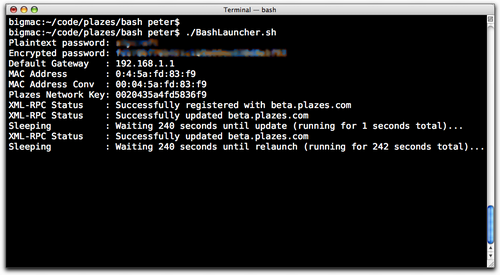
I’m continuing my frantic release (aka procrastination) schedule for the Plazes Launcher BASH shell script with a new version this afternoon: here’s the updated version (version 0.4).
This is the first version of the script to approximate the behaviour of a “real” Plazes.com Launcher — not only does it handle initial registration with the Plazes.com server, but it also handles the updates every 4 minutes and re-launches every 8 minutes specified in the Plazes API spec.
This version is also laid out somewhat more modularly, and includes the option to log events to a file.
In theory there should be no reason this shell script can’t now be used as a day-to-day Plazes Launcher (setting aside, of course, that it has none of the fancy features that GUI launchers have).
🗓️
The usual bunch were at lunch at the Formosa Tea House this afternoon and as we were checking out we were told about two new sub-Formosas that are opening, one on Water Street and on in the Ellen’s Creek Plaza. So now you’ll be able to buy lumber at Home Depot and stop for a stuffed bun on your way home.
🗓️
The code described here has been moved into Subversion.
I’ve modified the original Plazes Launcher BASH Shell Script to add Linux-compatibility. Here’s the updated version. This version also fixes a couple of bugs that only became evident under Linux.
I’ve not made any attempt to be “smart” about OS detection — you need to manually set an “OS” variable to either “linux” or “mac”. The only difference the setting makes is in the grabbing of the MAC address of the default gateway; I’ve added support for the output of the netstat and arp commands as they exist on my RedHat install (arp 1.88, netstat 1.42).
In theory, as long as OpenSSL and cURL are installed, this new version should work on a Linux-based mobile device like the Sharp Zaurus (mine is due to arrive Any Day Now, so I’ll be able to test shortly).
🗓️
The code described here has been moved into Subversion.
In anticipation of doing some work with mobile devices, I’ve become interested in building a lightweight Plazes launcher — something that doesn’t require a Perl, PHP, Python or any other “scripting language engine” overhead. At the same time, I don’t want something I have to compile — like a C or C++ launcher — partly because I’m lazy, and partly because I’m not smart enough.
The tentative result is a Plazes Launcher BASH Shell Script, a Plazes Launcher that, true to the “little bits of code glued together to do powerful stuff” UNIX philosophy, takes advantage of a whole bunch of [probably installed on your system already] standard UNIX tools to do what needs to be done:
- The MD5 hash of the Plazes.com password is created using OpenSSL
- The netstat and arp commands are used to grab the MAC address of the default gateway.
- The grep, cut, sed and wc commands are used for various string manipulation duties.
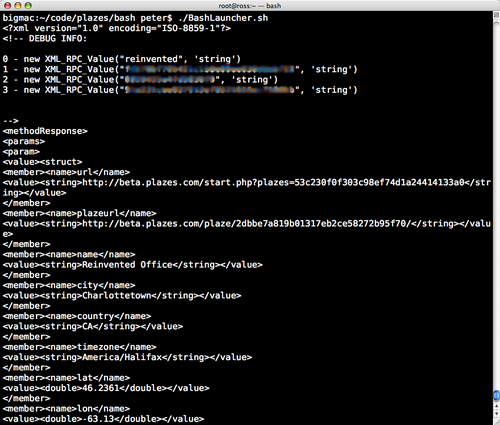
- cURL is used to send a hand-crafted XML-RPC request to the Plazes.com XML-RPC server.
In its current state, the script is Mac OS X-specific because it assumes the output of netstat and arp as it emerges from the OS X versions of those commands (and maybe from all FreeBSD-based systems — I’m not sure about that, though). It should be trivial to modify for other Unices.
Of course, like my earlier Plazes GUI Launcher for Ruby, this BASH version doesn’t do all of the things a Real Plazes.com Launcher should — like error detection, display of useful information, pinging the Plazes.com server every X minutes and so on. But it is a lightweight starting place.
🗓️
About This Blog
 I am Peter Rukavina and this is my blog. I am a writer, letterpress printer, and a curious person.
To learn more about me, read my /now, look at my bio, listen to audio I’ve posted, read presentations and speeches I’ve written, see things I’ve favourited elsewhere, or get in touch (peter@rukavina.net is the quickest way).
I have been writing here since May 1999: you can explore the 25+ years of blog posts in the archive.
 You can subscribe to an RSS feed of posts, an RSS feed of comments, an RSS feed of favourites elsewhere, or a podcast RSS feed that just contains audio posts. You can also receive a daily digests of posts by email. I also publish an OPML blogroll.
Instagram • YouTube • Vimeo • ORCID • OpenStreetMap • Internet Archive • PEI.art • Drupal • Github.