Today’s “random iPod shuffle track that started playing during my workout” (see also The Mandy Patinkin Workout) was The Grid, a Philip Glass composition from the 1982 Godfrey Reggio film Koyaanisqatsi.

It nearly killed me.

It’s 21 minutes long. It has all sorts of dramatic tempo changes. It generally chugs along at about 90 to 100 beats per minute, a pace that, on a stationary bicycle, is challenging to keep up with for 21 minutes solid, when you’re already 15 minutes into your pretend journey. Especially given the little bits of “no, wait, 80 bpm, okay, now 100.”

But, truth be told, it didn’t kill me. It made me stronger. I think.

And as if preordained, after speeding along to a track from a film subtitled “Life out of Balance,” during the “cool down” phase of my workout Shore Fields by Allan Rankin randomized itself into the mix:

Before we star talkin’
Would you do me a favor?
Have a look at these old pictures
There cracked and faded
Torn at the edges
But that’s the way I’m feelin’ tonight

🗓️
Fitness  •  Health  •  Music

Casa Mia debuts its new menu today. You already know about the pizza — now you can experience the new “dark chocolate pancakes,” “casa mia hash” and “double smoked bacon & pear sandwich.”

🗓️
Casa Mia  •  Charlottetown  •  Restaurants

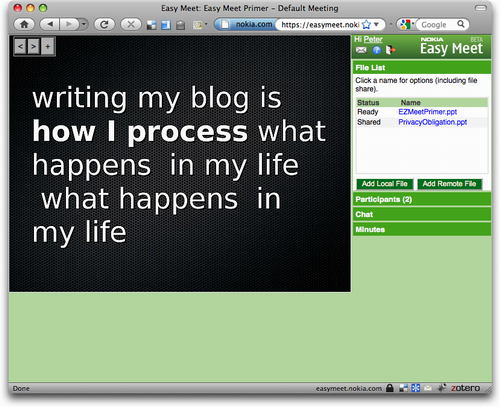
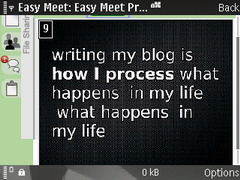
Nokia released a research prototype called Easy Meet today that looks like it might solve an issue that I noticed in my Philosophy 105 lectures this winter.

A weekly feature of the lectures was a PowerPoint projected on the big screen in the lecture theatre. Several times I found myself wanting to share things from the “audience” — web pages, images, PDF files — but there wasn’t an easy mechanism for doing this in real time.

Nokia Easy Meet in Firefox/Mac Nokia Easy Meet in Nokia Browser on my Nokia N95

While Easy Meet if obviously targeted at business meetings, there’s no reason why it couldn’t be used in an academic setting; in theory this would allow the sort of two way sharing that I was looking for: anyone with a laptop or mobile phone could share media with the class, and then others could annotate that media, and so on. It would be neat to try it out in this context.

🗓️
Nokia  •  Technology

With inspiration from Oliver and Don and Olle, I’ve dumped my personal library into LibraryThing, a web-based library, um, thing from our sister state of Maine.

To save hours of typing ISBNs, I used Oliver’s copy of Delicious Library along with the iSight camera on his Mac to quickly scan the bar codes of the books scattered around our house. I then exported from Delicious Library into a plain ASCII text file, edited the text file to remove everything by the ISBN, and then imported this into LibraryThing using its “Universal Importer.” Five minutes later and there were my 106 books in LibraryThing.

One of the things I learned by going through this process is that my library is almost completely made up of books about travel, medicine or design. I wasn’t completely aware that my tastes were so limited (you will note, as well, that there are no works of fiction in my library, reflecting my longstanding suspicion of the genre).

LibraryThing is free for up to 200 books, and cheap to join after that. I welcome you to sign up and befriend me: just visit librarything.com/profile/ruk can click “Add to Friends” in the top-right.

🗓️
Books  •  Libraries  •  Technology

If you start with this Flickr photo you can explore an annotated front door of a standard 20 foot shipping container — just follow the links in the notes embedded in the photo.

Shipping Container

Here’s the container itself, being used as a construction storage shed at the Confederation Centre of the Arts renovations:

Shipping Container

It’s amazing how much you can learn about containers, standards, maritime law and Korean manufacturing by studying the plates and stickers on a container:

  • The container was manufactured in 1982 by Hyundai Precision and Industry Company in Ulsan, South Korea.
  • The paint, both on the interior (grey) and exterior (rust) came from the multinational paint comglomerate Hempel.
  • The container was operated by Wallenius Wilhelmsen Logistics, a Norwegian shipping company, but owned by a company called Scalco in the Cayman Islands.
  • It was branded ScanDutch, “a pool for container shipping between Europe and the Far East… formally dissolved in 1992, after more than two decades of operations.” (source)
  • Safety approval for the container was by the French company Bureau Veritas.
🗓️

Some days it’s just extra-especially good to be a parent:

When your child learns to send you email...
🗓️
Email  •  Oliver

If you’re not too consumed with crucifixion-veneration activities on Good Friday, the CARI Pool in Charlottetown has an open swim from 10:00 a.m. right through to 8:00 p.m., with a lower-cost “Toonie Swim” from 1:00 p.m. to 4:00 p.m. The water slide is open from 4:00 p.m. to close.

Easter weekend is when we Canadians get our payback for all those midwinter holidays our American colleagues have that we don’t: both Good Friday and Easter Monday (which my American friends think we just make up) are regular workdays to the south.

🗓️

Give its new prominence, I’ve updated the web page that logs incoming calls to the Charlottetown Transit Schedule telephone information line, adding some information up top about total calls processed. This page updates in real time, so if you happen to be in front of a web browser when you call the line (902-367-3694), you can watch your key presses being logged (just reload the page as you interact).

I did some experimenting with sending an SMS follow up with the schedule information requested to the caller’s mobile phone this morning. The send-the-SMS (using ipipi.com) was very easy to implement as they have an SMTP interface you can send to; I got stymied, however, with trying to find a way to figure out if the calling number was a mobile: there doesn’t seem to be a way of doing this. As an alternative I may modify the UI of the telephone tree and add a “press * to receive a text message with this schedule” option. Stay tuned.

And remember, on Saturday mornings the regular University Avenue line runs twice as often as it used to, leaving downtown every half hour, and between 9:00 a.m. and 2:00 p.m. it reroutes to the Charlottetown Farmers’ Market.

🗓️

For my money, Mandy Patinkin is this generation’s preeminent interpreter of the Great American Songbook. I say this as someone who would rather scratch his eyes out than sit through a Broadway musical. But man, that guy’s got it. He also happens to be a rather good actor, having, in his Dr. Jeffrey Geiger character on Chicago Hope, perfected the “brilliant brooding curmudgeon doctor” a generation before Hugh Laurie’s Dr. House; and he was also Inigo Montoya. But I digress.

I mention Mandy Patinkin because yesterday was my first music-equipped session in the gym: my new smaller-than-a-thimble iPod shuffle arrived on Monday and I loaded it up my iTunes tracks, one of which happened to be a rousing medley of Supercalifragilisticexpialidocious and The Hokey Pokey. In Yiddish. (A track hanging around from my role as arranger of Oliver and Sophie’s wedding music).

And so as I stood there doing my gyrations on the treadmill on Wednesday morning there came Mandy Patinkin into my ears. Needless to say that my pace picked up and I ended up running an extra mile as a result.

The next song on the shuffle was Untouchable Face by Ani DiFranco, a song from a whole other chapter of the Great American Songbook, but also a rousing song in its own laconic way.

My iTunes music library has 643 songs or 1.7 days worth of music in it. One of the things that I discovered very early on is that I’m absolutely sick of much of it. When exactly did I go through a Lisa Loeb phase?

A lot of the rest of it isn’t particularly well-suited to the workout setting (see Nearer, My God to Thee by Mahalia Jackson and Somewhere Over the Rainbow from Rosemary Clooney). So I think my next step is going to have to be an infusion of fresh music and a special workout playlist.

The new iPod shuffle is Saturday Night Live sketch come to life: small enough that you can clip it to any part of you and not know it’s there. The controls-on-earphones, while leaving one vulnerable to a non-workable device if the earphones go missing or wonky, provides enough of a usability leap to make that vulnerability worth it — I just have to get my clicks and double clicks and triple clicks and clicks-and-holds straight. Even VoiceOver, the feature that, with a click-and-hold, reads out the name of the song and the artist, is something I find myself using a lot, even if only to see how the iPod reads out “Mandy Patinkin.”

🗓️
Fitness  •  Health  •  Music

Speaking of the Charlottetown Transit applications, I’ve updated the route, stop and schedule data should you wish to roll your own applications.

I’ve also released the PHP source for the Asterisk AGI script that drives the automated telephone system; even if you don’t want to create your own Charlottetown Transit Information Line, it might prove a useful (if kludgey) model for creating Asterisk AGI scripts to do other interesting things.

🗓️
Charlottetown  •  MySQL  •  PHP  •  Public Transit  •  Telephony

About This Blog

Photo of Peter RukavinaI am . I am a writer, letterpress printer, and a curious person.

To learn more about me, read my /now, look at my bio, listen to audio I’ve posted, read presentations and speeches I’ve written, see things I’ve favourited elsewhere, or get in touch (peter@rukavina.net is the quickest way).

I have been writing here since May 1999: you can explore the 25+ years of blog posts in the archive.

You can subscribe to an RSS feed of posts, an RSS feed of comments, an RSS feed of favourites elsewhere, or a podcast RSS feed that just contains audio posts. You can also receive a daily digests of posts by email. I also publish an OPML blogroll.

Instagram • YouTube • Vimeo • ORCID • OpenStreetMap • Internet Archive • PEI.art • Drupal • Github.