My friendly server at Casa Mia Café this afternoon asked me to spread the word about a photography exhibit happening next week at Ampersand. The exhibit is called Qoriwaynacunas (Quechua for “Youth of Gold”) and the photographs were taken by 9 youth in Peru with disposable cameras taking pictures of their everyday life.

The show opens Saturday, September 5, 2009 from Noon to 8:00 p.m. at Ampersand (98 Water Street, Charlottetown) with live acoustic music, and continues daily until September 11.  Admission is by donation and the photos are for sale; 100% of the proceeds from the sale of the photos go back to the community of Chocco, Peru.  For more information, phone 629-5834.

🗓️
Charlottetown  •  Photographs  •  Ampersand

We had about 20 people out last night for our first OpenStreetMap Mapping Party in Charlottetown.  It was a great bunch of enthusiastic people: young and old, artists and technologists, new to mapping and seasoned GPS veterans.  Special thanks to Bob Shand and Dan James for doing “get the GPS traces off the GPS units” technical support, and to Mark Leggott for facilitating our use of the excellent Language Lab at Robertson Library (it was the perfect facility for this sort of session).

. OpenStreetMap Mapping Party at UPEI Language Lab

🗓️

Apparently it’s very good, as it found me in my backyard in the Adirondack chair I was sitting in holding the phone:

iPhone GPS Finds Me
🗓️
iPhone  •  GPS

Once again this year I’ve taken the official Eastern School District School Calendar and created a set of public calendar files to make it easier for parents and others to shunt the information around their digital devices.  Here you go:

🗓️

In the August 3 and 10, 2009 issues of The New Yorker you’ll find a two-part essay by Ian Frazier on his 2001 road trip across Siberia (part one, part two, sketches, podcast).  The second part of the essay contains one of my favourite paragraphs of travel-writing ever:

Soon after Bikin, we suddenly entered a weird all-watermelon area. Watermelon sellers crowded both sides of the road under big umbrellas in beach-ball colors among wildly painted wooden signs. Sergei pulled over and bought a watermelon for a ruble, but as we went along the heaps of them kept growing until melons were spilling into the road and the sellers were giving them away. A man with teeth like a crazy fence hailed us and in high hilarity thrust two watermelons through the passenger-side window. By the time we emerged at the other end of the watermelon gauntlet, we had a dozen or more in the van. The watermelons were almost spherical, anti-freeze green, and slightly smaller than soccer balls. We cut one open and tried it — delicious. This was not a part of the world I had previously thought of as a great place for watermelons.

It’s the kind of paragraph you have to read over and over.  If you’re interested in Siberia, or in long road journeys, or just in good travel writing, I recommend you search out both parts of the essay.

🗓️
Siberia  •  Travel  •  Food  •  The New Yorker

There is a well-worn story in the Rukavina-Miller canon that goes like this: back when Catherine and I first moved to Prince Edward Island we were running short of money one week, and didn’t really have enough to scratch together for groceries.  On a lark we went out to the Charlottetown Driving Park with our last $10 and tried our hardest to pick the horses that might win us our fortune.  Following Catherine’s grandfather’s rule, or at least the rule he enforced while Catherine was around, we limited ourselves to $2 wagers.  But then a certain long-odds horse caught our eye, and we went all out and wagered $4.  The horse won, and we walked away $40 richer, enough to fill the cupboard and take us out to Swiss Chalet to boot.

Back in the early 1990s, the Driving Park seemed like a sort of time capsule of old Prince Edward Island.  Before it got all tarted up and casinoized it was a mildly rough-and-ready kind of place full of well-worm old-timers watching the races from their Impalas.  It was a good place for two new Islanders, wet behind the ears and in our late 20s, to get a sense of what Prince Edward Island’s old heart might look like.  And so we went almost every week.  We rarely wagered more than $10 total in a night, and we never bettered our $40 grocery win, but it was always a fun night.

Then, five years ago, things changed.  Suddenly the Driving Park was the Driving Park and Entertainment Centre, with a big addition, a new grandstand, and rumours of chocolate fountains and blackjack tables.  Longtime readers will recall that I did not greet this change with open arms and I’ve not been able to bring myself to go back to the track in the interim for fear of sullying myself with all the gold lamé, hookers, and free-flowing whisky.

But then last night I realized that Old Home Week was drawing to a close and in a strange triangulation managed to convince myself that a night at the track might somehow be turned into a teachable math moment for Oliver.  So we hitched a ride with Jodi out Kensington Road, paid our $12 to get in the gate, and waded through the chaos of the midway toward the track.

We bought a $2 race program — still a miracle of compact information-rich design — and I spent 15 minutes trying to explain to Oliver how to make sense of it.  We watched a race or two and then it was time to wager.  Oliver liked the name “Play On” (name-appreciation is the only father-to-son horse-picking wisdom I could pass on), and I liked the name “E.F. Quicky” (how can you go wrong with a horse that has “quick” right in its name) and so we placed a $2 wager on each horse to show, trading maximal payout for maximal chance of the thrill of at-least-partial victory.

To our surprise and delight, the horses finished first and second (E.F. Quicky, of course, came first) and we turned our original $4.00 into $4.50 (wagering “to show” you’re betting that the chosen horse will place first, second or third, so the payouts are not great).

And so when Oliver is sprawled in a gutter in suburban Tampa at age 32 with a tattered racing form tucked in his back pocket and  Johnny Walker dribbling out of his ears (yes, I cannot write hard-scrabble very well, given my limited life experience), he will be able to trace his gambling-laced lifestyle back to last night’s first taste of the life.

You know what, though: if you stay outside of the grandstand, with its “Cubano” sandwiches, club chairs and plasma screens beaming in races from Monaco, and just hang out track-side, you can still get a taste of the old heart of Prince Edward Island. 

They don’t let Impalas in any more, and you have to put up with “audiotainment” over the PA.  But when post time comes the crackle is still there, and you can get a sense, if only thrice-removed, of why so many Islanders are so passionate about the sport to effectively sell their souls to the devil to try to ensure its survival.

🗓️

Can you help me identify the fiddle instrumental that ran over the closing credits of this week’s episode of Mad Men?

🗓️
Music  •  Mad Men
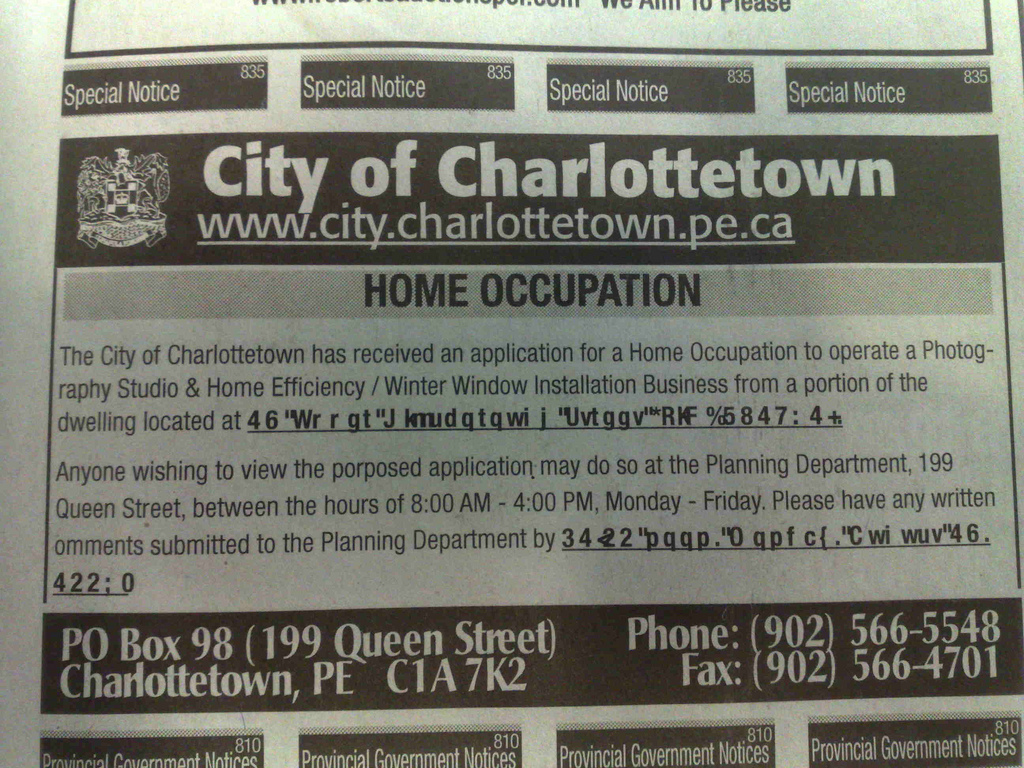
City of Charlottetown Ad in The Guardian
🗓️

I stumbled across Hugin, an open source photo stitching application, after hearing about OpenStreetView in a podcast interview with Steve Coast.

I’ve been interested in panoramic photo stitching since we first experimented it for these Quicktime VR panoramas of Green Gables back in 1997 (interesting side-story: those panos were used to help investigate the fire at Green Gables that happened only weeks after the original photos were taken).

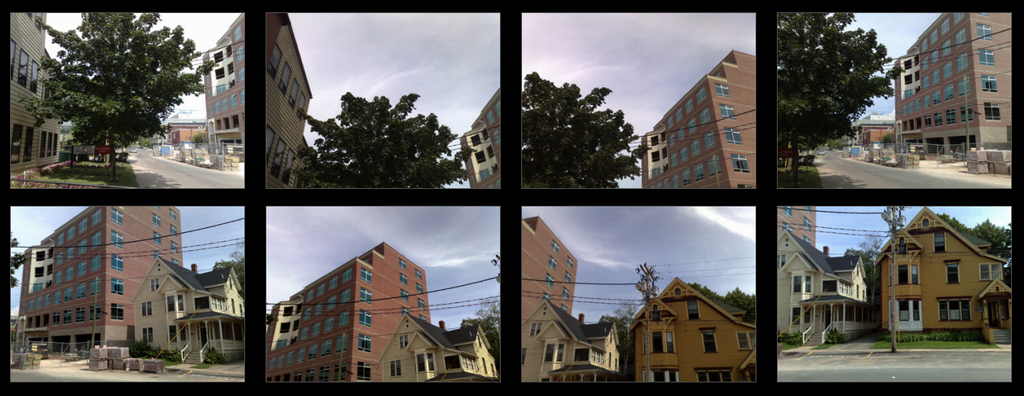
The state of the art has come a long way since the clunky old (but still somewhat amazing) Quicktime VR authoring tools, and Hugin is a great example of this. After installing it, I dashed out the front door of the office and snapped 8 photos of the new Homburg Skyscraper:

Panorama Parts

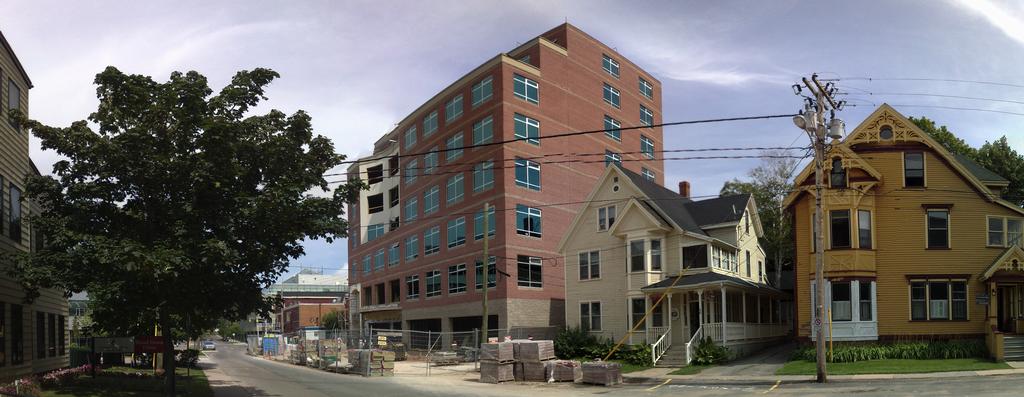
Ten minutes later I had this:

Fitzroy Street Panorama

🗓️
Photographs  •  Panorama  •  Hugin

In conjunction with the aforementioned DodoLab event in Charlottetown next week, I’m instigating an OpenStreetMap mapping party on Wednesday, August 26, 2009 from 6:00 p.m. to 10:00 p.m.

Anyone who is interesting in learning how to make maps is welcome to attend.  You don’t need to know anything as we can walk you through everything you need to know, and partner up new learners with seasoned map-making veterans.  There’s no age limit and it’s all free.

The modest goal for this first Charlottetown OpenStreetMap event is to map the Experimental Farm and neighbouring areas, so we’ll meet at 6:00 p.m. at the Charlottetown Farmer’s Market and use that as our base of operations.

We’ll start with some basic training, and then split up into squads and head out on foot, on bicycle, by car, or otherwise into the area in and around the farm to gather GPS traces for a few hours.  We’ll then reconvene to upload the map data to OpenStreetMap and then work on the process of editing the map itself with what we’ve gathered.

Official event details are on the OpenStreetMap wiki.  You can RSVP to me by email if you plan to attend.

Things that would be helpful to make the event a success:

  • if you’ve used OpenStreetMap before, your expertise would be welcome to show the way for others.
  • we need GPS receivers, standalone or built into mobile phones; if you have one or more, please bring them along.

If you want a little more background on the OpenStreetMap project, this podcast is a good place to start.

This promises to be lots of fun.

🗓️

About This Blog

Photo of Peter RukavinaI am . I am a writer, letterpress printer, and a curious person.

To learn more about me, read my /now, look at my bio, listen to audio I’ve posted, read presentations and speeches I’ve written, see things I’ve favourited elsewhere, or get in touch (peter@rukavina.net is the quickest way).

I have been writing here since May 1999: you can explore the 25+ years of blog posts in the archive.

You can subscribe to an RSS feed of posts, an RSS feed of comments, an RSS feed of favourites elsewhere, or a podcast RSS feed that just contains audio posts. You can also receive a daily digests of posts by email. I also publish an OPML blogroll.

Instagram • YouTube • Vimeo • ORCID • OpenStreetMap • Internet Archive • PEI.art • Drupal • Github.